wayground logo

Free Printable Worksheets

Font size

S
M
L
XL
Worksheets

DNA Review 22

Total questions: 64

Worksheet time: 1hrs 16mins

Name
Class
Date
1.

chromatin wrapped around histones is called a ...

a)

nucleosome

b)

looped domain

c)

chromatin fiber

d)

chromosome

2.
RNA contains the sugar
a)
ribose
b)
deoxyribose
c)
glucose
d)
lactose
3.
What is the difference between DNA and RNA in terms of bases?
a)
RNA contains uracil in place of thymine
b)
RNA contains uracil in place of adenine
c)
RNA contains uracil in place of guanine
d)
RNA contains uracil in place of  cytosine
4.
Which type of RNA takes the instructions from the nucleus to the cytoplasm?
a)
mRNA
b)
tRNA
c)
rRNA
d)
RNA polymerase
5.
Which RNA bases would pair with TACGAA in transcription
a)
AUGCUU
b)
ATGCTT
c)
GCATCC
d)
GCAUCC
6.
Translation takes place in the 
a)
ribosome
b)
chloroplast
c)
nucleus
d)
mitochondria
7.
Brings the amino acids to the ribosome
a)
mRNA
b)
tRNA
c)
rRNA
d)
DNA
8.

What is the term for a three-nucleotide sequence on mRNA that codes for an amino acid?

a)

base

b)

codon

c)

amine

d)

serine

9.

Which phrase best describes translation?

a)

creates a polypeptide chain based on mRNA

b)

catalyzes bonds between nucleotides

c)

produces RNA from DNA molecules

d)

recycles tRNA molecules for reuse

10.
How many bases are in one codon?
a)
1
b)
2
c)
3
d)
4
11.

What is the correct sequence of protein synthesis?

A. tRNA brings amino acids to the ribosome

B. DNA molecules serve as the templates for mRNA.

C. mRNA molecules move to ribosomes.

D. Polypeptides are formed on ribosomes.

a)

A-B-C-D

b)

B-C-A-D

c)

C-B-A-D

d)

D-B-A-C

12.
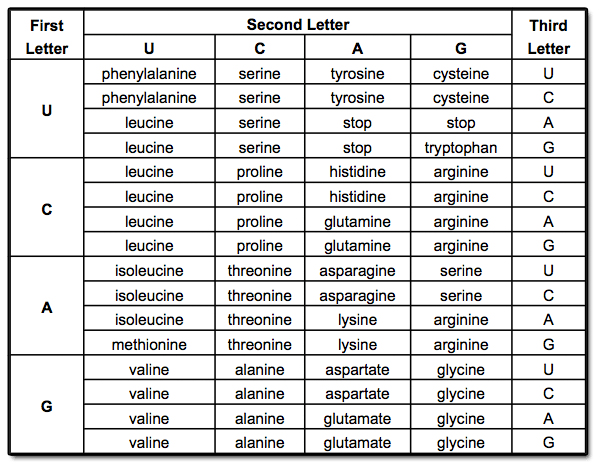
What amino acid is represented by the codon UUA?
a)
Phenylalanine
b)
Tyrosine
c)
Leucine
d)
Stop codon
13.
The monomer of a protein is the ______________.
a)
nucleotide
b)
amino acid
c)

ATP

d)

nucleic acid

14.

What is a protein:

a)

A polymer composed of many monosaccharides linked together by peptide bonds.

b)

A polymer composed of many amino acids linked together by peptide bonds.

c)

A polymer composed of many fatty acids linked together by peptide bonds.

d)

A polymer composed of many nucleic acids linked together by peptide bonds.

15.
A monomer of DNA is called a(n)
a)
Monosaccharide
b)
Amino Acid
c)

Nucleic acid

d)
Nucleotide
16.

Which sequence of DNA bases would pair with this partial strand?

ATG TGA CAG

a)

ATG TGA CAG

b)

TAC ACT GTC

c)

GTA AGT GAC

d)

CAT TCA CTG

17.

This picture is illustrating the ____ nature of DNA double helix.

a)

anti-parallel

b)

base pairing

c)

helical

d)

semi-conservative

18.

DNA replication results in two DNA molecules...

a)

each one made of original strands only

b)

each one made of new strands only

c)

each one made of a new + original strand combination

d)

one made of just new strands, the other made of the original strands

19.

In what phase of the cell cycle does DNA replication take place?

a)

G1

b)

S

c)

G2

d)

Mitosis

20.
If a strand reads:
3' A A A T T T C 5'
The matching strand would read...
a)
5' T T T A A A G 3'
b)
3' T T T A A A G 5'
c)
5' A A A T T T C 3'
d)
3' U U U A A A G 5'
21.
A process in which DNA has the unique ability to make an exact copy of itself.
a)
Replication
b)
Translation
c)
Transcription
22.
If a DNA molecule is 18% Guanine which of the following is correct
a)
18% cytosine, 32% adenine, 32% thymine
b)
32% cytosine, 18% adenine, 32% thymine
c)
18% cytosine, 64% adenine, 64% thymine
d)
32% cytosine, 32% adenine, 18% thymine
23.

What is this a picture of?

a)

DNA

b)

mRNA

c)

rRNA

d)

tRNA

24.

What process is occurring in this picture?

a)

DNA Replication

b)

DNA Transcription

c)

DNA Translation

d)

DNA Synthesis

25.

What process is occurring in this image?

a)

DNA transription

b)

DNA replication

c)

DNA translation

d)

Mitosis

26.

Each section of DNA that codes for a protein is called a...

a)

Nucleotide

b)

Intron

c)

Gene

d)

Anticodon

27.
What does mRNA do?
a)
provides information from DNA to ribosomes
b)
transfers amino acids to the ribosomes
c)
makes up ribosomes
d)
builds proteins
28.
What does rRNA do?
a)
provides information from DNA to ribosomes
b)
transfers amino acids to the ribosomes
c)
makes up ribosomes
d)
builds proteins
29.
What does tRNA do?
a)
provides information from DNA to ribosomes
b)
transfers amino acids to the ribosomes
c)
makes up ribosomes
d)
builds proteins
30.

Where does transcription take place?

a)

Inside the nucleus

b)

Inside the cytoplasm

c)

Inside the Ribosome

d)

Inside the Rough ER

31.

What is the correct order of the Central Dogma?

a)

Protein, replication, RNA

b)

Transcription, DNA, Protein

c)

DNA, transcription, Protein

d)

DNA, RNA , transcription

32.
The two strands of a DNA molecule are held together by ________ bonds between their base pairs.
a)

phosphodiester

b)
hydrogen
c)
peptide
33.
Which of the following is not a base found in DNA?
a)
adenine
b)
thymine
c)
cytosine
d)
uracil
34.
What part of a nucleotide accounts for the genetic variation between individuals?
a)
phosphate
b)
nitrogenous base
c)
deoxyribose
d)
sugar
35.
If a segment of double-stranded DNA has 40 percent A, how much of it is C?
a)
40
b)
10
c)
15
d)
20
36.

The triplets of mRNA read by a ribosome are called _____.

a)

anticodons

b)

intron

c)

codons

d)

rRNA

37.

The DNA sequence ATC-AGC-GCT-GGC is part of a gene. how many amino acids are coded for by this message?

a)

4

b)

8

c)

3

d)

12

38.

What are the building blocks of proteins called?

a)

Nucleic Acids

b)

Glucose

c)

Amino Acids

d)

Phosphate Groups

39.

Use the mRNA below to select the correct amino acid sequence:

AUG-UCA-AAA-UAG

a)

MET-SER-LYS-STOP

b)

MET-THR-LYS-TYR

c)

LEU-SER-CYS-STOP

d)

ILE-LYS-SER-STOP

40.
Which of the following would be a nucleotide found in DNA
a)
Ribose + phosphate + uracil
b)
Deoxyribose + phosphate + uracil  
c)
Deoxyribose + phosphate + adenine
d)
Ribose + phosphate + adenine
41.
If the mRNA sequence is AGA UUU CGA GCC,
what is the complementary tRNA anticodons?
a)
AGA TTT CGA GCC
b)
UCU AAA GCU CGG
c)
TCT AAA GCT CGG
d)
UCU AAA CGA GGG
42.

What is the correct sequence of protein synthesis?

A. tRNA brings amino acids to the ribosome

B. DNA molecules serve as the templates for mRNA.

C. mRNA molecules move to ribosomes.

D. Polypeptides are formed on ribosomes.

a)

A-B-C-D

b)

B-C-A-D

c)

C-B-A-D

d)

D-B-A-C

43.

Which of the following is the codon?

a)

CUC

b)

GAG

c)

CTC

d)

Leusine

44.

Which two thing are found on a molecule of tRNA?

a)

amino acids; anticodons

b)

amino acids; codons

c)

ribose sugar; proteins

d)

deoxyribose sugar; codons

45.
The parts of a gene that do NOT code for amino acids in a protein are called
a)
introns
b)
exons
c)
codons
d)
anticodons
46.

How do scientists cut DNA into smaller strands?

a)
restriction enzymes
b)

nucleotides

c)

looped domains

d)

histones

47.
Why do the fragments of DNA in gel electrophoresis travel away from the negative electrode?
a)
DNA is negatively charged so attracted to the positive end of the unit
b)
DNA is positively charged to attracted to the negative end of the unit
c)
the agarose gel in negatively charged
d)
the agarose gel is positively charged
48.
What is the purpose of gel electrophoresis?
a)
helps cut DNA
b)
count the genes in DNA
c)
separates DNA based on size
d)
allows for an exact replicated organism
49.
Shannon does not know who her father is.  There are three possibilities:  Jack, Daniel and Bill.  Who is the father?
a)
Jack
b)
Daniel
c)
Bill
50.
What applications can gel electrophoresis be used for?
a)
Parental Testing
b)
Criminal Investigations
c)
Sequence Endangered Species DNA
d)
All of the above
51.
Which suspect is linked to the crime scene by this DNA analysis
a)
Suspect A
b)
Suspect C
c)
Suspect D
d)
Suspect B
52.
Which suspect is likely guilty?
a)
Suspect #1
b)
Suspect #2
c)
Suspect #3
53.

A student performed a gel electrophoresis experiment. The results are represented in the diagram

below. Compared to the fragments at the top of the gel, the fragments at the lower end are

a)

larger, and move slower

b)

larger, and move faster

c)

smaller, and move faster

d)

smaller, and move slower

54.
When DNA is in its less coiled, "relaxed," state, between cell divisions, it is called
a)
autosomes
b)
chromatid
c)
chromatin
d)
centromere
55.

The proteins that DNA tightly winds around are called

a)

nucleosomes

b)

histones

c)

chromatids

d)

centromeres

56.
What mutation has occurred here? 
T-G-A-C-C-A
T-G-A-G-C-A
a)
Substitution
b)
Deletion
c)
Insertion
d)
Frameshift 
57.
a change in one DNA triplet that may result in a new triplet that codes for a stop codon instead of an amino acid is known as
a)
missense
b)
nonsense
c)
frameshift
d)
silent
58.
A type of substitution in which no  amino acids change is called 
a)
Missense
b)
Nonsense
c)
Silent
d)
Deletion
59.

ATTTGAGCC- Original

ATTGAGCC - Mutated

The example above is an example of a

a)

Insertion- Frameshift

b)

Deletion- Substitution

c)

Deletion -Frameshift

d)

Nonsense -Substitution

60.

Which mutation will cause translation to stop?

a)

Mutations 1 and 3 only

b)

Mutation 1 only

c)

Mutation 2 only

d)

Muations 1, 2, 3

61.
Which 2 molecules forms the sides (backbone) of the DNA ladder?
a)
deoxyribose and adenine
b)
deoxyribose and a hydrogen bond
c)
sugar and the nucleus
d)
deoxyribose (sugar) and phosphate
62.
Which is larger guanine or cytosine
a)
guanine because it's a purine
b)
guanine because it's a pyrimidine
c)
cytosine because it's a purine
d)
cytosine because its a pyrimidine
63.

Which of the following are purines?

a)

adenine

b)

cytosine

c)

guanine

d)

thymine

e)

uracil

64.

Which of the following describes the base pairing and bonding involved with nitrogenous bases?

a)

Adenine binds with Cytosine with 2 hydrogen bonds

b)

Adenine binds with Thymine with 2 hydrogen bonds

c)

Adenine binds with Guanine with 3 hydrogen bonds

d)

Adenine binds with Uracil with 3 hydrogen bonds