
 Worksheets
7th grade science review TEKS
Total questions: 78
Worksheet time: 2hrs 47mins

Which is the structure that we can't find in animal cells?
Mitochondria
Nucleus
Cell membrane
Cell wall

The organelle in charge of transforming the energy of the sunlight into chemical energy (glucose)?
Mitochondria
Golgi bodies
Chloroplast
Nucleus
You and your dad are moving the couch from one side to another. Your dad pushes with a force of 35 N to the right and you push with a force of 25 N right. What is the net force on the couch?
10 N
20 N
60 N
0 N

How will this object move?
20 N to the right
20 N to the left
80 N to the right
80 N to the left
Some human activities release greenhouse gases, including carbon dioxide, into the atmosphere. Which step would most likely help reduce the amount of carbon dioxide released?
reusing plastic bags instead of throwing them away
watering plants with rainwater instead of using tap water
traveling in cars instead of riding bicycles
generating power with wind turbines instead of burning coal

what kind of rock is rock type 2
sedimentary
igneous
metamorphic
lava


What is responsible for delivering oxygen and removing carbon dioxide from the body?
cell nucleus
excretory system
nervous tissue
respiratory system

In multicellular organisms, tissues are comprised of _______.
organs
systems
cells
blood

When tissues come together, they form ___________.
cells
atoms
organs
systems

Which of the following body systems work together for support, protection, and movement?
respiratory and cardiovascular
skeletal and muscular
skeletal and integumentary
digestive and respiratory
Which of the following shows the levels of organization of an organism from Smallest to Largest.
cells-tissues-systems-organs
organs-cells-systems-tissues
systems-organs-tissues-cells
cells-tissues-organs-systems
This body systems involves nutrient absorption, breaking down of food and enzymes.
Circulatory System
Respiratory System
Digestive System
Endocrine System
Identify the characteristic: When a dog is too hot, he will sweat through his paws and pant to cool himself down.
Reproduce
Made of cells
Share similar chemicals
Homeostasis
Which is a Physical change?
Color
Rusting
Burning
Reactions with acid
Which answers are kinetic energy?
Rolling rock
Bottom of a roller coaster
Sitting dog
Top of waterfall
In genetics, a lower case letter...
is the dominant gene
is the recessive gene
An example of a decomposer is a(n)
Fungi
Fox
Rabbit
Grass

regulates what goes into and out of the cell
Chloroplast
Cell wall
Cell membrane
Brain

all organisms are composed of one or more cells
Cell phone
Cell components
Cell wall
Cell Theory

a group of cells in an organism that have similar structure and function
Organelle
Organism
Organ System
Tissue

The pictures below show a rainforest tree canopy on the left and a toucan that lives in this tree canopy on the right. Select three explanations for why this rain forest tree canopy best supports populations of toucans.
It has trees with fruits for food
It provides many places to nest and reproduce
It has a lot of sunlight to stay warm
It has tall plants to stay above ground predators

This picture shows a desert environment, which is home to many lizards, small mammals, and cacti and other plants with short roots. This environment allows some plants and animals to live there because the soil in the desert is
dry and hard, allowing small animals to lay on the hard soil to get sunlight while allowing plants with short roots to sit on top of the soil and hold onto water.
dry and sandy, allowing small animals to burrow and hide from the Sun while allowing plants with short roots to reach and hold onto water.
wet and hard, allowing small animals to rest and stay cool on the wet soil while allowing plants with short root systems to push through the hard soil to soak up water.
cold and wet, allowing small animals to remain cool when it rains while allowing plants with short root systems to easily push through sandy soil to soak up water

The picture shows where oranges are grown in the United States. Oranges require a very long growing season with mild to hot weather.What is the most likely reason many of the oranges are grown in California?
There are more organisms that eat oranges in California than in any other states.
California has a climate that creates a good environment for growing oranges.
Oranges will only grow in states on the coast with environments near water.
Oranges will only grow in sandy soil that few of the other states have.

The picture below shows a scoop of soil that a student dug up from her school yard. How does the soil environment support the earthworm in the student's hands?
It is moist and cool with decaying debris
It gets a lot of sunlight so the earthworm can see
It has excessive oxygen for the earthworm to breath
It has clay for the earthworm to form holding tunnels
Tropical rain forests have the greatest biodiversity of any type of land ecosystem. How does biodiversity contribute to the sustainability of an ecosystem?
All of the above
The presence of a variety of herbivore species that can feed on a large number of different producer species helps ensure abundant prey for predators in the ecosystem.
Greater genetic variation within species makes it more likely that some individuals will survive a disease outbreak.
The presence of more species with different adaptations makes it more likely that some organisms will survive an ecological disaster.

Which ecosystem would most likely survive if the grasses were destroyed by a plant virus?
Ecosystem 2, because there are not many predators.
Ecosystem 2, because the grasses could grow back quickly.
Ecosystem 1, because there is a variety of producers that support the ecosystem
Ecosystem 1, because there are fewer primary consumers.
Both primary and secondary succession begin with pioneer species that
use up all the existing resources and prevent establishment of non-native organisms
modify the area and allow larger and more complex organisms to appear
change the area and make it safer from predatory organisms
invade the area so that new organisms cannot be established
Frederick is studying how ecological succession will change a freshly-plowed piece of land. Which data table represents what Frederick is most likely to record about the plant life in each stage of ecological succession?


Where does the food chain begin?
Insects
The sun
Mice
Birds of prey

The process of which plants intake energy from the sun and convert it to glucose (sugar)
Solar conversion
Energy intake
Photosynthesis
I don't know


Which body system is depicted in the picture?
Endocrine
Reproductive
Digestive
Excretory
Why is tearing a sheet of paper into pieces a physical change?
Tearing of a paper is a physical change because when the paper is torn only the shape and size of the paper is changed, no new substance is formed.
Tearing of a paper is a physical change because when the paper is torn only the shape and size of the paper does not change and new substance is formed.


Energy in motion is ____________ energy.
Potential
Energy
Kinetic
Friction
What are genes?
Segments of DNA found in chromosomes.
Another word used for chromosomes.
Several chromosomes put together.
An article of clothing.
What are alleles?
Different versions of a chromosome
Different versions of DNA
Different versions of a gene
Different versions of a phenotype

Using this dichotomous key, identity the name of the circled fish.
band-tail puffer
spotted goat fish
peacock flounder
trumpet fish
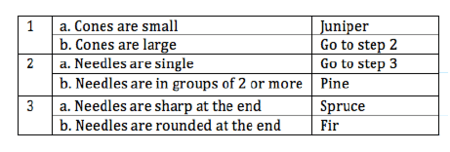
A dichotomous key for trees is provided. Hikers found a tree that has large brown cones and single sharp needles. What species of tree have the hikers found?
Juniper
Pine
Spruce
Fir

In the energy pyramid here, how much of the energy in each level gets lost as heat or used by the organism for survival?
80%
90%
10%
20%
What is the sun's role in the energy pyramid?
to produce chemical energy for the ecosystem.
to provide radiant energy for producers to convert to chemical energy.
to start the energy flow of the ecosystem.
to provide mechanical energy for producers to convert to chemical energy.
All these are examples of a chemical change EXCEPT....
Rusting metal
Boiling water
Burning paper
Rotting food.
All of these are example of a physical change EXCEPT .....
Melting butter
Flattening a piece of metal
Cutting paper
Tarnishing silver vase
All of the following are examples of a chemical change EXCEPT ....
Wood burning
Cake baking
Firecracker exploding
Ice melting
Which of the following is an example of chemical energy being converted into mechanical energy in organisms?
Animals convert the food they eat to muscle movement.
The weathering of Earth's surface breaks down rock to make soil.
Lightning strikes dry vegetation in an open field and causes a fire.
Plants store energy collected from sunlight in sugar they produce.
Green plants use sunlight to make their own food in the form of glucose. This process, known as photosynthesis, is an example of which of the following energy conversions?
Radiant energy to chemical energy
Sound energy to radiant energy
Chemical energy to mechanical energy
Mechanical energy to thermal energy

Chipmunks hibernate in burrows during the 5-6 month long winter in the Taiga. Why do chipmunks sleep during the winter?
to raise young ones
to hide from enemies
to survive the winter cold
to look the same as their surroundings
Biome found mostly near the equator
Desert
Grassland
Rainforest
Tundra
TRUE or FALSE?
Each biome has a characteristic set of native organisms that are adapted to living there.
true
false

This animal can store large amounts of water in its body. Which biome is it best adapted to?
Rainforest
Taiga
Desert
Temperate Deciduous Forest


Plants must adapt to their environment, too. Plants that live in dry climates usually have
big, round stems
wide leaves to absorb sunlight
small leaves coated in thick wax
short, small leaves

What adaptation is represented by the image?
Camouflage
Beak Design
Hibernation
Seed Dispersal

The spider plant (Chlorophytum comosum) is a viviparous plant. This means that seeds germinate into small plantlets while still attached to the parent plant. This plant also produces small white flowers on arching stems. The flowers develop into small seed pods and then the plantlets develop on the stems.
Being a viviparous plant is an advantage to the spider plant in which of the following ways?
Grazing animals are not attracted to the small white flowers.
The plant and the plantlets are not in competition for limited rainfall and light.
The plantlets are genetically different from the parent plant and are not affected by the same insect or pesticide problems.
The plants do not have to rely on animals, insects, or wind for pollination or seed dispersal.
Which internal adaptation allows water to be transported through the roots of a plant?
Xylem
Phloem
Stem
Pollen
Which best describes one disadvantage of asexual reproduction?
It increases biodiversity
It decreases biodiversity
It decreases population size
It increases combination of traits
It produces diverse offspring

Budding is a process in which a new individual is formed that is a clone of the parent. This type of reproduction is _____.
Sexual
Sporulation
Asexual
Binary Fission
Fragmentation
Sexual Reproduction _____
results in genetic variation in the offspring
produces offspring that are identical to the parent
decreases the chances of survival of the species
results in genetic material being donated to offspring by only one parent
produces uniform offspring
Jellyfish reproduce sexually. Which of the following best describes a jellyfish polyp (offspring)?
The jellyfish polyp will be genetically identical to the parent jellyfish.
The jellyfish polyp will be a diverse combination of the parent jellyfish genetic material.
The jellyfish polyp will have twice as much genetic material as the parent jellyfish.
The jellyfish polyp will be genetically identical to its siblings
The jellyfish polyp not have variations that will help it adapt to its environment
Some advantages of sexual reproduction include: (select all that apply)
genetic variation
improves chances of adapting to the environment
helps species survive catastrophes
it doesn't take as much energy as asexual reproduction
What are some advantages of asexual reproduction are: (select all that apply)
it only requires one organism
it takes less energy than sexual reproduction
offspring are already well-adapted for the environment
there is a lot of genetic variety
Which of the following represents sexual reproduction?


Prokaryotes (one-celled organisms without a nucleus) reproduce asexually through _____
budding.
binary fission.
spore formation.
vegetative propagation.

The diagram represents an animal cell undergoing mitosis. Which statement best describes the cells in the diagram?
Cells A, B, and C most likely contain completely different genetic material (DNA).
Cell A has the same genetic material (DNA) as cells B and C.
Cell C has genetic material (DNA) that is only half identical to cell B.
Cells B and C have identical genetic material (DNA) but different DNA than cell A.

