wayground logo

Free Printable Worksheets

Font size

S
M
L
XL
Worksheets

Plate Tectonics Unit Review

Total questions: 74

Worksheet time: 3575secs

Name
Class
Date
1.

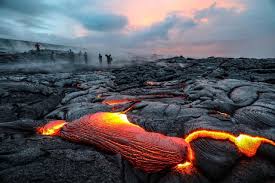
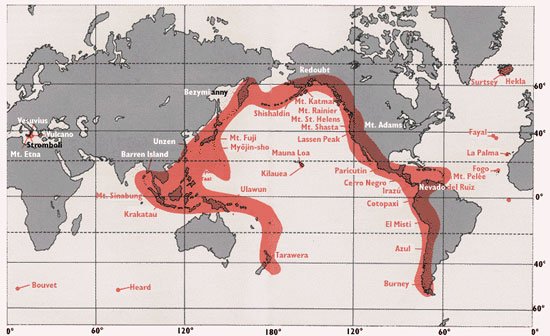
Volcanoes are usually found

a)

in the middle of the ocean

b)

along plate boundaries

c)

at the edge of continents

d)

in the southern hemisphere

2.

Before lava reaches the surface, the molten material is called ____.

a)

rock

b)

magma

c)

volcanic ash

d)

liquid fire

3.

Molten material that leaves a volcano's vent is called ___________.

a)

gas

b)

magma

c)

lava

d)

liquid fire

4.

A feature that forms in Earth´s crust when molten material reaches the surface is called a ____________________.

a)

Mountain

b)

Volcano

c)

Rift Valley

d)

Deep Ocean Trench

5.
The difference between magma and lava is _____
a)
where it is found (above or below the surface)
b)
how hot the molten rock is (lava is hotter than magma)
c)
 the type of boundary where it forms
d)
the viscosity of the molten rock (lava has a lower viscosity)
6.
This is the name for the chain of volcanos around the edge of the Pacific Plate.
a)
Circle of Fire
b)
Ring of Lava
c)
Ring of Fire
d)
Circle of Magma
7.

An area where material from deep within Earth´s mantle rises to the crust and melts to form magma is called

a)

a hot spot.

b)

a divergent boundary.

c)

a rift valley.

d)

a deep ocean trench.

8.

TRUE or FALSE: Volcanoes form along the mid-ocean ridges, where two plates move together.


If false change the underlined word to make it true.

a)

TRUE

b)

FALSE: apart

c)

FASLE: past each other

9.
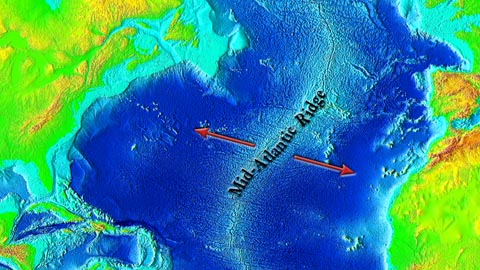
The image shows the Mid Atlantic Ridge. Which type of boundary occurs at this ridge where the ocean floor is spreading apart? 
a)
convergent
b)
divergent 
c)
transform fault
10.
What type of plate boundary is this?
a)
Plate
b)
Divergent
c)
Convergent
d)
Transform
11.
What type of event will occur at this boundary?
a)
Earthquake
b)
Volcano Eruption
c)
Tornado
d)
Mountain Building
12.
Which of the following causes Earth's tectonic plates to move?
a)
Energy from the Sun
b)
Magnetic Pole Reversal
c)
Convection currents in the mantle
d)
Faults in Mountain Ranges
13.
The type of plate boundary where two plates come together is a .....
a)
Convergent Boundary
b)
Divergent Boundary
c)
Transform Boundary
d)
Plate Boundary
14.
A divergent boundary occurs when plates ....
a)
Pull apart
b)
Come together
c)
Slide past each other
d)
subducting
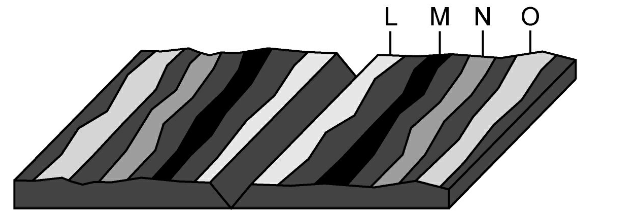
15.
Where would the oldest rock be found?
a)
L
b)
M
c)
N
d)
O
16.
How is it possible for new crust to be formed without increasing the surface area of the Earth?
a)
Crust is destroyed at the same time it is created
b)
New crust is underwater where it sinks
c)
New crust breaks more easily than old crust
17.
Mountains are created when....
a)
Two continental plates collide
b)
Two oceanic plates pull apart
c)
An Oceanic plate subducts under a Continental Plate
d)
Two continental plates pull apart
18.
The Himalayas in Asia are an example of what type of plate boundary?
a)
divergent
b)
continent-to-continent convergent
c)
ocean-to-continent convergent
d)
transform
19.
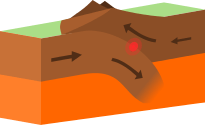
What process is occurring at Z?
a)
Convection currents       
b)
 Subduction 
c)
Two plates moving apart
d)
New ocean floor forming
20.
Why does the ocean floor sink beneath the continent at Z?
a)
The ocean floor is less dense than the continent.
b)
The ocean floor is more dense than the continent.
c)
The ocean floor is moving faster than the continent.
d)
The ocean floor is moving slower than the continent.
21.

the process by which the ocean floor sinks beneath a deep-ocean trench and back into the mantle again

a)

subduction

b)

magnetic reversal

c)

uplift

d)

mineral stripes

22.

pieces of Earth's lithosphere

a)

plates

b)

boundaries

c)

faults

d)

rift valley

23.

Earth’s plates are in slow, constant motion, driven by convection currents in the mantle

a)

Theory of Plate Tectonics

b)

Law of Conservation of Crust

c)

Law of Conservation of Mass

d)

Theory of Gravitational Pull

24.

What occurs when two plates come together and the denser one is forced under back into the mantle?

a)

reduction

b)

conduction

c)

subduction

d)

convection

25.

The youngest rocks on the seafloor are most likely found...

a)

closest to a mid-ocean ridge

b)

farthest from a mid-ocean ridge

c)

near the coastlines

d)

closest to a deep sea trench

26.

The spreading of the seafloor around mid-ocean ridges as new rock is formed in between two tectonic plates

a)

pyroclastic flows

b)

continental drift

c)

seafloor spreading

d)

tectonic plate

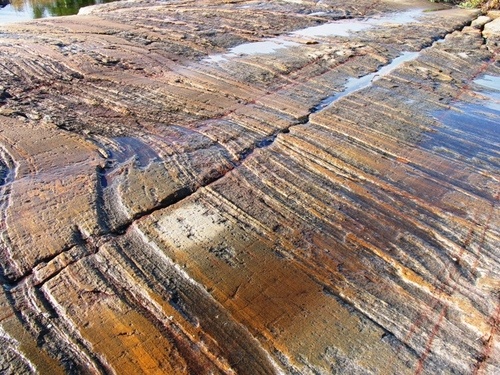
27.
This is a picture of glacier scars found in Africa.  What are these evidence for?
a)
Africa has always been near the equator
b)
Africa was once in an area of the Earth that had a very cold climate
c)
The continents have not moved
d)
sea floor spreading
28.
What does the theory of continental drift state?
a)
The continents were once joined in a super-continent and have moved over time
b)
Continents are stationary and do not move
c)
The Earth is broken into lithospheric plates that move due to convection currents
d)
none of the above
29.

According to the continental drift hypothesis, the presence of similar fossils in South America and Africa supports which scientific idea?

a)

Animals easily and frequently travel from Africa to South America.

b)

Species of animals probably traveled between continents on natural rafts (such as trees destroyed in tsunamis).

c)

Land bridges once existed that connected the continents.

d)

South America and Africa were once connected together.

30.
What is the force that moves the continents? 
a)
Conduction 
b)
Convection 
c)
Radiation 
d)
Conveyor belts 
31.
Convection currents are due to
a)
super hot core
b)
weather
c)
magnetic field
32.
During convection currents, _____ dense material rises, and _______ dense material sinks.
a)
less, more
b)
more, less
33.
What is a weakness or crack/break in the lithosphere that can shift and create an earthquake?
a)
Earthquake
b)
Epicenter
c)
Fault
d)
Focus
34.
What is the shaking of the Earth’s crust caused by a sudden release of energy?
a)
Earthquake
b)
Epicenter
c)
Fault
d)
Plate
35.
What is a large ocean wave that results from an underwater earthquake, landslide, or volcanic eruption?
a)
Aftershock
b)
Liquefaction
c)
Seismic Gap
d)
Tsunami
36.

The huge pieces of the earth's crust that move around on top of the mantle are called ____________________________.

a)

oceanic crust

b)

tectonic plates

c)

geologic miracles

d)

seismographic slates

37.

Tectonic plate movement occurs because of ___________________ currents in the ___________________.

a)

radiation, crust

b)

convection, mantle

c)

iron, outer core

d)

ocean, pacific

38.
Most earthquakes happen along the _________________. 
a)
coast
b)
faults
c)
desert
d)
directions
39.
Which type of plate boundary occurs at B?
a)
convergent
b)
divergent
c)
transform
d)
country
40.
Which type of plate boundary is shown at A?
a)
transform boundary
b)
convergent boundary
c)
divergent boundary
d)
fractured boundary
41.

Which type of crust is less dense?

a)

Continental

b)

Oceanic

c)

They are the same

d)

It depends

42.
Which type of crust is more dense and thinner?
a)
Continental
b)
Asthenosphere
c)
Oceanic
d)
Byers
43.

What is formed at the subduction zone?

a)

mountain ranges

b)

deep-sea trenches

c)

oceanic ridge

d)

hills and valleys

44.
Which rock is formed when melted rock cools?
a)
Metamorphic Rock
b)
Igneous Rock
c)
Sedimentary Rock
45.
This rock was another type of rock that was heated and compressed over time. What type of rock is this?
a)
Sedimentary
b)
Igneous
c)
Metamorphic
46.
What are the 3 major types of rocks?
a)
Igneous, Metamorphic, Sedimentary
b)
Metamorphic, Igneous, Cementation
c)
magma, lava, crystals
47.
The process by which metamorphic rocks are formed...
a)
heat and pressure
b)
erosion and deposition
c)
melting and cooling
48.
The name rock is given when it is broken down into smaller pieces.
a)
texture
b)
weathering
c)
sediment
d)
erosion
49.

Which rock is formed form the cooling of volcanic ash on Earth's surface?

a)

intrusive igneous

b)

foliated metamorphic

c)

extrusive igneous

d)

organic sedimentary

50.

Rocks that form from colling magma inside Earth?

a)

Igneous intrusive

b)

Igneous extrusive

c)

Metamorphic foliated

d)

Metamorphic nonfoliated

51.

A rock that forms from many small fragments of other rocks is a(n)

a)

igneous rock

b)

metamorphic rock

c)

sedimentary rock

d)

extrusive rock

52.

This is the continuous process of rock changing from one type to another.

a)

Igneous rocks

b)

Sedimentary rocks

c)

Metamorphic rocks

d)

Rock Cycle

53.

Which process is best illustrated by the diagram?

a)

igneous rock formation

b)

sedimentary rock formation

c)

igneous rocks changing into metamorphic rocks

d)

sedimentary rocks changing into metamorphic rocks

54.
Choose the number where the following description best fits:  Hot lava cools.
a)
1
b)
3
c)
4
d)
5
55.
Choose the number where the following description best fits:  Great pressure and heat.
a)
1
b)
2
c)
3
d)
4
56.
Choose the number where the following description best fits:  Great heat from the center of the Earth causes melting.
a)
1
b)
3
c)
4
d)
5
57.

Identify two processes labeled in this rock cycle that change igneous rock into sediments.

a)

heat and/or pressure

b)

melting and solidification

c)

deposition and cementation

d)

weathering and erosion

58.

What type of rock forms directly from magma?

a)

Igneous Rock

b)

Sedimentary Rock

c)

Metamorphic Rock

59.

According to this diagram, metamorphic rock is formed by

a)

melting and solidification

b)

burial and compaction

c)

weathering and erosion

d)

heat and pressure

60.

Which letter on the diagram shows pieces of igneous rock are compressed and glued together to form a sedimentary rock.

a)

A

b)

B

c)

C

d)

D

61.
Which type of evidence was NOT used by Alfred Wegener to support his continental drift hypothesis?
a)
Similar mountain ranges found on the eastern side of South America and the western side of Africa.
b)
Identical fossils found on different continents.
c)
Tropical plant fossils found in S. America.
d)
Glacial erosion found in Australia and Africa.
62.
In the early 1900's Alfred Wegener found evidence of identical rock types, identical fossils, and matching mountain ranges on different continents that are on opposite sides of an ocean.  What could be the explanation for these observations?
a)
All animals can swim extremely long distances 
b)
These observations have no significant meaning.
c)
In the past, continents were not located where they are today but were joined together 
d)
mountains are made through the same processes therefore they are very similar in their structure throughout the entire world.
63.
Which layer of Earth makes up the crust and the upper most part of the mantle.  This is the rigid layer that is broken into sections called plates.
a)
Crust
b)
Lithosphere
c)
Asthenosphere
d)
Mantle
64.
What do you call the supercontinent landmass formed million years ago?
a)
Pangea
b)
Asia
c)
Pantallasa
d)
Eurasi
65.

What are the two types of crust?

a)

Oceanic crust

b)

Atmospheric crust

c)

Continental crust

d)

Radiant crust

66.

Which of the layers of Earth is the hottest?

a)

Outer core

b)

Crust

c)

Mantle

d)

Inner core

67.
Which layer of Earth is located above the outer core?
a)
crust
b)
inner core
c)
mantle
d)
lithosphere
68.
What is the top layer of the Earth's surface called? 
a)
Mantle
b)
Innercore
c)
Outercore
d)
Crust
69.
What is the correct order (starting from the surface) of Earth's layers?
a)
crust, mantle, inner core, outer core
b)
mantle, outer core, inner core, crust
c)
inner core, outer core, mantle, crust
d)
crust, mantle, outer core, inner core
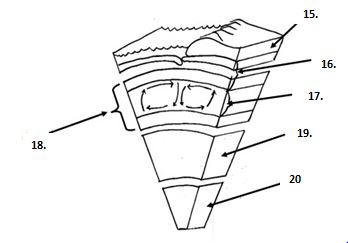
70.
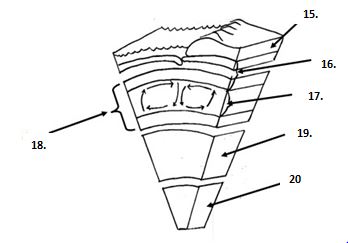
Identify each layer - #20.
a)
mantle
b)
asthenosphere
c)
inner core
d)
outer core
71.
Identify each layer - #15.
a)
Lithosphere
b)
Mantle
c)
Crust
d)
Asthenosphere
72.
Identify each layer - #19.
a)
mantle
b)
lithosphere
c)
inner core
d)
outer core
73.
Temperature _____________________ as you go deeper into the earth.
a)
increases
b)
decreases
c)
goes up and down depending on the layer
d)
stays the same
74.
Pressure ______________________ as you go deeper into the Earth
a)
increases
b)
decreases 
c)
goes up or down depending on the layer
d)
stays the same