Wayground logo

Free Printable Worksheets

Font size

S
M
L
XL
Worksheets

HOMS Review: Thermal Energy

Total questions: 70

Worksheet time: 1hrs 9mins

Name
Class
Date
1.
A measure of the average kinetic energy of the individual particles in an object is called:
a)
thermal energy
b)
conduction
c)
convection
d)
temperature
2.
A measure of the average kinetic energy of the individual particles in an object is called:
a)
thermal energy
b)
conduction
c)
convection
d)
temperature
3.
The temperature of a substance increases as___.
a)
the substance expands
b)
the average kinetic energy of its particles increases
c)
the substance's volume increases
d)
the substance's mass increases
4.

If the particles that make up an object begin to move quickly, their average kinetic energy _____ and the object's temperature _____.

a)

increases, falls

b)

increases, rises

c)

decreases, rises

d)

decreases, falls

5.
Energy that moves particles of matter is 
a)
temperature
b)
thermal energy
c)
heat
d)
friction
6.
Energy that moves particles of matter is 
a)
temperature
b)
thermal energy
c)
heat
d)
friction
7.

What do you mean by "absolute zero"?

a)

The coldest possible temperature.

b)

The hottest possible temperature.

c)

The mean or average of the hottest possible temperatures in the world.

d)

The mean or average between hottest and coldest possible temperature in the world.

8.

What happens when molecules reach absolute zero?

a)

The molecules move and stop alternately.

b)

The molecules stop moving.

c)

The molecules start moving.

d)

The molecules continue to move.

9.
Which direction is heat flowing in the picture?
a)
from the hand to the ice
b)
from the ice to the hand
c)
heat is not being transferred
d)
there is no way to tell
10.
How does heat flow?
a)
Always from cold to warm
b)
Always from warm to cold
c)
Both warm to cold & cold to warm
d)
It depends on the temperature
11.
There are four cups of hot cocoa. The cup sizes are shown. The temperature of the cocoa in each cup is 25 degrees celsius. Which cup has the MOST thermal energy?
a)
Large cup (Trenta)
b)
Small cup (Tall)
c)
Medium cup (Venti)
d)
All three are the same temperature so they have the same thermal energy
12.
There are 2 pans of water, one has 100 mL in it and one has 1000mL. You add 4000 joules of energy,  which one has the bigger change in temperature?
a)
100 mL
b)
1000 mL
c)
They the same material so they both heat to the same temperature
d)
They both will cool down.
13.

Specific Heat is....

a)

The speed of the particles in a substance

b)

The temperature of the substance

c)

How much energy it takes to heat something up

d)

Heat

14.

When heat is absorbed by a substance, what happens to the temperature of the substance?

a)

it increases

b)

it stays the same

c)

it decreases

d)

it depends on the substance

15.

When heat is released by a substance, what happens to its temperature?

a)

it increases

b)

it stays the same

c)

it decreases

d)

it depends on the substance

16.
A material with a(n) ___________ specific heat can absorb a great deal of thermal energy without a great change in temperature.
a)
High
b)
Low
17.

What is the definition of specific heat?

a)

The amount of heat energy required to change the state of a substance.

b)

The amount of heat energy required to lower the temperature of a substance by a certain amount.

c)

The amount of heat energy required to break the bonds between atoms in a substance.

d)

The amount of heat energy required to raise the temperature of a substance by a certain amount.

18.

How does specific heat affect the temperature change of a substance?

a)

Specific heat determines the amount of heat energy required to change the temperature of a substance.

b)

Specific heat determines the density of a substance.

c)

Specific heat determines the color change of a substance.

d)

Specific heat has no effect on the temperature change of a substance.
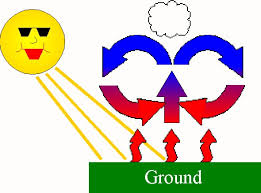
19.
What kind of heat transfer happens when the sun is heating your body?
a)
Conduction
b)
Radiation
c)
Convection
d)
Density
20.
Warm air rises and the cool air sinks demonstrates this type of heat transfer. 
a)
conduction
b)
convection
c)
radiation
d)
Insolation 
21.
Ironing a shirt is an example of...
a)
condensation
b)
conduction
c)
convection
d)
radiation
22.
Johnny accidentally grabbed the handle of the hot pot.
a)
conduction
b)
convection
c)
radiation
23.
Transfer of thermal energy through "space"
a)
conduction
b)
convection
c)
radiation
24.
A ______________ is a material that transfers thermal energy well.
a)
insulator
b)
protector
c)
conductor
d)
reflector
25.
Wood, straw, and wool are materials that are good __________________.
a)
insulators
b)
conductors
c)
reflectors
d)
generators
26.
objects that prevent heat transfer
a)
insulator
b)
conductor
c)
kinetic energy
d)
potential energy
27.
Silver, stainless steel, and copper are materials that are good _________________.
a)
insulators
b)
radiators
c)
currents
d)
conductors
28.
What is the transfer of heat by direct contact?
a)
Convection
b)
Radiation
c)
Conduction
29.
What is the definition of RADIATION
a)
 hot liquid or air that  expands, becomes less dense, and rises or becomes more dense, and sinks.
b)
When heat is transferred from objects like rays of light or electromagnetically.
c)
When heat transfers from objects that are touching.
d)
When heat transfers through the heater or AC in your house.
30.
What is the definition of CONVECTION
a)
When heat transfers through the heater or AC in your house.
b)
When heat transfers from objects that are touching.
c)
a  hot liquid or air that  expands, becomes less dense, and rises or becomes more dense, and sinks.
d)

when heat transfers through space

31.
What is the definition of CONDUCTION?
a)
When heat is transferred from objects like rays of light or electromagnetically.
b)
a  hot liquid or air that  expands, becomes less dense, and rises or becomes more dense, and sinks.
c)
When heat transfers from objects that are touching.
d)
When heat transfers through the heater or AC in your house.
32.
The liquid in a thermometer ______________ as the temperature increases.
a)
expands
b)
disappears
c)
freezes
d)
explodes
33.
The most common temperature scale used in the world where water freezes at 0 degrees and boils at 100 degrees is called the __________________ scale.
a)
Celsius
b)
Fahrenheit
c)
Pound
d)
Kelvin
34.
The movement of thermal energy from an object at a higher temperature to an object at a lower temperature is called ____________.
a)
thermal
b)
expansion
c)
temperature
d)
heat
35.
Thermal energy always moves from ____________ objects to ______________ objects.
a)
cooler, warmer
b)
warmer, cooler
c)
faster, slower
d)
slower, faster
36.
An increase in the volume of a substance when the temperature increases is called ___________________________________.
a)
kinetic energy
b)
thermal expansion
c)
temperature
d)
heat
37.

No more energy can be removed from matter at

a)

its freezing point

b)

0°C

c)

absolute zero

d)

273 K

38.

Water freezes at 32 degrees on which temperature scale?

a)

Fahrenheit

b)

Celsius

c)

Kelvin

d)

absolute zero

39.

The air inside the balloon heats up and expands, the balloon rises. This is an effect of

a)

thermal expansion

b)

thermal contraction

c)

thermal radiation

d)

thermal conduction

40.
Objects gain heat and _________. 
a)
expand
b)
contract
41.

When temperature increases, distance between molecules ______________.

a)

decreases

b)

increases

c)

stays the same

42.
Define a liquid.
a)
Indefinite shape, indefinite volume
b)
Definite shape, definite volume
c)
Found in stars
d)
Definite volume, indefinite shape
43.
The state of matter that has no definite size or shape is
a)
Solid
b)
Liquid
c)
Gas
44.
Particles (molecules) in a ______________________ have more energy than the other states of matter.
a)
gas
b)
solid
c)
liquid
45.
Particles of a liquid
a)
are tightly packed together and stay in a fixed position.
b)
have no viscosity.
c)
decrease in volume with increasing temperature.
d)
are free to move around one another but still touch.
46.
The speed of the molecules determines the _____.
a)
volume
b)
density
c)
pressure
d)
temperature
47.
What phase of matter is shown in the diagram?
a)
solid
b)
liquid
c)
gas
d)
physical changes
48.
Which state of matter?
a)
Solid
b)
Liquid
c)
Gas
d)
Texas
49.

State of matter that takes the shape of it's container and has a definite volume.

a)

Solid state

b)

Liquid state

c)

Gas state

d)

Plasma state

50.

State of matter that can fill containers with no fixed shape or volume.

a)

Solid state

b)

Liquid state

c)

Gas state

d)

Plasma state

51.

The diagram shows the changes in state of water (H2O). What is the process Z called?

a)

Condensation

b)

Freezing

c)

Vaporization

d)

Melting

52.

When a beaker of water is heated its volume increases a little. What is happening to the particles in the liquid?

a)

They are getting bigger.

b)

They are moving slower.

c)

They are moving faster.

d)

They are getting smaller.

53.

Which state of matter is represented in the following diagram?

a)

Liquid

b)

Liquid and gas

c)

Gas

d)

Solid

54.

Throughout the day, Matthew and Mei measure the temperature of lake water as it is warmed by the sun. The following table shows their data at four different times.

At what time was the thermal energy of the lake water the greatest?

a)

9 a.m.

b)

11 a.m.

c)

3 p.m.

d)

5 p.m.

55.

A cold metal spoon is placed in a bowl of hot soup. Which best describes how the spoon is affected?

a)

The heat from the soup does not affect the temperature of the spoon.

b)

The heat from the soup is conducted through the spoon, making the spoon warmer.

c)

The cold air in the room radiates into the soup, cooling it, and keeping the spoon cool.

d)

The cold from the spoon is conducted into the soup, causing the soup to cool to the same temperature as the spoon.T

56.

Which best describes the flow of heat?

a)

from a larger object to a smaller object

b)

from a warmer object to a cooler object

c)

from a cooler object to a warmer object

57.
Why does a metal lawn chair get hot in the sun when the grass sitting in the same sunlight remains cool to the touch?
a)
Heat travels easily through plants but not metals.
b)
Heat travels easily through both plants and metals.
c)
Heat travels easily through metal objects but not through plants.
58.
Conduction can only occur between two objects when –
a)
one object is less dense than the other.
b)
both objects are in physical contact with each other.
c)
one of the objects is made of a metal.
d)
both objects are exactly the same temperature.
59.
In what direction do hot liquids and gasses move?
a)
Side to Side
b)
Down
c)
Up
d)
Back and Forth
60.
Is a measure of how hot or cold something is 
a)
Cold
b)
Heat
c)
Temperature
d)
Thermal Energy 
61.
The energy of moving particles
a)
heat
b)
thermal energy
c)
school
d)
temperature
62.
The flow of thermal energy from warmer objects to cooler objects 
a)
Ice Cold
b)
Heater
c)
Heat
d)
Convection 
63.
The movement of thermal energy from a region of _________________ temperature to a region of _____________________ temperature is called heat.
a)
higher, lower
b)
cooler, warmer
c)
lower, higher
d)
medium, medium
64.
The rubber that makes up the handle on the pan is considered a thermal ___________________ because thermal energy moves slowly through this material.
a)
conductor
b)
insulator
c)
regulator
d)
temperature
65.

Objects with MORE MASS have______________

a)

lower potential energy

b)

lower number of atoms

c)

higher thermal energy

d)

higher temperature

66.

Temperature always measures the ___________ movement of molecules

a)

median

b)

mode

c)

total

d)

average

67.

Objects with MORE MASS have MORE thermal energy because

a)

there are more molecules with energy in bonds

b)

there are less atoms

c)

there is less kinetic energy in the system

d)

there is no potential energy at all

68.

Law of Conservation of Mass says...

a)

Energy is always created and destroyed

b)

Energy is only in hot things

c)

Energy can be destroyed easily

d)

Energy cannot be created or destroyed

69.

Which would require MORE energy to heat up?

a)

1 liter of water

b)

2 liters of water

c)

3 liters of water

d)

4 liters of water

70.

Which would require the LEAST amount of energy to heat up?

a)

1 gram of sand

b)

10 grams of sand

c)

100 grams of sand

d)

they would all use the same amount of energy