
 Worksheets
Biogeochemical cycles: Carbon & Water
Total questions: 61
Worksheet time: 44mins
All of the carbon in existence is continually recycled in the carbon cycle.
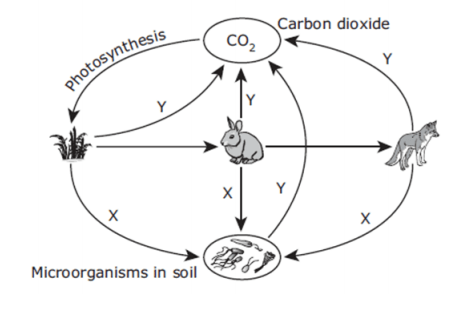
Y : Predation
Y : Decomposition
Y : Nitrogen Fixation
Y : Respiration
If the plant population decreased, the amount of total carbon on the planet would _________.
Stay the same
Increase
Decrease
C6H12O6 is also known as glucose (sugar). Where is it found?
Plants
Animals
Both plants and animals
Neither plants or animals
Which of the following are fossil fuels?
Coal, water, oil
Oxygen, coal, oil
Coal, Oil, Natural Gas
None of the above
How does carbon become locked inside the earth?
Tree roots expel carbon into the soil as they grow.
Humans use machines to pump carbon dioxide into large underground rocks.
Rocks become richer in carbon as time goes by.
The carbon-rich bodies of plants and animals decay into the earth after they die.
How do carbon emissions lead to global warming?
By trapping the sun's heat in the atmosphere.
By causing very hot volcanic eruptions.
Rocks become richer in carbon as time goes by.
By increasing the amount of carbon in the earth's crust

Which of the following have been changed or altered due to climate change ?
droughts
flooding
melting of polar ice caps
all of the above
Which example is a form of precipitation?
Dew
Fog
Frost
Hail
As a part of the water cycle, water from Earth's surface enters the clouds and finally falls back to the ground in the form of rain. What is the correct sequence of processes water undergoes?
Evaporation, Condensation, Precipitation
Precipitation, Condensation, Evaporation
Condensation, Evaporation, Precipitation
Evaporation, Precipitation, Condensation
What would happen if the Sun is removed from the water cycle?
The water cycle would not include precipitation but would continue with groundwater flow.
The water cycle would no longer occur because the Sun provides the energy for evaporation and transpiration.
The water cycle would no longer occur because the Sun provides energy for the formation of clouds.
The water cycle would not include evaporation and transpiration but would continue with condensation.

The image shows various stages in the water cycle. During which stage does water flow back towards the sea as runoff?
W
X
Y
Z
On Earth, what process generates most of the water vapor?
Condensation
Evaporation
Precipitation
Transpiration
Rain and snow are two different forms of precipitation that fall on Earth's surface. Which factor is responsible for there being different forms of precipitation?
Evaporation
Run-off
Temperature
Transpiration
What is precipitation?
Sweat from our bodies on hot days
Warm rain but not cold snow or sleet
Gas that we use in furnaces or ovens
Any form of water that falls from the sky

What is another name or synonym for the water cycle?
Geologic cycle
Hydrologic cycle
Geosphere
Carbon cycle

What is the energy source that drives the water cycle?
The Moon
The heat from our home in the winter all around the world
The Sun
The heat generated solely from the core of the earth

What are formed when water vapor condenses?
Clouds
Mountains
Transpiration
Valleys

The movement caused within a fluid by the tendency of hotter and therefore less dense material to rise, and colder, denser material to sink under the influence of gravity, which consequently results in transfer of heat. ____________________
Evaporation
Convection
Precipitation
Transpiration

Water in its gas form is called ____________________,
water vapor
precipitation
ice
air
What are the three methods of heat transfer?
conduction
convection
friction
radiation
Process of changing a liquid to a solid
boiling
freezing
condensation
melting
Hot air rising is an example of
Conduction
Convection
Radiation
Friction
State of matter where particles are tightly packed and move very little.
Solid
Liquid
Gas
Plasma
State of matter in which particles are free to flow over each other and take the shape of their container
Solid
Liquid
Gas
Plasma
Measure of the average kinetic energy of a substance
Total Thermal Energy
Heat Exchange
Temperature
Total Internal Energy
The process of changing a gas to a liquid
Freezing
Boiling
Condensation
Melting

The sun and a campfire are good examples of _________________________________, the
transfer of heat through electromagnetic rays.
Conduction
Convection
Radiation
Which compound does NOT contain carbon atoms?
carbon dioxide
ammonium
calcium carbonate
methane

Which statement is correct?
matter cycles; energy cycles
matter cycles; energy disintengrates
matter cycles; energy converts
matter converts; energy cycles
Which of the following is correct?
There is as much carbon on earth as when it was formed
Carbon is being created whenever it is recycled
Carbon is lost every time it is recycled
Carbon changes to different forms and is never recovered

What does the diagram indicate regarding the carbon cycle?
Only terrestrial processes cycle carbon
Only aquatic processes cycle carbon
Terrestrial and aquatic processes are separate
Both terrestrial and aquatic cycles operate together
___________________ is the process by which water changes from a liquid to a gas or vapor. __________________ is the primary pathway that water moves from the liquid state back into the water cycle as atmospheric water
Transpiration
Deposition
Percolation
Evaporation
____________________ is the process by which water on the ground surface enters the soil. ________________ rate in soil science is a measure of the rate at which soil is able to absorb rainfall or irrigation.
Infiltration
Percolation
Deposition
Condensation
_____________________ is water released from clouds in the form of rain, freezing rain, sleet, snow, or hail. It is the primary connection in the water cycle that provides for the delivery of atmospheric water to the Earth. Most ________________ falls as rain.
Snowmelt runoff
Precipitation
Surface runoff
Evaporation
__________________ is the process by which water vapor in the air is changed into liquid water. ________________ is crucial to the water cycle because it is responsible for the formation of clouds.
Transportation
Percolation
Condensation
Plant Uptake
__________________ is the process by which moisture is carried through plants from roots to small pores on the underside of leaves, where it changes to vapor and is released to the atmosphere. ______________ is essentially evaporation of water from plant leaves.
Transpiration
Percolation
Infiltration
Plant Uptake
Water that flows across the land and enters rivers and streams. It eventually flows into lakes and the ocean.
Snowmelt runoff
Surface Runoff
Deposition
Precipitation

