wayground logo

Free Printable Worksheets

Font size

S
M
L
XL
Worksheets

Nuclear Chemistry Practice

Total questions: 55

Worksheet time: 14hrs 45mins

Name
Class
Date
1.

When the isotope 5024X releases an alpha particle we get another element Y that looks like

a)

5022Y

b)

4622Y

c)

4820Y

d)

5426Y

2.

When the isotope 5024X releases a beta particle we get another element, Y, that looks like

a)

5023Y

b)

4622Y

c)

5025Y

d)

5024Y

3.

In order of most to least penetrating radiation we have

a)

Alpha , Beta, Gamma

b)

Beta , Gamma , Alpha

c)

Gamma, Beta, Alpha

d)

Gamma, Alpha, Beta

4.
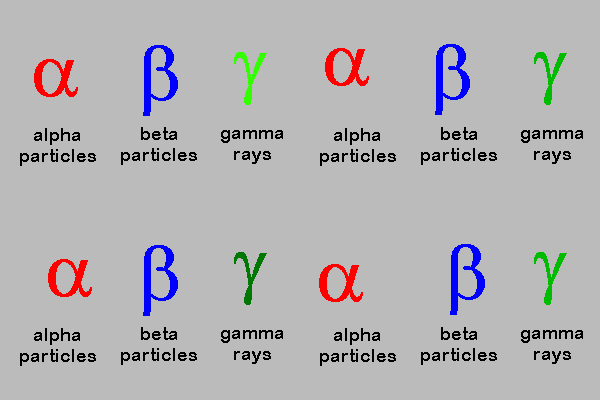
Which type of nuclear radiation is being emitted here?
a)
Alpha
b)
beta
c)
gamma 
d)
none
5.
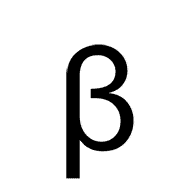
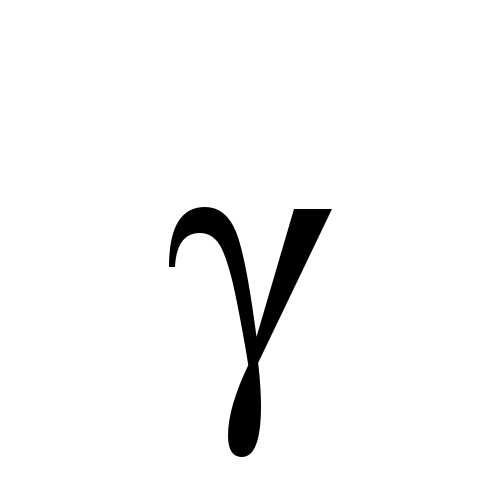
Has the symbol
a)
Alpha
b)
Beta
c)
Gamma
6.
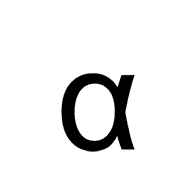
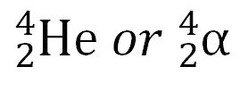
Has the symbol
a)
Alpha
b)
Beta
c)
Gamma
7.
Has the symbol
a)
Alpha
b)
Beta 
c)
Gamma
8.

Which type of radioactive decay gives off energy only (no particles)?

a)

alpha

b)

beta

c)

gamma

9.

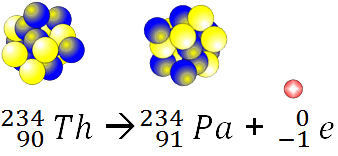
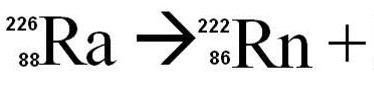
Complete the nuclear equation and determine the type of decay that is occurring in this reaction.

a)

alpha, 42He

b)

beta, 0-1e

c)

gamma

d)

none

10.
Gamma rays have a _____ charge
a)
0
b)
+1
c)
-1
d)
+2
11.
Alpha particles have a _____ charge.
a)
+2
b)
0
c)
+1
d)
-1
12.

Beta particles have a _____ charge.

a)

+2

b)

0

c)

+1

d)

-1

13.
A nuclear reaction where a nucleus splits into two smaller nuclei is... 
a)
Fission
b)
Fusion
c)
Gamma decay
d)
Beta decay
14.
What would two different isotopes of an atom have in common?
a)
Number of neutrons 
b)
Number of protons
c)
Atomic weight 
d)
Atomic mass
15.
What happens when the number of protons in an atom changes? 
a)
The number of electrons changes too 
b)
Usually nothing happens, unless the atom is radioactive 
c)
The atomic nucleus explodes
d)
It becomes a completely different atom, with different properties 
16.
What element is the ?
a)
Ag-115
b)
Cd-115
c)
Pd-115
d)
Not Listed
17.
Which type of nuclear radiation is being emitted here?
a)
alpha
b)
beta
c)
gamma
d)
none
18.
Balance the following equation:
146C --> 0-1e + ________
a)
145B
b)
146C
c)
147N
d)
42He
19.
Two or more nuclei combine to form one larger nucleus in the process of nuclear _____.
a)
Fusion
b)
Fission
c)
Tracing
d)
Decay
20.
This is an example of...
a)
Fission  reaction
b)
Fusion reaction
c)
Decomposition reaction
d)
Combustion
21.
When nuclei decay, massive amounts of __________ is released.
a)
energy
b)
jello
c)
protons
d)
neutrons
22.
Has the highest penetrating power.  Can penetrate our body.  Even several cm thick of lead or several meters thick of concrete cannot stop all of it.
a)
Alpha
b)
Beta
c)
Gamma
23.
What type of nuclear reaction is this?
a)
alpha
b)
beta
c)
gamma
d)
hot
24.
Gamma rays damage human cells/tissue.
a)
True
b)
False
25.
What is not true about fission reactions at power plants?
a)
They are exothermic
b)
They produce a lot of energy
c)
They are uncontrolled and fast
d)
They are slow and controlled
26.
What element is often used in nuclear reactions?
a)
Hydrogen
b)
Uranium
c)
Oxygen
d)
Mercury
27.
Most nuclear reactors use:
a)
Fission
b)
Fusion
28.
Which of the following is an example of nuclear fusion? 
a)
A plutonium atom is used to start a chain reaction that detonates a nuclear weapon 
b)
A uranium atom is split apart into lighter elements
c)
 Two hydrogen atoms are combined to form a helium atom
d)
Two hydrogen atoms bond with an oxygen atom to form a water molecule 
29.
In what part of an atom can protons be found? 
a)
Inside the electrons
b)
Inside the neutrons 
c)
Inside the atomic nucleus 
d)
 Inside the electron shells
30.
What is NOT a characteristic of gamma radiation?
a)
Most dangerous type of radiation
b)
High energy, high penetration
c)
stopped by thin metal
d)
Stopped by several feet of concrete or several inches of lead
31.
What is NOT a characteristic of an alpha particle?
a)
A negatively charged electron
b)
Stopped by paper
c)
A positively charged particle
d)
Low penetration
32.
Has a mass of 4 and a charge of +2
a)
Alpha
b)
Beta
c)
Gamma
d)
neutron
33.
How does nuclear fusion compare to nuclear fission? 
a)
Nuclear fusion produces no radioactive waste
b)
Nuclear fusion produces more radioactive waste
c)
. Nuclear fusion is cheaper and easier to produc
d)
Nuclear fusion requires rare, expensive elements to work
34.
Which of the following best describes the process of nuclear fission? 
a)
Splitting an atom's nucleus apart 
b)
Separating an atom's electrons from its nucleus 
c)
Fusing two atomic nuclei together 
d)
Splitting an atom's electrons in half 
35.
If Thorium-234 undergoes a beta decay, What element will be left in its place?
a)
Actinium-234
b)
Thorium-233
c)
Protactinium-234
d)
Radium-230
36.
What do carbon-12 and carbon-14 have in common? 
a)
They have the same number of protons
b)
They have the same number of neutrons
c)
 They have the same atomic mass
d)
They have the same atomic weight
37.
How is carbon-12 different from carbon-14?
a)
They have a different number of protons 
b)
They have a different number of electrons
c)
They have a different number of neutrons
d)
They are different elements 
38.
If we start off with element 5024X after an gamma decay we get another element that looks like
a)
5224X
b)
5023X
c)
5024X
d)
5025X
39.

The conversion of an atom of one element to an atom of another element is called (a)   .

40.

spontaneous emission from the nucleus of an atom

a)

positron

b)

radioactivity

c)

alpha particle

d)

gamma radiation

e)

beta particle

41.

particle of charge +1 and mass equal to that of an electron

a)

positron

b)

radioactivity

c)

alpha particle

d)

gamma radiation

e)

beta particle

42.
Scientist involved with discovery of radioactivity.
a)
Albert Einstein
b)
Ernest Rutherford
c)
Marie Curie
d)
Isaac Newton
43.
Arrange in order of increasing ability to penetrate matter.
a)
Beta, gamma, alpha
b)
Alpha, gamma, beta
c)
Gamma, beta, alpha
d)
Alpha, beta, gamma
44.
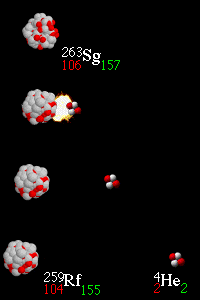
Classify this process.
a)
Nuclear fission
b)
Nuclear fusion
c)
Alpha decay
d)
Beta decay
45.
What do these symbols represent?
a)
alpha particle
b)
beta particle
c)
neutron
d)
gamma ray
46.
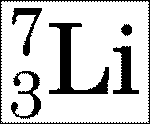
How many protons are in this atom?
a)
3
b)
4
c)
6
d)
10
47.
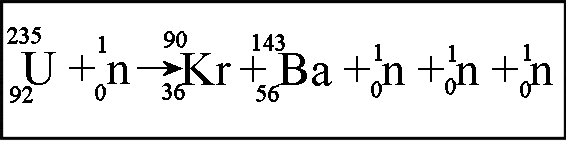
What process is modeled by the equation?
a)
alpha decay
b)
beta decay
c)
fission
d)
fusion
48.
What process is modeled with this equation?
a)
alpha decay
b)
beta decay
c)
fission
d)
fusion
49.
What is one problem with using nuclear fission as an energy source?
a)
finding radioactive elements that have longer half-lives
b)
finding ways of storing radioactive wastes
c)
finding compounds to cool heated water
d)
finding non-radioactive elements for reactors
50.
What type of decay is being illustrated in following picture? 
a)
beta decay
b)
alpha decay 
51.

Chernobyl is a town located in present day Ukraine, formerly USSR. On Saturday, April 26th, 1986 at exactly 1:23 am, one of the reactors at the Chernobyl nuclear power plant exploded. What caused the reactor to explode?

a)

sabotage by an enemy of the USSR

b)

an experiment gone wrong

c)

to this day, the reason is unknown

d)

earthquakes struck the plant

52.

How were the people of Pripyat affected by the meltdown?

a)

They weren't

b)

They were poisoned by radioactive fallout

c)

They gained supwerpowers

d)

They were all quietly eliminated by the Soviet government

53.

What did the Soviet government do when they heard about the meltdown?

a)

Nothing

b)

They cut off trade with the Ukraine

c)

They evacuated the city of Pripyat and tried to put out the fire at the plant

d)

They launched a nuclear bomb at the site to cover up the incident.

54.

What is Pripyat like today?

a)

It is a thriving, vibrant city and the center of trade in Russia

b)

It was wiped off the map by a tactical nuclear strike launched by the United States in 1991

c)

It is still radioactive and not safe to live in today

d)

It was absorbed by the expanding Ottoman Empire in 1498

55.

Atomic weapons were dropped on these two cities

a)

Manila and Bejing

b)

Tokyo and Moscow

c)

Nagasaki and Hiroshima

d)

Sydney and Hanoi