wayground logo

Free Printable Worksheets

NEW

Font size

S
M
L
XL
Worksheets

Physical Science Final Review

Total questions: 59

Worksheet time: 30mins

Name
Class
Date
1.
Which group of the periodic table is composed of inert (not reactive)  gases?
a)

alkali metals (group 1)

b)

alkaline earth metals (group 2)

c)

halogens (group 17)

d)

noble gases (group 18)

2.
Elements in a ..................have similar chemical properties.  
a)
period
b)
group
c)
row
3.

What is an element?

a)

A substance that can be divided

b)

A pure substance made from one kind of atom

c)

The basic unit of matter

d)

A substance made from two or more simpler substances

4.

What is a chemical reaction?

a)

a change in matter when the molecules rearrange to make new molecules

b)

a change in matter when matter changes its form or appearance

c)

a change in matter when the physical appearance changes

d)

a very boring change in matter

5.
In a chemical reaction, bonds are broken and new bonds are formed that create new substances. The bonds that are broken are called what?
a)
Reactants
b)
Products
c)
Atoms
d)
Catalysts
6.

An gel ice pack getting cold after you put it in the freezer for an hour. Is an example of a __________.

a)

Chemical Change

b)

Physical Change

7.
2 NO2 ----> 2 O2 + N2
a)

Synthesis

b)
Decomposition
c)
Single displacement
d)
Double displacement
8.
P4 +  3 O2 ----> 2 P2O3
a)

Synthesis

b)
Decomposition
c)
Single displacement
d)
Double displacement
9.
The rate of a reaction increases as temperature__________________.
a)
Decreases
b)
Increases
c)
Stays the Same
10.
Products will form faster if____________
a)
the particle size of the reactants are larger.
b)
temperature is decreased.
c)
concentration of the reactants are increased.
d)
the reaction is not stirred.
11.
_P4+_O  _P2O3
a)
3 P4+1 O→ 2 P2O3
b)
1 P4+1 O→ 2 P2O3
c)
1 P4+ 3 O→ 2 P2O3
d)
1 P4+ 2 O→ 3 P2O3
12.
_K + _Cl2 _KCl
a)
2 K + 16 Cl2 → 8 KCl
b)
2 K + 1 Cl2 → 2 KCl
c)
3 K + 4 Cl2 → 3 KCl
d)
1 K + 1 Cl2 →1 KCl
13.
The larger the mass you have the _____ force you need to change its motion.
a)
more
b)
less
14.

Your 2500 kg car experiences a net force of 5000 N. How fast will it accelerate?

a)

20 m/s2

b)

0.5 m/s2

c)

2 m/s2

d)

120 N

15.
What is the net force for this situation?
a)
17 N Right
b)
17 N Left
c)
3 N Right
d)
3 N Left
16.
The total momentum before a collision is _________ the total momentum after a collision.
a)
equal to 
b)
less than 
c)
more than
d)
It depends on the type of collision
17.
A 50 kg ball rolls down the street at 5 m/s. Calculate the momentum of the ball. 
a)
55 kg*m/s
b)
100 kg*m/s
c)
250 kg*m/s
d)
500 kg*m/s
18.
A 9300 kg railroad car traveling at a velocity of 5 m/s strikes a second boxcar that weighs 5000 kg at rest. At what speed will the second boxcar move?
a)
18.6 m/s
b)
9.3 m/s
c)
7.5 m/s
d)
1.86 m/s
19.

While playing with toy cars, Kirsten and Luca each push a car toward the center of the room. What happens when the toy cars collide?

a)

Energy is transferred.

b)

Energy is unchanged.

20.

The law of conservation of momentum states that

a)

the total initial momentum of all objects interacting with one another does not equal the total final momentum

b)

the total momentum of all objects interacting with one another is zero

c)

the total momentum of all objects interacting with one another remains constant regardless of the nature of the forces between the objects

21.

A material through which electrons do NOT flow easily is a(n) ______.

a)

insulator

b)

conductor

c)

fuse

d)

circuit breaker

22.

What is the current produced by a 9-volt battery flowing through a resistance of 0.2 ohms?

a)

1.8 amps

b)

45 amps

c)

0.022 amps

d)

8.8 amps

23.

Which two areas of physical science are closely related to the development of electric motors and generators?

a)

sound and light

b)

electricity and sound

c)

light and magnetism

d)

electricity and magnetism

24.

A type of magnet that has temporary magnetic effect when electric current flows through it.


This refer to

a)

Electric

b)

Electronic

c)

Electrostatic

d)

Electromagnet

25.
While electric current is flowing through a wire, what surrounds the wire?
a)
a magnetic field
b)
a glowing light
c)
neutrons
d)
protons
26.

What do you call a device that converts mechanical movement into electricity?

a)

electric field

b)

electric motor

c)

electric generator

d)

electric plasma

27.

What do we call a device that converts electricity into mechanical movement?

a)

electric charge

b)

electric motor

c)

electric current

d)

electric plasma

28.

What is potential energy?

a)

The stored energy of an object due to its position or condition.

b)

The energy that an object has due to its motion.

c)

The energy an object has due to its speed.

d)

The energy an object has due to its volume.

29.

What is kinetic energy?

a)

The stored energy of an object due to its position or condition.

b)

The energy that an object has due to its motion.

c)

The energy an object has due to its acceleration.

d)

The energy an object has due to its volume.

30.

What does the law of conservation of energy tell us?

a)

Energy is created and destroyed all of the time.

b)

Stars generate most of the energy on the earth.

c)

Energy can not be created or destroyed, only transfered.

d)

Dark matter absorbs most of the energy in the universe.

31.

When does an object have no kinetic energy?

a)

When it is at rest

b)

When it is moving very slowly

c)

When the only force acting on it is gravity

d)

When it has no electrical charge

32.

Which object has the most potential energy?

a)

A ball resting on the ground

b)

A ball thrown at 100 miles per hour

c)

A ball on top of the refrigerator

d)

A ball resting on the edge of cliff

33.
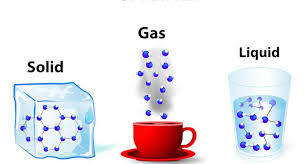
Of these three states of matter, which one has the most kinetic energy? 
a)
Solid 
b)
Liquid 
c)
Gas
34.

Adding thermal energy to matter causes its particles to _________________.

a)
move slower
b)
move faster
c)
melt
d)
feeze
35.

Thermal energy always travels from _____ to ______ objects

a)
hot to cold
b)
cold to hot
c)
cold to cold
d)
hot to hot
36.
When holding a cup of ice water, your warm hand becomes cold. How does the heat transfer?
a)
From the cold cup to your hand
b)
From the cold cup to the warm air
c)
From the ice to your hand
d)
From your warm hand to the cold cup.
37.
Temperature is a measure of the...
a)
total energy in a substance
b)
total kinetic energy in a substance
c)
average potential energy in a substance
d)
average kinetic energy of molecules in a substance
38.

A wave has a frequency of 50 Hz. What is the period of the wave?

a)

2 m

b)

0.02 m

c)

25 s

d)

0.02 s

39.

A radio wave has a wavelength of 4 m and a frequency of 4 Hz. What is the speed of the wave?

a)

16 m/s

b)

16 m

c)

4 Hz

d)

8 m/s

40.

Compared to a low pitch wave, a high pitch wave will have a

a)

higher frequency and shorter wavelength

b)

higher frequency and longer wavelength

c)

larger amplitude and shorter wavelength

d)

smaller amplitude and shorter wavelength

41.

Volume is the human perception of a wave's amplitude. Higher decibels relates to

a)

shorter wavelength

b)

longer wavelength

c)

larger amplitude

d)

smaller amplitude

42.

The speed of a wave is 50 m/s. It's wavelength is 1.6 m. What is the frequency of the wave?

a)

31.25 Hz

b)

25 Hz

c)

31.25 ohms

d)

25 ohms

43.
In a flashlight, what is the energy transformation?
a)
elastic to mechanical
b)
mechanical to gravitational
c)
mechanical to light to thermal
d)
chemical to electrical to thermal to light
44.
Which section of the spectrum is the ONLY one we can see?
a)
X-rays
b)
Visible Light
c)
Gamma Rays
d)
Ultraviolet Rays
45.
How are electromagnetic waves different from other waves? 
a)
They have very short wavelengths 
b)
They transmit energy instead of matter 
c)
They can travel through empty space
d)
They can change direction by reflection 
46.
Which of the following electromagnetic waves has the lowest energy?
a)
gamma ray
b)
infrared wave
c)
visible light wave
d)
microwave
47.
As the frequency of an electromagnetic wave increases, the amount of energy in that wave...
a)
increases.
b)
decreases.
c)
stays the same.
48.
High frequency waves have _________ wavelengths.
a)
varying
b)
long
c)
the same
d)
short
49.

The temperature in …………… is the highest of all.

a)

February

b)

April

c)

June

d)

July

50.

The lowest temperature is in ………………….

a)

January

b)

February

c)

June

d)

April

51.

The temperature in May is ……………degrees higher than the temperature in March.

a)

11

b)

7

c)

15

d)

23

52.
How many significant figures: 216 m
a)
1
b)
2
c)
3
d)
0
53.
How many significant figures: 153.0 mL
a)
1
b)
2
c)
3
d)
4
54.

1 kg = __ g

a)

1,000

b)

100

c)

10

55.

4 dm = ____ cm

a)

40

b)

400

c)

4,000

56.

4 L ___ 7,000 mL

a)

>

b)

<

c)

=

57.
8 feet = __ inches
a)
12
b)
56
c)
86
d)
96
58.
5 feet = __ inches 
a)
12
b)
50
c)
60
d)
120
59.
2 years= _____ days
a)
300
b)
364
c)
730
d)
760