
 Worksheets
Quiz on Electromagnetic waves
Total questions: 40
Worksheet time: 1hrs 12mins
Which of the following is true for sound waves?
They require a medium.
They are unrelated to vibrations.
They cannot travel through liquids
They can travel in a vacuum
A student asks a series of questions about a wave. The answer to which question will allow the student to determine whether the wave is electromagnetic or mechanical?
Does it require a medium in order to travel?
Can it pass through air and water?
Does it have a measurable speed?
Does it have a measurable frequency?
How do electromagnetic and mechanical waves compare?
Mechanical waves can only travel through a vacuum, but electromagnetic waves can travel through a solid, liquid, or gas.
Mechanical waves can travel through a solid, liquid, or gas, but electromagnetic waves can only travel through a gas.
Mechanical waves can only travel through a solid, liquid, or gas, but electromagnetic waves can travel through a vacuum.
Mechanical waves can travel through a solid, liquid, or gas, but electromagnetic waves can only travel through a solid.
A student is measuring the distance between the crest and the rest position of both a mechanical wave and an electromagnetic wave. Which question is the student trying to answer?
What is the speed of the waves?
What is the amplitude of the waves?
What is the wavelength of the waves?
What is the frequency of the waves?

Which distance represents the wavelength?
W
X
Y
Z

Which distance represents the amplitude?
W
X
Y
Z
What do radio waves, microwaves, X-rays, and gamma rays all have in common?
They all have the same wavelength.
They are electromagnetic waves.
They are detected in the same way.
They store the same amount of energy.

How many wavelengths separate point A and point B?
1.5
2.0
2.5
3.0

Point A represents what?
Trough
Midpoint
Crest
node
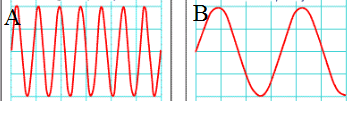
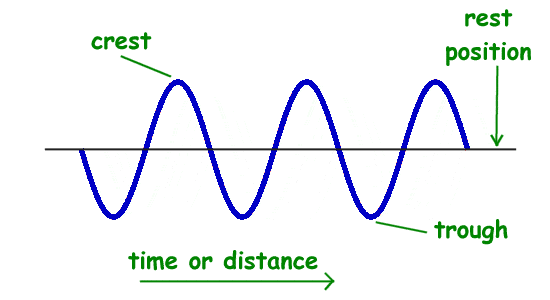
What is measured from crest to crest or trough to trough?
mediums
resting position
wavelength
origin
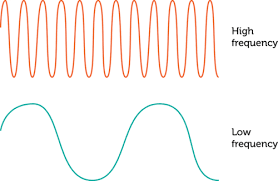
If a wave has a greater frequency, what happens to the wavelength?
increases
decreases
stays the same
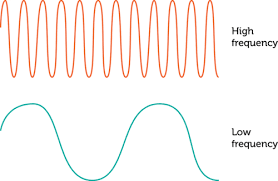
If a wave has a greater frequency, what happens to number of waves per second?
increases
decreases
stays the same
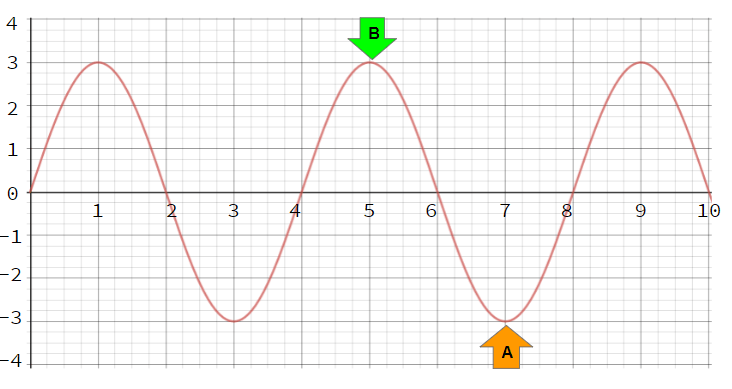
What is the amplitude of this wave?
2
3
6
10
What is the wavelength of this wave?
1
2
3
4
What property does the orange arrow (A) represent?
Crest
Trough
Wavelength
This sound has high pitch, which means it has a higher frequency. This means when you hear the sound...
More waves hit your ears per second
Bigger waves hit your ears
Less waves hit your ears per second
Longer waves hit your ears
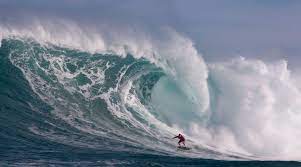
A disturbance that transfers energy from place to place through matter or space
wave
position
time
protein

How are Electromagnetic waves different from Mechanical waves?
EM waves have very short wavelengths
EM waves transmit energy instead of matter
EM waves can travel through the vacuum of space (without particles)
EM waves can change direction by reflection
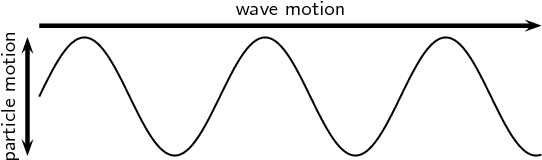

Select the correct order of waves on the EMS from low to high energy
Radio, Micro, Infra, Visible, Ultra, X-ray, Gamma
Gamma, X-ray, Ultra, Vis, Infra, Micro, Radio
Vis, Micro, Infra, Ultra, X-ray, Gamma, Radio
Micro, Radio, Vis, Infra, Ultra, X-ray, Gamma
Which has the LONGEST wavelength and, therefore, the LOWEST frequency/energy
Gamma Rays
Ultraviolet
Visible Light
Infrared rays
Which type of EM waves has the shortest wavelength?
radio wave
visible light
gamma ray
ultraviolet
Which electromagnetic wave possesses the least energy?
microwave
radio wave
infrared
gamma ray
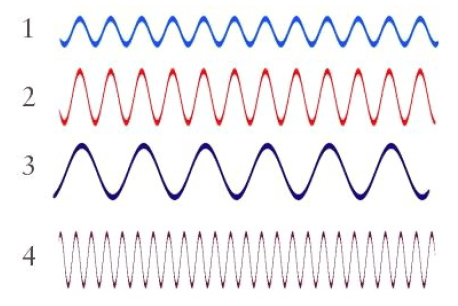


Electromagnetic waves vary in
the speed they travel in a vacuum.
wavelength and frequency.
the way they reflect.
the orientation of their electric and magnetic fields.
The full range of frequencies of electromagnetic radiation is called
visible light.
radio waves.
the electromagnetic spectrum.
invisible radiation.

The _______________ determines the color of visible light.
wavelength (and frequency)
speed
amplitude
particles of the medium

