Wayground logo

Free Printable Worksheets

Font size

S
M
L
XL
Worksheets

Punnett Square/ Pearson Square

Total questions: 65

Worksheet time: 16hrs 15mins

Name
Class
Date
1.
An allele that is masked when a dominant allele is present. The "weaker" gene. 
a)
Dominant Allele
b)
Recessive Allele
2.
An allele whose trait always shows up in the organism when the allele is present. The "stronger" gene. 
a)
Dominant Allele
b)
Recessive Allele
3.
An organism’s genetic makeup or allele combination.
a)
Genotype
b)
Phenotype
c)
Beanotype
d)
Notype
4.
An organism’s physical appearance, or visible traits. 
a)
Genotype
b)
Phenotype
c)
Beanotype
d)
Notype
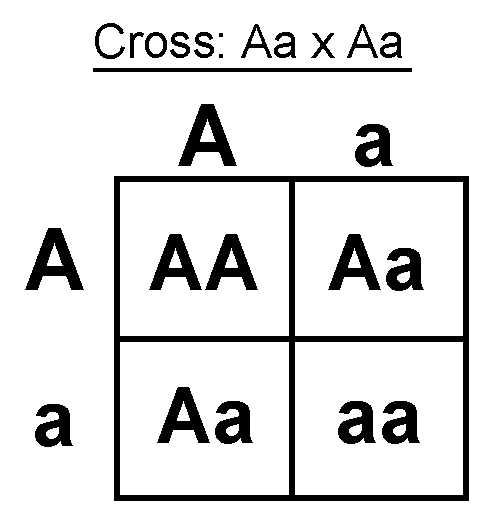
5.
What is called when a organism has  two different alleles for a trait. Tt or Rr
a)
Heterozygous
b)
Homozygous
c)
Domozygous
d)
Thermozygous
6.
What is called when a organism has two identical alleles for a trait. TT or tt. RR or rr
a)
Heterozygous
b)
Homozygous
c)
Domozygous
d)
Thermozygous
7.
In a certain species of plant, the color purple (P) is dominant to the color white (p).
According to the Punnett Square, what is the probability of an offspring being purple?
a)
25%
b)
0%
c)
100%
d)
50%
8.
In a certain species of plant, the color purple (P) is dominant to the color white (p).
According to the Punnett Square, what is the probability of an offspring being white?
a)
25%
b)
0%
c)
100%
d)
50%
9.
A ________________________ is used to predict the possible genotype from certain parents
a)
Mendel Grid
b)
Genetic Tic Tac Toe
c)
Punnett Square
d)
Pedigree Plot
10.
Dominant alleles are represented by a:
a)
Male gene
b)
lowercase letter
c)
recessive trait
d)
capital letter
11.
Which of the following is a phenotype?
a)
Aa
b)
red hair
c)
heterozygous
d)
DNA
12.
How many boxes would say BB?
a)
1
b)
2
c)
4
d)
0
13.
What is the genotypic ratio here
a)
TT = 25% Tt= 50% tt=25%
b)
all tall
c)
TT= 75% tt = 25%
d)
Tt = 100%
14.
A Punnet Square will 
a)
tell you exactly what your offspring will look like
b)
increase the chance you pass on recessive traits
c)
predict genotypes and phenotypes in offspring
d)
have no purpose but for Taylor to give us extra assignments
15.
Which of the following genotypes is heterozygous?
a)
Bb
b)
BB
c)
bb
d)
B
16.
T - tall and t = short
In the punnett square below, what belongs in the missing square
a)
tt
b)
Tt
c)
Bb
d)
TT
17.
What allele combination should go in the missing box?
a)
AA
b)
Aa
c)
aa
d)
none of these
18.
If B = brown hair and b = blonde hair, what is the probability of brown hair?
a)
25%
b)
50%
c)
0%
d)
75%
19.
This image shows a...
a)
Punnett Square
b)
Phenotype
c)
Genotype
d)
Dominant allele
20.
bb is a _________________ genotype
a)
Dominant
b)
Homozygous
c)
Genotype
d)
Phenotype
21.
Which of the following is homozygous recessive?
a)
rr
b)
AA
c)
TT
d)
Ff
22.
What percent of offspring will have the recessive trait?
a)
25
b)
50
c)
75
d)
100
23.
The passing of traits from parent to offspring 
a)
Heredity 
b)
Genetics 
c)
Hybrid 
d)
Probability 
24.
Who was the father of genetics 
a)
Sagan 
b)
Issac Newton 
c)
Gregor Mendel 
d)
C.jenkins 
25.
 Dominant alleles are-
a)
capital
b)
lowercase
c)
both
d)
neither
26.
 Recessive alleles are-
a)
capital
b)
lowercase
c)
both
d)
neither
27.
 which is heterozygous ?  
a)
Tt
b)
TT
28.
Which is homozygous ?
a)
Zz
b)
SS
29.
Chromosomes are made of
a)
DNA
b)
RNT
c)
WWE
d)
DMA
30.
A segment found on DNA is called a ______.
a)
Gene
b)
Jean
c)
Billie Jean
d)
Chromosome
31.
Which of the following genotypes is homozygous dominant?
a)
A
b)
Aa
c)
AA
d)
aa
32.
Which of the following genotypes is homozygous recessive?
a)
RR
b)
Rr
c)
rr
d)
None of the Above
33.
What is a phenotype
a)
The genetic make up (code)
b)
The physical trait
34.
Heterozygous is when...
a)
the alleles are the same
b)
the alleles are different
c)
the alleles are absent
d)
the alleles are present
35.
Which of the following alleles is homozygous (purebred) recessive?
a)
Tt
b)
tt
c)
TT
d)
t
36.
What is a punnett square?
a)
graph used to predict the possible genotypes of offspring in a given cross
b)
a graph used to predict the possible birth rate of offspring.
c)
a graph used to predict the possible behavioral characteristics an offspring could have
d)
None of the above
37.
In a punnet square where are the parent alleles written?
a)
Top and inside the boxes
b)
Only on the left and right side of the boxes. 
c)
outside of the boxes (top and left side)
d)
All on the top side of the boxes
38.
What genotype would go in box 2?
a)
BB
b)
Bb
c)
bb
39.
What genotype would go in box 3?
a)
BB
b)
Bb
c)
bb
40.
What genotype would go in box 1?
a)
BB
b)
Bb
c)
bb
41.
Why are there no white rabbit babies?
a)
The white gene is not present in any of the babies.
b)
It takes two recessive genes to show the trait.
c)
Grey is a better color.
d)
Baby five will be white.
42.

Which of these Punnett squares represents a cross between a homozygous dominant parent and a heterozygous parent?

a)
b)
c)
d)
43.

In a certain breed of cats, having black hair is the result of two dominant alleles for hair color (HH). The heterozygous genotype (Hh) produces a cat that has black and white spots. Having two recessive (hh) genes results in a white-haired cat. In the Punnett square below, what are the phenotypes of the parent cats?

a)

2 spotted cats

b)

2 black cats

c)

1 spotted cat and 1 white cat

d)

1 black cat and 1 spotted cat

44.

In a certain breed of cats, having black hair is the result of two dominant alleles for hair color (HH). The heterozygous genotype (Hh) produces a cat that has black and white spots. Having two recessive (hh) genes results in a white-haired cat. What is the chance that the parent cats in the Punnett square below will have an offspring with spotted fur?

a)

0%

b)

25%

c)

50%

d)

75%

e)

100%

45.
What chance does the offspring have of showing a recessive trait?
a)
50%
b)
75%
c)
100%
d)
25%
46.
Two heterozygous parents produce offspring. What is the probability of the HOMOZYGOUS DOMINANT GENOTYPE appearing in the offspring generation?
a)
75%
b)
25%
c)
50%
d)
100%
47.
HH crossed with Hh. What is the probability of hh?
a)
0%
b)
25%
c)
50%
d)
100%
48.

What is a ration?

a)

total amount of feed that an animal is allowed in a 48-hour period

b)

all the feed an animal eats in its lifetime

c)

amount of feed without reference to a specific time period

d)

total amount that an animal is allowed in a 24-hour period

49.

Which term describes the weight of a feed after all the moisture content has been removed?

a)

100% dry-matter basis

b)

as fed basis

c)

air dry basis

d)

dry weight

50.

Which of the following is not a step in balancing a ration?

a)

identify the needs of the animal

b)

calculate the amounts of each feed needed

c)

identify the kind of animal to be fed

d)

compare the costs of available sources of ingredients

51.

The weight of feed materials after moister has been driven out

a)

Feed Analysis

b)

Dry Matter

c)

Calorie

d)

Crude Protein

52.

The nitrogen content of feed multiplied by 6.25

a)

Crude Protein

b)

Dry Matter

c)

Ration

d)

Diet

53.

A simple way to calculate a ration for a specific animal

a)

Ration

b)

Feed Analysis

c)

Pearson Square

d)

Diet

54.

The type and amount of feed an animal received in its ration

a)

Ration

b)

Diet

c)

Calorie

d)

Feedstuff

55.

Which essential nutrient is necessary for survival?

a)

Protein

b)

Water

c)

Vitamin

d)

Mineral

e)

Carbohydrate

56.

Which essential nutrient is made of inorganic elements and need in small amounts

a)

Vitamin

b)

Carb

c)

Protein

d)

Mineral

57.

A simple way to calculate a ration for a specific animal

a)

Pearson Square Method

b)

Punnett Square

c)

Feed Analysis

d)

Feeding Standards

58.

T/F: Diets should be based on the needs of the animal being fed an the nutrient content of the feed available

a)

True

b)

False

59.

Formulate 100 pounds of a ration with 18% CP using yellow corn (10.1% CP) and soybean meal

(42.5% CP).

a)

10.1 lbs yellow corn 89.9lbs soybean meal

b)

24.4lbs yellow corn 75.6lbs soybean meal

c)

75.6lbs yellow corn 24.4lbs soybean meal

d)

32.4 lbs yellow corn 67.6 soybean meal

60.

What percentage of the cost of raising livestock is feed?

a)

25%

b)

50%

c)

75%

d)

85%

61.

You Want to feed Corn that is 10% CP and Mix it with Cottonseed Meal that is 30% CP to a cow that requires 15% CP in the diet.

a)

75% Corn

25% Cottonseed Meal

b)

60% Corn

40% Cottonseed Meal

c)

25% Corn

75% Cottonseed Meal

d)

Answer not provided

62.

Formulate 500lbs of a 21% CP ration using soybean Meal 44% CP and Corn 9% CP.

How many pounds of soybean meal and corn will be used?

a)

201.8lbs SBM

298.2lbs Corm

b)

328.5lbs SBM

171.5lbs Corn

c)

Answer not Provided

d)

345lbs SBM

155lbs Corn

63.

You want to feed oats that are 10% CP and mix it with Alfalfa Meal Pellets that are 25% CP to a ewe that requires 15% CP in the diet.

a)

Answer not provided

b)

68% Oats

35% AMP

c)

33.3% AMP

66.6% Oats

d)

66.6% Oats

33.3% AMP

64.

You want to feed corn that is 10% CP and mix it with Soybean Meal 45% CP to a gilt that requires 13% CP diet.

a)

13% Corn

10% SBM

b)

Answer not Provided

c)

45% SBM

55% Corn

d)

88% Corn

12% SBM

65.

Formulate 250lbs of a 19%CP ration using Cottonseed Meal 47% CP and Molasses 5% CP. How many pounds of Cottonseed Meal and Molasses will be used?

a)

83.25lbs CSM

166.5lbs Molasses

b)

86lbs CSM

166lbs Molasses

c)

84lbs Molasses

167lbs CSM

d)

Answer not provided