
 Worksheets
Astronomy - The Big Bang and the life cycle of stars
Total questions: 75
Worksheet time: 39mins
Hydrogen is the most common element in the universe. What is the second most common element?
carbon
lithium
uranium
helium
Our sun is this spectral type.
A star
M star
F star
G star
The least massive stars end their life cycle as:
White dwarfs
Neutron stars
Pulsars
Dust clouds
On a Hertzsprung-Russell diagram, most stars spend the majority of their life as
F stars
Main sequence stars
Planetary nebula
Giant stars
Between now and the last stage of our sun's life as a white dwarf, it will become
a red giant
a supernova
a magnetar
an emission nebula
The redshift of light from distant galaxies provides evidence that the universe is
shrinking, only
expanding, only
shrinking and expanding in a cyclic pattern
remaining the same size

According to this table, the average temperature of the universe since stage 3 has
decreased, only
increased, only
remained the same
increased, then decreased

According to the table, how soon did protons and neutrons form after the beginning of the universe?


Cosmic background radiation provides direct evidence for the origin of
the universe
our solar system
Earth's ozone layer
Earth's earliest atmosphere
Which piece of evidence best supports the theory that the universe began with an explosion?
measurements of rates of decay using carbon-14
measurements of cosmic background radiation
calculations of the distance from the sun to each asteroid in the asteroid belt
calculations of the temperature and luminosity of stars
Which evidence best supports the theory that the universe began with a massive explosion
cosmic background radiation in space
parallelism of planetary axes
radioactive dating of Earth's bedrock
life cycle of stars
The Big Bang Theory is an explanation for...
How gravity works
How the universe was formed
How our solar system formed
How light works
Scientists estimate the Big Bang happened...
14 million years ago
1 billion years ago
14 billion years ago
40 billion years ago
The first elements created after the Big Bang were...
Hydrogen, Helium
Hydrogen, Oxygen
Helium, Oxygen
Oxygen, Nitrogen
Compared to Earth's solar system, the whole universe is
younger and larger
younger and smaller
older and larger
older and smaller
Which sequence correctly lists the relative sizes from SMALLEST to LARGEST?
our solar system, universe, Milky Way Galaxy
our solar system, Milky Way Galaxy, universe
Milky Way Galaxy, our solar system, universe
Milky Way Galaxy, universe, our solar system
The _____ of a star determines its life cycle, including how it dies.
absolute magnitude
luminosity
shape
size
Galaxies are
converging
moving away
imploding on themselves
stationary
Earth's seasons are caused by
the moon's orbit around Earth
the distance between Earth and the sun
the orbit of stars around the sun
the tilt of the Earth's axis as it orbits the sun

According to the H-R Diagram, a star with a luminosity of 103 and a temperature of approximately 4,000 K would be classified as a
white dwarf
main sequence
giant
supergiant
What process powers stars, including our sun?
nuclear fusion
nuclear fission
magnetism
radioactive decay
What element is the main component of most stars?
iron
helium
carbon
hydrogen
The name of the theory that explains how our universe formed:
Solar Nebular Theory
Plate Tectonics Theory
The Big Bang Theory
The Accretion Theory
All stars form from
white dwarfs
nebulae
supergiants
black dwarfs
Stars are born inside of...
Nebulas
Supernovas
Black Holes
Singularities
In Nuclear Fusion....
Hydrogen is converted into Helium
Protons are converted into Electrons
Gas is converted into Dust
White Dwarves are converted into Red Giants
Stars with more mass...
Are always brighter than stars with less mass
Produce more energy than stars with less mass
Have less luminosity than stars with less mass
Have less gravity than stars with less mass
The Sun is a...
Main Sequence Star
Protostar
Red Giant
White Dwarf
When the core of a high mass star collapses it produces a...
Black Hole
Neutron Star
Supernova
White Dwarf
A Hertzsprung- Russell (HR) Diagram measures...
Luminosity & Magnitude
Temperature & Gravity
Luminosity & Temperature
Magnitude & Brightness
What happens in the core of a star?
hydrogen atoms are created
nuclear fusion
nuclear fission
a black hole forms

White
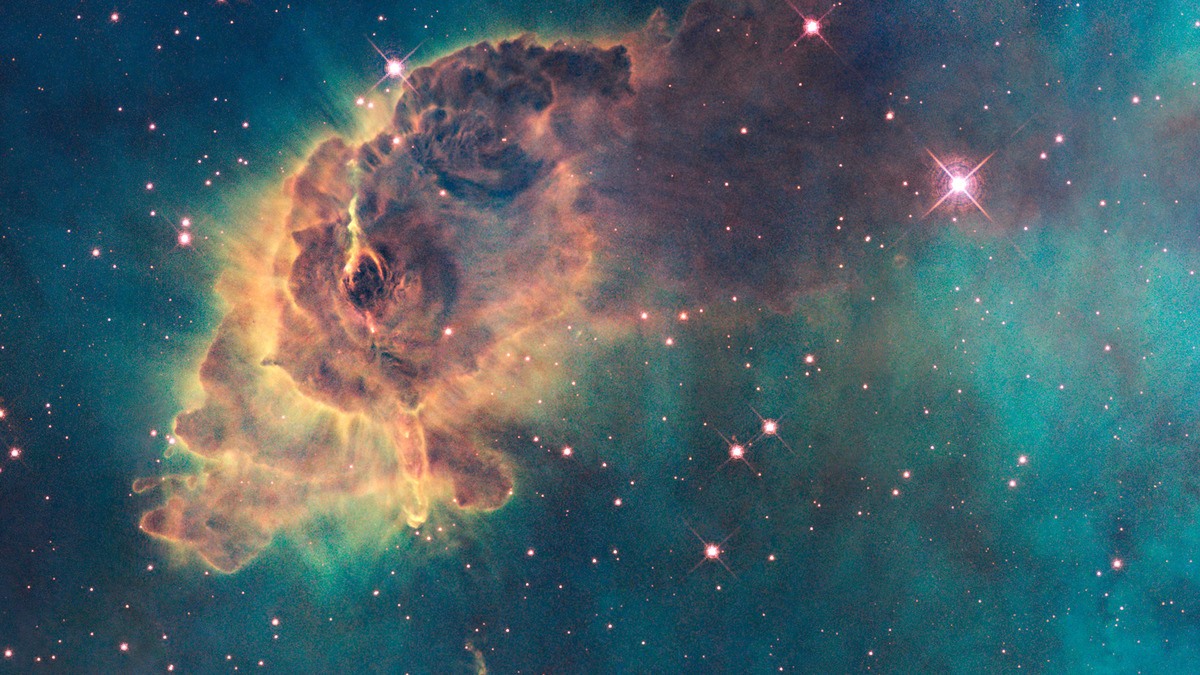
Before stars were stars, what were they?
Nebula
Black Hole
White Dwarfs
If a star being observed from Earth has a red shift, what does it mean?
It has planets revolving around it
It is a larger and cooler star
More massive stars generally have shorter life cycles than less massive stars because massive stars...
are older
Use fuel much faster than less massive stars
have a stronger gravitational pull
Use fuel much slower than less massive stars

What is a characteristic of the White Dwarf?
extremely hot and very bright
not as hot and very bright
extremely hot and not as bright
not as hot and not as bright
Which of these presents the celestial objects in order of smallest to largest?
galaxy, universe, planet, star, solar system, moon
moon, planet, star, solar system, galaxy, universe
solar system, galaxy, universe, planet, moon, star
star, galaxy, universe, solar system, moon, planet
moon, planet, solar system, star, galaxy, universe
Which of these is true?
the largest stars are also the hottest stars
the largest stars are also the brightest stars
the smallest stars are also the dimmest stars
the smallest stars are also the coolest stars
Cosmic Background Radiation is made up of ___
radio waves
infrared radiation
microwaves
gamma rays
The next stage in the life cycle of our Sun is ____
red giant
blue giant
white dwarf
black hole
main sequence star
Stars and galaxies did not form until about 4.6 billion years ago
True
False
An enormous cloud of dust and gas occupying the space between stars and acting as a nursery for new stars.
nebula
main sequence star
mass
luminosity
contracting mass of gas which represents an early stage in the formation of a star, before nucleosynthesis has begun
supervona
black hole
protostar
gravity
stars that are fusing hydrogen atoms to form helium atoms in their cores.
super redgiant
red giant
Nebula
main sequence star
very large star of high luminosity and low surface temperature, thought to be in a late stage of evolution when no hydrogen remains in the core to fuel nuclear fusion.
nuclear fusion
main sequence star
core collapse
red giant
a small very dense star that is typically the size of a planet, formed when a low-mass star has exhausted all its central nuclear fuel and lost its outer layers as a planetary nebula.
black dwarf
white dwarf
super redgiant
mass
extremely large red giant star with a minimum of 15 solar masses. The best known red supergiant is Betelgeuse, with a luminosity about 10,000 times that of the Sun.
super redgiant
main sequence star
supernova
neutron star
star that suddenly increases greatly in brightness because of a catastrophic explosion that ejects most of its mass.
nebula
supernova
luminosity
red giant
a celestial object of very small radius and very high density, composed predominantly of closely packed neutrons, thought to form by the gravitational collapse of the remnant of a massive star after a supernova explosion
neutron star
black hole
gravity
nuclear fusion
a region of space having a gravitational field so intense that no matter or radiation can escape.
INFORMAL
low mass star
high mass star
black hole
luminosity
a measure of the amount of matter in an object.
luminosity
mass
main sequence star
low mass star
the intrinsic brightness of a celestial object
mass
gravity
luminosity
stars
is the force by which a planet or other body draws objects toward its center
nebula
black hole
neutron star
gravity
involves the combining of several small nuclei into one large nucleus with the subsequent release of huge amounts of energy.
main sequence star
supernova
nuclear fusion
mass
This scientist is credited with coining the term "Big Bang".
Einstein
Guth
Hubble
Hoyle
Which of the following is NOT an evidence of the Big Bang?
Red Shift
Steady state
Cosmic Microwave Background Radiation
Nucleosynthesis
This element is the lightest,most abundant in the universe and is the key component of stars
Hydrogen
Helium
Oxygen
Carbon
When did the big bang occur?
5000 yrs ag0
13.7 billion yrs ago
2 million yrs ago
Unknown
The farther away galaxies are from us, the _______________ it is that they are moving away from us.
more uncertain
faster
slower
more unpredictable
Most scientists believe the Big Bang explains which of the following questions?
How the planets & moons formed.
How our Universe began.
How the sun turns hydrogen into helium.
How fast light travels through space.
Our theory of the universe was confirmed when the WMAP mission photographed the fossil remnant heat we now call _______
Fusion
Cosmic microwave background radiation
Doppler Effect
a Planetary Nebula
Astronomers think that the solar system formed from an interstellar
rocks
clouds
explosions
debris
The density of gas in a collapsing interstellar cloud is low at first, but ____________________draws matter together until it is concentrated enough to form a star and possibly planets.
space
mass
gravity
dust

Where is the concentration of matter the densest as an interstellar cloud collapses?
A
B
C
The Sun formed when the dense concentration of gas and dust at the center of a rotating disk reached a temperature and pressure high enough to fuse hydrogen into
carbon
lava
helium
The rotating disk surrounding the young Sun became our
moon
planet
comet
solar system
Space objects built of solid particles that can form planets through collisions and mergers are called
comets
asteroids
planetesimals
Theories of the origin of the solar system rely on direct ___________________ and data from probes.
satellites
observations
stories
Select all that apply
Which factors determine the force of gravitation between two bodies?
distance between the objects
composition of the objects
volumes of the objects
masses of the objects
Approximately how long ago was our sun formed?
The group of inner planets are known as:
The Terrestrial/Rocky Planets
The Jovian/Gas Giants
The Outer Planets
The Hallow Planets
The group of outer planets are known as:
The Terrestrial/Rocky Planets
The Jovian/Gas Giants
The Inner Planets
The Rocky Planets

