wayground logo

Free Printable Worksheets

NEW

Font size

S
M
L
XL
Worksheets

Revision 7

Total questions: 72

Worksheet time: 1hrs 24mins

Name
Class
Date
1.

The ability to do work (move) is called...

a)

Matter

b)

Energy

c)

Weight

d)

Force

2.

True or false: Energy cannot change from one type to another.

a)

True

b)

False

3.

Which of the following is an example of thermal energy?

a)

A light bulb

b)

The movement of a car

c)

The digestion of food

d)

Heat from a fire

4.

Energy from the sun is called...

a)

Conduction

b)

Rays

c)

Radiation

d)

Heat

5.

Faster moving atoms and molecules are associated with...

a)

Low thermal energy (cooler)

b)

High thermal energy (hotter)

6.

True or False: Energy can be created.

a)

True

b)

False

7.

Which of the following is NOT a form of energy?

a)

Thermal

b)

Mechanical

c)

Sound

d)

Water

8.

Energy that is stored is called...

a)

Kinetic Energy

b)

Potential Energy

c)

Mechanical Energy

d)

Thermal Energy

9.

Which has the most kinetic energy?

a)

A caught baseball

b)

A turtle swimming

c)

A parked car

10.

Energy that does not run out of its supply is called...

a)

Renewable Energy

b)

Nonrenewable Energy

c)

Recycled Energy

d)

Potential Energy

11.
The length of a paper clip.
a)
3 km
b)
3 m
c)
3 cm
12.
Best measurement for a piece of paper?
a)
1 Kilogram (kg)
b)
1 Gram (g)
13.
How much does a car weigh?
a)
5 g
b)
50 g
c)
500 kg
14.

A Balance measures

a)

water

b)

mass

c)

time

d)

tables

15.

A graduated cylinder measures

a)

time

b)

mass

c)

length

d)

volume

16.

A thermometer measures

a)

temperature

b)

length

c)

volume

d)

mass

17.

A scale measures

a)

time

b)

length

c)

weight

d)

temperature

18.

A timer measures

a)

length

b)

mass

c)

time

d)

temperature

19.

A ruler measures

a)

length

b)

mass

c)

temperature

d)

time

20.

A ruler or meter stick measures in

a)

degrees celsius

b)

grams

c)

liters

d)

meters

e)

seconds, minutes, hours

21.

A thermometer measures in

a)

degrees celsius

b)

grams

c)

liters

d)

meters

e)

seconds, minutes, hours

22.

A graduated cylinder measures in

a)

degrees celsius

b)

grams

c)

liters

d)

meters

e)

seconds, minutes, hours

23.

A balance measures in

a)

degrees celsius

b)

grams

c)

liters

d)

meters

e)

seconds, minutes, hours

24.

timer measures in

a)

degrees celsius

b)

grams

c)

liters

d)

meters

e)

seconds, minutes, hours

25.

Which tool do you use? If you want to measure the volume of water, use a

a)

ruler/meter stick

b)

timer

c)

balance/scale

d)

graduated cylinder

e)

thermometer

26.

Sound is a form of energy produced by ______________.

a)

Vibrations

b)

Distances

c)

Prisms

d)

Forces

27.

Sound waves travel the FASTEST through _____________.

a)

Gases

b)

Liquids

c)

Solids

28.

A place where no sound exists is...

a)

in the air.

b)

under water.

c)

space.

d)

all of the above

29.

When people speak their ________ vibrate.

a)

Ear drums

b)

Vocal chords

c)

Ears

d)

Tongue

30.

What is Pitch?

a)

How loud or soft a sound is.

b)

Muscle that holds vocal cords.

c)

Movement back and forth.

d)

How high or low a sound is.

31.

________ describes how LOUD a sound is.

a)

Amplitude

b)

Frequency

32.

____________ is determined by sound's frequency

a)

Compression

b)

Pitch

33.

A sound with a high frequency has a _____ pitch. A sound with a ____ frequency has a low pitch.

a)

high, low

b)

low, high

c)

medium, high

d)

high, medium

34.

______________ sounds have a larger amplitude

a)

Quiet

b)

Loud

35.

How many atoms of sodium (Na) are in one molecule of baking soda?

a)

1

b)

2

c)

3

d)

4

36.

Ozone and Oxygen molecules are the same substance because they both are made only of oxygen atoms.

a)

true

b)

false

37.

What is the chemical symbol for carbon?

a)

C

b)

Ca

c)

Cn

d)

Crn

38.
What is a reactant?
a)
The starting substance
b)
The ending substance
39.
Using the following chemical reaction
Hydrogen + Oxygen --> water
Identify the reactant(s).
a)
Hydrogen and Oxygen
b)
water
40.
Angelina mixes 2 substances together in a beaker. The beaker becomes hot and the liquid changes color.
Did a chemical reaction occur?
a)
yes, because the properties changed and a new substance was made.
b)
no, because the properties did not change.
41.
Which of the following are NOT signs that a chemical reaction occured?
a)
the properties changed
b)
bubbles of gas formed
c)
color stays the same
d)
smells different
42.
Alex wants to mix two substances together and to find out if a chemical reaction happens. What should he do?
a)
test the solubility before and after mixing
b)
measure the volume before and after mixing
c)
measure the mass before and after mixing
d)
test the density of the before substance but not the after substances.
43.
What is a pure substance that cannot be broken down into any other substance by physical or chemical means. Ex: Gold, Silver, Oxygen, & Nitrogen
a)
element
b)
compound
c)
mixture
d)
salad
44.
What is a  pure substance made of two or more elements chemically combined in a set ratio. Ex: CO2 has a set ratio of 1:2, meaning for every one carbon atom there are two oxygen atoms.
a)
element
b)
compound
c)
mixture
d)
salad
45.
What type of property can only be observed by changing the substance into a new substance. Ex: Flammability, oxidation
a)
chemical
b)
physical
46.
What two types of measurements make up DENSITY
a)
Mass and Volume
b)
Temperature and Mass
c)
Grams and Centimeters
d)
Volume and Weight
47.
Jack has a rock. The rock has a mass of 14g and a volume of 2cm3. What is the density of the rock?
a)
7 mL
b)
7 g/cm3
c)
28 g/cm3
d)
1/7 g/cm3
48.
If an object has a density of .6 g/mL and you put it into water, will it sink or float?  
a)
sink
b)
float
49.
If an object has a density of 3.6 g/mL and you put it into water, will it sink or float?  
a)
sink
b)
float
50.
Frank has an eraser. It has a mass of 4g, and a volume of 2cm3. What is its density?
a)
8 g/cm3
b)
2 g/cm3
c)
1/2 g/cm3
d)
24 g/cm3
51.
What units are used to measure mass?
a)
g
b)
cm3
c)
g/cm3
d)
cm3/g
52.
What is the formula for density?
a)
density = mass x volume
b)
density = mass / volume
c)
density = mass + volume
d)
density = mass - volume
53.
Helium balloons rise on earth because
a)
helium is less dense than air
b)
helium is more dense than air
c)
helium is cooler than air
d)
helium is warmer than air
54.
True or False:  The density of a specific type of material never changes.  
a)
True
b)
False
55.

How many Hydrogen atoms are in 4H2O?

a)

6

b)

8

c)

2

d)

4

56.

How many Oxygen atoms are in H2O?

a)

1

b)

2

c)

0

d)

4

57.

How many Magnesium atoms are in 10MgCl2?

a)

10

b)

5

c)

20

58.
How many elements are in C6H12O6?
a)
1
b)
2
c)
3
d)
4
59.

How many atoms are there TOTAL in H2SO4 ?

a)

6

b)

5

c)

7

d)

3

60.

How many Nitrogen atoms are in (NH₄)₂CrO₄?

a)

1

b)

2

c)

8

d)

16

61.

How many elements are present in this compound? (Careful!)

Mg2As3COHNi2

a)

2

b)

4

c)

6

d)

10

62.

Subatomic particles with a negative charge

a)

Electrons

b)

Neutrons

c)

Protons

d)

Quarks

63.
subatomic particles found on the outermost shell & responsible for the atom's reactivity
a)
neutrons
b)
valence electrons
c)
isotopes
d)
ions
64.
Subatomic particles with a positive charge
a)
neutrons
b)
atomic mass
c)
protons
d)
isotopes
65.
Measure mainly of the nuclear particles: protons + neutrons
a)
Subatomic Particles
b)
Atomic Number
c)
Atomic Mass
d)
Gluons
66.
Value representing the number of protons in an element
a)
Atomic Mass
b)
Mass Number
c)
Valence Electrons
d)
Atomic Number
67.
The image shows the periodic grid for POTASSIUM. What is Potassium's atomic number?
a)
19
b)
39
c)
20
d)
Impossible to tell
68.
The image shows the periodic grid for POTASSIUM. How many PROTONS are found in a potassium atom?
a)
19
b)
39
c)
20
d)
Impossible to tell
69.

What is the atomic mass of Neon?

a)

10

b)

20.18

c)

10.18

70.
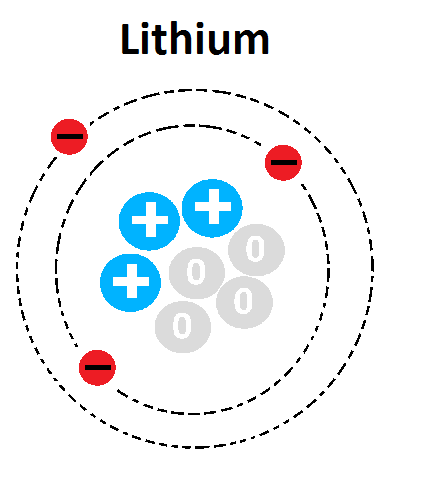
What is the atomic number of this atom?
a)
1
b)
3
c)
4
d)
7
71.
How many electrons should Nitrogen have around its Lewis dot model?
a)
1
b)
3
c)
4
d)
5
72.
How many electrons should Oxygen have around its Lewis dot model?
a)
5
b)
6
c)
7
d)
8