wayground logo

Free Printable Worksheets

NEW

Font size

S
M
L
XL
Worksheets

PS PRE-TEST Unit 7: Waves

Total questions: 71

Worksheet time: 2hrs 22mins

Name
Class
Date
1.
What is a medium?
a)
How fast the wave can move.
b)
The range of electromagnetic waves above red in the visible spectrum.
c)
A disruption in the connections of matter
d)
The substance a wave moves through.
2.
What is a wave?
a)
A repeated disturbance that moves energy.
b)
A repeated disturbance that moves a substance.
c)
A repeated back-and-forth or up-and-down motion.
d)
The way that light and sound transfer through space.
3.
If a student is making a wave with a slinky, what is the medium?
a)
the air around it
b)
the earth beneath it
c)
the slinky
d)
the wave itself
4.
What is a big difference between mechanical and electromagnetic waves?
a)
Mechanical do not need a medium and electromagnetic do.
b)
Mechanical waves are faster than electromagnetic.
c)
All mechanical waves are transverse.
d)
Electromagnetic do not need a medium and mechanical do.
5.
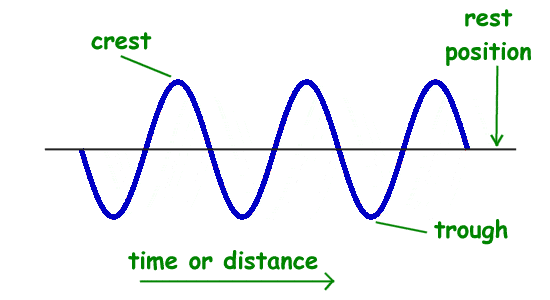
The highest point of a transverse wave is known as the _____.
a)
trough
b)
crest
c)
rarefaction
d)
compression
6.
The area where a longitudinal wave is spread out is known as a
a)
compression
b)
substitution
c)
rarefaction
d)
trough
7.
This is how many waves pass a point in a given time. When this number is higher, this means that the waves carries more energy.
a)
amplitude
b)
wavelength
c)
speed
d)
frequency
8.
This is the height between the crest and the rest line of a medium. The greater this is the greater the energy carried.
a)
wavelength
b)
frequency
c)
amplitude
d)
speed
9.
This is the distance from one point on a wave to the same point on the next wave.
a)
speed
b)
amplitude
c)
wavelength
d)
frequency
10.
What happens from left to right?
a)
Wavelength decreases and frequency increases
b)
Wavelength increases and frequency decreases
c)
Energy decreases
d)
The energy increases and then decreases
11.
When you look at the electromagnetic spectrum, Wavelength decreases and what increases?
a)
Amplitude
b)
Speed
c)
Frequency
d)
Wave height
12.
A wave carries...?
a)
energy only
b)
matter only
c)
the matter carries the energy
d)
neither
13.
What kind of wave can travel through space?
a)
electromagnetic waves
b)
compressional waves
c)
transverse waves
d)
longitudinal waves
14.
The lowest part of the wave is?
a)
trough
b)
crest
c)
point of origin
d)
compression point
15.
In a transverse wave, particles move...?
a)
back and forth
b)
vertically
c)
up and down
d)
wherever the matter's going
16.
What is the measure of how many waves pass a point in a certain amount of time?
a)
frequency
b)
wavelength
c)
midpoint
d)
crest and trough
17.
In a longitudinal wave, the particles move...?
a)
back and forth
b)
up and down
c)
vertically
d)
in the direction of the hertz
18.
The units for frequency are measured in _____________.
a)
hertz
b)
seconds
c)
m/s
d)
m
19.
What is the speed of a sound wave that has a frequency of 250 hertz and a wavelength of 8 meters? 
a)
31 m/s
b)
250 m/s
c)
2000 m/s
d)
5280 m/s
20.
Which is an example of a longitudinal wave?
a)
light wave
b)
sound wave
c)
visible wave
d)
radio wave
21.

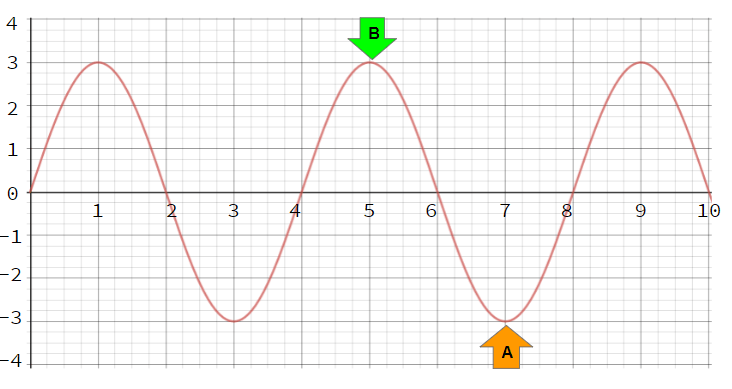
The diagram below shows two points, A and B, on a wave train.

How many wavelengths separate point A and point B?

a)

1.0

b)

1.5

c)

3.0

d)

0.75

22.

Which is the longitudinal wave?

a)
b)
c)
d)
23.

Transverse waves are:

a)

perpendicular

b)

parallel

24.

What's the difference between mechanical and electromagnetic waves?

a)

electromagnetic needs a medium but mechanical does not

b)

mechanical waves can travel through a vacuum, but electromagnetic can't

c)

Mechanical needs a medium, while electromagnetic doesn't

25.

Sound is faster than light

a)

True

b)

False

26.

Waves transfer matter

a)

True

b)

False

27.

How do we measure one wave cycle of a longitudinal wave?

a)

from compression to compression

b)

rarefaction to rarefaction

c)

with the Oscilloscope

28.

The lines in the emission spectrum for hydrogen are formed from ___.

a)

energy given off when the electron moves from higher energy levels to lower energy levels

b)

electrons given off as hydrogen burns

c)

protons given off when protons move from higher energy levels to lower energy levels

d)

electrons given off as hydrogen cools

29.

Which color has the highest frequency?

a)

green

b)

blue

c)

red

d)

yellow

30.

Which color has the highest energy per photon quanta?

a)

green

b)

blue

c)

red

d)

yellow

31.

Which color has the longest waves?

a)

red

b)

orange

c)

yellow

d)

green

32.

Energy of a photon is ___ proportional to frequency.

a)

directly

b)

inversely

33.

Which color has the shortest wavelengths?

a)

yellow

b)

green

c)

blue

d)

indigo

34.

A student asks a series of questions about a wave. The answer to which question will allow the student to determine whether the wave is electromagnetic or mechanical?

a)

Does it require a medium in order to travel?

b)

Can it pass through air and water?

c)

Does it have a measurable speed?

d)

Does it have a measurable frequency?

35.
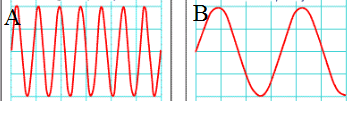
Which wave has a greater frequency?
a)
A
b)
B
36.

Point A represents what?

a)

Trough

b)

Midpoint

c)

Crest

d)

node

37.

What is measured from crest to crest or trough to trough?

a)

mediums

b)

resting position

c)

wavelength

d)

origin

38.

If a wave has a greater frequency, what happens to number of waves per second?

a)

increases

b)

decreases

c)

stays the same

39.

What is the amplitude of this wave?

a)

2

b)

3

c)

6

d)

10

40.
 A wave has frequency of 50 Hz and a wavelength of 10 m. What is the speed of the wave?
a)
500 m/s
b)
50 m/s
c)
5 m/s
d)
0.5 m/s
41.

Select the correct order of waves on the EMS from low to high energy

a)

Radio, Micro, Infra, Visible, Ultra, X-ray, Gamma

b)

Gamma, X-ray, Ultra, Vis, Infra, Micro, Radio

c)

Vis, Micro, Infra, Ultra, X-ray, Gamma, Radio

d)

Micro, Radio, Vis, Infra, Ultra, X-ray, Gamma
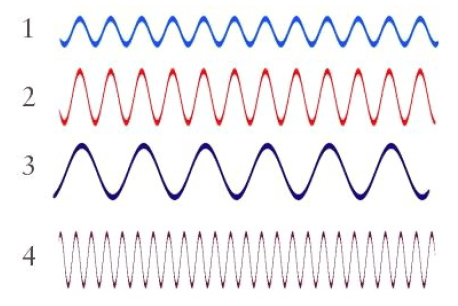
42.
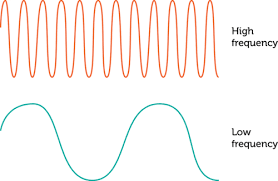
Which wave in the diagram has the greatest frequency?
a)
1
b)
2
c)
3
d)
4
43.
Which of the following can sound travel through?
a)
solid
b)
liquid
c)
gas
d)
all of the above
44.
Which type of light has the highest energy of this group?
a)
red
b)
yellow
c)
green
d)
blue
45.
This color in the visible part of the spectrum has the lowest energy. 
a)
Blue
b)
Green
c)
Red
d)
Violet
46.

Electromagnetic waves vary in

a)

the speed they travel in a vacuum.

b)

wavelength and frequency.

c)

the way they reflect.

d)

the orientation of their electric and magnetic fields.

47.

Light always travels at the same speed through the vacuum of space. In a vacuum, there is no medium (matter) for light to pass through. When light passes into a medium, it will

a)

speed up.

b)

slow down.

c)

stay the same speed.

48.

When light slows down, it _____.

a)

changes color

b)

goes dark

c)

bends

d)

gets brighter

49.

According to the wave particle theory, light is made up of ________ that behave like _______ .

a)

waves; particles

b)

colors; waves

c)

particles; waves

d)

colors; particles

50.
Which has the SHORTEST wavelength and, therefore, the highest frequency/most energy
a)
Radio waves
b)
Ultraviolet Rays
c)
Gamma Rays
d)
X-rays
51.
Which has the LONGEST wavelength and, therefore, the lowest frequency/energy
a)
Gamma Rays
b)
Radio Waves
c)
Visible Light
d)
Infrared rays
52.
How much of the electromagnetic spectrum is visible?
a)
All of it
b)
None of it
c)
Most of it
d)
Only a small part
53.

What was the identity of the unknown substance?

a)

LiCl

b)

CuSO4

c)

NaCl

d)

KNO3

54.

What was the identity of the unknown substance?

a)

LiCl

b)

CuSO4

c)

NaNO3

d)

KNO3

55.

When an electron returns to ground state from an excited state, the atom will

a)

emit energy

b)

absorb energy

c)

rotate

d)

wiggle

56.
Why are line emission spectra of elements called "atomic fingerprints"?
a)
They are all the same
b)
They are all unique
c)
They are all similar
d)
They all contain colored light
57.

The unknown emissions spectra belongs to the element

a)

Hydrogen

b)

Mercury

c)

Neon

d)

Sodium

58.

The unknown emissions spectra belongs to the element

a)

Hydrogen

b)

Mercury

c)

Neon

d)

Sodium

59.

X-Rays and Ultrasound are useful medical diagnostic tools. Both these technologies are similar to one another in that they both:

a)

use EMR.

b)

are non-invasive imaging technologies.

c)

safe to use in examining infants and adults.

d)

require technicians to wear safety and protective clothing when operating the machines.

60.

Which of the following electromagnetic waves can travel through matter and cause damage to cells?

a)

radio waves

b)

microwaves

c)

infrared waves

d)

gamma rays

61.

An electromagnetic wave consists of an magnetic field & an electric field. What is their relationship in the wave?

a)

They travel in opposite directions

b)

They travel parallel to each other

c)

They travel perpendicular to each other

d)

They travel at 45 degree angles to each other

62.

Light can bounce off matter, leading to ______.

a)

emssion

b)

reflection

c)

absorption

d)

transmission

63.

which of the following emits visible light?

a)

glass

b)

a light bulb

c)

a black shirt

d)

a mirror

64.

We see a "rainbow of colors" that when perceived together produce:

a)

black light

b)

white light

c)

gamma rays

d)

x-ray images

65.

Joseph studied whether different materials can block certain electromagnetic waves by testing television reception in different parts of a house. At each part of the house,Joseph used a different antenna. The experiment could have been improved by_________.

a)

testing reception of a different channel during each trial

b)

using the same antenna during each trial

c)

measuring the antenna length in centimeters

d)

measuring the distance to the television station

66.
What kind of wave is pictured?
a)
Transverse
b)
Longitudinal
c)
surface
d)
none of the above
67.
a)
B is called rarefaction
b)
B is called compression
c)
B is called the crest
68.
a)
A is compression
b)
A is the trough
c)
A is the rarefraction
69.

Magnetic tape is useful and cheap storage

a)

True

b)

False

70.

Traditional hard drives and old floppy disks use magnetic storage.

a)

True

b)

False

71.
Which type(s) of signal(s) can be transmitted as radio waves?
a)
Analog
b)
Digital
c)
Both
d)
Neither