
 Worksheets
Momentum & Energy - set 2 - Review
Total questions: 40
Worksheet time: 2hrs 0mins
Stretched bow and arrow?
Select all: Work is equal to...
KE + PE
Change in energy
mg
Fd
Bobby lifts a book to the second floor in 20 seconds. Carol lifts the same book to the second floor in 10 seconds. Who did more work?
Bobby
Carol
They did the same amount of work
Not enough information
A girl weighs 400 N. She runs up a flight of stairs of height 5 m in 4 seconds. Her power is:
320 W
400 W
500 W
2 000 W


When you rub your hands together on a cold day, you use friction to convert
Mechanical energy into thermal energy
Thermal energy into nuclear energy
Chemical energy into mechanical energy.
Electrical energy into thermal energy
Which energy-conversion chain occurs whenever coal is burned to create steam to spin the generator at a power station?
chemical to mechanical to potential
thermal to chemical to mechanical to electrical
chemical to thermal to mechanical to electrical
chemical to chemical to mechanical to radiant
50 J of work is done lifting a 20.0 N book in the air. How high was it lifted?
2.5 m
3.5 m
0.4 m
25 m
A student with a mass of 62 kg walks up a flight of stairs with a height of 3.4 meters. How can he decrease his power?
walk slower
walk faster
carry his friends books
Check all of the things that can affect power
Work
Time
Force
Distance
A weightlifter holds a 100 kg barbell above her head. Is work done?
Yes because there is a force applied to the barbell and the force causes a displacement of the barbell.
Yes because there is an upward force applied to the barbell and the barbell moves vertically.
No because no displacement occurred.
No because there is no force applied.

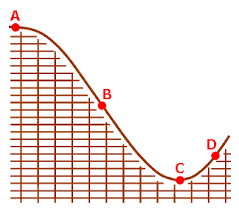
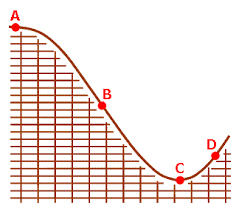
How will you describe the energy at Point A?
mostly potential energy
mostly kinetic energy
losing PE, gaining KE
losing KE, gaining PE
Energy is
how fast you do something.
the ability to do work.
confusing.
how fast you lift something.
If you use 30 J of energy to move an object, you have done ____ J of work.
3
10
30
0

On a work vs time graph, you can calculate the power by
the area.
the y-axis.
the y-intercept.
the slope.
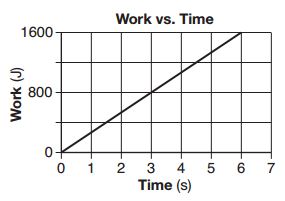
How much power was generated from 0-4 seconds?
1100 W
4 W
267 W
1600 W

If you run up the stairs slower you will
do more work.
do less work.
generate more power.
generate less power.
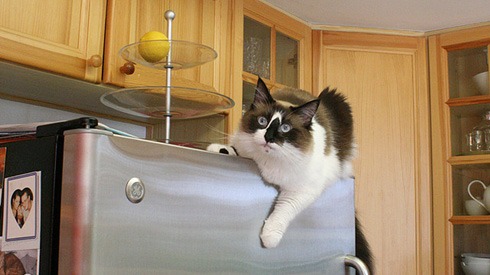
A 5 kg cat falls off a 3 m tall fridge. What is the cat's PE as it starts to fall?
15 J
30 J
150 J
1470 J

A 5 kg cat falls off a 3 m tall fridge. What is the cat's KE just before it lands on the floor?
15 J
30 J
150 J
1470 J
How high up is a 3200-kg plane if it has 960000 J of potential energy?
10 m
30 m
307200000 m
300 m
A 40-kg person is climbing 3 m up a flight of stairs in 6 seconds. How much power did they exert climbing the stairs?
400 W
1200 W
200 W
120 W
How does conservation of energy explain why something that is falling should speed up?
It gains kinetic energy because it gains potential energy.
It loses kinetic energy because no work was done on it.
It gains kinetic energy because it loses potential energy.
It loses kinetic energy because the Earth gains potential energy.
What is the kinetic energy (KE) of a 0.06kg tennis ball traveling at a speed of 150m/s?
(a) Joules
What is the gravitational potential energy (GPE) of a 5.0kg object located 2.0m above the ground?
(a) Joules
What is the mechanical energy of a 500kg rollercoaster car moving with a speed of 3m/s at the top of a hill that is 30m high? (HINT: calculate GPE & KE)
(a) Joules
At a specific point in its swing, a pendulum has 2J of kinetic energy and 1J of potential energy. What is the pendulum's total mechanical energy?
(a) Joules

