wayground logo

Free Printable Worksheets

Font size

S
M
L
XL
Worksheets

Applied Revision

Total questions: 107

Worksheet time: 1hrs 1mins

Name
Class
Date
1.
Most atoms have no net charge because they have....
a)
an equal number of charged and non-charged particles
b)
neutrons in their nuclei
c)
an equal number of electrons and protons
d)
an equal number of neutrons and protons
2.
What would you name this molecule?
a)
SNa3
b)
H3O
c)
NaCl
d)
H2O
3.
If a you saw the following, K+; what does it tell you about the  the ion.
a)
it has lost one electron 
b)
it has lost one proton 
c)
it has lost two electrons 
d)
it is a negative ion 
4.
In a covalent bond, one or more electrons are? 
a)
shared 
b)
lost 
c)
gained 
d)
transferred 
5.

If an atom has no charge, which of the following must be true?

a)

It has more neutrons than protons or electrons.

b)

There are only neutrons inside the atom.

c)

Its number of protons is equal to its number of electrons.

d)

The neutrons in the atom outnumber the electrons and protons.

6.
What is an atom or group of atoms that has an electric charge?
a)
ion
b)
metal
c)
nonmetal
d)
ionic compound
7.

Atoms form ions because they want to have a (a)   outer shell.

8.

How is an ionic bond formed?

a)

Sharing of electrons

b)

Delocalised electrons

c)

Transfer of electrons

9.

Select all of the statements below that are correct to describe the structure and properties of ionic compounds...

a)

They have high melting and boiling points

b)

They have a lattice structure

c)

The ions are held together by intermolecular forces

d)

They can conduct electricity when molten

e)

They can conduct electricity when solid

10.

Which of the below is an ionic compounds?

a)

Ni

b)

MgCl2

c)

H2O

d)

CH4

11.

Oxygen is in group 6 of the periodic table, which ion would it form?

a)

O-

b)

O+

c)

O2-

d)

O2+

12.

Ionic bonds are formed between...

a)

Non - metals

b)

A metal and a non-metal

c)

Metals

13.
What is the basis of a metallic bond?
a)
the attraction of neutral metal atoms.
b)
the attraction between protons and neutrons.
c)
the attraction between positive metal ions and interlocking electrons.
d)
the attraction between positive metal ions and free floating electrons.
14.
There are more metals than non metals in the periodic table.
a)
True
b)
False
15.
At room temperature, most metals are
a)
liquid
b)
solid
c)
gas
d)
an alloy
16.
What does malleable mean?
a)
able to be shaped
b)
will break easily
c)
can be used for wire
d)
is shiny
17.
Which of these is NOT an alloy?
a)
bronze
b)
copper
c)
brass
d)
stainless steel
18.
Electrons that are free to move in metals
a)
delocalized electrons
b)
oxidation number
c)
chemical bond
d)
salts
19.
What is the ability of a substance to be pulled into a thin strand?
a)
Malleability
b)
Ductility 
c)
Conductivity
d)
Solubility
20.
Why do metals have high melting points?
a)
They don't
b)
The negatively charged electrons act as a glue to hold the positively charged ions together.
c)
All the electrons become delocalised
21.
Why do metals conduct
a)
They are shiny
b)
The electrons are held tightly within the lattice
c)
The electrons are delocalised and able to move
d)
The electrons are shared between two metal ions
22.

Why does the melting point of metals increase across period 3, from Sodium (Na) to Aluminium (AI)?

a)

Size of atoms gets smaller

b)

Attraction force between nuclei and free electron increases

c)

Increased space between the valence electrons in the "sea"

d)

Increased number of valence electrons contributed to the "sea"

23.

List four factors that affects the rate of a reaction

a)

temperature

b)

concentration

c)

surface area

d)

volume

e)

catalysts

24.

A temperature increase causes the particles ......

a)

to slow down

b)

move faster

c)

collide higher

d)

in the right order

25.
The following graph shows two different reaction pathways for the same overall reaction at the same temperature. Which pathway is slower and why?
a)
Red, because the activation energy is larger
b)
Blue, because the activation energy is lower
c)
both reaction progress at the same rate
26.
What does NOT happen when the temperature is increased?
a)
Particles collide more often
b)
Particles collide with more energy
c)
Particles move faster
d)
More particles collide in the correct orientation
27.

Why does a higher concentration increase the rate of reaction?

a)

it increases the amount of reactants

b)

it lowers the activation energy

c)

it increases the energy of particle collisions

d)

it increases the frequency of particle collisions

28.

The ______________is required to break the bonds of the reactants.

a)

Carbonic energy

b)

Activation energy

c)

Plutonic energy

d)

Energi Gaib

29.
What is the rate of reaction?
a)
How fast a reaction is 
b)
How big a reaction is
c)
How loud a reaction is
d)
How much gas a reaction produces
30.
Grinding a seltzer tablet into powder increases the rate of reaction due to increased
a)
concentration
b)
surface area
c)
temperature
d)
reactants
31.

A temperature increase causes the particles ......

a)

to slow down

b)

move faster

c)

collide higher

d)

in the right order

32.
The rate of a chemical reaction is NOT affected by which of the following:
a)
temperature
b)
concentration
c)
particle size (surface area)
d)
All of these affect reaction rates
33.
Products will form faster if____________
a)
the particle size of the reactants are larger.
b)
temperature is decreased.
c)
concentration of the reactants are increased.
d)
the reaction is not stirred.
34.
A ______________ is a substance that increases the rate of a reaction without being used up during the reaction. 
a)
catalyst
b)
product
c)
reactant
d)
solute
35.
What makes something radioactive?
a)
elements with an atomic number above 81
b)
an unstable nucleus
c)
contaminated sewage
d)
It decays over time
36.
What makes something radioactive?
a)
elements with an atomic number above 81
b)
an unstable nucleus
c)
contaminated sewage
d)
It decays over time
37.

A radioactive nuclide has a ____ stable nucleus than a non-radioactive nucleus of the same element.

a)

more

b)

less

c)

identical

d)

small

38.
Has a mass of 4 and a charge of +2
a)
Alpha
b)
Beta
c)
Gamma
39.
Has the symbol
a)
Alpha
b)
Beta 
c)
Gamma
40.
This is the symbol for a(n)
a)
alpha particle
b)
beta particle
c)
gamma particle
41.
Takes two small nuclei and combines them into a larger nucleus
a)
fission
b)
fusion
42.
The splitting of a nucleus into smaller nuclei is
a)
fusion
b)
fission
c)
half-life
d)
gamma radiation
43.
How is nuclear fusion different from nuclear fission?
a)
In fusion, the product is a larger atomic nucleus.
b)
Fission produces energy but fusion does not.
c)
Fusion produces energy but fission does not.
d)
In fission, the product is a larger atomic nucleus.
44.
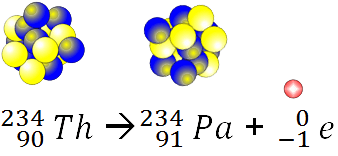
Which type of nuclear radiation is being emitted here?
a)
Alpha
b)
beta
c)
gamma 
d)
none
45.
This is an example of ---
a)
Radioactive Decay
b)
Nuclear Fission
c)
Nuclear Fusion
d)
Fossil fuel reaction
46.
Which type of nuclear radiation is being emitted here?
a)
alpha
b)
beta
c)
gamma
d)
none
47.
What particle completes this reaction?
a)
alpha particle
b)
beta particle
c)
gamma particle
d)
neutron
48.

Why does alpha decay occur?

a)

The nucleus is too large to be stable

b)

The proton to neutron ratio is unstable

c)

The nucleus is in an excited state. This usually follows other types of decay.

49.

Why does beta decay occur?

a)

The nucleus is too large to be stable

b)

The proton to neutron ratio is unstable

c)

The nucleus is in an excited state. This usually follows other types of decay.

50.

Why does gamma decay occur?

a)

The nucleus is too large to be stable

b)

The proton to neutron ratio is unstable

c)

The nucleus is in an excited state. This usually follows other types of decay.

51.

What type of protein is in milk?

a)

HBV

b)

LBV

c)

Saturated

d)

Unsaturated

52.

What type of fat is in milk? Type in your answer

(a)  

53.

What is the name of the milk sugar that some people are intolerant to (cannot digest)?

(a)  

54.

What mineral is milk high in?

a)

Iron

b)

Calcium

c)

Fluoride

d)

Fibre

55.

What vitamin does milk lack?

a)

Vitamin A

b)

Vitamin B

c)

Vitamin C

d)

Vitamin D

56.

Which type of milk should be served to young children?

a)

Whole milk

b)

Low fat milk

c)

Skimmed milk

d)

Flavoured milk

57.

How would you describe the price of milk in general?

a)

Cheap

b)

Very expensive

58.

What 2 types of carbohydrate is milk lacking?

a)

Sugar and Starch

b)

Starch and Sugar

c)

Sugar and Fibre

d)

Starch and Fibre

59.

Type 3 culinary uses of milk. Give a food example of each. Example: Soups e.g cream of mushroom

4 lines
60.

Fill in the blanks. Yoghurt is made when harmless ________ are added to pasteurised _____

(a)  

61.

Which of the following can be added to natural yoghurt to flavour it?

a)

Chicken

b)

Milk

c)

Cabbage

d)

Fruit

62.

Type a disadvantage of flavoured yoghurts (e.g Mooju milkshakes, chocolate, fruit or other flavours)

4 lines
63.

What is the brand name of a very popular low fat yoghurt that is high in artificial sugar?

(a)  

64.

Type 3 culinary uses of yoghurt in the diet.

4 lines
65.

Which of the following animals is cheese made from? (there is more than one correct answer!)

a)

Cow

b)

Buffalo

c)

Goat

d)

Mouse

66.

Fill in the blanks. The enzyme (a)   is found in animal stomachs and it is used in the formation of cheese.

67.

Which part of curdled milk is used to form cheese?

a)

Curds

b)

Whey

68.

the first stage of cheese production is the pasteurisation of milk. What temperature and time frame is used in pasteurisation?? :)

a)

100 degrees, 5 seconds

b)

78 degrees, 15 seconds

c)

72 degress, 25 seconds

d)

22 degrees, 100 seconds

69.

Pasteurisation kills Pathogenic bacteria. What does "Pathogenic" mean?

a)

Healthy

b)

Hard to kill

c)

Disease causing

d)

Disease curing

70.

Homogenisation distributes the _____ molecules in milk to improve the flavour of milk.

a)

protein

b)

fat

c)

sugar

d)

calcium

71.

Step 2 in cheese production is when a starter culture is added. What does lactose change/ break down into?

a)

Lactase

b)

Lactic acid

c)

Cellulose

d)

Protein

72.

When rennet is added to milk, what does the milk seperate into?

a)

Milk and Cheese

b)

Curds and Water

c)

Cheese and Whey

d)

Curds and Whey

73.

Select 2 reasons why salt is added to the cheese curds?

a)

Adds flavour

b)

Removes flavour

c)

Preserves the cheese

d)

Removes the cheesy smell

74.

Step 5 of the Cheese making process is pressing curds into moulds for 6 to 12 months. Why is this done?

a)

To develop mould

b)

To develop flavour

c)

To reduce bacteria

d)

To reduce the cheesy smell

75.

Which of the following cheese is classified as Hard cheese?

a)

Mozzarella

b)

Cheese strings

c)

Cheddar

d)

Stilton

76.

What type of soft cheese is used mainly on pizza?

a)

Cottage

b)

Brie

c)

Mozzarella

d)

Feta

77.

Which 2 of the following are types of Processed cheese?

a)

Cheese strings

b)

Stilton

c)

Cheese slices

d)

Moulded cheese

78.

What is this a picture of that has become very popular?

a)

A stack of cheese, duh.

b)

Cheese boardgame

c)

Cheese wedding cake

d)

Cake that looks like cheese

79.
Two or more substances that are mixed together but not chemically combined is a ___
a)
compound
b)
mixture
c)
keratin
d)
chromatography
80.
The physical separation of mixtures into individual components is..
a)
chromatography
b)
opacity 
c)
latent
d)
trace evidence 
81.
chromatography separates the mixture of dyes on the basis of their ----------------------------
a)
density
b)
solubility
c)
gravity
d)
boiling point
82.
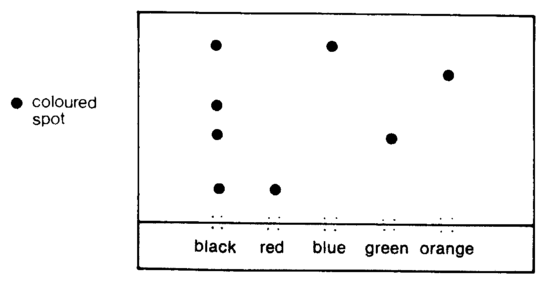
On the chromatogram given -------------- is mixture.
a)
red
b)
orange
c)
green
d)
black
83.
The leaf has a shiny, waxy cuticle around it to
a)
increase the rate of photosynthesis
b)
attract more light
c)
control water loss
d)
stop carbon dioxide and oxygen gases escaping
84.
Most of the chloroplast cells are found in the
a)
upper epidermis
b)
pallisade mesophyll layer
c)
lower epidermis
d)
stomata
85.
The water needed for photosynthesis comes into the leaves through the
a)
upper epidermis
b)
stomata
c)
guard cells
d)
xylem cells
86.
The important gases, carbon dioxide and oxygen, enter and leave the leaf through the
a)
upper epidermis
b)
phloem
c)
stomata
d)
guard cells
87.
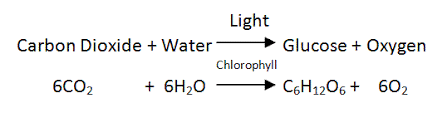
The reactants needed for photosynthesis to occur are:
a)
carbon dioxide & water
b)
carbon dioxide & oxygen
c)
oxygen & water
d)
carbon dioxide, oxygen & water
88.
The role of the guard cell is to
a)
help control the temperature of the plant
b)
control how much water enters the leaf
c)
control how much glucose is stored
d)
control the movement of water vapour & gases 
89.
Plants need to take in oxygen gas for respiration
a)
only at night 
b)
only during the day
c)
both during the day & the night
90.
Transpiration helps the plant
a)
make more sugars at night
b)
move water from the roots to the stem and leaves
c)
move sugars from the leaf to be stored in the stem & roots
d)
make more chloroplasts
91.
Water & soluble nutrients move through the plant in 
a)
the phloem cells
b)
the xylem cells
c)
the root hair cells
d)
palisade mesophyll layer
92.
Sugar and the products of photosynthesis move through the plant in 
a)
the phloem cells
b)
the xylem cells
c)
the root hair cells
d)
palisade mesophyll layer
93.

Photosynthesis occurs in:

a)

Mitochondria

b)

Chloroplasts

c)

Humans

d)

Animals

94.

What are the reactants in Photosynthesis?

a)

Sun, CO2, glucose

b)

glucose and oxygen

c)

sun, carbon dioxide, water

d)

water, glucose

95.

The process in which plant cells make energy

a)

Exothermic

b)

Endothermic

c)

Cellular Respiration

d)

Photosynthesis

96.

In cellular respiration, carbon starts out in the glucose molecule, but ends up in a(n)

a)

oxygen molecule

b)

water molecule

c)

CO2 molecule

d)

C6H12O2 molecule

97.

In photosynthesis, what kind of molecule does hydrogen start in?

a)

water

b)

oxygen

c)

glucose

d)

carbon dioxide

98.

In what process does ATP get created?

a)

photosynthesis

b)

cellular respiration

c)

radiation

d)

chemical

99.

How do humans get glucose so they can live?

a)

breathe it in

b)

photosynthesis

c)

eat food

d)

drink liquids

100.

Mitochondria and Chloroplasts are:

a)

organelles

b)

cells

c)

only in humans

d)

only in plants

101.

Cellular respiration happens

a)

only in plants

b)

only in animals

c)

only in humans and animals

d)

in plants and animals

102.

The products of cellular respiration are

a)

air and water

b)

carbon dioxide, water, and ATP

c)

glucose and carbon dioxide

d)

ATP, glucose, and oxygen

103.

For photosynthesis, a plant needs water, sun, and...

a)

oxygen

b)

carbon dioxide

c)

glucose

d)

mitochondria

104.

For humans to live, we need energy. What is the name of the energy that the body makes in cellular respiration?

a)

sugar

b)

glucose

c)

ATP

d)

fructose

105.

What is a product of photosynthesis AND a reactant for cellular respiration?

a)

oxygen

b)

water

c)

carbon dioxide

d)

Doctor Pepper

106.

The sun gives us what type of energy?

a)

chemical

b)

radiation

c)

potential

d)

kinetic

107.

Cellular respiration happens in the

a)

plants only

b)

animals only

c)

chloroplasts

d)

mitochondria