
 Worksheets
Nuclear Reactions Review
Total questions: 50
Worksheet time: 33mins
Which of the following is an alpha decay particle?
electron
helium nucleus
positron
gamma ray

What type of radioactive decay is this example?
alpha
beta minus
beta plus
gamma

What change happens in the nucleus for this radioactive decay example?
loses 2 protons + 2 neutrons
neutron becomes a proton
proton becomes a neutron
no change to nucleus
Which type of radioactive decay has the highest penetrating ability?
alpha
beta
gamma
it is the same for all of them

Using your periodic table, what is the element formed when Astatine undergoes alpha decay
Po-206
Rn-206
At-206
Bi-206

What two subatomic particles are found in an atom's nucleus?
Protons and neutrons
neutrons and electrons
electrons and protons

What does the graph show is needed to keep the nucleus stable?
As protons increases, more neutrons are needed.
As protons increases, less neutrons are needed.
As neutrons increase, less protons are needed.

What is likely to happen to unstable nuclei with too many, or too few, neutrons?
They will decay by emitting radiation.
They will loose all their electrons.
They will bond with other atoms.

What could an unstable nucleus emit?
Alpha, gamma, beta, and sometimes a neutron.
Alpha, beta, gamma, and sometimes delta
Alpha, beta, delta, and sometimes gamma

If the nucleus has too few neutrons, it will emit two protons and two neutrons called ___________.
an alpha particle
a beta particle
a neutron
gamma radiation
Alpha decay causes the mass number of the nucleus to decrease by ________ and the atomic number of the nucleus to decrease by _______.
four, two
two, four
one, two
two, three

Which symbol(s) represent an alpha particle?
yellow
blue
red
Which symbol(s) represent an beta particle?
yellow
blue
red
Which symbol(s) represent gamma radiation?
yellow
blue
red
If the nucleus has too many neutrons, a neutron will turn into a proton and emit a fast-moving electron. This process is known as ___________.
alpha radiation
beta radiation
gamma radiation
neutron radiation
Beta radiation is ____________________
an electron from an electron shell.
an electron from the nucleus.
two protons and two neutrons.
a high frequency electromagnetic wave.
What will happen if the nucleus has too many neutrons?
A neutron will turn into a proton and emit a fast-moving electron.
A proton will turn into a neutron and emit a fast-moving electron.
A neutron will break into two and emit a fast-moving alpha particle.

What observation suggests the atom is mostly empty space?
Most alpha particle travel straight through.
Some alpha particles are deflected at small angles.
Occasionally an alpha particle come straight back.
After emitting an alpha or beta particle, how may a nucleus lose excess energy?
Releasing a neutron
Releasing gamma radiation
Emitting Infra-red radiation

Which form of radioactive decay is the most ionising?
Alpha
Beta
Gamma
Occasionally a neutron can be emitted by radioactive decay. Which process will not result in neutron emission?
Absorbing cosmic rays in the atmosphere.
Firing alpha particles at Beryllium.
Nuclear fission reactions.
Nuclear fusion reactions.

What type of radiation is the most penetrating?
Alpha
Beta
Gamma
What subatomic particle determines the name of the element?
Electron
Proton
Neutron
Boson
What observation suggests the nucleus of the atom is positively charged?
Most alpha particle travel straight through.
Some alpha particles are deflected at small angles.
Occasionally an alpha particle come straight back.
What observation suggests the nucleus carries almost all of the atom's mass?
Most alpha particle travel straight through.
Some alpha particles are deflected at small angles.
Occasionally an alpha particle come straight back.
What is likely to happen to unstable nuclei with too many, or too few, neutrons?
They will decay by emitting radiation.
They will loose all their electrons.
They will bond with other atoms.
Alpha decay causes the mass number of the nucleus to decrease by ________ and the atomic number of the nucleus to decrease by _______.
four, two
two, four
one, two
two, three
Which symbol(s) represent an alpha particle?
yellow
blue
red
Which symbol(s) represent an beta particle?
yellow
blue
red
Which symbol(s) represent gamma radiation?
yellow
blue
red
If the nucleus has too many neutrons, a neutron will turn into a proton and emit a fast-moving electron. This process is known as ___________.
alpha radiation
beta radiation
gamma radiation
neutron radiation
What type of radiation is the most penetrating?
Alpha
Beta
Gamma
What subatomic particle determines the name of the element?
Electron
Proton
Neutron
Boson
During this type of radioactive decay, two protons and two neutrons are ejected, lowering the atomic number of the atom by two.
alpha decay
beta decay
gamma decay
Plutonium (atomic number 94) becomes Uranium (atomic number 92). What type of radioactive decay takes place?
alpha decay
beta decay
gamma decay
Because of its ability to penetrate materials, which of the following is the most dangerous radiation?
gamma
alpha
beta
medical X-rays
22087Fr —› ____ + 42He
22089Ac
22490Th
21685At
21688Ra
22286Rn —› ____ + 42He
22589Ac
21187Fr
21885At
21884Po
13755Cs —› ____ + 0-1e
17872Hf
13753I
14154Xe
13756Ba
3215P—› ____ + 0-1e
3216S
3214Si
1632S
3417Cl


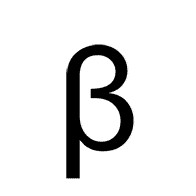
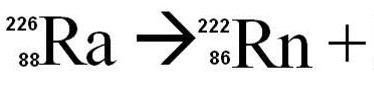
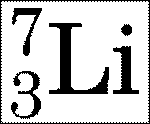

This type of decay can be stopped with concrete and lead
Alpha
Beta
Gamma

This type of decay can be stopped with paper or human body
Alpha
Beta
Gamma

94Be + 11H → _____ + 42He

This is the correct equation for U-238 decay.
true
false

