wayground logo

Free Printable Worksheets

NEW

Font size

S
M
L
XL
Worksheets

Specific Heat and Heating Curve Quiz

Total questions: 45

Worksheet time: 57mins

Name
Class
Date
1.
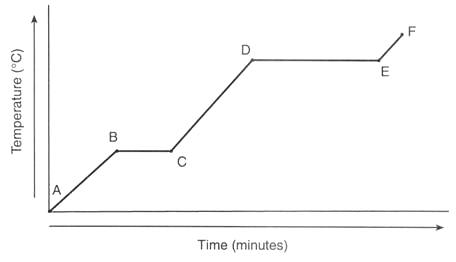
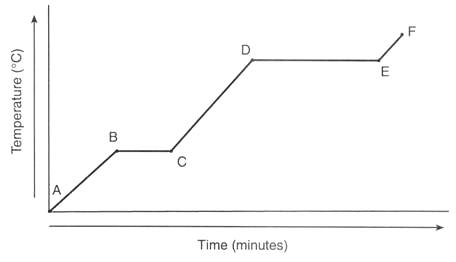
What line segment represents only the solid state?
a)
A-B
b)
B-C
c)
C-D
d)
D-E
2.
Which segment represents the heat of fusion?
a)
A-B
b)
B-C
c)
C-D
d)
D-E
3.
What state(s) of matter are present at D-E?
a)
Solid-liquid
b)
Liquid
c)
Liquid-gas
d)
Gas-Solid
4.
Between which points is the temperature of the substance remaining constant?
a)
A-B only. 
b)
A-B, C-D, E-F
c)
B-C only. 
d)
B-C, D-E
5.
Between which points is the temperature of the substance increasing?
a)
A-B only. 
b)
A-B, C-D, E-F
c)
B-C only. 
d)
B-C, D-E
6.
Between which points is the substance changing state?
a)
A-B only. 
b)
A-B, C-D, E-F
c)
B-C only. 
d)
B-C, D-E
7.
What would be the effect on the particles if more heat is supplied to the system?
a)
They would slow down
b)
They would stop moving
c)
They would speed up
d)
There would be no effect
8.
The energy in endothermic reactions is
a)
released
b)
absorbed
9.
Heat flows from _______ to ______ objects
a)
cooler to warmer
b)
warmer to warmer
c)
warmer to cooler
d)
cooler to cooler
10.
Heat is measured in 
a)
joules
b)
grams
c)
°Celcius
d)
J/g⋅°C
11.
In the specific heat formula "q" stands for which variable?
a)
energy
b)
mass
c)
specific heat
d)
change in temperature
12.

In the specific heat formula "C" stands for which variable

a)

energy

b)

mass

c)

specific heat

d)

change in temperature

13.
The energy in exothermic reactions is
a)
released
b)
absorbed
14.
The unit for specific heat is:
a)
g/J⋅°C
b)
Celsius
c)
Joule
d)
J/g⋅°C
15.
Energy can not be created or destroyed, it can only be transferred refers to the....
a)
Gibb's Law of Energy
b)
Law of Conservation of Mass
c)
Law of Entropy
d)
Law of Conservation of Energy
16.
__ is the measure of the average kinetic energy of the particles in a sample of matter
a)
Energy
b)
Temperature
c)
Entropy
d)
Gibb's Energy
17.
A sample of iron receives 55.0 J of heat energy that raises the temperature of the iron 25.0°C. If iron has a specific heat of .10 J/g°C, what is the mass of the iron sample?
a)
138.7 g
b)
140 g
c)
22 g
d)
4.5 g
18.

If 238 J of heat is absorbed by a sample of metal with a mass of 40.7 g, and it raises the temperature from 20.0°C to 32.4°C, what is the specific heat capacity of the metal?

a)

120,000 J/g°C

b)

0.472 J/g°C

c)

72.5 J/g°C

d)

781 J/g°C

19.
A 500.0 g piece of Aluminum is put in water. It's temperature goes from 30.0°C to 23.0°C. How much energy was released?  The Specific heat of Aluminum is 0.900 J/g°C.
a)
79.4 J
b)
1350 J
c)
3150 J
d)
-3150 J
20.

What are two units for Heat?

a)

calories and joules

b)

J/g⋅°C and J/g⋅K

c)

joules and Celsius

d)

Celsius and Kelvin

21.
Is Freezing endothermic or exothermic?
a)
endothermic
b)
exothermic
22.
A device used to measure the heat absorbed or released during a chemical or physical process is called a
a)
Thermometer
b)
Calorimeter
c)
Barometer
d)
Entrometer
23.

What type of heat transfer is a beaker on a hot plate an example of?

a)

Conduction

b)

Covection

c)

Radiation

d)

Chemical

24.
How much heat does an aluminum block absorb if 10.00 grams ae heated from 25.0oC to 50.0oC? the specific heat of aluminum is .900J/goC
a)
450
b)
-450
c)
225
d)
-225
25.
Durning a phase change the temperature of a substance_________.
a)
always increases
b)
always decreases
c)
always stays the same
d)
varies
26.
A 24.0 gram sample of copper was heated from 25.0oC to 500.0oC, 4378J of heat were absorbed, what is the specific heat of copper?
a)
.384
b)
49909200
c)
2.60
d)
8.77
27.
When you dropped a hot metal sample into room temperature water in the lab what happened?
a)
the heat from the metal traveled into the water
b)
the cool from the water traveled into the hot metal
c)
both of the other answers are correct
28.
A sample of iron receives 50.J of heat energy that raises the temperature of the iron 25.0°C. If iron has a specific heat of .10 J/g°C, what is the mass of the iron sample?
a)
25g
b)
30g
c)
20g
d)
50g
29.
What letter represents boiling?
a)
B
b)
C
c)
D
d)
E
30.
What letter represents a liquid being heated?
a)
A
b)
B
c)
C
d)
D
31.

How much energy does it take to freeze 39.2 g of liquid benzene (C6H6)? (ΔHfus = 9.08 kJ/mol, ΔHvap = 28.4 kJ/mol)

a)

4.940 kJ

b)

-4.940 kJ

c)

258 kJ

d)

-258 kJ

32.

Heat of Fusion can be applied to what phase change?

a)

condensation

b)

vaporization

c)

sublimation

d)

melting

33.

A release of energy occurs during which change of phase?

a)

solid to liquid

b)

liquid to gas

c)

gas to liquid

d)

solid to gas

34.

delta T is calculated by

a)

Ti - Tf

b)

Tf - Ti

35.

Which of the following is NOT a unit of heat?

a)

joules

b)

calories

c)

degrees Celsius

d)

All are units of heat.

36.

The symbol for specific heat is .......

a)

C

b)

q

c)

m

d)

T

37.

Which picture shows the correct flow of energy?

a)
b)
c)
d)

They are all Correct

38.

On this heating curve of water, point B is known as:

a)

zero point

b)

melting point

c)

boiling point

d)

point of no return

39.

On this heating curve of water, point D is known as:

a)

boiling point

b)

freezing point

c)

melting point

d)

solid/liquid transition

40.

What state(s) of matter exist between points D and E?

a)

gas and plasma

b)

only liquid

c)

liquid and solid

d)

liquid and gas

41.

What state(s) of matter exist between C and D?

a)

liquid and gas

b)

solid and liquid

c)

only liquid

d)

solid and gas (sublimation)

42.
What is the freezing point for this substance?
a)
60 °C
b)
40 °C
c)
80 °C
d)
100 °C
43.
.
.
.
.
.
.
What letter represents a gas being cooled?
a)
B
b)
C
c)
D
d)
E
44.
Phase change from gas to liquid 
a)
sublimation
b)
condensation
c)
vaporization
d)
freezing
45.

Which of the following is NOT a unit of heat?

a)

joules

b)

calories

c)

degrees Celsius

d)

All are units of heat.