wayground logo

Free Printable Worksheets

Font size

S
M
L
XL
Worksheets

Biology EOC Review - Cell Energy

Total questions: 55

Worksheet time: 37mins
Name
Class
Date
1.
Which organelle performs PHOTOSYNTHESIS?
a)
Chloroplast
b)
Mitochondria
2.
Which of the following is the correct equation for PHOTOSYNTHESIS?
a)
CO+ light + H2O --> O+ Sugar
b)
CO+ sugar + H2O --> O+ light
c)
O2 + light + H2O --> CO+ Sugar
d)
CO+ O2 + H2O --> Light+ Sugar
3.
What process occurs when light energy is captured in autotrophs and converted into sugar?
a)
Photosynthesis
b)
Cellular Respiration
4.
What is the ultimate ORIGINAL source of energy for living things
a)
Sugar
b)
Sun
c)
Moon
d)
Carbon Dioxide
5.
Which organisms perform Photosynthesis?
a)
Only Autotrophs
b)
Only Heterotrophs
c)
Autotrophs and Heterotrophs
6.
Which of the following is an example of an AUTOTROPH?
a)
Appletree
b)
Dog
c)
Mushroom
d)
Human
7.
Which of the following is an example of a HETEROTROPH?
a)
Grass
b)
Algae
c)
Lemon Tree
d)
Bear
8.
What is the pigment in chloroplasts that performs photosynthesis?
a)
Chlorosynthesis
b)
Chlorophyll
c)
ADP
d)
Electron Transport
9.
Which gas is removed from the atmosphere during photosynthesis?
a)
hydrogen
b)
oxygen
c)
nitrogen
d)
carbon dioxide
10.
What are the products of photosynthesis?
a)
water and carbon dioxide
b)
oxygen and glucose
c)
oxygen and carbon dioxide
d)
oxygen and water
11.
Plants need ________ for photosynthesis
a)
oxygen
b)
soil
c)
carbon dioxide
d)
sugar
12.
What is photosynthesis?
a)
The process in which humans eat their food
b)
When a photographer takes a photo.
c)
To get your pictures from the photo lab.
d)
The process in which plants make their food.
13.
Chloroplasts are...
a)
Structures of animal cells to produce ATP
b)
Organelles where lipids are elaborated
c)
Specialized structures of plants where food is made
d)
Waste organelle of plants
14.
What is the pigment in chloroplasts that performs photosynthesis?
a)
Chlorosynthesis
b)
Chlorophyll
c)
ADP
d)
Electron Transport
15.
Leaves look green because.....
a)
they eat their vegetables
b)
to blend into their environment
c)
they contain a molecule named chlorophyll
d)
they are sick
16.
Which organelle from the plant cell is primarily responsible for converting sunlight to energy?
a)
Mitochonria
b)
Nucleus
c)
Vacuole
d)
Chloroplast
17.
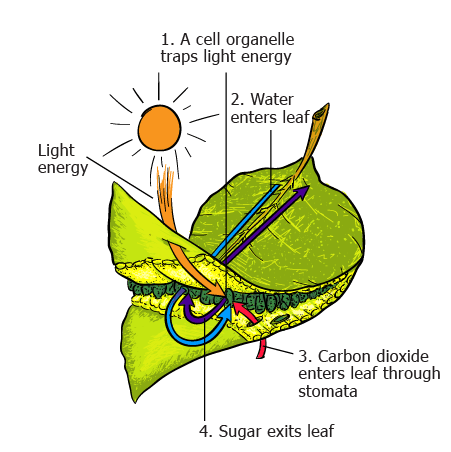
What process is the diagram representing?
a)
Photosynthesis
b)
Soil development
c)
Plant reproduction
d)
Nitrogen Cycle
Nitrogen cycle
18.
What is produced as a result of photosynthesis?
a)
Glucose and Chlorophyll
b)
Glucose and Oxygen
c)
Water and Light energy
d)
Carbon dioxide and Water
19.
If all four plants were watered daily but placed in a closet, receiving no sunlight, what process would NOT occur?
a)
Ingestion of carbon dioxide
b)
Filtration of water through the soil
c)
Photosynthesis
d)
Water absorbtion
20.
Look at the image
What substances and organelle work together to absorb sunlight to perform photosynthesis in this example?
a)
cell wall and chloroplast
b)
mitochondria and water
c)
vacuole and carbon dioxide
d)
chloroplast and chlorophyll
21.
What is the function of ATP in living things?
a)
provides energy for cells
b)
stores genetic information
c)
provides structure in the nucleus
22.
Which structures shown in the Figure make up the ADP molecule?
a)
A and B
b)
A, B and C
c)
A, B, C, and D
d)
C and D
23.
Which of the following can be compared to a battery in need of recharging?  (empty wallet)
a)
ADP
b)
ATP
c)
Ribose
d)
Adenosine
24.
Which bond of the ATP molecule is broken in order to release energy?
a)
A
b)
B
c)
C
d)
D
25.
Which structures shown in the Figure make up the ATP molecule?
a)
A and B
b)
A, B and C
c)
A, B, C, and D
d)
C and D
26.
Where is the energy stored in ATP molecules
a)
In the Ribose Sugar
b)
In the Adenine group
c)
In the Phosphate bonds
d)
In the Bank
27.
What type of macromolecule is ATP/ADP?
a)
Carbohydrate
b)
Nucleic Acid
c)
Lipid
d)
Protein
28.

Which of the following is the first reaction in aerobic respiration?

a)

Glycolysis

b)

Krebs Cycle

c)

Electron Transport Chain

d)

Calvin Cycle

29.

Which of the following is a reactant for aerobic respiration?

a)

ATP

b)

Carbon Dioxide

c)

Glucose

d)

Water

30.

How is chemical energy released in a cell?

a)

Forming bonds

b)

Breaking bonds

c)

Forming atoms

d)

Breaking down atoms

31.

What molecule do animal and plant cells use to power processes in the cell?

a)

ATP

b)

Glucose

c)

NADH

d)

Oxygen Gas

32.

Which molecule contains the stored chemical energy that is released in aerobic respiration?

a)

ATP

b)

Carbon Dioxide

c)

Glucose

d)

Oxygen Gas

33.

Where does glycolysis happen?

a)

Cell Membrane

b)

Chloroplast

c)

Cytoplasm

d)

Mitochondria

34.

Where does the electron transport chain take place?

a)

Cell membrane

b)

Chloroplast

c)

Cytoplasm

d)

Mitocchondria

35.

Which part of aerobic respiration makes the most ATP?

a)

Calvin Cyle

b)

Electron Transport Chain

c)

Glycolysis

d)

Krebs Cycle

36.

Which of the following is made during the Krebs Cycle?

a)

Carbon Dioxide

b)

Glucose

c)

Oxygen Gas

d)

Water

37.

Cell respiration is aerobic because...

a)

It is used to gives cell the energy needed to work.

b)

It produces oxygen gas in the electron transport chain

c)

It uses oxygen gas in the electron transport chain.

d)

It produces water at the end of the electron transport chain.

38.

What are the reactants for cell respiration?

a)

Carbon dioxide and water

b)

carbon dioxide and glucose

c)

glucose and water

d)

glucose and oxygen gas

39.

What is pumped into the inner membrane space during the electron transport chain?

a)

Carbon dioxide

b)

Electrons

c)

Hydrogen ions

d)

Oxygen gas

40.

Why is oxygen gas important in aerobic respiration?

a)

It provides energy to the cell.

b)

It creates an environment that is favorable doing glycolysis.

c)

It donates electrons to the electron transport chain.

d)

It absorbs electrons at the end of the electron transport chain.

41.

Why do plants do aerobic respiration even though they also do photosynthesis?

a)

To prevent heterotrophs from using the glucose that plant cells made in photosynthesis.

b)

To breathe in oxygen gas to keep their cells alive.

c)

To use the stored chemical energy made during photosynthesis.

d)

To balance photosynthesis and prevent too much sugar from building up in the cell.

42.

Which organisms do aerobic respiration?

a)

Autotrophs

b)

Heterotrophs

c)

All of the above

43.

What is made at the end of glycolysis?

a)

Carbon dioxide

b)

FADH2

c)

Pyruvate

d)

Water

44.

Why is NADH important?

a)

It absrobs damaging electrons moving around the cell.

b)

It transfer electrons and hydrogen to electron transport chain.

c)

It is made during the Krebs Cycle.

d)

It can be recycled and used again.

45.

What product of the Krebs Cycle gets used in the Electron Transport Chain

a)

ATP

b)

Carbon Dioixde

c)

NADH

d)

Water

46.
Fermentation involves
a)
aerobic respiration
b)
anaerobic respiration 
47.
Why is yeast used to bake bread? 
a)
The waste gas, CO2, makes bread rise
b)
The alcohol produced makes bread dangerous
c)
The yeast consumes O2, causing bread to rise
48.
What cells in the body may undergo lactic acid fermentation during exercise? 
a)
Muscle cells
b)
Fat cells
c)
Liver cells
d)
Skin cells
49.
Fermentation is cellular respiration without which molecule?
a)
CO2
b)
O2
c)
C6H12O6
50.
How are lactic acid and alcoholic fermentation similar?
a)
They have the same products
b)
They have the same reactants
c)
They both require oxygen
d)
They occur in the same organisms
51.
When respiration occurs with oxygen, it is called _______
a)
anaerobic
b)
aerobic
c)
light-dependent
d)
fermentation
52.

What are the waste products from fermentation? (Choose all that apply)

a)

starch

b)

carbon dioxide

c)

glucose

d)

alcohol

53.
What is a disadvantage of fermentation as a process? 
a)
It produces too much ATP
b)
It only produces 2 ATP
c)
It occurs in the absence of oxygen
d)
It is only for quick bursts of energy
54.
Lactic acid fermentation occurs in your muscles after a workout because your cells are struggling to get
a)
Glucose
b)
Sunlight
c)
Oxygen
d)
Water
55.

What process must occur BEFORE fermentation?

a)

Glycolysis

b)

Photosynthesis

c)

the electron transport chain

d)

the calvin cycle