
 Worksheets
Acids and Bases
Total questions: 50
Worksheet time: 38mins
Which of the following values would represent the pH of a strong base?
1
8
7
13
What range of values on the pH scale represent solutions with a higher ratio of hydronium (H3O+) ions?
0-14
below 7
7
above 7
Common salt is
Acidic
Neutral
Basic
all of them
Neutralization is a reaction between
Strong acid and a weak acid
Strong base and a weak acid
Strong acid and a strong base
Strong acid and a weak base
Name the acid present in our stomach.
Sulphuric acid
Hydrochloric acid
Nitric acid
Carbonic acid
What is NOT a characteristic of a strong acid?
High concentration of H+
High concentration of OH-
completely dissociates in an aqueous solution
large distance between atoms
Which of the following is a strong acid?
Ethanoic acid
Nitric acid
Carbonic acid
Citric acid
Which of the following is the correct balanced equation showing the dissociation of sulfuric acid into ions?
H2SO4 (aq) → H+ (aq) + SO4–(aq)
H2SO4 (aq) ⇌ 2H+ (aq) + SO42- (aq)
HSO4 (aq) → H+(aq) + SO4–(aq)
H2SO4 (aq) → 2H+ (aq) + SO42- (aq)
Which of the following statements is true?
If the H+ ion concentration in a solution increases by a factor of 10, the pH of the solution increases by 1
If the H+ ion concentration in a solution increases by a factor of 10, the pH of the solution decreases by 1
What ions do Metals form when they react?
Negative
Positive
HCl, HBr, HI
--sulfuric acid--
--nitric acid--
--hydrochloric acid--
--hydrobromic acid--
--hydroiodic acid--
Which of the following is a weak acid
HClO3
H2S
HNO3
HBr
Which of the following is NOT a strong base
Be(OH)2
CsOH
KOH
NaOH
acid + base -->
salt + water
salt + oxygen
salt + carbon dioxide
Complete the following reaction:
HCl + MgOH -->
MgCl +H2O
Mg+ + H2O
MgCl+H+
MgCl+OH−+CO2
Complete the following reaction:
Sulfuric acid + magnesium oxide -->
Magnesium sulfate + water
Magnesium + water
Magnesium sulfate + hydrogen
Which is a characteristic of a base?
tastes sour
found mostly in foods
feels slippery
turn litmus paper red
pH is the measure of the concentration of ______.
Acids
H+ ion
OH- ion
Bases
According to Arrhenius, what is the definition of an ACID?
a substance that contains hydroxide and ionizes to produce OH-
a substance that contains hydrogen and ionizes to produce H+
a substance that contains hydrogen and ionizes to produce OH-
a substance that contains hydroxide and ionizes to produce H+
According to Bronsted-Lowry, what is the definition of an BASE?
a substance that donates a hydrogen (H+) ion
a substance that donates a hydroxide (OH-) ion
a substance that accepts a hydrogen (H+) ion
a substance that accepts a hydroxide (OH-) ion
What is being donated/accepted between conjugate acid-base pairs?
a hydrogen (H+) ion
a hydroxide (OH-) ion
water
a neutron

What is the conjugate base in the following reaction?
HCO3-
HCl
H2CO3
Cl-

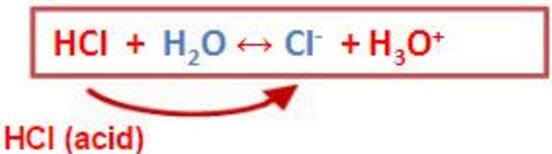
Which of the following are properties of acids but not bases? Select all that apply.
Changes the color of an indicator
Sour taste
Reacts with metals to produce hydrogen gas
Feels slippery
Neutralization is the process of an acid and a base reacting to form what? Select all that apply
An ionic salt
Hydronium ions
NaCl
Water
An arrhenius acid
produces hydroxide ions in a solution
is a proton donor
produces hydrogen ions in a solution
is a proton acceptor
An arrhenius base
produces hydroxide ions in a solution
is a proton donor
produces hydrogen ions in a solution
is a proton acceptor
A bronsted lowry acid
produces hydroxide ions in a solution
is a proton donor
produces hydrogen ions in a solution
is a proton acceptor
Water can act as both an acid and a base according to the bronsted lowry model. This means water is
neutral
conjugate
ionic
amphoteric
Identify the true statement about the following reaction:
F- + H2O --> HF +OH-
H2O is a bronsted lowry base
H2O is not an acid or base according to either model
H2O is a bronsted lowry acid
H2O is an arrhenius acid
Acid-base conjugate pairs differ by a single
Electron
Proton
Neutron
Oxygen
Which of the following show an acid and its conjugate base pair (in that order)
H2SO4, SO42-
OH-, H2O
NH4+, H2O
H2CO3, HCO3-
What is the conjugate acid of water?
OH−
H3O+
H2O2
HOH
A strong base in a water solution
is a weak electrolyte
produces many H+ ions
will not dissolve
completely dissociates into ions.
What is the pH of a solution with a hydrogen ion concentration of 1.0 x 10⁻⁸ M?
(HINT...pH = -log [H+] )
-8
6
8
14
What is the pH of a 0.0001 M HCl solution
1
4
7
11
What is the pOH of a 1 x 10⁻⁸ M solution of HNO3?
8
6
7
7.5
For a solution, pH + pOH =
7
14
1.0 x 10⁻¹⁴
-log (1.0 x 10 -14)
What is the pH of a solution that has a [H+] of 2.5 x 10⁻⁵?
4.60
2.5
5.0
7
Acids have a ______ pH and a _________ pOH
low, high
high, low
An acid will not have a pOH
Find the pH of a solution with [OH-] = 8.41 x 10⁻⁴.
3.08
10.92
9.88
11.23
_Zn+_HCl-->_ZnCl2 +_H2
A solution has a [OH-] of 7.23 ×10⁷ . This solution has a pOH of
1.7 ×10⁷
5.89 ×10⁻⁸
11.9
2.14
Calculate the [H+] for the following [OH−] .
[OH−] = 6.83 x 10⁻¹¹
[H+] = 3.8
[H+] = 1.48 x 10⁻⁴
[H+] = 1.02 x 10⁻¹
[H+] = 1.5 x 10⁵
Calculate the pOH for the following concentration.
[H+] = 4.72 x 10⁻³
pOH = 1.0 ×10⁻¹²
pOH = 2.33
pOH = 2.12 × 10⁻¹²
pOH = 11.7

