wayground logo

Free Printable Worksheets

Font size

S
M
L
XL
Worksheets

Final Exam Preparation #2- Coordinate Algebra Cumulative Review

Total questions: 148

Worksheet time: 4hrs 5mins
Name
Class
Date
1.
-science of collecting and analyzing data
a)
statistics
b)
statistical question
c)
biology
d)
forenzics
2.
-information being collected
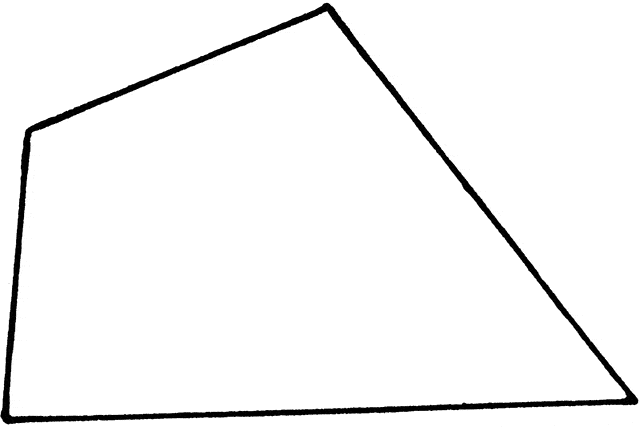
a)
data
b)
variability
c)
tally
d)
graph
3.
-type of question that expects a variety of answers
a)
statistical question
b)
scientific question
c)
rhetorical question
d)
hypothetical question
4.
occurs when observations in a data set are NOT all the same
a)
variability
b)
statistically
c)
historically
d)
reliability
5.
-describes how spread out the data is
a)
variability
b)
interval
c)
frequency
d)
mean
6.
-sum divided by number of addends
a)
mean
b)
median
c)
mode
d)
range
7.
-most frequently occurring number in a data set
a)
mean
b)
median
c)
mode
d)
range
8.
-center number of a data set
a)
mean
b)
median
c)
mode
d)
range
9.
-NOT a middle measure
a)
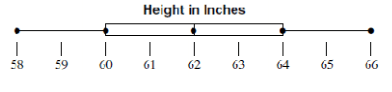
mean
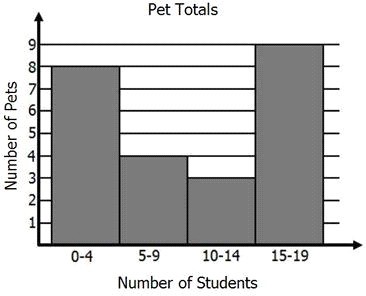
b)
median
c)
mode
d)
range
10.
-difference between the largest and smallest value of a data set
a)
mean
b)
median
c)
mode
d)
range
11.
-graph organized according to place value
a)
stem and leaf plot
b)
dot plot
c)
histogram
d)
box plot
12.
-plot of numerical data along a number line
a)
stem and leaf plot
b)
dot plot
c)
histogram
d)
box plot
13.
-bar graph of data intervals
a)
stem and leaf plot
b)
dot plot
c)
histogram
d)
box plot
14.
-graph that summarizes data into 5 measures
a)
stem and leaf plot
b)
dot plot
c)
histogram
d)
box plot
15.
-range of numbers
a)
interval
b)
average
c)
frequency
d)
mean
16.
-graph used to convey information about center and variability
a)
stem and leaf plot
b)
dot plot
c)
histogram
d)
box plot
17.
-graph that uses dots to show frequency
a)
stem and leaf plot
b)
dot plot
c)
histogram
d)
box plot
18.
measure of variability when data is skewed
a)
interquartile range
b)
mean absolute deviation
c)
deviation from the mean
d)
upper quartile
19.
-describes middle 50% of data
a)
lower quartile range
b)
mean absolute deviation
c)
interquartile range
d)
deviation from the mean
20.
-measure of variability when data is symmetric
a)
deviation from the mean
b)
median
c)
interquartile range
d)
mean absolute deviation
21.
A rectangle is a paralellogram.
a)
True
b)
False
22.
This figure has 4 right angles and 4 congruent sides. Which term BEST names the figure?
a)
square
b)
rectangle
c)
kite
d)
trapezoid
23.
This figure has 2 pairs of parallel sides and 2 pairs of congruent sides.
a)
Paralellogram
b)
kite
c)
trapezoid
d)
triangle
24.
All of the following figures must have 4 right angles except...
a)
trapezoid
b)
square
c)
rectangle
25.
All of the following figures must have 4 congruent sides except...
a)
rectangle
b)
rhombus
c)
square
26.
Name that shape.
a)
trapezoid
b)
quadrilateral
c)
parallelogram
d)
rhombus
27.
A _______________ is a quadrilateral with two sets of parallel sides.
a)
trapezoid
b)
parallelogram
c)
kite
d)
triangle
28.
What do all of the angles of a quadrilateral have to add up to?
a)
90 degrees
b)
180 degrees
c)
270 degrees
d)
360 degrees
29.
Which quadrilateral has no parallel sides and adjacent sides that are congruent?
a)
Square 
b)
Trapezoid
c)
Kite
d)
Parallelogram
30.
Which of the following properties is true about parallelograms?
a)
Base angles are congruent.
b)
Diagonals are congruent.
c)
Opposite sides are parallel.
31.
Which property is shown below?
__________________________
7n = 21 then n = 3
a)
Division Property
b)
Sorcery
c)
Reduction of Multiples
d)
Distributive Property
32.
If 2x - 5 = 10, then 2x = 15.
a)
Subtraction Property of Equality
b)
Addition Property of Equality
c)
Division Property of Equality
d)
Substitution
33.
If 3x = 15, then x = 5
a)
Subtraction Property of Equality
b)
Addition Property of Equality
c)
Division Property of Equality
d)
Multiplication Property of Equality
34.
x = x
a)
Transitive Property of Equality
b)
Symmetric Property of Equality
c)
Reflexive Property of Equality
d)
Division Property of Equality
35.
If y/4 = 5, then y = 20
a)
Multiplication Property of Equality
b)
Division Property of Equality
c)
Addition Property of Equality
d)
Subtraction Property of Equality
36.
If AB = CD and CD = EF, then AB = EF
a)
Symmetric Property of Equality
b)
Reflexive Property of Equality
c)
Transitive Property of Equality
d)
CLT or Simplify
37.
Name the property described:
If PQ = RS then RS = PQ
a)
Reflexive
b)
Symmetric
c)
Transitive
d)
Addition
38.
For any numbers a, b, and c, if a = b and b = c, then a = c.
a)
Transitive Property         
b)
Symmetric Property
c)
Reflexive Property
d)
Substitution Property
39.
Which property is shown below?
__________________________
4(x+6) = 4x + 4(6)
a)
Reflexive
b)
Distributive
c)
Transitive
d)
Substitution
40.
If a = b, then a may be replaced by b in any expression.
a)
Transitive Property         
b)
Reflexive Property             
c)
Symmetric Property 
d)
Substitution Property
41.

What property of equality is shown below?

25 + d = 36

25 + d - 25 = 36 - 25

a)

addition property of equality

b)

subtraction property of equality

c)

division property of equality

d)

multiplication property of equality

42.

What property of equality is shown below?

y - 12 = 30

y -12 + 12 = 30 +12

a)

addition property of equality

b)

subtraction property of equality

c)

multiplication property of equality

d)

division property of equality

43.
(7 + 3) + 4 = 7 + ( 3 + 4)
a)
Distributive Property
b)
Commutative Property of Addition
c)
Associative Property of Multiplication
d)
Associative Property of Addition
44.
x 2 = 2 x 9
a)
Commutative Property of Multiplication
b)
Associative Property of Multiplication
c)
Multiplicative Inverse Property
d)
Distributive Property
45.
x 12 =12
a)
Identity Property of Multiplication
b)
Commutative Property of Multiplication
c)
Multiplication Property of One
d)
Distributive Property
46.
5 + (-5) = 0
a)
Zero Property
b)
Inverse Property of Addition
c)
Identity Property of Addition
d)
Distributive Property
47.
(6 x 2) x 3=6 x (2 x 3)
a)
Commutative Property of Multiplication
b)
Associative Property of Multiplication
c)
Multiplicative Inverse Property
d)
Multiplicative Identity Property
48.
Simplify 14(b – 10).
a)
4b
b)
b – 140
c)
14b – 140
d)
14b – 10
49.
What is the Distributive property of equality
a)
a.  If a=b, then  a can be substituted for b in any equation or expression
b)
b.  a(b+c)=ab+ac
c)
c  For any real number a, a=a .
d)
d.  If a=b, then b=a
50.
Identify the property shown.
a)
Commutative Property of Addition
b)
Associative Property of Addition
c)
Distributive Property
d)
Addition Property of 0
51.

Which property is NOT used to solve for x?


4 (x/2 + 1) = 2

a)

Distributive Property

b)

Subtraction Property of Equality

c)

Multiplication Property of Equality

d)

Division Property of Equality

52.

Which property is NOT used to solve for x?


2x/5 -7 = 3

a)

Addition Property of Equality

b)

Multiplication Property of Equality

c)

Division Property of Equality

d)

Subtraction Property of Equality

53.
Rewrite (9 + 6) + 5 using the associative property.
a)
20
b)
(9 + 6) + 5 = (9 + 5) + 6
c)
(9 + 6) + 5  = 9 + (6+5)
d)
(9 + 6) + 5  = 5 + 9 + 5 + 6
54.
Determine which choice best shows the commutative property of multiplication.
a)
1x1=1
b)
(1x7)+(1x6)=
c)
1x7=7x1
d)
(1x7)x6=1x(7x6)
55.
Simplify the expression:
8(5 + w)
a)
40 + w
b)
40+8w
c)
85 + 8w
d)
13+8w
56.

Complete the equation using the distributive property.

12x + 10 =

a)

10 + 12x

b)

12 + 10x

c)

12(x+10)

d)

2(x + 5)

57.
Identity Property of Multiplication
a)
5 x 0 = 0
b)
8 x 3 = 3 x 8
c)
12 x 1 = 12
d)
8 + 0 = 8
58.
Which is an example of the identity property of addition?
a)
5 + 1 = 6
b)
5 - 0 = 5
c)
5 + 0 = 5
d)
5 + 2 = 5
59.
Which property says -7(x - 4) = -7x + 28?
a)
Addition Property
b)
Multiplication Property
c)
Division Property
d)
Distributive Property
60.

What is our school's mascot?

a)

Panther

b)

Lion

c)

Mustang

d)

Eagle

61.

Translate the blue shape to the pink shape...

a)

5 Right

2 Down

b)

5 Left

2 Up

c)

3 Right

1 Down

d)

3 Left

1 Up

62.

A rectangle is translated 6 units to the right and 4 units down on the coordinate plane. Which rule best describes this transformation?

a)

(x - 6 , y + 4)

b)

(x + 6 , y + 4)

c)

( x - 6 , y - 4)

d)

( x + 6 , y - 4)

63.

A TRANSLATION of a figure can be considered

a)

A turning of the figure about some fixed point

b)

A slide of the figure

c)

An enlargement or a reduction of the figure

d)

A mirror image of the figure

64.

What is the image of the point (2, 2) under the translation that shifts (x, y) to (x-2, y+4)

a)

(4 , 6)

b)

(0 , 6)

c)

(-4 , 3)

d)

(1 , -5)

65.

In a transformation, the final figure is called the

a)

Pre-Image

b)

Image

c)

Reflection

d)

Translation

66.

Find the image of the point (3, 2) that has undergone a reflection across the y - axis.

a)

( 3, 2)

b)

( 3, -2)

c)

(-3, -2)

d)

(-3 , 2)

67.

Find the image of the point (3, 2) that has undergone a reflection across the x - axis

a)

(-3 , -2)

b)

(3 , -2)

c)

(-2 , 3)

d)

(2 , -3)

68.

Thomas describes a reflection as point J moving from J(−2,6)

to J′(−2,−6). What Quadrant did he reflect to?

a)

Quadrant I

b)

Quadrant II

c)

Quadrant III

d)

Quadrant IV

69.

An example of a transformation that flips each point of a shape over the same line.

a)

Translation

b)

Rotation

c)

Reflection

d)

Transformation

70.

Given P(2, -4) I(1, -8) G(-3,5) when reflected across the x-axis, What are the new coordinates?

a)

P(-2,4) I(-1 , 8) G(3, -5)

b)

P(2 , 4) I( 1, 8) G(-3 , -5)

c)

P(-2, -4) I(-1, -8) G(-3, -5)

d)

P(2,4) I(-1,8) (-3, 5)

71.
Identify the rule after a 90° counter clockwise rotation:
(x, y) ---> ___________
a)
( y, -x)
b)
( -y, x)
c)
( -x, -y)
d)
( y, -x)
72.
Identify the rule after a 90° CLOCKWISE rotation:
(x, y) ---> ___________
a)
( x, -y)
b)
( y , -x)
c)
( -y, x)
d)
( -x, -y)
73.
Identify the rule after a 180° CLOCKWISE or COUNTER CLOCKWISE
(x, y) ---> ___________
a)
( -x, -y)
b)
( -y, x)
c)
( -x, y)
d)
(y, -x)
74.
Identify the rule after a 270° CLOCKWISE rotation:
(x, y) ---> ___________
a)
(y, -x)
b)
( -x, -y)
c)
(-y, x)
d)
( y, x)
75.
The red triangle represents what type of rotation:
a)
180° Clockwise
b)
90° Clockwise
c)
90° Counter Clockwise
d)
270° Clockwise
76.

y=7y=7  

a)

Even Function

b)

Odd Function

c)

Function - neither even nor odd

d)

Not a function

77.

y=x2+3x+9y=x^2+3x+9  

a)

Even Function

b)

Odd Function

c)

Function - neither even nor odd

d)

Not a function

78.

y=7x89x2+33y=7x^8-9x^2+33  

a)

Even Function

b)

Odd Function

c)

Function - neither even nor odd

d)

Not a function

79.

y=12x7+6x58x3+4xy=12x^7+6x^5-8x^3+4x  

a)

Even Function

b)

Odd Function

c)

Function - neither even nor odd

d)

Not a function

80.

The function shown in the graph is:

a)

Even

b)

Odd

c)

Neither Even nor Odd

d)

Not a Function

81.
a)

Even Function

b)

Odd Function

c)

Function - Neither Even Nor Odd

d)

Both Even and Odd Function

e)

Not a Function

82.

Is this function even, odd or neither?

a)

Even

b)

Odd

c)

Neither

83.
a)

Even Function

b)

Odd Function

c)

Function - Neither Even Nor Odd

d)

Not a Function

84.

What does the word translation mean in math?

a)

To change an object by flipping it

b)

To change an object by turning it

c)

To change an objects by sliding it

85.

Why are these two figure congruent?

a)

They are the same shape and width

b)

They are the same shape and height

c)

They are the same shape and size

d)

They are not congruent

86.

When translating an object which direction would you apply to the "x" coordinate?

a)

left or right

b)

Up or down

87.

When translating an object, which direction would you apply to the "y" coordinate?

a)

left or right

b)

up or down

88.

Determine where Point X' would be if you translated Point X 3 units left and 9 units down.

a)

(-5, -4)

b)

(-1, -7)

c)

(-4, -5)

d)

(-1, 5)

89.

Determine where Point T' would be if you translated Point T 6 units up and 3 units to the right.

a)

(5, 1)

b)

(5, 3)

c)

(6, 3)

d)

(3, 6)

90.

Where is A' after a translation of 3 units right and 4 units down?

a)

(-4, 4)

b)

(-1, 0)

c)

(2, -1)

d)

(3, -4)

91.

Determine how to translate triangle A'B'C' to triangle ABC.

a)

(x + 2, y - 5)

b)

(x - 2, y + 5)

c)

(x - 2, y + 9)

d)

(x + 2, y - 9 )

92.

The original figure prior to a transformation is called the...

a)

Pre-image

b)

Image

93.

Describe the given translation:

(x, y) ----> (x + 2, y - 3)

a)

slide up 2 units and left 3 units

b)

slide right 2 units and up 3 units

c)

slide right 2 units and down 3 units

d)

slide left 3 units and right 2 units

94.

What does this transformation say to do?

(x, y) -----> (x, y + 4)

a)

slide down 4 units

b)

slide up 4 units

c)

slide right 4 units

d)

slide left 4 units

95.

Point M (-3, 5) is translated using this rule.

(x, y) ----> (x - 1, y)

What are the coordinates of M'?

a)

(-4, 5)

b)

(-2, 5)

c)

(-4, 4)

d)

(-3, 4)

96.
1. Which of the following best describes the process of finding the range for a set of data?
a)
ADD the biggest and smallest numbers
b)
Place the number in order from least to greatest then find the middle.
c)
Find the difference between the Maximum and the Minimum.
d)
Find the average.
97.
What is the maximum value?
a)
58
b)
66
c)
64
d)
60
98.
Which interval shows the greatest number of pets?
a)
15-19
b)
0-4
c)
5-9
d)
10-14
99.
What is the median of the data?
a)
200
b)
100
c)
90
d)
140
100.
What is the MEDIAN of this data
a)
95
b)
90
c)
100
d)
40
101.

What is the mean of the following data set? 133,140,98,98,140,119,119

a)

42

b)

98

c)

119

d)

121

102.

What is the median 133,140,98,98,140,119,119.

a)

200

b)

96

c)

119

d)

121

103.

Median means?

a)

Most frequent

b)

Middle number

c)

Average

d)

Largest minus smallest

104.

Find the mode of 34,48,87,56,87,51,29

a)

34

b)

48

c)

87

d)

56

105.
What does "mean" mean?
a)
average
b)
middle
c)
repeats the most
d)
variation
106.
How many students were greater than or equal to 60 inches tall?
a)
21
b)
11
c)
17
d)
6
107.
Which plot has a larger interquartile range?
a)
Top plot
b)
Bottom plot
108.
What percent of students have heights between 60 inches and 66 inches?
a)
75%
b)
50%
c)
100%
d)
25%
109.
Which box and whisker plot has the highest median?
a)
Top plot
b)
Bottom plot
110.
Which box and whisker plot has the smallest lower quartile (Q1)?
a)
Top plot
b)
Bottom plot
111.

Find the outlier of the data set.


15, 20, 18, 35, 17, 35, 13

a)

no outlier

b)

35

c)

13

d)

15

112.

The middle number of an ordered set of data is called what?

a)

mean

b)

median

c)

mode

d)

outlier

113.

Find the range in the data set.


14, 20, 19, 22, 14, 17

a)

14

b)

8

c)

6

d)

no range

114.

The ___ is the data item(s) that occur the most often.

a)

mean

b)

median

c)

mode

d)

range

115.

Find the mean of the data set.


31, 20, 51, 31, 27

a)

31

b)

51

c)

27

d)

30

116.

A(n) ____ of a data set is much greater or much less than the other data values.

a)

mean

b)

median

c)

mode

d)

outlier

117.
Find the Lower Quartile of the following numbers:
84, 88, 72, 74, 98, 16, 94 
a)
72
b)
88
c)
94
d)
There is no Lower Quartile.
118.
Find the Upper Quartile of the following numbers:
84, 88, 72, 74, 98, 16, 94 
a)
72
b)
88
c)
94
d)
There is no Upper Quartile.
119.
Find the IQR of the following numbers:
84, 88, 72, 74, 98, 16, 94 
a)
78
b)
12
c)
16
d)
There is no IQR.
120.
Use the 1.5 IQR rule to determine if there are any outliers for the following numbers:
84, 88, 72, 74, 98, 16, 94 
a)
Yes, 16 is an outlier.
b)
Yes, 33 is an outlier.
c)
Yes, 98 is an outlier.
d)
There are no numbers less than 39 or greater than 124, therefore there are no outliers.
121.

Is there an outlier? If so, what is it?

17, 36, 45, 98, 25, 34, 19, 45, 36

a)

outlier: none

b)

outlier: 98 and 17

c)

outlier: 98

d)

outlier: 17

122.
What is the median of the data?
a)
200
b)
100
c)
90
d)
140
123.
Which box and whisker plot has the highest median?
a)
Top plot
b)
Bottom plot
124.

What is the median of the data?

a)

10

b)

12

c)

13

d)

14

e)

18

125.

What is the range of the data?

a)

80

b)

10

c)

70

d)

40

e)

30

126.

What is the lower quartile of the data?

a)

30

b)

40

c)

70

d)

80

e)

100

127.

The faculty of BMS were asked to state their age. The results are shown above in the box plot. What is the minimum age found in the box plot?

a)

23

b)

33

c)

42

d)

20

128.

The box plot shown above shows the length of time (minutes) children spent in the swimming pool. What is maximum amount of time the children spent in the swimming pool?

a)

95

b)

70

c)

77.5

d)

50

129.

Based on the box plot above, how do I find the IQR?

a)

45 - 33

b)

45 + 33

c)

23 + 58

d)

58 - 23

130.
What data value is the upper quartile?
a)
64
b)
62
c)
66
d)
58
131.
What is the interquartile range (IQR) of the data set?
a)
20
b)
25
c)
5
d)
10
132.
Which interval shows the greatest number of pets?
a)
15-19
b)
0-4
c)
5-9
d)
10-14
133.
21. How many students are represented by the histogram?  
a)
Cannot be determined
b)
9
c)
31
d)
35
134.

Translate the blue shape to the pink shape...

a)

5 Right

2 Down

b)

5 Left

2 Up

c)

3 Right

1 Down

d)

3 Left

1 Up

135.

A rectangle is translated 6 units to the right and 4 units down on the coordinate plane. Which rule best describes this transformation?

a)

(x - 6 , y + 4)

b)

(x + 6 , y + 4)

c)

( x - 6 , y - 4)

d)

( x + 6 , y - 4)

136.

A TRANSLATION of a figure can be considered

a)

A turning of the figure about some fixed point

b)

A slide of the figure

c)

An enlargement or a reduction of the figure

d)

A mirror image of the figure

137.

What is the image of the point (2, 2) under the translation that shifts (x, y) to (x-2, y+4)

a)

(4 , 6)

b)

(0 , 6)

c)

(-4 , 3)

d)

(1 , -5)

138.

In a transformation, the final figure is called the

a)

Pre-Image

b)

Image

c)

Reflection

d)

Translation

139.

Find the image of the point (3, 2) that has undergone a reflection across the y - axis.

a)

( 3, 2)

b)

( 3, -2)

c)

(-3, -2)

d)

(-3 , 2)

140.

Find the image of the point (3, 2) that has undergone a reflection across the x - axis

a)

(-3 , -2)

b)

(3 , -2)

c)

(-2 , 3)

d)

(2 , -3)

141.

Thomas describes a reflection as point J moving from J(−2,6)

to J′(−2,−6). What Quadrant did he reflect to?

a)

Quadrant I

b)

Quadrant II

c)

Quadrant III

d)

Quadrant IV

142.

An example of a transformation that flips each point of a shape over the same line.

a)

Translation

b)

Rotation

c)

Reflection

d)

Transformation

143.

Given P(2, -4) I(1, -8) G(-3,5) when reflected across the x-axis, What are the new coordinates?

a)

P(-2,4) I(-1 , 8) G(3, -5)

b)

P(2 , 4) I( 1, 8) G(-3 , -5)

c)

P(-2, -4) I(-1, -8) G(-3, -5)

d)

P(2,4) I(-1,8) (-3, 5)

144.
Identify the rule after a 90° counter clockwise rotation:
(x, y) ---> ___________
a)
( y, -x)
b)
( -y, x)
c)
( -x, -y)
d)
( y, -x)
145.
Identify the rule after a 90° CLOCKWISE rotation:
(x, y) ---> ___________
a)
( x, -y)
b)
( y , -x)
c)
( -y, x)
d)
( -x, -y)
146.
Identify the rule after a 180° CLOCKWISE or COUNTER CLOCKWISE
(x, y) ---> ___________
a)
( -x, -y)
b)
( -y, x)
c)
( -x, y)
d)
(y, -x)
147.
Identify the rule after a 270° CLOCKWISE rotation:
(x, y) ---> ___________
a)
(y, -x)
b)
( -x, -y)
c)
(-y, x)
d)
( y, x)
148.
The red triangle represents what type of rotation:
a)
180° Clockwise
b)
90° Clockwise
c)
90° Counter Clockwise
d)
270° Clockwise