
 Worksheets
Final Practice Exam
Total questions: 80
Worksheet time: 1hrs 1mins
Scientific Methods: If I water the plant more often, then it will grow taller. Name the independent variable.
The height of the plant
The size of the pot
The amount of water
The amount of light.

Scientific Methods: Find the slope.
-2/3
3/2
-3/2
2/3
Scientific Methods: What is the slope of the line with the equation y = 3x + 5?
5/3
5
3
3/5
Scientific Methods: What is the y-intercept of a line with the equation y = 6x -11 ?
-11
6
11
-6

Scientific Methods: What is the equation of this linear graph?
position = 20 + Time
y = 20 - x
position = 20 - Time
y = 20 + x

Scientific Methods: Which reading could be correct?
2.65 mm
2.6 cm
2.65 cm
2.6 mm
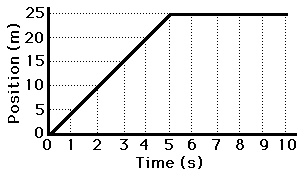
Constant Velocity: What is the displacement from 0-10 seconds?
25 m away
5 m away
6 m away
15 m away
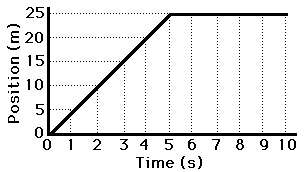
Constant Velocity: What is the average velocity from 0-10 seconds?
2.5 m/s away
5 m/s away
1 m/s away
1.5 m/s away
Constant Velocity: A car starts 2 mi east of the school and travels with a velocity of 35 mi/hr east for 3 hours. Where does it end up?
105 mi east
103 mi east
107 mi east
105 mi west
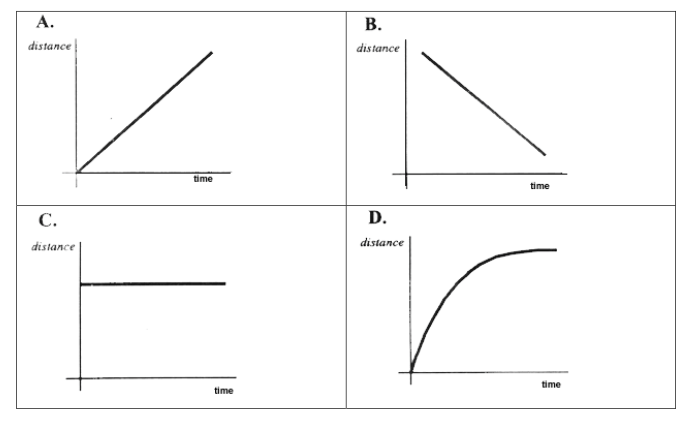
Constant Velocity: The distance-time graphs shown represent the motion of a car. Which of the following graphs represents the car at constant, positive velocity?
graph A
graph B
graph C
graph D

Constant Velocity: In which of the following graphs (click the image) are both runners moving at the same speed (note that graph c is the bottom right graph, and graph d is the bottom left graph)?
Graph A
Graph B
Graph C
Graph D
Constant Velocity: Bill runs 400 meters to Andy's house, turns around, and runs 400 meters back home. What is Bill's distance?
0 meters
400 meters
800 meters
1600 meters
Constant Velocity: On a position vs. time graph, the less steep the slope _____.
the slower the speed
the faster the speed
less acceleration
greater acceleration

Acceleration: What is the acceleration of the object from 5-7 seconds?
0.5m/s2
1.0 m/s2
1.5 m/s2
2.0 m/s2
Acceleration: A car accelerates from rest to 45 m/s in 10 seconds. What is the average acceleration?
4.5m/s2
45 m/s2
10 m/s2
0.20 m/s2

Acceleration: What is happening in this graph from point B to C?
The object is going down a hill.
The object is returning to its starting location.
The object is slowing down.
The object is staying still.

Acceleration: What is happening in this graph from point A to B?
The object is accelerating.
The object is not moving.
The object is decelerating.
The object is moving at a constant speed.

Acceleration: What is happening between 3 seconds and 4 seconds?
The object is moving in a negative direction.
The object is returning to its starting position.
The object is slowing to a stop.
The object is changing direction.

Acceleration: Find the displacement during the first 2 seconds.
8 meters
4 meters
2 meters
5 meters
Acceleration: In order to calculate displacement on a velocity vs. time graph...
find the slope
calculate the area under the curve
subtract final position and initial position
displacement cannot be found on this graph

Acceleration: Describe this motion...
constant positive velocity
constant positive acceleration
increasing positive velocity
decreasing negative velocity

Acceleration: Describe this motion...
constant negative velocity
constant positive acceleration
the object is at rest
increasing negative velocity
Vector Addition & Relative Motion: If a car moves 5 km North, 12 km South, and then 15 km North, what is the distance traveled?
8 km
8 km, North
32 km, North
32 km
Vector Addition & Relative Motion: If a car moves 5 km North, 12 km South, and then 15 km North, what is its displacement?
8 km
8 km, North
32 km, North
32 km

Vector Addition & Relative Motion: Given the FBD shown, what is the magnitude of the vector sum of the forces indicated?
0 N
120 N
20 N
70 N

Vector Addition & Relative Motion: Given the information provided by the diagram, what is the value of the upward force?
1100 N
700 N
900 N
200 N
Projectile Motion: An object is projected horizontally from a cliff. The time it takes to hit the ground is
more than if it was just dropped
less than if it was just dropped
the same amount of time than if it was just dropped
impossible to determine
Projectile Motion: What effect does the mass of a projectile have on the time it's in the air? (Neglecting air resistance)
The lighter the projectile, the greater the time in the air
The heavier the projectile, the greater the time in the air
It has no effect
The lighter the projectile, the less the time in the air
Projectile Motion: A plane flying horizontally at 120 m/s drops a crate. When the crate strikes the ground 15 seconds later, what is the magnitude of the horizontal component of its velocity?
147 m/s
120 m/s
1800 m/s
8 m/s
Projectile Motion: When an object is launched horizontally, what is the initial vertical velocity?
0 m/s
It's always 9.8 m/s
It depends on the horizontal launch speed
It depends on the color of the object being launched
Projectile Motion: At which of the following places does a projectile have the greatest acceleration?
At the peak of its trajectory
Half way to the peak
At the instant it is launched
All points have the same acceleration
Projectile Motion: Suppose a projectile is moving through the air as it goes up and back down. When the object is at its maximum height, what is something that is NOT true?
the vertical velocity is zero
the object is about to switch directions
the vertical acceleration is 0 m/s2
The horizontal acceleration is 0 m/s2
Projectile Motion: A diver initially moving horizontally with speed 'v' dives off the edge of a vertical cliff and lands in the water a distance 'd' from the base of the cliff. How far from the base of the cliff would the diver have landed if the diver initially had been moving horizontally with speed '3v'?
d
3d
2d
4d

Projectile Motion: Three stones of different mass (1m, 2m & 3m) are thrown vertically with different velocities (1v, 2v & 3v). The diagram indicates the mass and velocity of each stone. Rank from low to high the max height of each stone. Assume air resistance is negligible.
I, II, III
II, I, III
III, II, I
all reach the same height
Newton's Laws: A car is driving on the road when a fly hits the window. In this situation:
The force exerted on the car by the fly is less than the force exerted by the fly on the car.
The force exerted on the car by the fly is equal to the force exerted by the fly on the car.
The force exerted on the car by the fly is greater than the force exerted by the fly on the car.
The fly does not exert a force on the car.
The car does not exert a force on the fly.
Newton's Laws: An elevator is traveling upward in an elevator shaft at a constant speed. Assume that all friction effects are negligible. According to this situation, the forces on the elevator are best described by the following:
The upward force is greater than the downward force due to gravity.
The upward force is equal to the downward force due to gravity.
The upward force is less than the downward force due to gravity.
The upward force is greater than the sum of the downward force due to gravity and air resistance.
The upward force is less than the sum of the downward force due to gravity and air resistance.
Newton's Laws: A ball is launched from rest in outer space. Assume all outside forces other than the launch force are negligible. Three seconds after the ball has been launched, which of the following is true?
The ball is accelerating in the direction of motion due to the launch force.
The ball is accelerating in the direction opposite motion due to the launch force.
The ball accelerates in the direction of motion initially and then moves with constant velocity.
The ball accelerates in the direction opposite motion initially and then moves with constant velocity.
The ball is not accelerating and moves with constant velocity.

Newton's Laws: A person stands on a scale in order to weigh herself. Both the scale and the person are at rest. The diagram shows two possible forces acting on her. Which of the following is the correct description of the forces acting on her?
the force exerted by the scale is greater than the force due to gravity on her
the force exerted by the scale is equal to the force due to gravity on her
the force exerted by the scale is less than the force due to gravity on her
only the force due to gravity exists
only the force exerted by the scale exists
Newton's Laws: Suppose a particle is accelerated through space by a constant 10-N force. Suddenly the particle encounters a second force of 10-N in a direction opposite to that of the first force. The particle
is brought to a rapid halt.
theoretically accelerates to speeds approaching the speed of light.
continues at the speed it had when it encountered the second force.
gradually decelerates to a halt.
none of the above
Newton's Laws: A rock that weighs 75 N is dropped from a building and falls downwards through the air. Air resistance exerts a force of 50 Newtons upwards. The rock will
accelerate downwards and speed up
accelerate downwards and slow down
acceleration upwards and speed up
accelerate upwards and slow down

Newton's Laws: Which free body diagram could represent an object traveling at a constant speed?
a
b
c
d

Newton's Laws: What must be the value of force 'D' to move the object represented by the diagram at constant velocity?
300 N
0 N
80 N
Impossible to determine given the information provided
Circular Motion: Centripetal acceleration always points _____.
in the direction of the object's motion
in the opposite direction of the object's motion
towards the center of the circle
towards the outside of the circle
Circular Motion: A dog sits 1.5 m from the center of a spinning merry-go-round. The magnitude of the velocity is 4.5 m/s.
What is the magnitude of the dog’s centripetal acceleration?
13.5 m/s^2
4.5 m/s^2
1.5 m/s^2
11.5 m/s^2
Gravitation: What happens to Gravitational force if the masses of both objects are reduced to 1/3 of what they originally were?
9 times as large
1/9 as large
1/3 as large
3 times as large
Gravitation: If I quadruple the mass of one object, but don't change anything else... What happens to the gravitational force between two objects?
Doubles
Quadruples
Cut in Half
4x Smaller

Gravitation: The picture shows the relative masses of five pairs of planets (A-E) all equal distances apart.
Which pair experiences the least gravitational force based on the masses listed?
A
B
C
D
E

Gravitation: The picture shows the relative mass and radius of five planets (A-E).
Based on the information provided, on which planet would a person standing on the surface experience the greatest gravitational force?
A
B
C
D
E

Gravitation: Of the three masses, the two masses that experience the most gravitational force between them are ______________.
m1 & m2
m1 & m3
m2 & m3
All forces are equal.

Circular Motion: A what point in the image do you think that Philippe should let go of the string in order to hit the target?
A
B
C
D
E

Circular Motion: A fighter jet is pulling up vertically to make a circular path with radius r. Based on the jet’s position in its circular path as shown, what direction is the centripetal force on the jet?
left
right
up
down
Circular Motion: Why do astronauts orbiting the Earth in the international space station experience weightlessness?
There is no gravity there.
The space station is falling at the same rate as the astronauts.
There are booster rockets attached to the space station.
There is gravity but it is so small it appears that there is none.
Energy: As an object falls downwards, which type of energy decreases?
kinetic
potential
electrical
static
Energy: How much work is produced when 350 N is used to move a car 5 m?
70 J
1750 J
355 J
175 J
Energy: An engine reaches its top speed from rest in 7.5 s. It is able to perform 250,000 J of work in that time. How much power does this engine have in that time?
0.00003 W
33,333 W
1,875,000 W
1873 W

Energy: At what point would the skater have the greatest kinetic energy if starting from rest at point A and assuming that friction is negligible?
A
B
C
D

Energy: The skater is released from rest and friction is negligible. Which point corresponds to the maximum height he would rise to?
A
B
C
D

Energy: A skater with a large mass and a skater with a small mass start at the same height. Which skater has a greater speed at the bottom of the ramp?
large mass skater
small mass skater
they have the same speed
speed cannot be determined in this scenario

Energy: When the pendulum is released, energy begins to transfer from ____________ to ______________.
Ug; K
K; Us
Us; Ug
K; Ug
Energy: Riley pushes an object with a force over a displacement. If Leah pushes the same object with quadruple the force for half the displacement, she does how much more work?
3 times more
6 times more
Twice as much
The same amount
Energy: Drew pushes a box up a ramp to a height h in a certain amount of time t. Kim pushes the same box up the ramp to the same height in 4 times the time. The amount of power used by Kim is _____ of the amount of power used by Drew?
1/316
4
1/16
1/4

Impulse & Momentum: According to the graph, what is the impulse from 0-4 seconds?
15 N
15 N*s
30 N
30 N*s
Impulse & Momentum: Two vehicles, a car and a truck, have identical velocities. The truck has 8 times the mass of the car. Compare the momentum of each object.
The truck has 8x the momentum of the car.
The car has 8x the momentum of the truck.
The truck has 1/8 the momentum of the car.
The momentum of each is equal.
Impulse & Momentum: A 1.0kg ball has a velocity of 12 m/s downward just before it strikes the ground and bounces up with a velocity of 12 m/s upward. what is the change in momentum of the ball?
zero kg * m/s
24 kg * m/s, downward
12 kg * m/s, downward
24 kg * m/s, upward
12 kg * m/s, upward

Impulse & Momentum: According to the graph, what is the impulse from 0-5 seconds?
40 N
40 N*s
62.5 N
62.5 N*s
Impulse & Momentum: Which of the following is not a method of determining impulse?
Change in momentum
Area of a Force versus Time graph
Product of net force and time
All answers will calculate impulse
Impulse & Momentum: A roller coaster climbs up a hill at 5 m/s and then zips down the hill at 25 m/s. The momentum of the roller coaster is
the same throughout the ride.
zero throughout the ride.
greater up the hill than down.
greater down the hill than up.
Impulse & Momentum: When comparing the momentum of two moving objects, which of the following is correct?
If the masses are equal, they will have equal momentum regardless of velocity.
The object with more mass will have less momentum if the velocities are the same.
The object with less mass will have less momentum if the velocities are the same.
If the masses are equal, the object with a higher velocity will have less momentum.
Impulse & Momentum: Most safety devices built into automobiles operate according to which of the following principles?
By increasing the time over which occupants decelerate, the force on the occupant decreases.
By decreasing the time over which occupants decelerate, the force on the occupant decreases.
By increasing the time over which occupants decelerate, the force on the occupant increases.
By decreasing the time over which occupants decelerate, the force on the occupant increases.
Waves: Which of the following is NOT true about sound waves?
Sound waves are always longitudinal waves.
The loudness of a sound wave measures the amplitude of the wave.
Sound waves do not require a medium to transmit energy.
The speed of sound is dependent on the temperature of the medium.
Waves: Which of the following is NOT true about light waves?
Light waves do not require a medium to transmit energy.
Light waves can interfere with one another to change their colors.
Light waves can doppler shift to change their colors.
Light waves are always longitudinal waves.

Waves: What is the period of the wave according to the graph provided?
2s
4s
6s
8s
Waves: If a star is being observed from Earth and it's light has shifted towards the blue side of the electromagnetic spectrum it would be...
Moving towards the Earth
Moving away from the Earth
This is a trick question that cannot be answered
It isn't a star, it is a very large blueberry.
Waves: A piano tuner strikes a key and a tuning fork at the same time. If the tuning fork has a frequency of 512 Hz and 2 beats are heard, which of these could be the correct frequency of the piano string?
512 Hz
514 Hz
256 Hz
1024 Hz
Waves: How high or low humans perceive a sound to be, depending on the frequency, is referred to as...
amplitude
wavelength
pitch
volume

Waves: How many wavelengths are there from point F to point G?
1
1.5
2
2.5

Waves: What does letter D represent for the transverse wave shown in the image?
frequency
wavelength
amplitude
interference

Waves: According to superposition, which choice best describes what occurs when the waves pictured pass over one another?
A
B
C
D

Waves: What is the wavelength of the standing wave pictured in the image?
1 meter
2 meters
4 meters
5 meters
Waves: If a star is being observed from Earth and it's light has shifted towards the red side of the electromagnetic spectrum it would be...
Moving towards the Earth
Moving away from the Earth
This is a trick question that cannot be answered
It isn't a star, it is a very large blueberry.

