wayground logo

Free Printable Worksheets

Font size

S
M
L
XL
Worksheets

Science 30 Unit D Review

Total questions: 84

Worksheet time: 14hrs 0mins

Name
Class
Date
1.

What is potential energy?

a)

moving energy

b)

stored energy

c)

renewable energy

d)

non renewable energy

2.

What is kinetic energy?

a)

moving energy

b)

potential energy

c)

stored energy

d)

renewable energy

3.
Energy of motion is which type of energy?
a)
Potential
b)
Kinetic
c)
Sound
d)
Gravitational
4.
The ability to do work is
a)
power
b)
energy
c)
thermal
d)
kinetic
5.

When energy changes from one form to another, we call it a _______________.

a)

transformation

b)

creation

c)

expiration

d)

compilation

6.
In energy transformations, "wasted energy" usually takes what form?
a)
heat
b)
chemical energy
c)
light
d)
sound waves
7.

What is the energy transformation in hydroelectric dams?

a)

Kinetic to electrical

b)

Kinetic to heat

c)

Electric to kinetic

d)

Sound to electric

8.

A kettle uses 100J of electrical energy to produce 7J of sound energy and 93J of thermal energy. How efficient is the kettle?

a)

100%

b)

7%

c)

93%

d)

95%

9.

A washing machine uses 250J of electrical energy to produce 125J of useful energy. How efficient is it?

a)

5%

b)

50%

c)

55%

d)

100%

10.

Total energy = 200J
Useful energy = 20J

Workout the efficiency of this lightbulb.
efficiency = useful enegytotal energy in ×100efficiency\ =\ \frac{useful\ enegy}{total\ energy\ in}\ \times100  

a)

100%

b)

80%

c)

40%

d)

10%

11.

Heat energy is also called ______ energy.

a)

chemical

b)

electrical

c)

mechanical

d)

thermal

12.
The process of energy changing from one form into another
a)
efficency
b)
law of conservation of energy
c)
energy transformation
d)
thermal energy
13.
Efficiency is...
a)
The percentage of energy that is actually used to do work
b)
The stuff in the walls that keeps energy in
14.
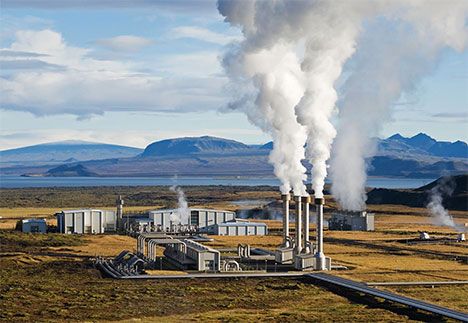
This energy comes from heat, such as geysers, beneath earth’s surface.  
a)
Biomass 
b)
Geothermal 
c)
Solar
d)
Oil
15.

Earth’s nearest star (our Sun) radiates this type of energy.

a)

Solar

b)

Coal

c)

Propane

d)

Oil

16.
This energy comes from splitting Uranium atoms.
a)
Nuclear
b)
Petroleum
c)
Natural Gas
d)
Wind
17.
Which of the following energy transformations occur when a lamp that is plugged into a wall socket is functioning correctly?
a)
Chemical to light
b)
Electrical to chemical
c)
Electrical to light
d)
Chemical to electrical
18.
What is the efficiency of a machine if 55.3 J of work are done on the machine, but only 14.3 J or work are done by the machine?
a)
0.25 Joules
b)
26%
c)
3.86 Joules
d)
386%
19.

Total energy = 350J
Useful energy = 70J

Workout the efficiency of this iphoneX.
efficiency = useful energytotal energy in ×100%efficiency\ =\ \frac{useful\ energy}{total\ energy\ in}\ \times100\%  

a)

100%

b)

80%

c)

40%

d)

20%

20.

Total energy = 34000J
Useful energy = 340J

Workout the efficiency of this vintage VW Beetle.
efficiency = useful energytotal energy in ×100%efficiency\ =\ \frac{useful\ energy}{total\ energy\ in}\ \times100\%  

a)

100%

b)

10%

c)

40%

d)

20%

21.

This car needs 8600J of energy to power it. If 5000J is changed into useful energy, how much energy is wasted?

a)

13600J

b)

3600J

c)

5000J

d)

8600J

22.
What is the most plentiful fossil fuel? 
a)
Oil
b)
Natural Gas
c)
Petroleum 
d)
Coal
23.
The careful use of a resource is....
a)
recycling
b)
pollution
c)
depositing
d)
conservation
24.
Fossil fuels are classified as nonrenewable because they.......
a)
require expensive equipment
b)
take millions of years to replace
c)
can be found all over 
d)
provide all the energy we use
25.
Corn, wheat, and soybeans can be made into a substance called ethanol. In some places, ethanol is part of a mixture used to power cars and trucks. What type of alternative energy resource is ethanol?
a)
Hydroelectric
b)
Geothermal
c)
Biofuels
d)
Solar
26.
Which of the following is not a type of fossil fuel? 
a)
Coal
b)
Light
c)
Petroleum
d)
Natural Gas
27.
Where did the energy for fossil fuels come from?
a)
Animals
b)
Plants
c)
Sun
d)
Chemosynthesis
28.

Which of these is not a fossil fuel?

a)

Coal

b)

Oil

c)

Electricity

d)

Natural Gas

29.

This fossil fuel is formed from the remains of small organisms that lived in the ocean AND is a thick, black liquid

a)

natural gas

b)

coal

c)

oil

d)

steam

30.

Which of the following is NOT a fossil fuel.

a)

coal

b)

carbon dioxide

c)

petroleum oil

d)

natural gas

31.

The fuel used in power plants to make electricity is

a)

natural gas.

b)

petroleum oil.

c)

coal.

d)

water.

32.

What is the heat of formation for 6 moles of ethanol? Use your heats of formation table for reference.

a)

-1666.2 kJ/mol

b)

-277.7 kJ/mol

c)

52.3 kJ/mol

d)

Only able to calculate in a reaction

33.

Calculate ΔH\Delta H  using heats of formation for the combustion of methane:
CH4(g) + 2O2(g)  CO2(g) +2H2O(l)CH_4\left(g\right)\ +\ 2O_2\left(g\right)\ \rightarrow\ CO_2\left(g\right)\ +2H_2O\left(l\right)  
Use your heats of formation table for reference.

a)

-890.25 kJ/mol

b)

-604.45 kJ/mol

c)

-754.15 kJ/mol

d)

No way to tell

34.

What is the heat of formation for 8 moles of ammonia? Use your heats of formation table for reference.

a)

-369.52 kJ/mol

b)

-46.19 kJ/mol

c)

-92.38 kJ/mol

d)

-102.4 kJ/mol

35.
What kind of energy conversion does a combustion reaction involve?
a)
Kinetic to Potential Energy
b)
Chemical Potential Energy to Kinetic or Thermal Energy
c)
Potential Energy to Nuclear Energy
d)
Mass to Energy
36.

8.7: Combustion is when a __________ reacts with oxygen

a)

petrol

b)

fuel

c)

fire triangle

d)

carbon dioxide

37.
Nuclei with too many or too few neutrons are
a)
unstable
b)
unnatural
c)
stable
d)
never found
38.
Which of the following is NOT a type of nuclear radiation?
a)
alpha particles
b)
x-rays
c)
gamma particles
d)
beta particles
39.

What is the atomic number of this element?

a)

238

b)

92

c)

U

d)

none of these

40.

What is the mass number of this element?

a)

238

b)

92

c)

U

d)

none of these

41.

What is the symbol of this element?

a)

238

b)

92

c)

U

d)

none of these

42.
Which of the following occurs in the nucleus during alpha decay?
a)
2 protons & 2 neutrons are lost
b)
2 neutrons & 2 electrons are gained
c)
2 protons & 2 neutrons are gained
d)
2 neutrons & 2 electrons are lost
43.
During beta decay, a nucleus
a)
gains a proton and loses a neutron
b)
loses a proton and gains a neutron
c)
gives up two protons and two neutrons
d)
loses an electron
44.
What type of particle has no mass and no charge?
a)
alpha
b)
beta
c)
gamma
d)
none of these
45.
What type of particle is the same as a He nucleus?
a)
alpha
b)
beta
c)
gamma
d)
none of these
46.
What type of particle has a charge of -1
a)
alpha
b)
beta
c)
gamma
d)
none of these
47.
What type of particle has a charge of 0
a)
alpha
b)
beta
c)
gamma
d)
none of these
48.

In this example of alpha decay, what is the mass number of radium before the decay?

a)

314

b)

226

c)

222

d)

88

49.

What are the values of x in the following alpha decay?

a)

236

b)

244

c)

60

d)

240

50.

What are the values of y in the following alpha decay?

a)

94

b)

92

c)

96

d)

236

51.

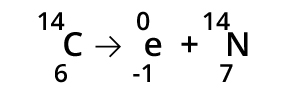
What are the values of x in the following beta decay?

a)

94

b)

236

c)

240

d)

96

52.

What are the values of y in the following beta decay?

a)

98

b)

96

c)

97

d)

240

53.

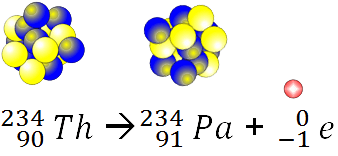
In balancing the nuclear reaction, What is the identity of the element labeled E?

a)

Pu

b)

U

c)

Th

d)

Np

54.

The missing product from this reaction is

a)

beta particle

b)

positron

c)

gamma particle

d)

alpha particle

55.
Takes two small nuclei and combines them into a larger nucleus
a)
fission
b)
fusion
56.
The splitting of a nucleus into smaller nuclei is
a)
fusion
b)
fission
c)
half-life
d)
gamma radiation
57.
How do nuclear power-plants work?
a)
Fusion
b)
Half-life
c)
Fission
d)
Fusion or fission
58.
Where does fusion occur naturally?
a)
Underwater
b)
All around us
c)
In the radioactive waste
d)
On the sun
59.
An example of an uncontrolled fission reaction is _______________
a)
Nuclear power plants
b)
Radio active decay
c)
Atomic Bomb
d)
On the surface of the sun
60.
_________ happens naturally due to an unstable nucleus.
a)
fission
b)
fusion
c)
radioactive decay
d)
K-capture
61.
The major drawback to nuclear fission reactors is the difficulty of achieving safe disposal of radioactive waste products.
a)
true
b)
false
62.
Which type of nuclear radiation is being emitted here?
a)
Alpha
b)
beta
c)
gamma 
d)
none
63.
Which type of nuclear radiation is being emitted here?
a)
alpha
b)
beta
c)
gamma
d)
none
64.
What particle completes this reaction?
a)
alpha particle
b)
beta particle
c)
gamma particle
d)
neutron
65.

What is the term for an ongoing series of nuclear reactions?

a)

fission

b)

chain reaction

c)

fusion

d)

nuclear

66.

When two smaller nuclei come together, it is called ________.

a)

nuclear fission

b)

nuclear fusion

c)

chain reaction

d)

critical mass

67.

Plutonium (of mass number 240 and proton number 94) decays with the emission of alpha-particle. What is the new proton number and mass number of the new nucleus?

a)

proton number = 92, mass number = 236

b)

proton number = 92, mass number = 240

c)

proton number = 91, mass number = 240

d)

proton number = 91, mass number = 236

68.

The radioactive nucleus Rubidium (of mass number 87 and proton number 37) decays with the emission of a beta-particle. How many protons and neutrons are left in the nucleus?

a)

protons = 37, neutrons = 49

b)

protons = 37, neutrons = 50

c)

protons = 38, neutrons = 49

d)

protons = 38, neutrons = 87

69.
What type of nuclear equation is this?
a)
fusion
b)
fission
c)
alpha
d)
beta
70.
The cleanest burning fossil fuel is ______.
a)
coal
b)
oil
c)
wind
d)
natural gas
71.
_____________ power is electricity produced by flowing water.
a)
Solar 
b)
Wind 
c)
Hydroelectric 
d)
water
72.

What is a renewable resource?

a)

A resource you can reuse over and over

b)

An object you cannot replace

c)

Fossil fuels

d)

A resource that has a nearly unlimited supply
73.
Wind Energy is...
a)
 Energy that comes from harnessing the movement of the air
b)
Energy that comes from the Sun
c)
A source of renewable energy, such as solar, wind, or geothermal energy
d)
Fuel from plant material
74.
Heat transferred from beneath the surface of Earth and used to produce energy for human use is...
a)
Hydropower
b)
Wind Energy
c)
Geothermal Energy
d)
Solar Energy
75.

All of the following are considered renewable energy sources EXCEPT –

a)

Wind

b)

Coal

c)

Biomass

d)

Solar

76.

Which one of these is NOT a type of renewable energy?

a)

solar

b)

wind

c)

biomass

d)

nuclear

77.
Water is renewable because it.......
a)
can be frozen
b)
important to all life
c)
can be replaced constantly
d)
can evaporate
78.

Which of the following is caused by the gravitational pull of the Moon?

a)

Sunlight

b)

Hydrogen

c)

Biomass

d)

Tides

79.

Photovoltaics is a technology from which energy source?

a)

Solar

b)

Wind

c)

Hydropower

d)

Hydrogen

80.

Which of the following resources uses the Earth's gravitational force?

a)

Solar

b)

Wind

c)

Biomass

d)

Hydropower

81.

Which of the following uses organic materials?

a)

Wind

b)

Hydrogen

c)

Hydropower

d)

Biomass

82.
What is one of the biggest disadvantages to wind turbines?
a)
They're big
b)
They can interfere with bird migration
c)
They're expensive
d)
It takes a long time to put one up and then maintain it
83.
Why are fossil fuels more widely used than solar energy?
a)
Solar energy is harder to find
b)
Fossil fuels are much cheaper
c)
Fossil fuels are more abundant
d)
The sun's energy can never be harnessed
84.

Before coal has formed over millions of years, it is a wet, sampling of decaying plant material called...

a)

Peanut Butter

b)

Peat

c)

Mud

d)

Sedimentary Rock