wayground logo

Free Printable Worksheets

NEW

Font size

S
M
L
XL
Worksheets

Semester 2 Final Review

Total questions: 80

Worksheet time: 1hrs 14mins

Name
Class
Date
1.
True or False
The Earth is the center of the solar system.
a)
True
b)
False
2.
The order of the planets is:
a)
Mars,Venus,Earth,
Mercury,Saturn
Jupiter, Uranus, Neptune
b)
Earth,Venus,Mars
Jupiter, Neptune,
Mercury,Saturn,
Uranus
c)
Mercury,Venus,Earth
Mars,Jupiter,
Saturn,Uranus
Neptune
3.
What is a common characteristic of the inner planets?
a)
Large
b)
Gaseous
c)
Rings
d)
Rocky Surface
4.
Which planet rotates to give day/night every 24 hours?
a)
Mercury
b)
Venus
c)
Earth
d)
Mars
5.
What is in between the inner planets and the outer planets?
a)
Asteroid belt
b)
Kuiper belt
c)
Sun
d)
Moon
6.
Kepler's 2nd Law deals with 
a)
the shape of the planets' orbits
b)
the speed/area the planet travels 
c)
the length of time it takes the planet to orbit the sun
7.

When do planets move the fastest?

a)

Close to the sun

b)

Far away from the sun

8.
Planets orbit the Sun in a shape called a(n)
a)
circle
b)
ellipse
c)
focus
d)
perihelion
9.
An underground layer of rock or sediment that holds water?
a)
Reservoir
b)
Aquifer
c)
Groundwater
d)
Watershed
10.

Earth's current atmosphere is

a)

78% nitrogen, 21% oxygen, 0.9% argon and 0.037% carbon dioxide

b)

78% oxygen, 21%nitrogen, 0.9% argon, 0.037% carbon dioxide

c)

78% nitrogen, 21% argon, 1% oxygen

d)

78% oxygen, 21% nitrogen, 1% carbon dioxide

11.

The layers of the atmosphere in order from bottom to top are

a)

troposphere, stratosphere, mesosphere, thermosphere, exosphere

b)

troposphere, mesosphere, atmosphere, thermosphere

c)

mesosphere, thermosphere, troposphere, stratosphere, exosphere

d)

thermosphere, stratosphere, mesosphere, troposphere, exosphere

12.

What two gases make up the majority of air?

a)

helium & argon

b)

helium & oxygen

c)

ozone & nitrogen

d)

nitrogen & oxygen

13.

What is the “fuel” that “feeds” a hurricane

a)

cold air

b)

dry air

c)

warm and moist air

d)

warm and dry air

14.

El Nino is a change in the ocean currents in the western Pacific. How does that change affect currents on the eastern side of the Pacific along the South American and North American coasts?

a)

It has no effect; the western Pacific is too far away to affect the eastern edge

b)

The heat of El Nino causes the Ring-of-Fire earthquake zone around the Pacific plate to be more active

c)

Upwelling currents in the east are blocked and there is a large die-off of sea life

d)

Both b and c are true

15.

Which of the following is a potential cause of climate change?

a)

the drift of continents across the globe

b)

volcanic eruptions

c)

burning of fossil fuels

d)

All of the above.

16.

What causes an onshore breeze?

a)

The wind will blow from the lower pressure over the water to higher pressure over the land causing the sea breeze.

b)

The wind will blow from the higher pressure over the water to lower pressure over the land causing the sea breeze.

c)

Onshore breezes do not exist on Earth.

d)

Both A and C.

17.

What is the, "Rain Shadow" effect?

a)

An area having relatively little rain due to the effect of a barrier, especially a mountain range, that causes the prevailing winds to lose their moisture on the windward side.

b)

An area having relatively little rain due to the effect of a barrier, especially a mountain range, that causes the prevailing winds to lose their moisture on the opposite side from the where the wind is blowing.

c)

An area having a relatively large amount of rain due to the effect of a barrier, especially a mountain range, that causes the prevailing winds to lose their moisture on the windward side.

d)

An area having relatively no rain due to the effect of a barrier, especially a mountain range, that causes the prevailing winds to gain their moisture on the opposite side of the wind.

18.
What is the name for this giant loop of energy leaping from the solar surface? 
a)
aurora
b)
prominence
c)
solar flare
d)
sunspot
19.
Which statement is true about the sun?
a)
It is a star.    
b)
It is the largest star in our galaxy. 
c)
It is a planet close to Earth.
d)
It is a moon. 
20.
The most common elements in the SUN are 
a)
carbon and oxygen
b)
water and carbon dioxide
c)
calcium and potassium
d)
hydrogen and helium
21.
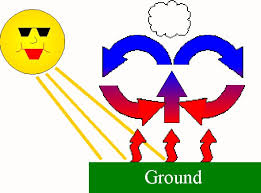
Warm air rises and the cool air sinks.
a)
conduction
b)
convection
c)
radiation
22.
What type of winds blow constantly, predictably, and over long distances?
a)
land breezes
b)
mountain breezes
c)
global winds
d)
land breezes
23.
Which diagram shows the formation of a land breeze? 
a)
diagram Y
b)
diagram X
c)
neither 
d)
both
24.
A severe storm which involves a funnel cloud forming over land is:
a)
hurricane
b)
tornado
c)
thunderstorm
d)
blizzard
25.
What phase of the moon is pictured here?
a)
New moon
b)
First quarter moon
c)
Full moon
d)
Last quarter moon
26.
This is when an object spins on its axis. 
a)
Rotation
b)
Orbit
c)
Tilt
d)
Revolution
27.
The order of a lunar eclipse is..
a)
Sun-Earth-Moon
b)
Earth-Sun-Moon
c)
Moon-Sun- Earth
d)
Earth-Moon-Sun
28.
Hydroelectric power produces electricity using.....
a)
Wind
b)
Sunlight
c)
Moving water
d)
Dung
29.
 Energy from the sun is known as......... 
a)
hydroelectric energy
b)
geothermal energy
c)
solar energy
d)
wind energy
30.
The cleanest burning fossil fuel is ______.
a)
coal
b)
oil
c)
wind
d)
natural gas
31.
Fossil fuels are classified as nonrenewable because they.......
a)
require expensive equipment
b)
take millions of years to replace
c)
can be found all over 
d)
provide all the energy we use
32.
What characteristic do all renewable resources share?
a)
Produced by waste products
b)
Form underground from dead organisms.
c)
Replaced in a short period of time
d)
Allow energy to pass through them easily
33.
Why is the Sun considered the ultimate energy source?
a)
The Sun is the center of our solar system.
b)
The Sun provides energy for the water cycle and plants.
c)
The Sun is limited in the amount of energy released daily.
d)
The Sun rises and sets each day as seen from Earth.
34.
2. What is it called when humans generate electricity by using the heat of the Earth?
a)
Geothermal Energy
b)
Hydroelectric Energy
c)
Radiation Energy
35.
Phases of the moon in which the moon appears to be getting larger are referred to as _.
a)
waxing
b)
waning
c)
new
d)
eclipse
36.
What are the reasons for the seasons?
a)
Earth's tilt and rotation.
b)
Earth's rotation and revolution.
c)
Earth's tilt and revolution.
d)
Earth's tilt and resolution
37.
What part of the moon do we see from Earth?
a)
all of it
b)
the same side
c)
none of it
d)
only one quarter
38.
What model is where the earth is in the middle of our universe?
a)
Heliocentric Model
b)
Geocentric Model
c)
Moon phases
d)
Tidal Phases
39.
What Model is where the sun is the center of the universe?
a)
Geocentric
b)
Heliocentric
c)
Earth's rotations
d)
Earth's planets
40.
A solar eclipse can occur only during the _________________.
a)
Full moon
b)
New moon
c)
Quarter moon
41.
A lunar eclipse can occur only during the _________________.
a)
Full moon
b)
New moon
c)
Waxing moon
42.
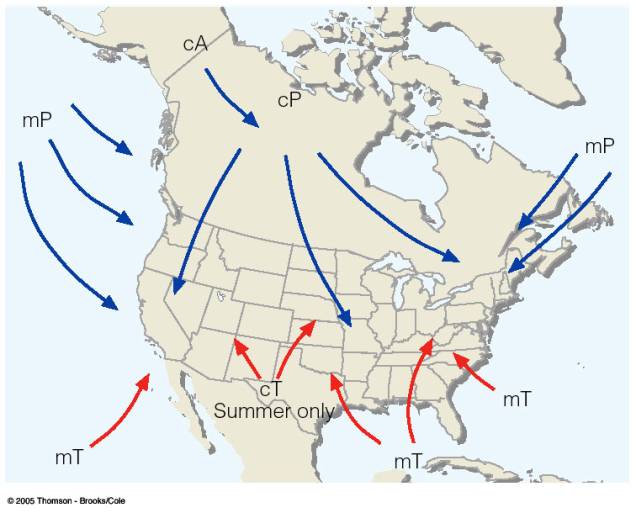
A dry and hot air mass would be...
a)
Maritime arctic
b)
Maritime tropical
c)
Continental tropical
d)
Continental polar
43.
A dry and cold air mass would be...
a)
Maritime polar
b)
Continental polar
c)
Maritime tropical
d)
Continental tropical
44.
Where would you find a tropical maritime air mass?
a)
over the ocean, near the equator
b)
over the ocean, near the poles
c)
over a continent, near the equator
d)
over a continent, near the poles
45.
Which abbreviation of an air mass can be identified as dry and hot?
a)
cP
b)
mP
c)
cT
d)
mT
46.
Which abbreviation of an air mass can be identified as cold and moist?
a)
cP
b)
mP
c)
cT
d)
mT
47.
Air travels
a)
from high pressure to low pressure
b)
from low pressure to high pressue
48.
What kind of breeze is this & what time of day/night would it form?
a)
Land breeze - daytime
b)
Land breeze - nighttime
c)
Sea breeze - daytime
d)
Sea breeze - nighttime
49.
As you go to the top of a mountain (altitude increases), what happens to temperature?
a)
Nothing
b)
It increases
c)
It decreases
d)
It goes up and down
50.
As altitude _____________ temperature ___________. 
a)
decreases, decreases
b)
increases, increases
c)
increases, decreases
d)
decreases, increases
51.
The _______ of  a mountain range is the side that receives a lot of precipitation.
a)
dry side
b)
leeward/dry side
c)
windward/wet side
d)
cloudy side
52.
A rapidly moving cold air mass runs into a warm air mass. The cold air slides under the warm air. This is called a(n)  .....
a)
cold front
b)
warm front
c)
stationary front
d)
occluded front
53.
When a warm air mass gently slides on top of a cold air mass, and you have drizzly rain and then warmer weather, what type of front is it?
a)
warm front
b)
cold front
c)
occluded front
d)
stationary front
54.
This type of wind comes from the POLES. It blows from east to west and brings freezing weather. 
a)
Prevailing Westerlies
b)
Polar Easterlies
c)
Polar Westerlies
d)
Horse Latitudes
55.
This type of wind helped blow trader's ships from Europe to the Americas. It blows winds from EAST to WEST. 
a)
Polar Easterlies
b)
Trade Winds
c)
Prevailing Westerlies
d)
Horse Latitudes
56.
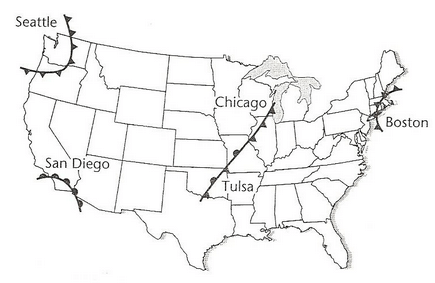
Which type of front is located near Boston?
a)
warm front
b)
cold front
c)
stationary front
d)
occluded front
57.
Which front is located near San Diego?
a)
cold front
b)
warm front
c)
occluded front
d)
stationary front
58.
Which of these is an example of precipitation?
a)
snow
b)
air
c)
clouds
d)
vapor
59.
Water stored below the Earth's surface is called:
a)
Groundwater
b)
Bogs
c)
Water in the ground
60.
The land area that supplies water to a river system is called a
a)
water table
b)
trailer
c)
house
d)
watershed
61.

At which point does the greatest stream erosion occur?

a)

A

b)

B

c)

C

d)

D

62.

Rivers carry their sediment until reaching the ocean. The faster moving water of the river meets the ocean water and slows down. The slowing down of the river water creates what land feature?

a)

wind forms a delta because there are no trees to stop the wind and wave action is greatest at the mouth of a river

b)

the overpopulation of coral reef in the shallow waters has caused a tremendous stockpile of sediment at the mouth of rivers as they empty into the ocean

c)

none of the these

d)

A delta forms from the deposition of sediment from the river

e)

all of these

63.

Where do deltas form?

a)

in desert areas

b)

at the source of a river

c)

at the mouth of a river

d)

in valleys formed by glaciers

64.

What river feature does this image show?

a)

Meander

b)

Oxbow Lake

c)

Tributary

d)

Headwaters

65.

What landform can you see in the picture?

a)

Meanders

b)

Rapids

c)

Estuary

d)

V shaped valleys

66.

Is there Erosion or Deposition at point B

a)

Erosion

b)

Deposition

67.

Is the river flowing Faster or Slower at point B

a)

Faster

b)

Slower

68.

Which has longer wavelengths?

a)

Radio

b)

Visible

c)

Gamma

d)

X-ray

69.

Stars form in giant clouds of gas and dust. What are these clouds called?

a)

Black Hole

b)

White Dwarf

c)

Super Nova

d)

Nebula

70.

When a mass of hydrogen has enough density, it begins to fuse the hydrogen atoms together. This produces heat and light. What is this classified as?

a)

nebula

b)

star

c)

galaxy

d)

planet

71.

Which describes the location of star A correctly?

a)

Star A is less bright than the Sun and has a surface temperature above 25,000 K

b)

Star A is brighter than the Sun and has a surface temperature below 25,000 K

c)

Star A is less bright than the Sun and has a surface temperature of above 11,000 K

d)

Star A is brighter than the Sun and has a surface temperature below 11,000 K.

72.

Which type of stars belong to spectral class K and have the lowest luminosity?

a)

Giants

b)

White Dwarfs

c)

Supergiants

d)

Main-Sequence stars

73.

What is the nearest star to planet Earth

a)

Moon

b)

Sun

c)

Sirius

d)

Proxima Centauri

74.

Which galaxy is the largest in the local group?

a)

Milky Way

b)

Andromeda

c)

Triangulum

d)

Le Gentil

75.
The most commonly accepted theory that explains the beginning of our known universe is the -
a)
Theory of Evolution
b)
Big Bang Theory
c)
Cell Theory
d)
Blackhole theory
76.
Gravity is the force objects put on each other because of their ______.
a)
mass
b)
friendliness
c)
acceleration
d)
speed
77.

stars in a round,oval, spherical shape

a)

elliptical

b)

spiral

c)

barred spiral

d)

irregular

78.

core of stars with curved arms

a)

elliptical

b)

spiral

c)

barred spiral

d)

irregular

79.

shaped unlike the others

a)

elliptical

b)

spiral

c)

barred spiral

d)

irregular

80.

what is a light year

a)

distance light travels in a year

b)

speed light travels in a year

c)

distance from sun to earth

d)

distance from earth to moon