wayground logo

Free Printable Worksheets

NEW

Font size

S
M
L
XL
Worksheets

Final Exam Review _ Unit 2 _ H Chem

Total questions: 41

Worksheet time: 49mins

Name
Class
Date
1.
Elements which are shiny, conduct electricity and heat are called
a)
metal
b)
nonmetal
c)
metalloid
d)
nonexistent
2.
Which is a halogen?
a)
Helium
b)
Chlorine
c)
Oxygen
d)
Neptune
3.
If an atom had the same properties as fluorine (F), it would probably be located in
a)
period 1.
b)
period 2.
c)
group 2.
d)
group 17.
4.
Atoms with similar properties are most likely located...
a)
in the same period.
b)
in the same group.
c)
in different periods.
d)
to the right and left of each other.
5.
Each element is unique based on its number of protons, also known as the...
a)
atomic mass
b)
valence number
c)
atomic symbol
d)
atomic number
6.
A proton is....
a)
A negatively charged subatomic particle
b)
A positively charged subatomic particle
c)
A neutrally charged subatomic particle
d)
The only subatomic particle located in the nucleus
7.
A neutron has a charge of
a)
+2
b)
No charge
c)
-1
d)
+1
8.
Which is a neutron?
a)
A
b)
B
c)
C
9.

where are the metaloids found

a)

far left, vertical

b)

stair step/diagonal

c)

far right horizontal

d)

at the bottom

10.

A row on the Periodic Table of Elements

a)

family

b)

period

c)

row

d)

isotope

11.
___________ is the only metal that is a liquid at room temperature.
a)
Platinum
b)
Water
c)
Tin
d)
Mercury
12.

What are the seven diatomic elements?

a)

H2, Cl2, Br2, O2, N2, I2, F2

b)

H2, Cl2, I2, F2, Hg2, Br2, Fe2

c)

H2, Cu2, Ni2, B2, O2, I2, Fe2

13.

What are diatomic elements?

a)

Elements that form two-atom molecules when not combined in a compound.

b)

Two elements that combine with one atom from each element.

c)

Elements that are always in pairs no matter what.

14.

Atoms are made up of what?

a)

molecules

b)

compounds

c)

elements

d)

subatomic particles

15.

Which subatomic particle has a positive charge?

a)

proton

b)

neutron

c)

electron

d)

midichlorian

16.

The nucleus of an atom contains which subatomic particles?

a)

protons and electrons

b)

protons and neutrons

c)

electrons and neutrons

d)

protons, electrons, and neutrons

17.

which explanation of this notation is correct?

a)

12 is proton #

b)

6 tells you there are 6 neutrons

c)

6 tells you there are 6 protons

d)

12 is not a mass # here

18.
How many neutrons does the isotope of lithium have?
a)
8
b)
3
c)
4
d)
5
19.

Element X has 2 isotopes. X-125 and X-126. For every 100 atoms of X, 30 of them have a mass of 125.0 amu and 70 have a mass of 126.0 amu. What is the average atomic mass of X?

a)

125.3 amu

b)

125.7 amu

c)

126.3 amu

d)

126.7 amu

20.

Based on the mass spec data, which Iron isotope is the most abundant?

a)

Fe-54

b)

Fe-56

c)

Fe-57

d)

Fe-58

21.
In a flame test the ______________
are excited
a)
protons
b)
neutrons
c)
electrons
d)
bonds
22.
24.1% of all the isotopes of a an element have a mass of 75.23 amu, 48.7% have a mass of 74.61 amu, and 27.2% have a mass of 75.20 amu.
What is the average mass of this element?
a)
74.92 amu
b)
24.97 amu
c)
75.01 amu
d)
74.51 amu
23.
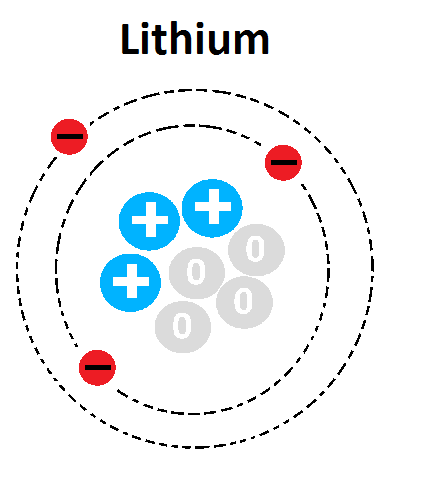
What is the name of this element?
a)
Helium
b)
Hydrogen
c)
Argon
d)
Silver
24.
What is the mass number of this atom?
a)
1
b)
3
c)
4
d)
7
25.
What is the atomic number of this atom?
a)
2
b)
4
c)
6
d)
none of the above
26.
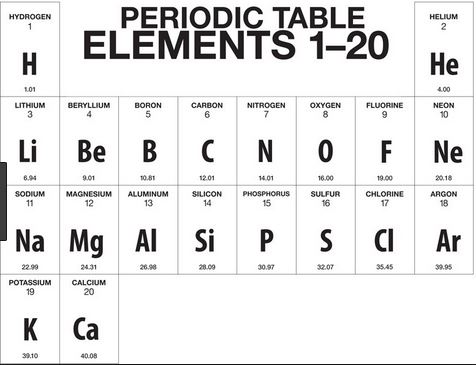
What group does this element belong to?
a)
Group 1: Alkali metals
b)
Group 18: Noble Gases
c)
Group 2: Alkaline-Earth Metals
d)
Group 17: Halogens
27.

How many valence electrons does Helium Have?

a)

1 Valence electron

b)

2 Valence electron

c)

3 Valence electron

d)

4 Valence electron

e)

5 Valence electron

28.

How many valence electrons does Beryllium have?

a)

1

b)

2

c)

3

d)

4

e)

5

29.

A wave with a large wavelength will have a ______ frequency and _____ energy

a)

high, low

b)

high, high

c)

low, high

d)

low, low

30.

The frequency of violet light is 7.5x10¹⁴ Hz. What is its wavelength?

a)

4.0x10⁻⁷ m

b)

4.0x10⁷ m

c)

2.25x10²³m

d)

2.25x10²³ Hz

31.

Energy is measured in........

a)

Wavelength

b)

Meters

c)

Joules

d)

Frequency

32.
What is the frequency of UV light that has an energy of 2.39 × 10 -18 J? 
a)
2.32 x 10Hz
b)
3.60 x 10¹⁵ Hz
c)
1.58 x 10-51 Hz
d)
3 x 10⁸  m/s
33.
What atom matches this electron configuration?
1s22s22p63s23p64s23d10
a)
Zinc
b)
Copper
c)
Nickel
d)
Germanium
34.
What electron configuration matches an oxygen atom?
a)
1s22s22p63s2, 3p64s23d104p5
b)
1s22s22p4
c)
1s22s22p6
d)
1s22s22p63s23p64s23d1
35.
What is the noble gas configuration for beryllium?
a)
[He]1s2
b)
[He]2s2
c)
[Li]2s1
d)
[Li]2s2
36.

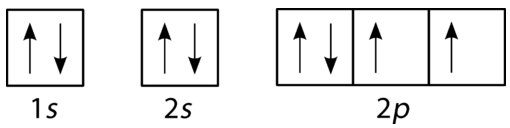
This orbital diagram represents:

a)

Carbon

b)

Boron

c)

Nitrogen

d)

Oxygen

37.

What is incorrect about this orbital diagram?

a)

Both arrows in the 2p box should be pointing up

b)

There are too many electrons in the 1s orbital

c)

In the 2p boxes, there should only be 1 electron in the first 2p box and one in the 2nd 2p box

d)

All the arrows should be pointing up

38.
Electronegativity is the...
a)
energy needed to remove the outermost electron.
b)
ability of an atom to attract electrons from another atom.
39.
Which element has the greatest electronegativity: Nitrogen (N) or Arsenic (As)?
a)
Nitrogen (N)
b)
Arsenic (As)
40.
As you move down the first group, reactivity _________.
a)
Increases
b)
Decreases
c)
Stays the same
d)
They are all inert
41.
Isotopes are atoms of the same element that have the same number of __________ but different number of __________ . Therefore, isotopes of the same element have different masses. 
a)
protons, neutrons
b)
protons, electrons
c)
neutrons, protons
d)
electrons, protons