Wayground logo

Free Printable Worksheets

Font size

S
M
L
XL
Worksheets

Unit 6 Review

Total questions: 39

Worksheet time: 1hrs 1mins

Name
Class
Date
1.
According to this evolutionary tree, which organism is most distantly related to the human?
a)
crayfish
b)
grasshopper
c)
perch
d)
frog
2.
Which two animals are most closely related?
a)
Swordfish and Frog
b)
Swordfish and Alligator
c)
Frog and Alligator
d)
T. rex and Alligator
3.
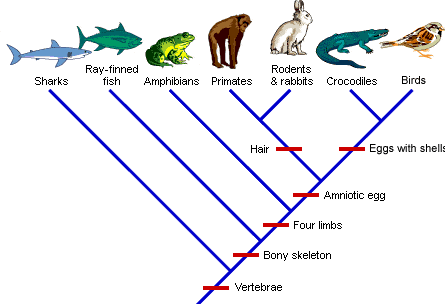
According to this cladogram, sharks are MOST closely related to which organism? 
a)
Amphibians
b)
Ray finned fish
c)
Crocodiles
d)
Birds
4.
Change over time
a)
Natural Selection
b)
Selective Breeding
c)
Homeostasis
d)
Evolution
5.
Structures with the same parts have different functions; suggests that organisms share a common ancestry
a)
vestigial structures
b)
homologous structures
c)
adaptive radiation
d)
fossil
6.
Study of embryos of various organisms to show a common ancestor because of similarities in development
a)
natural selection
b)
embryology
c)
speciation
d)
evolution
7.
The diagram shows fossils in different rock layers. Which of these statements about the age of these fossils is most likely correct?
a)
Fossil A and C are the same age
b)
Fossil B is older than fossil C
c)
Fossils A is older than fossil B
d)
Fossil D is older than fossil C
8.
What does Darwin's theory of evolution suggest?
a)
species change over time
b)
extinct species are not related to living species
c)
different species can interbreed
d)
animals that look alike are most closely related
9.
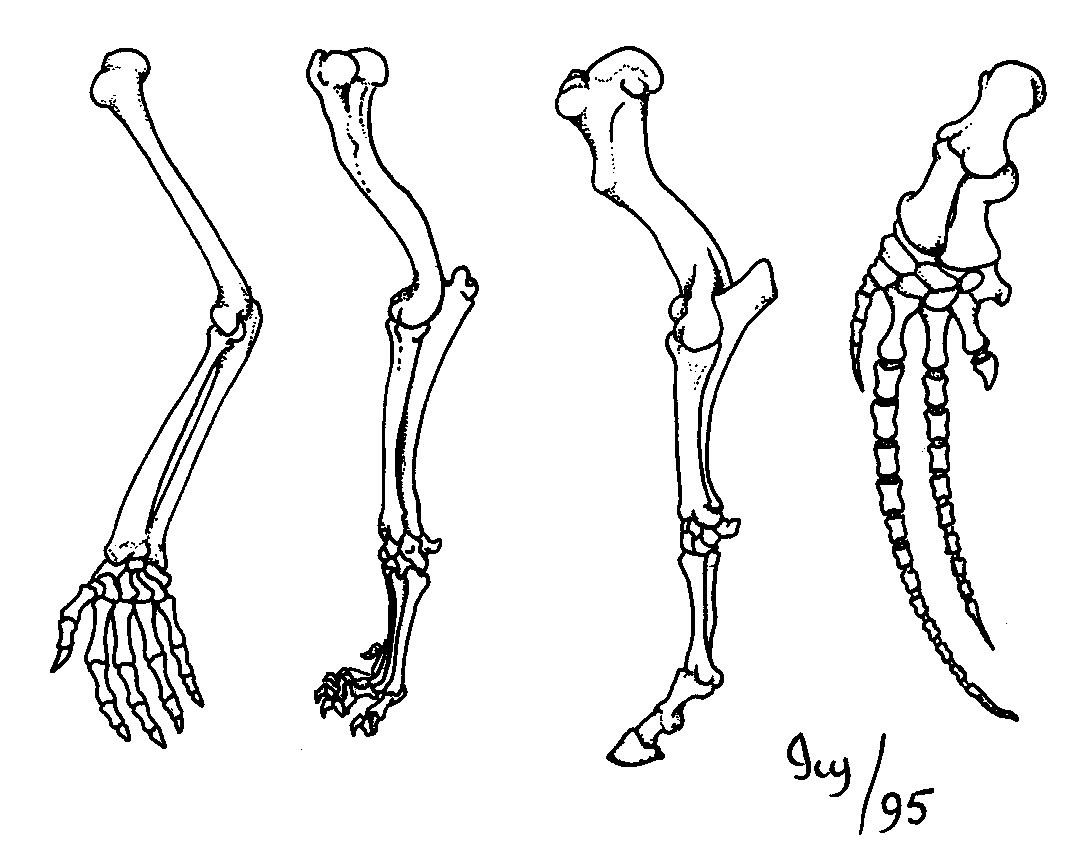
What type of structures are these?
a)
homologous
b)
vestigial 
c)
analogous
d)
fossil
10.

Whales are aquatic mammals that contain a pelvis (hip) bone. Even though it does not aid in its movement, the function must have been used by a common ancestor of the whale. Thus, the pelvis is referred to as a(n)

a)

vestigial structure

b)

analogous structure

c)

homologous structure

11.

Which organism is LEAST closely related to humans?

a)

Humans

b)

Horse

c)

Gorilla

d)

Chimapnzee

12.
Mutations are important because they bring about
a)
death of the organism in which they develop
b)
genetic variation needed for a population to evolve
c)
benefits for the individual, not for the population
d)
Hardey-Weinberg equilibrium within a population
13.
Finches on the Galapagos Islands had different beaks in order to help them do what?
a)
Build nests
b)
Fight off predators
c)
Collect food sources
d)
Compete with rivals
14.
This scientist came up with the idea of natural selection.
a)
Jean Baptiste Lamarck
b)
Gregor Mendel
c)
Charles Darwin
d)
Thomas Malthus
15.
Inherited trait that helps an organism survive is a(n) __________.
a)
Fossil
b)
Adaptation
c)
Ancestor
d)
Natural selection
16.
Survival of the fittest or when favorable adaptations reproduce faster is called what?
a)
Evolution
b)
Adaptation
c)
Natural selection
d)
Fossilization
17.

Male bearded dragons bob their head to attract mates. Males compete for females.

Which condition for natural selection is seen above?

a)

Genetic Variation

b)

Overproduction

c)

Differential Survival and Reproduction

d)

Environmental Variability

e)

Struggle for existance

18.

Zebras have limited food availability due to droughts.

Which condition for natural selection is seen above?

a)

Genetic Variation

b)

Overproduction

c)

Differential Survival and Reproduction

d)

Environmental Variability

e)

Struggle for existance

19.

Spotted leopards and black leopards are the same species. Spotted leopards can give birth to black leopards.

Which condition for natural selection is seen above?

a)

Genetic Variation

b)

Overproduction

c)

Differential Survival and Reproduction

d)

Environmental Variability

e)

Struggle for existance

20.

A group of giraffes all have different spot patterns. Some are dark, some are light, some are large patches, and some have small spots.

Which condition for natural selection is seen above?

a)

Genetic Variation

b)

Overproduction

c)

Differential Survival and Reproduction

d)

Environmental Variability

e)

Struggle for existance

21.
What type of selection is depicted in the picture? 
a)
stabilizing 
b)
directional 
c)
disruptive 
d)
the answer is not here
22.
What type of selection?
a)
Directional 
b)
Stabilizing
c)
Disruptive
23.
Which of the three graphs shows stabilizing selection?
a)
A
b)
B
c)
C
24.
Which of the three graphs shows disruptive selection?
a)
A
b)
B
c)
C
25.
What type of natural selection is this?
a)
Disruptive Selection
b)
Directional Selection
c)
Stabilizing Selection
d)
Sexy Selection
26.

Some female peacocks prefer males with large, colorful tales while other female peacocks prefer males with no tail at all. Females are now mating only with the tail they prefer. What type of reproductive barrier is this?

a)

behavioral isolation

b)

hybrid sterility

c)

temporal isolation

d)

mechanical isolation

27.
A flash flood carried a raft of Amazon ants away from their original population. There is enough distance between the two groups, that they will never meet in nature again. What type of reproductive barrier is this?
a)
behavioral isolation
b)
temporal isolation 
c)
gametic isolation
d)
geographic isolation 
28.
Gentoo penguins will present a mate with a pebble that they find to attract a mate. Emperor penguins have a specific call and movement that they make to attract a mate. Which type of isolation do these penguins demonstrate?
a)
temporal isolation 
b)
behavioral isolation
c)
geographical isolation
d)
anatomical isolation
29.

In the Great Lakes region of North America, gray wolves and coyotes are similar species but do not mate because their breeding periods occur at different times of the year.

a)

Geographic isolation

b)

Behavioral isolation

c)

Temporal isolation

30.

The females of two species of fruit fly, Drosophila melanogaster and Drosophila simulans release slightly different mating hormones called pheromones, which are used to attract male mates.

a)

Geographic isolation

b)

Behavioral isolation

c)

Temporal isolation

31.

The American toad (Anaxyrus americanus) and Fowler's toad (Bufo fowleri) live in the same area. However, The American toad mates in early summer while Fowler’s mates in late summer.

a)

Geographic isolation

b)

Behavioral isolation

c)

Temporal isolation

32.

Albert’s squirrel and the Kaibab squirrel are distinct subspecies that live on opposite sides of the Grand Canyon. They were once one species, but now differ significantly, including fur coloring.

a)

Geographic isolation

b)

Behavioral isolation

c)

Temporal isolation

33.

Earth's early atmosphere had no

a)

gasses

b)

volcanoes

c)

water vapor

d)

free oxygen

34.
How old do Paleontologists believe the Earth is?
a)
2015 years old
b)
3.6 billion years old
c)
4.6 billion years old
d)
4.6 million years old
35.
The Geologic Time Scale is a record of what?
a)
old geologists
b)
sweet geology music
c)
the known history of rocks and fossils
d)
a list of every living thing ever
36.
This experiment was conducted by the scientists:
a)
Stanley Miller and Harold Urey
b)
Harold Urey and Albert Einstine
c)
Harrison Ford and Denzel Washington
d)
James Watson and Francis Crick
37.
Which question were the scientists trying to answer with this experiment?
a)
Where do cells come from?
b)
What came first the chicken or the egg?
c)
How are biomolecules formed?
d)
What gave rise to the Eukaryotic cell?
38.
What was the result of the Miller-Urey Experiment?
a)
amino acids
b)
nucleotides
c)
lipids
d)
glucose
39.
Miller/Urey and other scientists have shown that:
a)
 Life on early Earth required material from space
b)
Cells survived in the primitive atmosphere
c)
Amino acids could be produced from inorganic molecules 
d)
Simple cells can be produced in a laboratory