wayground logo

Free Printable Worksheets

NEW

Font size

S
M
L
XL
Worksheets

Chemistry Spring Semester Review

Total questions: 44

Worksheet time: 2hrs 43mins

Name
Class
Date
1.

WHAT'S THE NAME FOR P2O4?

a)

PHOSPHORUS OXIDE

b)

PHOSPHORUS(II) OXIDE

c)

DIPHOSPHORUS TETROXIDE

d)

DIPHOSPHORUS TETROXYGEN

2.

WHAT IS THE NAME FOR MgSO4

a)

MAGNESIUM(II) SULFATE

b)

MAGNESIUM SULFIDE

c)

MAGNESIUM SULFIDE TETROXIDE

d)

MAGNESIUM SULFATE

3.

WHAT IS THE FORMULA FOR CARBON TETRACHLORIDE?

a)

C4Cl4

b)

CCl4

c)

CClO4

d)

CC4

4.

WHAT IS THE FORMULA FOR LITHIUM OXIDE?

a)

LiO2

b)

Li2O

c)

Li2O3

d)

LiO

5.
_P4+_O  _P2O3
a)
3 P4+1 O→ 2 P2O3
b)
1 P4+1 O→ 2 P2O3
c)
1 P4+ 3 O→ 2 P2O3
d)
1 P4+ 2 O→ 3 P2O3
6.
_K + _Cl2 _KCl
a)
2 K + 16 Cl2 → 8 KCl
b)
2 K + 1 Cl2 → 2 KCl
c)
3 K + 4 Cl2 → 3 KCl
d)
1 K + 1 Cl2 →1 KCl
7.
Substances that enter into a chemical reaction (found to the left side of the arrow) 
a)
product
b)
reactant
c)
chemical
d)
balanced equation
8.

What reaction has the following general formula:
CxHy + O2 >CO2 + H2OC_xH_y\ +\ O_2\ ->CO_{2\ }+\ H_2O  

a)

Combination

b)

Decomposition

c)

Single Replacement

d)

Double Replacement

e)

Combustion

9.

What type of reaction is the following:
BaCl2+2KI > 2KCl + BaI2BaCl_2+2KI\ ->\ 2KCl\ +\ BaI_2  

a)

Combination

b)

Decomposition

c)

Single Replacement

d)

Double Replacement

e)

Combustion

10.

What type of reaction is the following:
2KI > 2K + I22KI\ ->\ 2K\ +\ I_2  

a)

Combination

b)

Decomposition

c)

Single Replacement

d)

Double Replacement

e)

Combustion

11.

What type of reaction is the following:
Zn + 2HCl > ZnCl2+H2Zn\ +\ 2HCl\ ->\ ZnCl_2+H_2

a)

Combination

b)

Decomposition

c)

Single Replacement

d)

Double Replacement

e)

Combustion

12.

Convert 7.3 mm to m.

a)

0.73 m

b)

0.073 m

c)

0.0073 m

d)

0.00073 m

13.

Convert this number into scientific notation: 0.068

a)

6.9 x 10⁶

b)

6.8 x 10⁻⁹

c)

6.8 x 10⁻²

d)

None of the above

14.

Convert this number into scientific notation: 950,000

a)

9.5 x 10⁵

b)

9.5 x 10⁻⁹

c)

9.5 x 10²

d)

None of the above

15.

What is the correct reading of the water level in the image?

a)

40 mL

b)

39.0 mL

c)

38.5 mL

d)

38.0 mL

16.
Why do ice cubes float in a  glass of water?
a)
the ice cubes are more dense than the water
b)
the water is more dense than the ice cubes
c)
the water is more dense than the glass
d)
the ice is more dense than the glass
17.
Jack has a rock. The rock has a mass of 14g and a volume of 2cm3. What is the density of the rock?
a)
7 mL
b)
7 g/cm3
c)
28 g/cm3
d)
1/7 g/cm3
18.

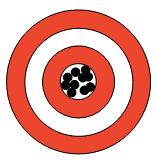
This bullseye demonstrates...

a)

High Accuracy & High Precision

b)

High Accuracy & Low Precision

c)

Low Accuracy & High Precision

d)

Low Accuracy & Low Precision

19.
This bullseye demonstrates...
a)
High Accuracy & High Precision
b)
High Accuracy & Low Precision
c)
Low Accuracy & High Precision
d)
Low Accuracy & Low Precision
20.

What is Avogadro's number?

a)

6.02 x 10²³

b)

1 mole

c)

600 million

d)

6.02

21.

How many moles are in 8.30 X 10²³ molecules of H2O?

a)

1.38 X 10²³ moles H2O

b)

1.38 moles H2O

c)

2 moles H2O

d)

1 mole H2O

22.
What is the molar mass of H2O?
a)
6.02 x 10²³
b)
16 grams
c)
18 grams
d)
15.99999 grams
23.
How many moles are in 20 grams of Ca (Calcium)?
a)
0.5 
b)
1
c)
3
d)
20
24.
N2 +  3H2 → 2NH3 
How many moles of hydrogen are needed to react with 2 moles of nitrogen?
a)
6
b)
2
c)
3
d)
1
25.
Cl2 + 2KBr → Br2 + 2KCl
How many grams of potassium chloride (KCl) can be produced from 356 g of potassium bromide (KBr)?
a)
749 g
b)
223 g
c)
479 g
d)
814 g
26.
When does a chemical reaction stop?
a)
When the lab is finished
b)
When the excess reactant is used up
c)
When the limiting reactant is used up
d)
Chemical reactions never stop
27.
What does Boyle's law relate to?
a)
Temperature and Volume
b)
Volume and Pressure
c)
Temperature and Pressure
28.
What is the formula for Boyle's Law?
a)
P1V1=P2V2
b)
P1V1/P2V2
c)
P1V2=P2V1
d)
P1/V1=P2/V2
29.
What is the formula Charles' Law?
a)
V = T
b)
VT = VT
c)
T1 / V1 = T2 / V2
d)
V1 / T1 = V2 / T2
30.
The volume occupied by 3 moles of N2 at 0oC and 101.3 kPa is ____.  
a)
67.2 L
b)
22.4 L
c)
7.47 L
d)
134.4 L
31.
In order to convert to Kelvin, you add ______ to the Celsius measurement.
a)
372
b)
273
c)
237
d)
732
32.
What is 50 C in Kelvin?
a)
223
b)
323
c)
100
d)
50
33.
You have a gas that has a pressure of 2 ATM and a volume of 10L.  What would be the new volume if the pressure was changed to 1 ATM?
a)
5 L
b)
20 L
c)
It would stay at 10L
d)
1 L
34.
What law combines all 3 factors (pressure, temperature, and volume)
a)
Combined Gas Law
b)
Charle's Law
c)
Boyle's Law
d)
Avagadros Ideal Gas Law
35.

Solutions that conduct a current are called ____________ and are made from ___________ compounds.

a)

electrolytes; ionic

b)

nonelectrolytes; ionic

c)

electrolytes; molecular

d)

electrolytes; covalent

36.
The ___ is the thing being dissolved.
a)
solute
b)
solvent
c)
mixture
d)
suspension
37.
What is the most common solvent in everyday life?
a)
Ethanol
b)
Tuluene
c)
Water
d)
Oils
38.
How does temperature affect solubility?
a)
Solubility is not affected by temperature.
b)
Solubility decreases with an increase in temperature.
c)
Solubility increases with an increase in temperature.
39.

Molarity is ...

a)

grams of solute/deciliters of solvent.

b)

grams of solute/liters of solution.

c)

moles of solute/liters of solution.

d)

moles of solute/milliliters of solvent.

40.
What is the universal solvent?
a)
salt
b)
sugar
c)
water
d)
ice
41.

What percentage of the total atomic mass of carbon monoxide (CO) is composed of carbon?

a)

29%

b)

43%

c)

57%

d)

73%

42.

What percentage of the total atomic mass of magnesium bromide (MgBr2) is composed of bromine? Hint - consider the mass of both atoms of bromine in your calculation.

a)

13%

b)

43%

c)

63%

d)

87%

43.

Calculate the molar mass of KOH.

a)

28 g/mol

b)

56 g/mol

c)

84 g/mol

d)

112 g/mol

44.

What is the molar mass of Cl2?

a)

17 g/mol

b)

35.5 g/mo;

c)

71.0 g/mol

d)

89 g/mol