
Font size
 Worksheets
2022 Conceptual Physics 2nd Semester Final Exam Review
Total questions: 190
Worksheet time: 3hrs 39mins
The unit "m/s/s" is a unit of...
velocity
displacement
time
acceleration
The unit "m/s" is a unit of...
velocity
displacement
time
acceleration
The unit "s" is a unit of...
velocity
displacement
time
acceleration
The unit "m" is a unit of...
velocity
displacement
time
acceleration
Which variable is associated with "How fast?"
Time
Velocity
Acceleration
Displacement
Which variable is associated with "How long does it take?"
Time
Velocity
Acceleration
Displacement
Which variable is associated with "How far?"
Time
Velocity
Acceleration
Displacement
If an object starts at rest, what does that mean?
Initial Velocity: Vo = 0 m/s
Final Velocity: Vf = 0 m/s
Acceleration: a = 0 m/s/s
Displacement: X = 0 m
Time: t = 0 s
If an object comes to a stop, what does that mean?
Initial Velocity: Vo = 0 m/s
Final Velocity: Vf = 0 m/s
Acceleration: a = 0 m/s/s
Displacement: X = 0 m
Time: t = 0 s
A car accelerates from 10 m/s to 20 m/s in 5 s. What is the time (t)?
10 m/s
20 m/s
5 s
A car accelerates from 10 m/s to 20 m/s in 5 s. What is the initial velocity (Vo)?
10 m/s
20 m/s
5 s
A car accelerates from 10 m/s to 20 m/s in 5 s. What is the final velocity (Vf)?
10 m/s
20 m/s
5 s
A car accelerates from 10 m/s to 20 m/s in 5 s. What variable is unknown?
Initial Velocity (Vo)
Final Velocity (Vf)
Time (t)
Acceleration (a)
A car accelerates from 10 m/s to 20 m/s in 5 s. What equation do you use to solve for acceleration?


A car accelerates from 10 m/s to 20 m/s in 5 s. What is the acceleration of the car?
2 m/s/s
2 m/s
6 m/s/s
6 m/s
Find the UNKNOWN in this problem: How long does it take for a car to come to a complete stop if it is moving at 20 m/s, then brakes with an acceleration rate of -5 m/s/s?
Initial Velocity (Vo)
Final Velocity (Vf)
Acceleration (a)
Time (t)
Find the UNKNOWN in this problem: A dog starts at rest and runs with an average velocity of 3 m/s. How fast is the dog running at the end of its trip?
Vo
Vavg
Vf
a
What EQUATION would you use to solve this problem? A ball rolls 25 m in 5 s. What is the average velocity of the ball?


What EQUATION would you use to solve this problem? The average velocity of a car is 20 m/s. If it starts from rest, what is the final velocity of the car?
What EQUATION would you use to solve this problem? The average velocity of a runner is 4 m/s. If the person runs 1000 m, how long did they run?
What EQUATION would you use to solve this problem? A biker starts at rest and accelerates at a rate of 1.2 m/s/s for 5 s. What is the final velocity of the biker?
Solve this problem: A cheetah accelerates at 3.7 m/s/s for 5 seconds. If its final velocity is 21 m/s, determine the cheetah’s initial velocity.
0 m/s
2.5 m/s
39.5 m/s
18.5 m/s
Solve this problem: A biker initially traveling at 12 m/s slams on her brakes and comes to a stop. What is her average velocity?
24 m/s
12 m/s
18 m/s
6 m/s
A skateboarder travels 1024 m in 180 s. What is the average velocity of the skateboarder?
0.18 m/s
7.32 m/s
844 m/s
5.69 m/s
Solve this problem: How long does it take for a car travelling an average velocity of 22 m/s to go 824 m?
0.027 s
24.31 s
37.45 s
51.33 s
Solve this problem: An elevator starts moving upward at a velocity of 1.4 m/s and is accelerating 1.7 m/s/s. How fast is the elevator travelling after 4 s?
7.3 m/s
8.2 m/s
6.4 m/s
7.1 m/s
Solve this problem: A ball rolls for 16 s at an average velocity of 2.7 m/s. How far does it travel?
5.9 m
18.7 m
31.8 m
43.2 m
Solve this problem: A biker travels with an average velocity of 6.3 m/s. The biker speeds up to 7.2 m/s to catch up with a friend. What is the initial velocity of the biker?
5.4 m/s
8.1 m/s
6.8 m/s
4.8 m/s
What is Newton's 1st Law?
An object in motion stays in motion, an object at rest stays at rest, unless acted on by an unbalanced force.
Force = Mass x Acceleration
For every force, there is an equal and opposite force.
What is Newton's 2nd Law?
An object in motion stays in motion, an object at rest stays at rest, unless acted on by an unbalanced force.
Force = Mass x Acceleration
For every force, there is an equal and opposite force.
What is Newton's 3rd Law?
An object in motion stays in motion, an object at rest stays at rest, unless acted on by an unbalanced force.
Force = Mass x Acceleration
For every force, there is an equal and opposite force.
Inertia depends only on...
shape
weight
applied force
mass
Inertia is...
An applied force.
The tendency of objects to resist change in motion (keep doing what their doing).
A type of acceleration.
A type of friction.
Which object has the MOST inertia?
A ping-pong ball.
A golf ball.
A tennis ball.
A bowling ball.
According to Newton's 3rd Law, forces...
act alone.
come in pairs.
are always perpendicular.
come in groups of four.
For every force, there is an equal and opposite force. What is EQUAL?
The size of the forces.
The direction of the forces.
The type of forces.
The motion of the objects.
For every force, there is an equal and opposite force. What is OPPOSITE?
The size of the forces.
The direction of the forces.
The type of forces.
The motion of the objects.
You pull a tablecloth out from under some dishes. Which object on the table would have the most inertia?
A heavy glass
A plastic plate
A spoon
All items have the same inertia.
You push an empty box. A student puts a backpack in the box. If you keep pushing with the same force, what would happen to the acceleration?
It increases.
It decreases.
It stays the same.
A force is a hammer pushing down on a nail. What is its "equal and opposite" force?
The nail being pushed down into the wood.
The air pushing up on the hammer.
The hand pushing down on the hammer.
The nail pushing up on the hammer.
A ball rolls into a wall with 20 N of force. What is the size of the force that the wall applies to the ball?
Greater than 20 N
Less than 20 N
0 N
20 N
A child is pulling a wagon. If the child increases the force on the wagon, what will happen to the acceleration?
Acceleration increases
Acceleration decreases
Acceleration stays the same
You are pushing a shopping cart with a constant force. You add groceries to the cart, and its mass is doubled. What happens to the acceleration?
Acceleration decreases by half.
Acceleration doubles.
Acceleration stays the same.
Acceleration decreases by 1/4.
Air is rushing out of a balloon. The balloon pushes air to the left. What is the "equal and opposite" force?
The balloon gets smaller.
The balloon moves to the left.
Air pushes the balloon upward.
Air pushes the balloon to the right.
A backpack is sitting on the floor. It does not move until a student picks it up. This demonstrates...
Newton's 1st Law
Newton's 2nd Law
Newton's 3rd Law
When you go bowling, it takes more force to roll a heavy bowling ball than a light bowling ball. This demonstrates...
Newton's 1st Law
Newton's 2nd Law
Newton's 3rd Law
When you jump down on a trampoline, the trampoline pushes back up on you. This demonstrates...
Newton's 1st Law
Newton's 2nd Law
Newton's 3rd Law
Which object has the most inertia?
A baseball (0.15 kg) moving at 40 m/s.
A car (1000 kg) that is not moving.
A cannon ball (5 kg) moving at 100 m/s.
A student (60 kg) sitting in a desk.
The unit for mass is...
Newton (N)
kilogram (kg)
meters per second squared (m/s2)
meters per second (m/s)
The unit for force is...
Newton (N)
kilogram (kg)
meters per second squared (m/s2)
meters per second (m/s)
The unit for acceleration is...
Newton (N)
kilogram (kg)
meters per second squared (m/s2)
meters per second (m/s)
You kick a ball. This shows Newton's 1st Law because...
The harder you kick the ball, the more it accelerates.
When you kick the ball, the ball pushes back on you.
The ball doesn't move until you kick it.
The example does not show this law.
You kick a ball. This shows Newton's 2nd Law because...
The harder you kick the ball, the more it accelerates.
When you kick the ball, the ball pushes back on you.
The ball doesn't move until you kick it.
The example does not show this law.
You kick a ball. This shows Newton's 3rd Law because...
The harder you kick the ball, the more it accelerates.
When you kick the ball, the ball pushes back on you.
The ball doesn't move until you kick it.
The example does not show this law.
You push a box using a force of 70 N. The box has a mass of 10 kg. What is its acceleration?
700 m/s2
60 m/s2
80 m/s2
7 m/s2
You drop a bowling ball and it accelerates at 10 m/s2. If the bowling ball has a mass of 5 kg, with what force will it hit the ground?
5 N
0.5 N
50 N
2 N
You push a box of books with a force of 80 N. If it accelerates at 2 m/s2, then what is the mass of the box?
82 kg
40 kg
160 kg
78 kg
You push a person on a scooter with a force of 30 N. If the person and scooter have a mass of 60 kg, how fast with they accelerate?
30 m/s2
2 m/s2
0.5 m/s2
90 m/s2
A dog pulls on a leash with a force of 40 N. What is the size of the force that the leash applies to the dog?
Greater than 40 N
Less than 40 N
0 N
40 N
Two children are being pulled in a wagon. If the wagon's acceleration stays the same, what happens to the force if one child jumps out of the wagon (mass is decreased)?
Force increases
Force decreases
Force stays the same
A pencil pushing down on paper is a force. What is the "equal and opposite" force?
The pencil moving across the paper.
The hand pushing down on the pencil.
The pencil pushing up on the hand.
The paper pushing up on the pencil.
Which statement about inertia is FALSE?
More mass, more inertia.
More mass, less inertia.
Less mass, less inertia.
Inertia means objects keep doing what they're doing.
Your backpack pulls down on your shoulders with a force of 200 N. What is the "equal and opposite" force?
Your shoulders pushing up with 100 N force on the backpack.
Your shoulders pushing down on the backpack with a force of 200 N.
Your shoulders pushing up with 200 N force on the backpack.
The backpack accelerating downward.
The amount of friction depends on the normal force of the objects pressing together.
True
False

FN=100N, Ff=20N
μ=5.0
μ=0.2
μ=1.2
μ=0.1
Normal force is
Always opposite the weight
Always parallel and down the incline
Always perpendicular to the surface
It depends on the direction of motion
Pressure is force per unit area. What is the SI unit for pressure?
N
Nm
Pa
kPa

Amira puts two books on a table as shown in the diagram. The books are the same size and mass. Which book exerts greater pressure on the table?
A
B
What pressure will be exerted by a 10 N box that has equal sides of 1 meter?
1 Pa
2 Pa
5 Pa
10 Pa
20 Pa


Which one falls faster in vacuum? An elephant or a leaf?
Elephant
Leaf
They are the same
Nothing can be said
If air resistance is ignored, the distance that a freely falling body in equal time intervals of 1 s _________________
increases as it falls
decreases as it falls
remains the same
depends on the mass of the body
Which one falls faster in vacuum? An elephant or a leaf?
Elephant
Leaf
They are the same
Nothing can be said
If air resistance is ignored, the distance that a freely falling body in equal time intervals of 1 s _________________
increases as it falls
decreases as it falls
remains the same
depends on the mass of the body
If a ball is thrown downward at 30 m/s, what will its speed be at 4 s? (Assume no air resistance)
40 m/s
70 m/s
50 ms
10 m/s
An object free falls for 3.5 seconds. How far does it fall?
120.05 m
17.15 m
60.03 m
34.3 m

Which of the dot diagrams best describe the motion of a free-falling object that is dropped from rest?
Diagram A
Diagram B
Diagram C
As a rock in FREE FALL falls through the air, acceleration
stays constant
decreases until it hits terminal velocity
increases until it hits terminal velocity
increases ~10 m/s each second
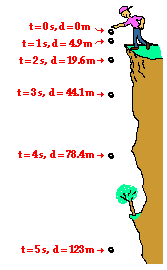
Using g = -10 m/s2:
A ball is tossed up from the ground at a speed of 40 m/s. How many seconds does it take to get to the top of its arc?
2
4
6
8
Which of the dot diagrams best describe the motion of a free-falling object that is dropped from rest?
Diagram A
Diagram B
Diagram C
If a freely falling object were somehow equipped with a speedometer, its speed reading would increase each second by
its rate depends on its initial speed
about 15 m/s
about 10 m/s
about 5 m/s

If you throw a ball straight up, what is its velocity at the highest point?
9.81 m/s2
0.0 m/s2
9.81 m/s
0.0 m/s
A ball is tossed upward and caught at the same position of throw. In the absence of air resistance, the speed of the ball when it is caught would be
less than the speed it had when tossed upwards
the same as the speed it had when tossed upwards
more than the speed it had when tossed upwards
The state that exists when the only force acting on an object is gravity is called
momentum
acceleration
inertia
free fall
An object in equilibrium can still have forces acting on it.
True
False

The free body force diagram shows the forces acting on Peter at point (a) .

Which diagram shows the forces acting on Peter when he is falling at Terminal Velocity?
1
2
3
Which statement correctly describes the weight and mass of an object?
Weight is always the same, mass changes depending on the gravitational field strength.
Weight and mass both depend on the gravitational field strength.
Weight changes depending on the gravitational field strength, mass is always the same.
Neither weight nor mass depend on the gravitational field strength.
An object that has momentum can be described as _________
a) changing its velocity
b) moving fast
c) resisting changes in its state of motion
d) having its mass in motion
e) encountering a net force
Which one of these objects has the greater amount of momentum?
A turtle that slowly crosses a road
A parked car
A stop sign
Which one of the following units represents the standard metric units of momentum
Newtons * meter / second
Kilograms * meter / second2
meter / second
Kilograms * meter / second
During a collision. an object experiences an impulse. How can this impulse be calculated?
Multiplying force by time
Multiplying mass by velocity
Dividing velocity by time
Multiplying mass by acceleration
During a collision. an object experiences an impulse. The impulse causes and is equal to the _____ of the object
energy change
kinetic energy change
force
momentum
momentum change
When a cannon fires a cannon ball, it recoils backwards. This occurs because of...
Energy in the system is conserved
Energy in the system is increased
Momentum in the system is conserved
Energy in the system is not conserved
A freight car of mass 20,000kg moves along a track at 15 m/s. What is the momentum of the car?
30,000 kg*m/s
3,000 kg*m/s
300,000 kg*m/s
3,000,000 kg*m/s
A 2kg object moving at 5 m/s encounters a 30 N resistive force over a duration of 0.10 seconds. The impulse experienced by this object is _____
0.30 N*s
2 N*s
2.5 N*s
3 N*s
7 N*s
A football player is running north down the field, and has a momentum of 120 kg*m/s. He experience a southward impulse of 200 N*s. What is the final momentum of the player
80 kg*m/s north
80 kg*m/s south
320 kg*m/s north
320 kg*m/s south
A 40 kg object has an eastward momentum of 360 kg*m/s. The object encounters a westward impulse of
120 N*s. What is its final velocity?
3 m/s
6 m/s
9 m/s
12 m/s
An egg landing on a soft surface will remain intact. The surface increases the _____ and decreases the _____ during the impact
impulse, time
impulse, force
force, time
time, force
A 5kg ball has a momentum of 30 kg*m/s. What is the speed of the ball
150 m/s
35 m/s
6 m/s
5 m/s
Padded dashboards in cars are safer in accidents than non padded ones because the passenger hitting the dash has...
a) Increased time of impact
b) decreased impulse
c) decreased impact force
d) a and b
e) a and c
A small fish is at rest. A big fish, with 4 times the mass and a speed of 20 cm/s swallows the small fish. What is the new speed of the fish?
20 cm/s
16 cm/s
5 cm/s
25 cm/s
80 cm/s
Before objects A and B collide, A has a momentum of 26 kg*m/s and B has a momentum of -14 kg*m/s. After the collision, A has a momentum of 8 kg*m/s. B has a momentum of..
2 kg*m/s
4 kg*m/s
6 kg*m/s
12 kg*m/s
32 kg*m/s
A 10 kg object moves at 2 m/s to the right and collides with a 4 kg object moving at 5 m/s to the left. The total momentum is_____
20 kg*m/s
40 kg*m/s
10 kg*m/s
30 kg*m/s
0 kg*m/s
Two skaters stand facing each other. One skater's mass is 60 kg, and the other's mass is 72 kg. If the skaters push away from each other without spinning,
the lighter skater has lees momentum
their momenta are equal but opposite
their total momentum doubles
their total momentum decreases
A piece of silly putty is dropped onto a skateboard as it rolls by. The putty sticks to the skateboard and moves the direction the board is moving. What type of collision is this?
Inelastic collision
Elastic Collision
Perfectly Inelastic collision
No collision
If a collision is elastic which of the following must be true?
Momentum is not conserved
The objects are in an open system
The total momentum is equal to 0
Kinetic Energy is conserved
If a collision is inelastic which of the following must be true?
the total momentum of the system is conserved
The total momentum of the system is not conserved
The total momentum of the system is 0
The total kinetic energy of the system is conserved
If there is a perfectly inelastic collision, which of the following must be true?
The total momentum of the system is 0
The total kinetic energy of the system is conserved
The objects stick together after colliding
The total momentum of the system is not conserved
Two carts collide. They stick together and continue moving. Is momentum conserved in this interaction?
Yes
No
Two carts collide. They stick together and continue moving. Is total kinetic energy conserved in this interaction?
Yes
No
A BMW rear ends a car at the stop light. Neither car sticks together. The momentum was conserved in the collision but the kinetic energy was not conserved. What type of collision is this?
Elastic Collision
Inelastic Collision
Perfectly inelastic Collision
No Collision
What is the equation for momementum?
p=m×v
p=m×a
p=f÷a
m=p×v
What are the units for impulse? Two options
J
m/s
kg-m/s
N
N-s
The purpose of crumple zones on a car is to
decrease time of impact.
increase force of impact.
increase the time of impact.
decrease the impulse during impact.
The ability to do work or cause change:
work
energy
momentum
power
Energy in the form of motion.
mechanical energy
potential energy
kinetic energy
momentum
Stored energy in the form of position or condition.
potential energy
kinetic energy
momentum
mechanical energy
A soccer player kicks a ball with 20 Newtons of force causing it to travel 100 meters. How much work is done on the ball?
200 J
80 J
5 J
2000 J
A worker climbs a ladder and does 8 J of work on a 2 N object. What is the distance they lift the object?
18 m
4 m
10 m
6 m
Where is the kinetic energy of pendulum at its highest?
at the top of the swing
at the bottom of the swing
at 1/4 of the swing
at 3/4 of the swing

At which point of this roller coaster is the energy 1/2 kinetic and 1/2 potential?
A
B
C
D
Two workers use 100 N of force to move a sofa 2 meters in 2 seconds. How much power is required?
100 watts
400 watts
104 watts
50 watts
The SI unit for power is...?
Watts
Joules
Newtons
Metres


Suppose a cart has a kinetic energy of 0.5 J. If you add enough mass to double the mass and make the cart go three times as fast, its kinetic energy is now ---.
6 J
3 J
18 J
9 J

Two equal mass marbles are at the top of a ramp. One marble falls to the ground off the back while the other rolls down the ramp. What is true about the marbles when they reach the ground?
The marble that rolled down the ramp is moving faster than the marble that fell.
The marble that fell down the back of the ramp is moving faster than the marble that rolled.
The marble that rolled down the ramp is not moving when it reaches the ground.
The two marbles are moving with the same speed.

A block starts at rest at point P at the top of a ramp which is height h above the ground. The block slides down one side and up the other, stopping at a point less than h above the ground.
The block did not go as high on the other side because gravity pulls down.
The block did not go as high on the other side because potential energy always has to decrease.
The block did not go as high on the other side because work from friction made the mechanical energy less.
The situation as described is impossible to happen.

If there is no friction on this track, at which point would the coaster have the most kinetic energy?
A
B
C
D
A 40-kg person is climbing 3 m up a flight of stairs in 6 seconds. How much power did they exert climbing the stairs?
400 W
1200 W
200 W
120 W
What effect do external forces like an applied force, friction force, or drag force have?
They have no effect on a system's mechanical energy.
They convert kinetic energy into potential energy.
They convert potential energy into kinetic energy.
They convert between mechanical energy and other forms of energy to change the total mechanical energy of the system.
How does conservation of energy explain why something that is falling should speed up?
It gains kinetic energy because it gains potential energy.
It loses kinetic energy because no work was done on it.
It gains kinetic energy because it loses potential energy.
It loses kinetic energy because the Earth gains potential energy.
Round 509.967 to 4 significant figures.
509.9
509.0
510.0
510.
How many significant figures are in the number 4.56 x 10³?
5
4
6
3
Write 1.26 x 10³ in standard or expanded form.
1260
126
126.0
12.6
Write 5,795,000 in scientific notation
5.795 x 10³
5.795 x 10⁴
57.95 x 10⁵
5.759 x 10⁶
Convert 5.89 x 10⁻⁴ to standard or expanded form.
0.00589
0.000589
58900
58.900
Calculate and report 0.0005 meters + 0.029 meters to the correct number of significant figures?
0.0295 meters
0.300 meters
0.030 meters
0.029 meters
Calculate and report 9544 lbs - 321 lbs to the correct number of significant figures?
9000 lbs
9220 lbs
9223 lbs
9862 lbs
Calculate and report 5,000 ÷ 870 to the correct number of significant figures ?
5.74
6
5.7
5
Calculate and report 2.4 x 550 to the correct number of significant figures?
1320
1300
1000
1320.0
Convert 67,400,000 to proper scientific notation.
6.74 x 10⁷
67.4 x 10⁶
6.74 x 10⁻⁷
674 x 105
Convert 0.000044 to proper scientific notation.
4.4 x 10⁵
44 x 104
44 x 10-4
4.4 x 10⁻⁵
If the exponent is a positive number:
The number is large
The number is small
If the exponent is a negative number:
The number will be small
The number will be large
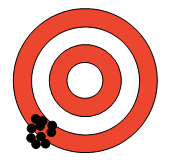
The results of these attempts on a target indicate...
High Accuracy & High Precision
High Accuracy & Low Precision
Low Accuracy & High Precision
Low Accuracy & Low Precision
Measurements: 12.3, 14.5, 10.1, 16.9
True Value: 25.0
These measurements are…
Accurate, but not precise
Precise, but not accurate
Both precise and accurate
Neither precise nor accurate
Measurements: 24.9, 25.2, 25.1, 24.8
True Value: 25.0
These measurements are…
Accurate, but not precise
Precise, but not accurate
Both precise and accurate
Neither precise nor accurate
How close a measurement is to the true value is called..
Accuracy
Precision
Significant
Estimate
The root word kilo means
1,000
1/1,000
100
The root word milli means
your youngest little baby sibling
1/1,000
1/100
1,000
10-9
tera
pico
giga
nano
109
tera
pico
giga
nano

How many minutes are in a school year, 187 days?
269,280 min.
16, 200 min.
16, 156 min.
269,000 min.
Convert 62 miles/hour to feet/second. (5,280 ft = 1 mi)
5,456 ft/s
.003 ft/s
91 ft/s
909 ft/s
If you do not understand a direction or part of a lab procedure, you should
figure it out as you do the lab
try several methods until something works
ask the instructor before proceeding
skip it and go on to the next part
In the laboratory, the following should not be worn
loose clothing
dangling jewelery
sandals
all of the above
True or False: Laboratory work can be started immediately upon entering the laboratory even if the instructor is not yet present.
True
False
The base for mass in the SI system is the __________.
meter
gram
kilogram
liter
The base unit of length in the SI system is the ______.
Meter
Liter
Kilogram
milligram

What is this measurement?
2.9375 cm
2.9375 in
2 15/16 cm
2 15/16 in

What is the measurement to the correct degree of precision?
(a)

