wayground logo

Free Printable Worksheets

NEW

Font size

S
M
L
XL
Worksheets

Spring Final Review

Total questions: 68

Worksheet time: 3hrs 37mins
Name
Class
Date
1.
Convert 17 m to cm:
a)
0.17 cm
b)
0.017 cm
c)
1,700 cm
d)
170 cm
2.
1000 grams = _____ kilograms
a)
0.0001
b)
1,000,000
c)
10
d)
1
3.
1 L = _______ mL
a)
1
b)
10
c)
100
d)
1000
4.
Change from standard form to scientific notation: 12,000,000
a)
12.0  x  107
b)
0.12  x  107
c)
1.2  x  106
d)
1.2  x  107
5.
Change from standard form to scientific notation:  0.000398
a)
39.8  x  10-5
b)
3.98  x  10-5
c)
3.98  x  10-4
d)
39.8  x  10-6
6.
125,678,000: Change to scientific notation
a)
1.25678  x  1012
b)
.125678  x  10-9
c)
12.5678  x  108
d)
1.25678  x  108
7.
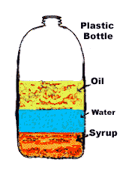
Which liquid is the least dense?
a)
oil
b)
water
c)
syrup 
d)
plastic bottle
8.
What is the formula for density?
a)
density = mass x volume
b)
density = mass / volume
c)
density = mass + volume
d)
density = mass - volume
9.
Frank has an eraser. It has a mass of 4g, and a volume of 2cm3. What is its density?
a)
8 g/cm3
b)
2 g/cm3
c)
1/2 g/cm3
d)
24 g/cm3
10.

Which of the following is an assumption of the kinetic-molecular theory of gases?

a)

Collisions between gas particles are inelastic.

b)

Gases consist of closely spaced particles.

c)

Gas particles move around in an orderly manner.

d)

The temperature of a gas depends on the average kinetic energy of the gas particles.

11.

Convert: 253 °C to K:

a)

526 K

b)

625 K

c)

0 K

d)

186 K

12.

Convert: 175 K to °C:

a)

-98 °C

b)

79 K

c)

230.9 °C

d)

-48.2 °C

13.
What particle provided the positive charge for an atom?
a)
proton 
b)
neutron
c)
electron
d)
nucleus
14.
The dense center region of an atom
a)
electron cloud
b)
core
c)
nucleus
d)
centrino
15.
Subatomic particle that determines the identity of the atom
a)
proton
b)
nucleus
c)
electron
d)
neutron
16.
An atom with an unequal number of protons and electrons is said to have (a) ___.
a)
no charge
b)
balance
c)
charge
d)
unbalance
17.
In order of most to least penetrating radiation we have
a)
Alpha , Beta,  Gamma
b)
Beta , Gamma , Alpha
c)
Gamma, Beta, Alpha
d)
Gamma, Alpha, Beta
18.

What is an isotope?

a)

forms of the same element that contain equal numbers of electrons but different numbers of protons

b)

forms of the same element

c)

forms of the same element that contain equal numbers of protons but different numbers of neutrons

d)

An atom with no nucleus

19.
What makes something radioactive?
a)
elements with an atomic number above 81
b)
an unstable nucleus
c)
contaminated sewage
d)
It decays over time
20.
How many protons are in an atom with an atomic number of 20, an atomic mass of 45, and a charge of +2?
a)
20
b)
10
c)
2
d)
18
21.
How many electrons are in an atom that has an atomic number of 34, an atomic mass of 74 and a charge of -2?
a)
34
b)
36
c)
2
d)
40
22.
How many neutrons will an atom have it has an atomic number of 26, an atomic mass of 58 and a charge of +3?
a)
26
b)
58
c)
32
d)
3
23.

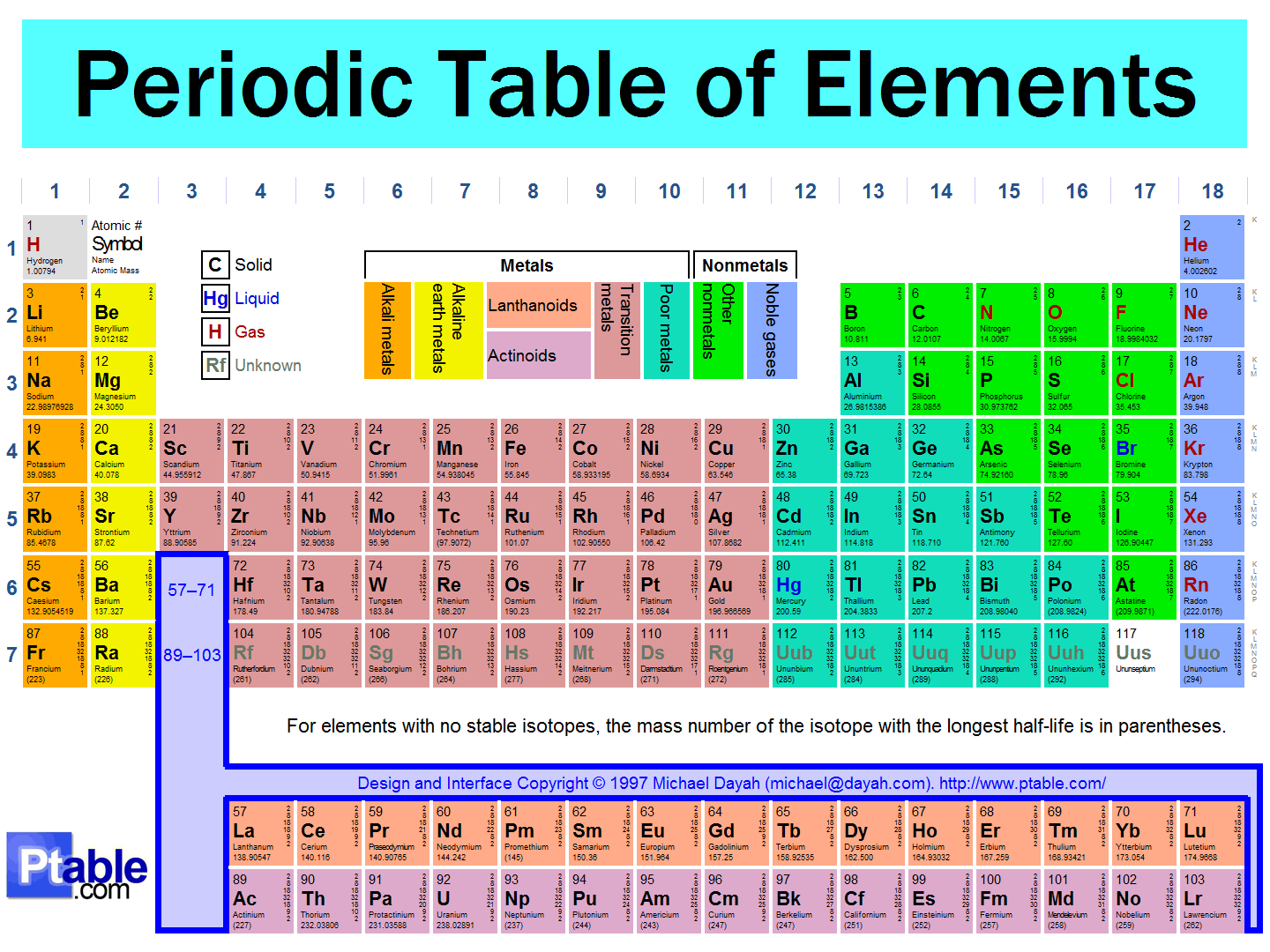
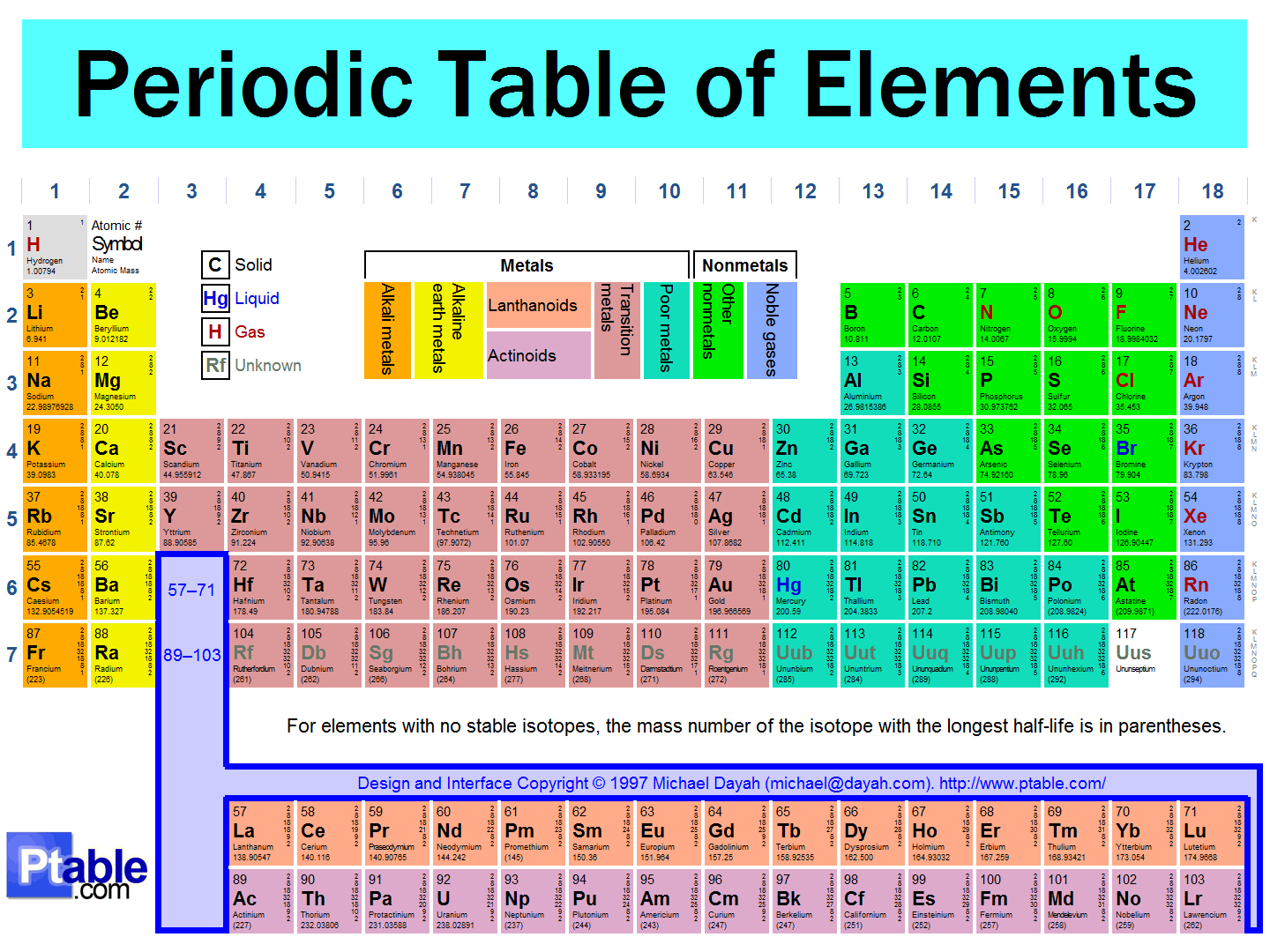
The horizontal rows on the periodic table are called

a)

groups

b)

families

c)

periods

d)

atomic numbers

24.

Each vertical column on the periodic table is called a...

a)

group

b)

tower

c)

period

d)

crew

25.

In each square of the periodic table, the number at the bottom is the:

a)

atomic number

b)

atomic mass

c)

chemical symbol

d)

element name

26.
The number at the top of each square on the periodic table is the ...
a)
atomic number
b)
atomic mass
c)
Chemical Symbol
d)
Element Name
27.

On the periodic table, elements on the right side of the "stair-step" line are classified as:

a)

nonmetals

b)

metals

c)

gases

d)

Halogens

28.

These elements located on the "stair-step" line are sometimes called "semiconductors."

a)

Metals

b)

Nonmetals

c)

Metalloids

d)

Groups

29.
Most of the elements on the periodic table are classified as _____.
a)
Metals
b)
Nonmetals
c)
Metalloids
d)
Periods
30.

How many Valance electrons does Iodine Have?

a)

6

b)

16

c)

7

d)

17

31.

Elements in the same group or family have the same number of

a)

neutrons

b)

valence electrons

c)

electrons

d)

energy levels

32.
How many electrons does Oxygen need to fill its outer shell?
a)
3
b)
4
c)
1
d)
2
33.
How many valence electrons does Neon have?
a)
7
b)
8
c)
9
d)
10
34.
What is the number of valence electrons for Beryillum?
a)
1
b)
4
c)
2
d)
7
35.

Different isotopes have...

a)

different mass numbers

b)

different atomic numbers

c)

different electrons

d)

different protons

36.
Which element has the smaller atomic radius: potassium (K) or bromine (Br)?
a)
potassium (K)
b)
bromine (Br)
37.
As you move across the periodic table from left to right, the atomic radius decreases.  This is because - 
a)
the number of protons increases, so attraction to electrons increases
b)
the number of energy levels increases
c)
the number of electrons increases
d)
the atomic mass increases
38.
In the compound TiO2, titanium has a charge of
a)
4+
b)
2+
c)
2-
d)
4-
39.
What is the ionic compound formed between Ca and Br?
a)
CaBr
b)
CaBr2
c)
Ca2Br
d)
Ca2Br
40.
Nitrogen will form which of the following ions?
a)
N
b)
N-3
c)
N-5
d)
N+5
41.

The name of FeCl₂ is

a)

iron chloride

b)

iron (II) chloride

c)

iron (I) chloride

d)

iron dichloride

42.

When naming a compound, which of these is written first?

a)

Metal

b)

Nonmetal

c)

Anion

d)

Cation

43.

When naming a compound, what must the last part be?

a)

the element with "ide" at the end

b)

the element with the ending "ite"

c)

the name of the element

d)

the element with "ide" at the end, unless its a polyatomic ion

44.

The name of the compound Ca3(PO4)2

a)

calcium phosphate

b)

tricalcium diphosphate

c)

calcium phosphorus oxide

d)

calcium phosphide

45.
The chemical formula of Iron (III)bromide is
a)
FeBr
b)
Fe(III)Br
c)
FeBr₃
d)
Fe₂Br₃
46.
The chemical compound for sodium phosphate would be:
a)
NaPO4
b)
Na2PO4
c)
Na3PO4
d)
Na(PO4)3
47.
What can be generalized about covalent bonds?
a)
Electrons will be exchanged.
b)
Electrons will be transferred.
c)
Electrons will be given and taken.
d)
Electrons will be shared.
48.
What two types of atoms make a covalent bond?
a)
2 Nonmetals
b)
1 Nonmetal & 1 Metal
c)
2 Metals
d)
2 Noble Gases
49.

Which formula is for phosphorus trichloride?

a)

KCl3

b)

PCl3

c)

K3Cl

d)

P3Cl

50.
What is the correct name for NO?
a)
Mononitrogen Monoxide
b)
Nitrogen Monoxide
c)
Mononitrogen Dioxide
d)
Nitrogen Oxide
51.
__NaClO--> __NaCl + __O2
a)
2,2,2
b)
2,2,3
c)
3,2,2
d)
1,2,3
52.
Which reaction type is the following:  Na + CaF2 --> Ca + NaF
a)
Decomposition
b)
Single Replacement
c)
Synthesis
d)
Double Replacement
53.
Which reaction type is the following: AgF + CaCl2 --> AgCl + CaF2
a)
Decomposition
b)
Single Replacement
c)
Synthesis
d)
Double Replacement
54.
Which chemical reaction breaks down into 2 substances?
a)
Double Replacement
b)
Single Replacement
c)
Synthesis
d)
Decomposition
55.
Which of the following is an example of synthesis?
a)
Na + Br--> NaBr
b)
KClO--> KCl + O2
c)
HgO + Cl2-->HgCl + O2
d)
Cl2 + NaBr --> NaCl + Br2
56.
2 KClO3 → 2 KCl + 3 O2
How many moles of oxygen are produced when 6.7 moles of KClO3 decompose completely?
a)
6.7 mol
b)
1.0 mol
c)
10.1 mol
d)
4.5 mol
57.
For the Balanced Reaction: 3 Mg + 1 Fe2O3 → 3 MgO + 2 Fe; What is the Ratio of moles of MgO to moles Fe?
a)
3mol Mg / 2 mol Fe
b)
2 mol Mg/ 3 mol Fe
c)
1 mol Fe/ 2 mol Fe
d)
3 mol MgO / 2 mol Fe
58.
Using the following equation:
Fe2O3(s) + 3H2(g) → 2Fe(s) + 3H2O(l)
How many moles of iron can be made from  6 moles H2
a)
4 moles Fe
b)
6 moles Fe
c)
9 moles Fe
d)
2 moles Fe
59.
What is the molar mass of (NH4)2CO3 ?
a)
144 g
b)
138 g
c)
96 g
d)
78 g
60.
How many water molecules are in 5.2 moles of water?
a)
6.02 x 10²³
b)
5.2
c)
3.1304 x 1024
d)
8.638 x 10⁻²⁴
61.

CH4 + 2 O2 → CO2 + 2 H2O

How many moles of carbon dioxide are produced from the combustion of 110 g of CH4?

a)

13.7 mol

b)

2.75 mol

c)

6.11 mol

d)

6.85 mol

62.
The limiting reactant
a)
slows the reaction down
b)
is used up first
c)
is the reactant that is left over
d)
controls the speed of the reaction
63.

This image demonstrates that

a)

There is a direct correlation with the atmospheric CO2 and the CO2 in seawater

b)

That pH of the ocean increases as the atmospheric CO2 increases

c)

That there is no correlation between pH of the ocean and atmospheric CO2

64.
How many moles are needed to make 2.5 L of a 3.8 M solution? 
a)
9.5 mol
b)
0.66 mol
c)
1.5 mol
d)
15 mol
65.

What is the [H+] if the pH is 4.0?

a)

1.0 x 10⁻¹⁰ M

b)

1.0 x 10⁻¹⁴ M

c)

1.0 x 10⁻⁴ M

d)

1.0 x 10⁻⁷ M

66.

If the pH of a solution is 4.0, what is the pOH?

a)

4.0

b)

10.0

c)

1.0 x 10 -4

d)

cannot be determined from the information

67.

Which of the following show an acid and its conjugate base pair (in that order)

a)

H2SO4, SO42-

b)

OH-, H2O

c)

NH4+, H2O

d)

H2CO3, HCO3-

68.
Which of the following is the best conclusion that can be made from this graph?
a)
atmospheric carbon dioxide levels have been decreasing since 1960
b)
Hawaii has a lot of carbon dioxide
c)
humans have been working hard to decrease carbon dioxide levels
d)
atmospheric carbon dioxide levels have increased steadily since 1960