Wayground logo

Free Printable Worksheets

Font size

S
M
L
XL
Worksheets

Final Review

Total questions: 50

Worksheet time: 2hrs 2mins
Name
Class
Date
1.
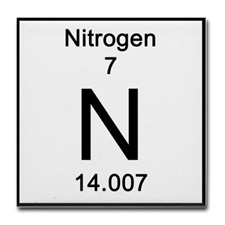
What is the number of protons that the element in this image contain?
a)
14
b)
7
c)
15
d)
18
2.

What electron configuration matches an oxygen atom?

a)

1s22s22p63s2, 3p64s23d104p5

b)

1s22s22p4

c)

1s22s22p6

d)

1s22s22p63s23p64s23d1

3.

What form of energy is emitted when an excited electron returns to the ground state?

a)

Photon (light)

b)

Heat

c)

Kinetic

d)

Potential

4.

How is the alpha particle written in a nuclear equation?

a)

42He

b)

24He

c)

0-1e

d)

00γ

5.
Solve this equation for alpha decay.
85209At = ___ + 24He
a)
83205Bi
b)
86209Rn
c)
81207Tl
d)
85208At
6.
The type of bond where valence electrons are SHARED is called: 
a)
Covalent
b)
Ionic
c)
Hydrogen
d)
Isotope 
7.
The type of bond where valence electrons are TRANSFERRED is called: 
a)
Covalent
b)
Ionic
c)
Hydrogen
d)
Isotope
8.
Between metals and nometals
a)
Ionic Bonds
b)
Covalent Bonds
c)
Both bonds
d)
Neither bond
9.
Between  nonmetals
a)
Ionic Bonds
b)
Covalent Bonds
c)
Both bonds
d)
Neither bond
10.

LiBr is called

a)

lithium bromine

b)

lithium (I) bromine

c)

lithium bromide

d)

lithuim (I) bromide

11.
What is the correct name for C4H6?
a)
Carbon Hexahydride
b)
Pentacarbon Pentahydride
c)
Hexacarbon Tetrahydride
d)
Tetracarbon Hexahydride
12.
What is Sulfur Trichloride?
a)
SCl3
b)
SiCl3
c)
SCl4
d)
Si3Cl
13.

Which of these is the strongest bond?

a)

single bond

b)

double bond

c)

triple bond

14.
Which element has the smaller atomic radius: potassium (K) or bromine (Br)?
a)
potassium (K)
b)
bromine (Br)
15.
Which element has the greatest electronegativity: Nitrogen (N) or Arsenic (As)?
a)
Nitrogen (N)
b)
Arsenic (As)
16.

Predict the products for the this Single Replacement reaction:

K + HCl →

a)

KCl + H2

b)

KHCl

c)

KH + Cl2

d)

HCl + K2

17.

How many protons are found in the following isotope?

a)

207

b)

82

c)

125

d)

289

18.
How many valence electrons?
a)
2
b)
3
c)
5
d)
10
19.
Which group of the periodic table is composed of inert (not reactive)  gases?
a)
alkali metals
b)
alkaline earth metals
c)
halogens
d)
noble gases
20.
Elements in a ..................have similar chemical properties.  
a)
period
b)
group
c)
row
21.
The atom with the largest atomic radius in Period 4 (row 4) is - 
a)
K
b)
Kr
c)
Fe
d)
Fe
22.
Which has the greater Electronegativity: 
N or C?
a)
C
b)
N
23.
How many valence electrons are found in atoms of group 15?
a)
4
b)
5
c)
2
d)
3
24.
For the reaction...
SO2 + O2  <−>  SO3
If the concentration of SO2 is increased, the equilibrium of the reaction will shift ___________.
a)
left
b)
right
c)
left and right 
d)
neither left nor right
25.
For the reaction...
H2 (g)  + Cl2 (g) <−>  2HCl (g)  +  heat
If the temperature is cooled, the _________ reaction will be favored.
a)
forward
b)
reverse
c)
forward and reverse
26.
Which of the following is NOT true at equilibrium?
a)
The forward and reverse reactions proceed at the same rate.
b)
The concentrations of reactants and products do not change.
c)
The concentration of the reactants is equal to the concentration of the products.
d)
The forward and reverse reactions continue to occur.
27.
How do catalysts increase the rate of reaction?
a)
The frequency of collisions is the increased
b)
the activation energy is lowered
c)
the energy of collisions is increased
d)
Both the frequency and energy of collisions is increased
28.

How many joules of heat are needed to raise the temperature of 10.0 g of aluminum from 22.0°C to 55.0°C, if the specific heat of aluminum is 0.903 J/g°C?

a)

298 Joules

b)

0.003 Joules

c)

297 J/g°C

d)

0.003 J/g°C

29.

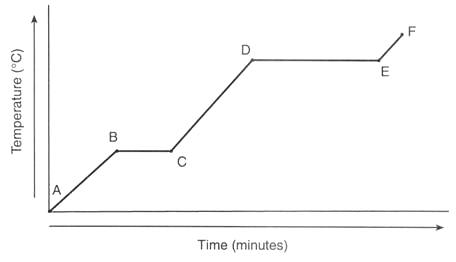
What line segment represents only the solid state? (Diagram F)

a)

A-B

b)

B-C

c)

C-D

d)

D-E

30.

Between which points is the temperature of the substance remaining constant? (Diagram F)

a)

A-B only.

b)

A-B, C-D, E-F

c)

B-C only.

d)

B-C, D-E

31.

A substance's heating curve is shown in the graph. What is its boiling point? (Diagram B)

a)

100 C

b)

60 C

c)

80 C

d)

20 C

32.
What state of matter is Y?
a)
solid 
b)
liquid
c)
gas
d)
supercritical fluid
33.
When 50 grams of KCl is dissolved in 100 grams of water at 50 ºC, the solution can be correctly described as:
a)
supersaturated
b)
unsaturated
c)
saturated
34.
When 20 grams of KNO3 is dissolved in 100 grams of water at 80 ºC, the solution can be correctly described as:
a)
supersaturated
b)
saturated
c)
unsaturated
35.
Which elements have the most similar chemical properties?
a)
K and Na
b)
K and Ca
c)
K and Cl
d)
K and S
36.

What is the name of MgS ?

a)

magnesium sulfide

b)

magnesium monosulfide

c)

magnesium sulfur

d)

magnesium (II) sulfide

37.

How much water should be added to a 500 mL of a 2.4M KCl solution to make a 1.0M solution?

a)

1200 mL

b)

700 mL

c)

500 mL

38.

How many moles of NaCl are present in 600 ml of a 1.5M NaCl solution?

a)

900 moles

b)

0.9 moles

c)

2.5 moles

39.

If a 3 L sample of gas at 3 atm and 50 degrees Celsius is brought to STP, what will be the new volume of the gas sample.

a)

7.6 mL

b)

7.6L

c)

10.6L

d)

22.4L

40.

A sample of gas is kept in a 1.4 L container at 50 degrees C and a pressure of 600 kPa. Calculate the number of moles of gas in the container.

a)

0.04 moles

b)

3.2 moles

c)

0.31 moles

d)

31.7 moles

41.
Which is a halogen?
a)
Helium
b)
Chlorine
c)
Oxygen
d)
Neptune
42.
Group Name and Number for Neon
a)
Alkaline Earth Metals 2 or 2A
b)
Noble Gases 18 or 8A
c)
Halogens 17 or 7A
d)
Alkali Metals 1 or 1A
43.

What is a valence electron?

a)

an electron that is found in the outermost shell of an atom.

b)

an electron found in the innermost shell of an atom.

c)

an electron found in the middle shell.

44.

How many valence electrons does Boron have?

a)

1

b)

2

c)

3

d)

4

45.

What coefficients will balance the following combustion reaction:

aC5H12 + bO2 →\rightarrow  cCO2 + dH2O

a)

a=1, b=4, c=5, d=6

b)

a=2, b=16, c=10, d=12

c)

a=1, b=8, c=5, d=6

d)

a=1, b=2, c=3, d=4

46.

A chemical with an empirical formula of C2H5 has a molecular mass of 87.21 g/mol. What is this chemical's molecular formula?

a)

C4H10

b)

C2H5

c)

C8H20

d)

C6H15

47.

Predict the Products of the double-replacement (precipitate) reactions


Pb(NO3)2(aq) + MgI2(aq) →

a)

Pb(NO3)2 (aq) + MgI2 (s)

b)

PbI2 (s) + Mg(NO3)2 (aq)

c)

Pb(NO3)2 (s) + MgI2 (aq)

d)

PbMg (s) + I(NO3)2 (aq)

48.
2Na + 2H2O → 2NaOH+ H2
How many grams of hydrogen are produced if 120 g of Na are available?
a)
5.2 g
b)
2.6 g
c)
690 g
d)
45 g
49.

Based on the activity series, what will be the products?

Au + HCl →

a)

AuCl + H

b)

No Reaction

c)

AuCl + H2

d)

Au2Cl + H2

50.

Predict the product(s) of this reaction (don't worry about balancing):

Mg + HCl →

a)

No Reaction

b)

MgCl2 + H2

c)

MgCl2 + H

d)

MgCl + H2