Wayground logo

Free Printable Worksheets

Font size

S
M
L
XL
Worksheets

Biology Leap Review

Total questions: 46

Worksheet time: 2hrs 32mins

Name
Class
Date
1.

What is the function of carbohydrates?

a)

provides quick energy

b)

stores energy

c)

helps with growth and repair of tissues

d)

stores genetic information

2.
Which biomolecule is also known as enzymes?
a)
Carbohydrate
b)
Lipid
c)
Nucleic Acid
d)
Protein
3.
Which biomolecule is made of amino acids?
a)
Nucleic Acid
b)
Carbohydrate
c)
Protein
d)
Lipid
4.
If you want a reaction to speed up you need an _________.
a)
nucleic acid
b)
enzyme
c)
nerve cell
d)
carbohydrate
5.

In what process is mRNA synthesized?

a)

Transcription

b)

Translation

c)

DNA Replication

d)

Mitosis

6.

TRANSCRIBE this DNA sequence: TACGTTACT

a)

AUGCAAUGA

b)

ATGCAATGA

c)

AUGGATUGA

d)

TACGTTACT

7.
The process to go from mRNA to a protein is called ____
a)
transcription
b)
rRNA
c)
replication
d)
translation
8.

In which phase of the cell cycle does the replication of DNA occurs?

a)

G1 phase

b)

S phase

c)

G2 phase

d)

M phase

9.

What process involves the division of cell cytoplasm?

a)

Meiosis I

b)

Meiosis II

c)

Cytokinesis

d)

Karyokinesis

10.

Which of the following animal cells has already undergone meiotic cell division?

a)

Sperm cell

b)

Muscle cell

c)

Nerve cell

d)

Red blood cell

11.

What are the products of the meiotic cell division?

a)

2 haploid daughter cells

b)

2 diploid daughter cells

c)

4 haploid daughter cells

d)

4 diploid daughter cells

12.

The diploid number of chromosomes of a dog is 28. During Meiosis I, one of the homologous chromosome pairs does not separate. How many chromosomes are there in one of the gametes?

a)

13

b)

14

c)

27

d)

28

13.

If cells in the process of dividing are subjected to colchicine, a chemical that inhibits the formation of spindle fibres, at which stage will mitosis end?

a)

Prophase

b)

Metaphase

c)

Anaphase

d)

Telophase

14.

Stem cells are

a)

undifferentiated or unspecialized cells in the body.

b)

differentiated or specialized cells in the body.

c)

only found in the inner mass cells of blastocyst

d)

only found in a fetus

15.
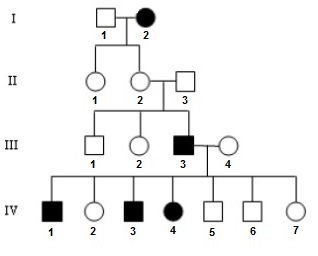
This pedigree represents the inheritance of hemophilia in this family. How many of the females have the hemophilia trait?
a)
8
b)
5
c)
2
d)
3
16.
In the second generation-how many people are carriers of the trait?
a)
2
b)
3
c)
5
d)
6
17.

When one allele is not dominant over another, resulting in a blended phenotype for heterozygous offspring is considered....

a)

Incomplete Dominance

b)

Codominance

18.

When one allele is not dominant over the other, resulting in both traits expressed in a heterozygous individual.....

a)

Incomplete Dominance

b)

Codominance

19.

Some flowers are controlled by codominance. Red flowers (RR), blue flowers (BB) and Speckled flowers (RB).


Cross a red flower with a speckled flower. What is the phenotypic ratio?

a)

2 red, 2 speckled

b)

2 red, 2 blue

c)

2 blue, 2 speckled

20.

In mice coat color is incompletely dominant. Black and white are homozygous. Brown mice are heterozygous.


What is the genotype for a brown mouse?

a)

BB

b)

Bb

c)

bb

21.

In cattle red coats are represented as RR, and white coats are represented as WW.


What is the genotype for Roan color?

a)

RR

b)

RW

c)

WW

22.
A white blood cell that makes antibodies
a)
T cell
b)
bacteria
c)
B cell
d)
mast cell
23.
These cells remain in the blood stream after an immune response.
a)
Memory B and T Cells
b)
Killer T Cells and B Cells
c)
Helper T  and B Cells
d)
Suppressor Cells and Macrophages
24.
Proteins produced by B cells and designed to mark antigens to be destroyed, specific to the antigen.
a)
Antigens
b)
Active Immunity
c)
Antibodies
d)
Antibiotics
25.
The part of foreign materials that cause a response from the immune system are called _____________________.
a)
Antigens
b)
Active Immunity
c)
Antibodies
d)
Antibiotics
26.

Which of the following is an example of positive feedback?

a)

Thermoregulation

b)

Blood Pressure

c)

Childbirth

d)

Blood Sugar Levels

27.
Homeostasis
a)
allows for a wildly fluctuating internal environment
b)
is impossible in vertebrates
c)
is the maintenance of a relatively stable internal environment and often incorporates a form of feedback regulation
d)
is the maintenance of a relatively stable external environment and often incorporates a form of feedback regulation
28.
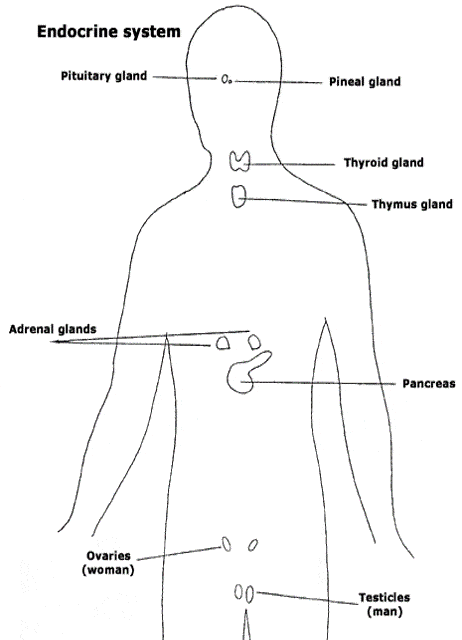
a body system that controls growth and homeostasis by secreting hormones from glands.
a)
skeletal system
b)
nervous system
c)
endocrine sytem
d)
integumentary system
29.
Rapid growth during puberty causes your body to release more and more growth hormones. As you grow, more and more growth hormones are released until puberty is reached, and then the hormones stop.
a)
Positive Feedback Response
b)
Negative Feedback Loop 
30.
The cell below is in a _____________ solution.
a)
Hypertonic
b)
Hypotonic
c)
Isotonic
31.
You put a cell into a solution, the cell grows. Is the solution hypotonic or hypertonic to the cell? 
a)
hypertonic
b)
hypotonic
c)
isotonic
d)
not enough information
32.
If a cell is placed in a HYPOTONIC solution, water will move _________ of the cell, causing it to ___________.
a)
into, swell
b)
out of, shrivel
c)
in and out of the cell, stay the same
33.
Which of the following is the correct equation for PHOTOSYNTHESIS?
a)
CO2 + light + H2O --> O2 + Sugar
b)
CO2 + sugar + H2O --> O2 + light
c)
O2 + light + H2O --> CO2 + Sugar
d)
CO2 + O2 + H2O --> Light+ Sugar
34.
What is the main purpose of the light reactions?
a)
To provide the energy and electrons for the calvin cycle
b)
To capture energy and make sugar
c)
To reflect green light
d)
To make sugars
35.

Where do the dark reactions (Calvin cycle) take place?

a)

thylakoid membrane

b)

lumen

c)

stroma

36.
Cellular respiration takes place in the
a)
nucleus
b)
cytoplasm
c)
ribosomes
d)
mitochondria
37.
Glucose is broken down during which process
a)
Krebs cycle
b)
Calvin cycle
c)
Glycolysis
d)
Photosynthesis
38.
What are the products of aerobic respiration?
a)
Glucose and oxygen
b)
Carbon dioxide and water
c)
Lactic acid
d)
Carbon monoxide
39.
Aerobic respiration is different from anaerobic respiration in that aerobic respiration needs...
a)
chlorophyll
b)
carbon dioxide
c)
glucose
d)
oxygen
40.

The largest number of individuals that an environment can support long term is...

a)

carrying capacity

b)

emigration

c)

immigration

d)

population density

41.

Something that regulates the size of a population is called...

a)

a limiting measure

b)

a limiting factor

c)

carrying capacity

d)

biodiversity

42.

What is the carrying capacity of the graph?

a)

1000

b)

8000

c)

800

d)

600

43.
Which of the following would INCREASE the carrying capacity of an ecosystem?
a)
increase in predators
b)
disease
c)
increase in available food
d)
drought
44.

A scientist was studying a population of fish in a pond over a period of 10 years. He observed that the population increased each year for 3 years, and then remained nearly constant for the rest of the study. The best explanation for this observation is that the population had

a)

stopped reproducing

b)

reached carrying capacity

c)

mutated into a different species

d)

run out of food and all died

45.
In an energy pyramid, energy_______ as you move up the pyramid.
a)
Increases
b)
Decreases
c)
Stays the same
d)
Changes up and down
46.
In the energy pyramid here, how much of the energy in the producers gets passed to the herbivores?
a)
10%
b)
20%
c)
80%
d)
90%