
 Worksheets
U7: Bridge Quizziz Review 🔁
Total questions: 75
Worksheet time: 2hrs 8mins

What is the process in which populations CHANGE gradually over time?
evolution
species
variation
competition

What do you call similar structures that related species have inherited from a common ancestor?
Natural Selection
Analogous Structure
Vestigial Structure
Homologous Structure
Cheetah's all have 99% identical DNA. Which is/are true?
They are more likely to evolve into a new species than other cats due to gene flow.
They are likely to go extinct because they have so little variation.
They likely underwent a bottleneck in their history.
The founder's effect made it so they have several different subspecies.
Cheetahs never prosper and winners never cheat.

_______________ occurs when a population declines to a very small number then goes back up but results in a permanent loss of genetic diversity in the population (example: the Cheetah population)
coevolution
bottleneck
archaeopteryz
mutation
What effect can bottleneck events have on populations that have nearly become extinct?
Bottleneck events lead to increased gene flow and genetic diversity.
Bottleneck events have no impact on populations that have nearly become extinct.
Bottleneck events lead to the founder effect and eventually increase genetic diversity.
Bottleneck events reduce the size of the population and greatly reduce genetic variation.
What was unique about Darwin's ideas that made his different from the people before him who had suggested evolution?
Darwin had an explanation for HOW it happened.
Darwin had an explanation for WHY it happened.
Darwin had an explanation for WHERE it happened.
Darwin had an explanation for WHEN it happened.
Fossils were an integral part of understanding evolution and providing evidence for its occurrence. What is true of all fossil evidence?
They show organisms got larger than their ancestors.
They show organisms got smaller than their ancestors.
They show organisms changed from their ancestors while maintaining some similarities.
They showed step by step how organisms changed.
1. The process of choosing parent organisms for desired characteristics is called
natural selection
Artificial selection
random selection
genetic manipulation
What is an example of artificial selection?
Letting dogs choose their own mate
Letting plants pollinate on their own
Crossing a labrador and a poodle to create a labradoodle

What is the advantage of having different shaped beaks?
To look different from other species.
To be able to eat the food readily available in the environment.
To protect itself against predators.
To protect itself against prey.

This is any variation that makes an organism better suited to its environment.
Evolution
Graduation
Species
Adaptation

How do adaptations help animals?
To escape animals
to hunt for food
to survive in their habitats
All of these are correct

A population of birds lives on a small island. Another population of the same species lives on the mainland. The distance between the island and the mainland is too great for birds to fly back and forth. Recently, a series of sandbars and tiny islands have formed between the island and the mainland. What is the most likely effect of this change?
an increase in mutations in both bird populations
an increase in gene flow between the bird populations
an increase in genetic drift between the bird populations
an increase in mutations in the island population
When genetic information travels from one population to another it is called _____.
variation
gene flow
bottleneck effect
genetic drift

Henry was studying two populations of the same species of lizards. One population lived on an island and the other lived on the mainland. Both populations were affected by a hurricane that hit the island and the mainland with equal force. A year later, Henry was testing the gene frequency and saw a decrease in genetic variation in the island species, but not in the mainland species. Which best describes a conclusion he might have reached?
Gene flow greatly affects small populations, but large populations can recover.
Genetic drift greatly affects small populations, but large populations can recover.
Gene flow greatly affects large populations, but small populations can recover.
Genetic drift greatly affects large populations, but small populations can recover.
Which of the following examples can cause gene flow between populations?
an increase in predators to a population of zebra
a volcanic eruption that kills half of a population of mice
bird droppings that contain seeds from a different location
a person that sprays a toxin on a group of mosquitoes

Northern Elephant Seal populations were hunted during the 1800's from a population of over a million down to just 18 individuals by 1882. The current population of Northern Elephant seals is about 175,000. As a result of this near extinction, Northern Elephant Seals have extremely low genetic diversity. What is it called when a species goes from a large population to an extremely small group of individuals which repopulate?
The Bottleneck Effect
The Founder Effect
Genetic Drift
Gene Flow
Which of these statements about the founder effect is true?
It happens when a large population is reduced down to only a few individuals.
It increases the amount of genetic diversity in a population.
It occurs when a few individuals colonize a new habitat making a new population.
The new population always has the same genetic diversity as the original population.
Homologous structures are defined as anatomical structures originating from the same structure in ancestral form. For instance, a bird's wing and the front flippers of a seal are examples of homologous structures. Which of the following does the presence of homologous structures in vertebrates suggest?
All vertebrates developed at the same rate.
All vertebrates developed internally.
All vertebrates evolved from different animals.
All vertebrates have a common ancestor.
The position and shape of the bones in the forelimbs of four present-day vertebrates were studied. Two of the organisms seemed to be more closely related to each other than to the other vertebrates. This relationship was most likely based on evidence using the field of —
comparative anatomy
DNA sequences
biochemistry
fossil record
Survival of the fittest can best be described as –
the process by which only the strongest of a species will be able to survive and reproduce
the process in which organisms that are better adapted to their environment will have a better chance of surviving and reproducing
the reason the strongest of the species will not be able to reproduce as often as others
the reason weaker organisms in a species will always be killed by predators
Adaptations that result from natural selection are expected to increase the fitness of an organism. In terms of natural selection, which of the following best describes fitness?
Being able to escape from predators
Being among the strongest organisms in a population
Being able to survive, find a mate, and produce offspring
Being able to survive long enough to reach the adult
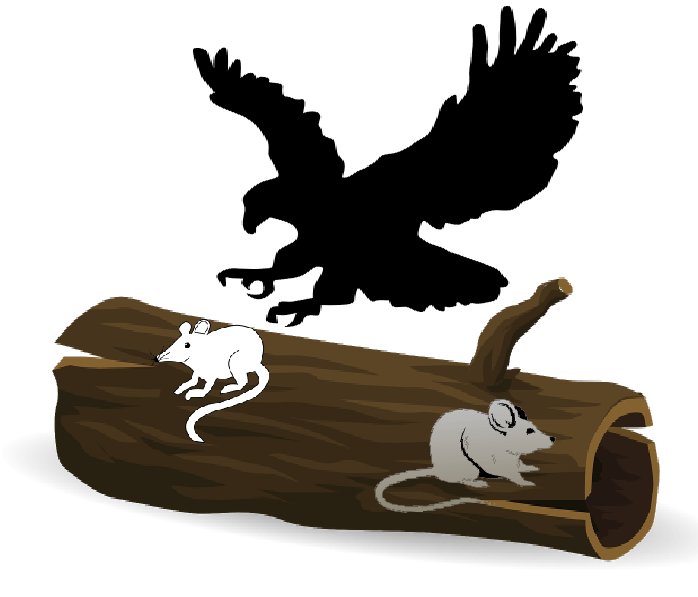
Over the years, white mice became extinct and darker mice survived. This is
stabilizing selection
directional selection
disruptive selection
due to exercise

individuals with alleles for an extreme type are more likely to survive and reproduce
stabilizing selection
directional selection
disruptive selection
genetic drift
If the fossil record of human evolution is incomplete, why do scientists still believe humans evolved from ape-like ancestors?
Because existing evidence in the fossil record strongly suggests it
Because scientists make a lot of money by promoting the theory of evolution
Because the theory of evolution is more than 100 years old, which means it must be correct
Because humans and apes look similar to one another
The two most important things that the fossil record tell us about the history of life on Earth are...
some species go extinct, and it is impossible for new species to take their place
some species go extinct, and new species appear over time
species usually never go extinct, but somehow dinosaurs did go extinct
Earth never changes, and changes to life on Earth happen very quickly
What is is the study of how and why plants and animals live where they do?
Evolution
Adaptive Radiation
Biogeography
Biogeology

Which of the following would be an example of homologous structures?
the trunk of an elephant, the snout of a pig, and the nose of a dog
the wings of a bat and the wings of a butterfly
the tale of a dolphin and the hump on a camel’s back
the arm bones of an ape and the front leg bones of a horse

A bird's wing and a butterfly's wing have the same function, but they have very different structures. These structures are classified as follows:
homologous structures
analogous structures
vestigial structures
embryological homologues
The arm of a human, the flipper of a whale, and the wing of a bat all have similar bone structures. Therefore, these parts of the body would all be considered...
homologous structures
vestigial structures
transitional fossils
common ancestors
What observations did Darwin make about the finches he looked at?
The birds on the different islands were all the same
The birds on the different islands were slightly different
The birds resembled a bird on the main island
The birds resembled birds from millions of years ago

The different sizes and shapes of the birds, beaks, and claws allowed finches to do what?
Eat different types of food from one another
Survive in different habitats
Survive gladiator battles
Dig larger holes
Darwin published his idea of natural selection which explained that
species naturally go extinct
species can adapt to their surroundings by choice
Species have variations that give a competitive advantage and are passed on to offspring
Species are the same and work together to survive

Based on the adaptations Charles Darwin observed in finches and tortoises in the Galápagos, he wondered
if species living on different islands had once been members of
the same species.
if finches and tortoises had originated from the same ancestral
species.
if all birds on the different islands were finches.
why all tortoises on the different islands were identical.
Charles Darwin’s observation that finches of different species on the Galápagos Islands have many similar physical characteristics supports the hypothesis that these finches
have the ability to interbreed.
acquired traits through use and disuse.
all eat the same type of food.
descended from a common ancestor.
Darwin’s ideas about natural selection were inspired by what he observed on the Galápagos Islands, while Wallace’s ideas about natural selection were inspired by what he observed on the Malay Archipelago.
True
False

The image below is the famous “I think” sketch that appears in one of Darwin’s notebooks. This sketch represents.
the branches of a tree
all organisms share a common ancestor
organisms don't change and where created in the present form
the Beagle's itinerary


What is another name for "DNA evidence" for evolution?
molecular biology
genetic biology
molecular genetics

Some female peacocks prefer males with large, colorful tales while other female peacocks prefer males with no tail at all. Females are now mating only with the tail they prefer. What type of reproductive barrier is this?
behavioral isolation
hybrid sterility
temporal isolation
mechanical isolation
In the Great Lakes region of North America, gray wolves and coyotes are similar species but do not mate because their breeding periods occur at different times of the year.
Geographic isolation
Behavioral isolation
Temporal isolation
The females of two species of fruit fly, Drosophila melanogaster and Drosophila simulans release slightly different mating hormones called pheromones, which are used to attract male mates.
Geographic isolation
Behavioral isolation
Temporal isolation
The American toad (Anaxyrus americanus) and Fowler's toad (Bufo fowleri) live in the same area. However, The American toad mates in early summer while Fowler’s mates in late summer.
Geographic isolation
Behavioral isolation
Temporal isolation
Albert’s squirrel and the Kaibab squirrel are distinct subspecies that live on opposite sides of the Grand Canyon. They were once one species, but now differ significantly, including fur coloring.
Geographic isolation
Behavioral isolation
Temporal isolation
individuals with alleles for an extreme type are more likely to survive and reproduce
stabilizing selection
directional selection
disruptive selection
genetic drift

the selection pressure favors the extreme phenotypes, dividing the population into 2 distinct groups
directional selection
stabilizing selection
geographic selection
disruptive selection

Individuals with intermediate traits are more likely to survive and reproduce
stabilizing selection
directional selection
adaptive radiation
disruptive selection
Tall kelp have a distinct advantage over shorter kelp in receiving needed sunlight in their ocean environment
directional selection
disruptive selection
stabilizing selection
sexual selection
artificial selection
Aspen trees that are over 25 m tend to blow over in high winds; aspen that are under 15 m don't get enough sun
directional selection
stabilizing selection
disruptive selection
artificial selection
sexual selection
modern corn plants are the descendants of teosinte, a wild corn plant that has been selectively bred for over 1000 years.
directional selection
stabilizing selection
disruptive selection
artificial selection
sexual selection
On average, human newborns weigh 7.2 pounds.
directional selection
stabilizing selection
disruptive selection
artificial selection
sexual selection

Label the natural selection graphs correctly...
1 Stabilizing, 2 Directional, 3 Disruptive
1 Disruptive, 2 Stabilizing, 3 Directional
1 Directional, 2 Stabilizing, 3 Disruptive

Starlings produce an average of five eggs. If there are more than five the parents cannot adequately feed the young. Fewer than five and predators may destroy them. As a result, five eggs becomes the most common number.
Stabilizing
Directional
Disruptive

Seed cracker birds have either large beaks or small beaks. They do not have medium sized beaks because medium sized beaks do not allow for adequate cracking of seeds.
Stabilizing
Directional
Disruptive

