wayground logo

Free Printable Worksheets

NEW

Font size

S
M
L
XL
Worksheets

Unit 6 _ Final Exam Review _ Quizizz

Total questions: 47

Worksheet time: 26mins
Name
Class
Date
1.
Which lab tool might you use to measure the volume of a liquid?
a)
electric scale
b)
bunsen burner
c)
test tube
d)
graduated cylinder
2.
What is the volume of 150 grams of lead if it has a density of 11.3 g/cm3?
a)
13.3 g
b)
13.3 cm3
c)
.075 g
d)
1695 cm3
3.
At higher temperatures
a)
particles in an object have less energy
b)
particles in an object move faster
c)
a gas contracts
4.

Freezing

a)

Solid to gas

b)

Liquid to solid

c)

Gas to solid

5.

Boiling

a)

liquid to gas

b)

gas to solid

c)

gas to liquid

6.

Solid to Gas

a)

Deposition

b)

Sublimation

c)

Evaporation

7.

Definite shape and definite volume

a)

Solid

b)

Liquid

c)

Gas

8.

Has a definite volume but not a definite shape

a)

Solid

b)

Liquid

c)

Gas

9.

Liquid to Gas

a)

Condensation

b)

Evaporation

c)

Sublimation

10.
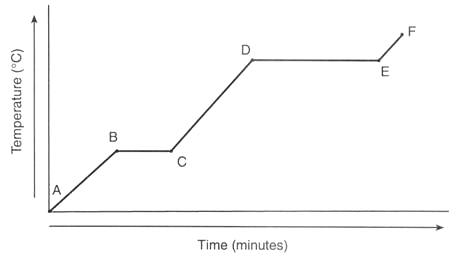
Between what two points is the most energy being added to the system
a)
A -B
b)
B-C
c)
C-D
d)
D-E
11.
Which line segment demonstrates vaporization occurring?
a)
B-C
b)
C-D
c)
D-E
d)
E-F
12.
A substance's heating curve is shown in the graph.  What is its boiling point?
a)
100 C
b)
60 C
c)
80 C
d)
20 C
13.
A substance's heating curve is shown in the graph.  What is its boiling point?
a)
100 C
b)
60 C
c)
80 C
d)
20 C
14.

What state/phase is the object likely from points A to B?

a)

Solid

b)

Liquid

c)

Gas

d)

Plasma

15.

Use the graph below to answer this question. What state of matter would the substance be at point F?

a)

solid

b)

liquid

c)

gas

16.

NaCl

a)

Element

b)

Compound

c)

Mixture

17.

MgCl2

a)

Element

b)

Compound

c)

Mixture

18.

Mg

a)

Element

b)

Compound

c)

Mixture

19.
Ice melting is an example of a
a)
physical change
b)
chemical change
c)
physical property
d)
chemical property
20.
Physical properties are
a)
properties that can be observed without changing the identity of the substance
b)
properties that describe how a substance changes into a completely different substance
c)
properties that we can only observe with our eyes
d)
properties that we need special tools to observe
21.
What does Boyle's law relate to?
a)
Temperature and Volume
b)
Volume and Pressure
c)
Temperature and Pressure
22.
When the temperature of matter increases the particles...
a)
speed up and move closer
b)
speed up and move farther apart
c)
slow down and move closer together
d)
slow down and move farther apart
23.
When Pressure increases then the Volume must...
a)
Increase
b)
decrease
24.
A sample of a gas has a volume of 852 mL at 298 K. What temperature is necessary for the gas to have a volume of 945 mL?
a)
Pt = P1 + P2 + P3 + ...
b)
P1V1 = P2V2
c)
V1/T1 = V2/T2
d)
P1V1/T1 = P2V2/T2
25.
A gas that has a pressure of 2 atm and a volume of 10 L.  What would be the new volume if the pressure was changed to 1 atm?
a)
P1/T1 = P2/T2
b)
P1V1 = P2V2
c)
V1/n1 = V2/n2
d)
PV = nRT
26.
A sample of gas with a volume of 30.0 mL at 25.0oC is heated to 50.0oC.  What is the new volume of the gas?
a)
P1V1 = P2V2
b)
P1/T1 + P2/T2
c)
PV = nRT
d)
V1/T1 = V2/T2
27.
If a balloon is cooled what will happen to the volume?
a)
Volume will increase
b)
Volume will decrease
c)
Volume will not change
28.

Convert

100oC100^oC  to Kelvin

a)

373 K373\ K  

b)

273 K273\ K  

c)

212 K212\ K  

d)

0 K0\ K  

29.

Convert

450 K450\ K  to Celsius

a)

723oC723^oC  

b)

277oC277^oC  

c)

177 oC177\ ^oC  

d)

623oC623^oC  

30.

What is the boiling point of water on the Celsius scale?

a)

0oC0^oC

b)

373oC373^oC

c)

100oC100^oC

d)

212oC212^oC

31.

What is the boiling point of water on the Kelvin scale?

a)

0K0^{ }K

b)

373K373^{ }K

c)

100K100^{ }K

d)

212K212^{ }K

32.

If I have 5.6 liters of gas in a piston at a pressure of 1.5 atm and compress the gas until its volume is 4.8 L, what will the new pressure inside the piston be?

a)

1.8 atm

b)

3.27 atm

c)

1.8 L

d)

3.27 atm

33.

A sample of nitrogen occupies a volume of 250 mL at 25oC. What volume will it occupy at 95oC?

a)

308.70 mL

b)

456.1 mL

c)

308.70oC

d)

456.1oC

34.

A quantity of gas has a volume of 250 L, at 290 K and 303.98 kPa of pressure. What volume must the gas be for the gas to be at 273 K and 101.33 kPa?

a)

78.4 L

b)

88.5 L

c)

706 L

d)

771 L

35.

A gas is at a pressure of 760 mm Hg. What is its pressure in psi?

a)

14.7 psi

b)

1 psi

c)

205 psi

d)

0.547 psi

36.

A gas is at a pressure of 95 kPa. What is its pressure in atmospheres?

a)

1.5 atm

b)

1.09 atm

c)

0.94 atm

d)

0.82 atm

37.

The gas in my car's tires is at 32 psi. How many Pascals is this?

a)

4.26 Pa

b)

2.8 Pa

c)

2.18 Pa

d)

220,571 Pa

38.

The state of matter where particles are very spread out and moving quickly.

a)

gas

b)

liquid

c)

solid

d)

Helium

39.

The state of matter that has particles close together and vibrating.

a)

liquid

b)

solid

c)

gas

d)

water

40.
Why does water NOT change temperature during phase changes?
a)
Because the molecules of water take in all the heat to their nucleus
b)
Because heat is not the same thing as temperature
c)
Because adding heat doesn't ever change the temperature of water
d)
Because all of the energy is used to overcome the attraction of molecules
41.
All changes in the state of matter of a substance requires
a)
vibration
b)
water
c)
permission
d)
energy
42.

What Is Matter?

a)

Anything That has mass and takes up space.

b)

Anything that you can see or taste.

c)

What you can touch.

d)

you and go throught this.

43.
What Is Volume?
a)
How heavy something is.
b)
The amount of space taken up by and object.
c)
How a liquid flows.
d)
The international unit of measurement.
44.

Molecules are always moving no matter what phase they are in: solid, liquid, gas.

a)

True

b)

False

45.
All phase changes are
a)
chemical changes
b)
chemical reactions
c)
physical changes
d)
irreversable
46.
Anything that has mass and takes up space is called ______.
a)
atom
b)
compound
c)
matter
d)
molecule
47.

Which phase of matter has molecules with the greatest attraction  (held together the most) among its particles?

a)

solid

b)

liquid

c)

gas

d)

plasma