
 Worksheets
AP Microeconomics Review 2
Total questions: 101
Worksheet time: 2hrs 41mins
Consumers will buy more of a good when its price is lower and less when its price is higher.
Law of Demand
Law of Supply
Price Floor
Price Ceiling
The point at which the quantity demanded for a product or service is equal to the quantity supplied of that product or service.
Equilibrium
Price Stability
Shortage
Supply
A minimum price consumers are required to pay for a good or service.
Price Ceiling
Market Clearing Price
Equilibrium
Price Floor
A maximum price consumers are required to pay for a good or service.
Price Ceiling
Equilibrium
Market Clearing Price
Price Floor
A market in which a single seller dominates.
Monopolistic Competition
Monopoly
Oligopoly
Perfect Competition
A market structure in which a large number of firms all produce the same product and no single seller controls supply or prices.
Monopoly
Monopolistic Comeptition
Oligopoly
Perfect Competition
What is the Profit Maximizing Formula?
Revenue > Expenses
MR > ATC
MR = MC
AFC + AVC = ATC
What is the difference between Accounting (Normal) Profit and Economic Profit?
Merchandise Costs
Opportunity Cost
Labor Cost
Expenses

According to the Profit Maximizing Formula, how many units should this firm produce?
2
3
4
5
Which of the following is the best definition for Marginal Cost?
The cost of producing more units
The cost of producing one additional unit
Fixed costs
Variable Costs
A change in Fixed Costs affect which of the following? (check all that apply)
AFC
AVC
ATC
MC
Does an increase in Fixed Costs affect a firm's output?
Yes
No
Maybe
Does an increase in Variable Costs affect a firm's output?
Yes
No
Maybe

With which worker does this firm begin to experience Diminishing Marginal Returns?
First
Second
Third
Fourth
What is the best definition for Short Run?
A period of time in which at lease one resource is fixed
A period of time in which all resources can change
A period of 1 to 5 years
A period of 5 or more years

A firm expands its fixed resources and its overall costs of production go down. It is experiencing...
Increasing returns to scale
Constant returns to scale
Negative returns to scale

Which of these is NOT a characteristic of Perfectly Competitive markets?
Many small firms
Virtually identical products
High barriers to entry
No need to advertise

If a firm's Marginal Costs increase, its output will...
Increase
Decrease
Stay the Same
Shut down
In the long run, a Perfectly Competitive Firm will..
Earn zero economic profit
Earn an economic profit
Make an economic loss
Shut down
Which of the following best describes Allocative Efficiency?
D = ATC
D = AVC
D = MC
Run = DMC
What will happen when there is short-term PROFIT in a market?
Firms will enter the market, and prices will rise.
Firms will enter the market, and prices will fall.
Firms will leave the market, and prices will rise.
Firms will leave the market, and prices will fall.

The image above shows a firm making
Economic Profit
Economic loss
Breaking even
Shutting down

Should the following firm shutdown?
Yes
No
Not enough information present

The above figure shows a perfectly competitive firm. If the market price is more than $20 per unit, the firm
will definitely shut down to minimize its losses.
will stay open to produce and will make zero economic profit.
will stay open to produce and will incur an economic loss.
will stay open to produce and will make an economic profit.
might shut down but more information is needed about the fixed cost.
Scarcity is best defined as
the difference between limited wants and limited economic resources.
the difference between the total benefit of an action and the total cost of that action.
the difference between unlimited wants and limited economic resources.
the opportunity cost of pursuing a given course of action.
the difference between the marginal benefit and marginal cost of an action.

A linear production possibilities curve indicates which of the following?
Constant opportunity costs
Decreasing opportunity costs
Increasing opportunity costs
Diminishing marginal returns
Labor-intensive production

According to the graph above, if a country is currently producing at point X, the opportunity cost of producing another consumer good is
20 capital goods
more than 20 capital goods
fewer than 20 capital goods
20 consumer goods
fewer than 20 consumer goods

Beef has been increasing in price. As a result, what will happen to the demand for hamburger buns?
Increase
Decrease

The solid line on the graph represents a _______________, which when implemented cause shortages.
Price ceiling
Price floor
Total revenue -total cost=
average cost
Profit
Marginal cost
Perfectly Competitive, Normal Profit


Single-Price Monopoly, Economic Profit


Profit-Maximizing Quantity
Qf
Qa

What is the Nash Equilibrium?
Both fast-food restaurants should choose to concentrate on fries.
Both fast-food restaurants should choose to concentrate on burgers.
Brewer’s should choose to concentrate on fries, and Royal’s should choose to concentrate on burgers.
Total revenue -total cost=
average cost
Profit
Marginal cost
The shape of Average cost is
upward sloping
downward sloping
U shaped
Total cost is a sum of Fixed cost and
fixed revenue
variable cost
average cost
What is the goal of a firm?
to make profits
to maximize profits
to maximize revenue
none of the above
The image above shows a firm making
Economic Profit
Economic loss
Breaking even
Shutting down
Should the following firm shutdown?
Yes
No
Not enough information present

Identify the profit maximizing level of price for this monopoly firm.
Collusion most frequently occurs in industries that are
oligopolistic
monopolistically competitive
monopolistic
perfectly competitive
Collusion is difficult for an oligopoly to maintain
Because antitrust laws make collusion illegal
Because, in the case of oligopoly, self-interest is in conflict with cooperation
If additional firms enter of the oligopoly
For all the above reasons
A monopoly can price discriminate between two groups of consumers if each group has
a large consumer surplus.
a different willingness to pay.
the same willingness to pay.
the ability to resell the good to the other group.
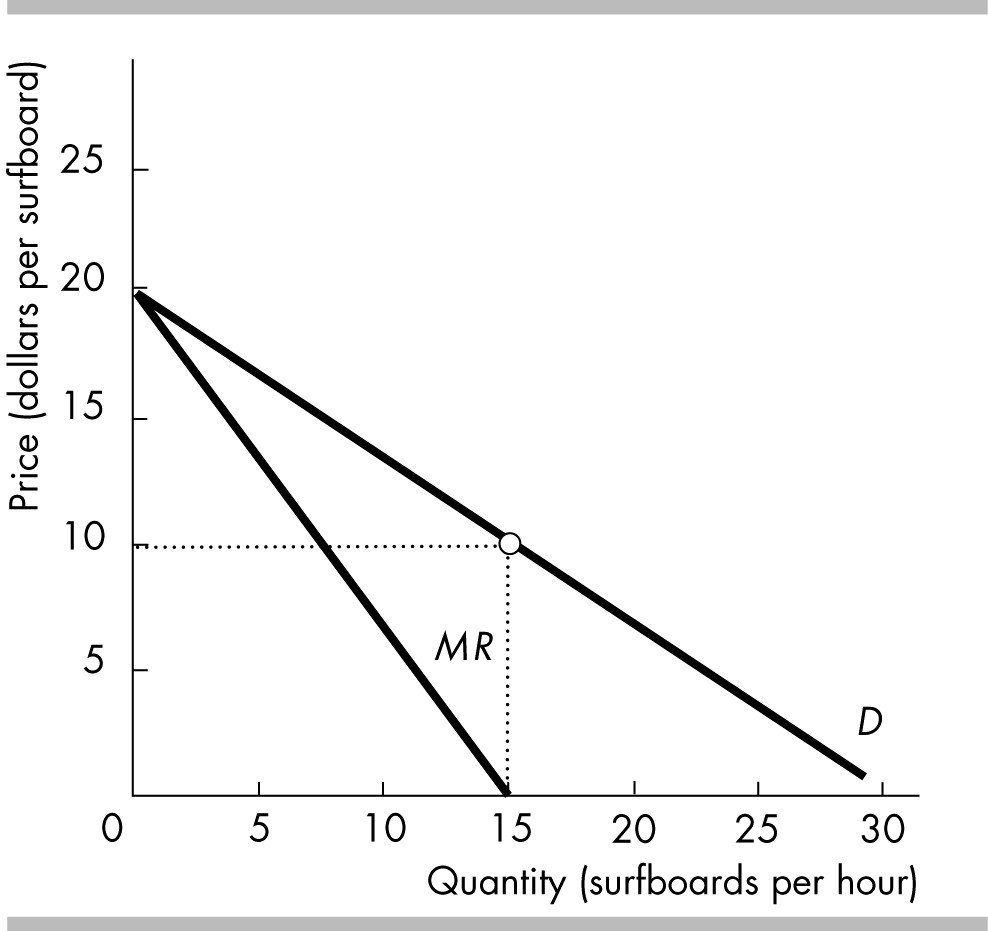
Sue's Surfboards is the sole renter of surfboards on Big Wave Island. Sues demand and marginal revenue curves are illustrated in the figure above. Sue's Surfboards currently rents 15 surfboards an hour. Sue's total revenue from the 15 surfboards is
$300
$220
$150
$100
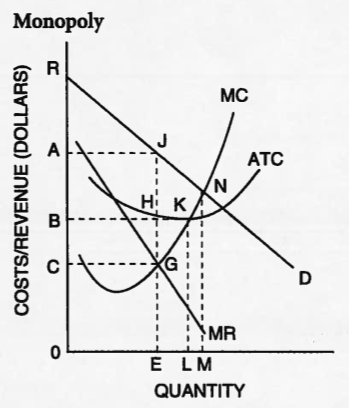
Which of the following is true about production in an imperfectly competitive market?
Choose 1 answer:
The amount produced minimizes marginal cost.
Less is produced than is socially optimal.
The amount produced minimizes average total cost.
More is produced than is socially optimal.
The amount produced is the same as in perfect competition.
Which of the following is true about an imperfectly competitive firm’s marginal revenue (MR) curve if it has a linear and downward-sloping demand curve?
MR decreases at an increasing rate.
MR increases at first, then decreases.
MR is constant.
MR decreases and is less than demand.
MR is greater than demand.
Price leadership and collusion often occur in this type of market structure
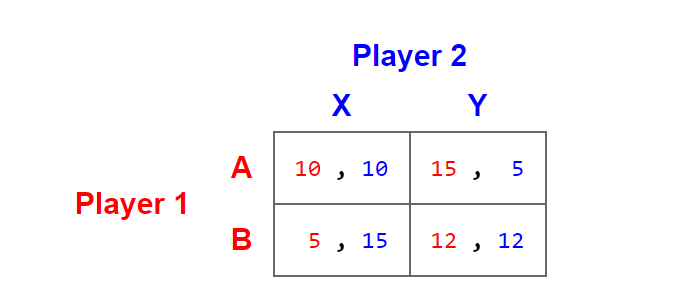
The amounts in the matrix represent potential profits to each player. What of the following correctly represents that game's nash equilibrium?
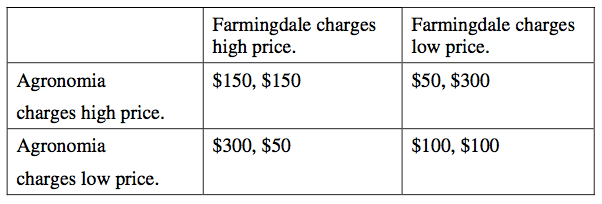
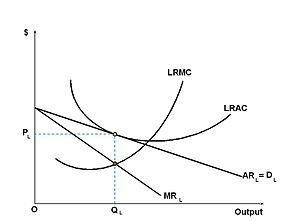
If this graph is for a monopolistically competitive firm, it best represents
short run economic loss.
short run extra-normal profit.
long run economic profit.
long run equilibrium at normal profit.
short run accounting loss.
Firms in perfect and monopolistic competition will continue to produce in short run as long as
Price is greater than min ATC
Price is greater than min MC
Price is greater than min AVC
Price is greater than AVC
Price is greater than ATC
What is the Profit Maximizing Formula?
Revenue > Expenses
MR > ATC
MR = MC
AFC + AVC = ATC
Which of these is NOT a characteristic of Perfectly Competitive markets?
Many small firms
Virtually identical products
High barriers to entry
No need to advertise
A firm’s demand curve for labor is equal to a segment of its
average variable cost curve
total revenue curve
marginal cost curve
marginal revenue product curve
average product curve

The graph above shows the marginal revenue product curve and supply curve of labor for a firm. The introduction of new management techniques dramatically increases workers productivity. Which of the following changes is most likely to occur?
The supply curve will shift to the left, increasing the wage rate.
The supply curve will shift to the right, increasing employment.
The marginal revenue product curve will shift to the right, increasing wage rate.
The marginal revenue product curve will shift to the left, reducing employment.
Neither the marginal revenue product curve nor the supply curve will shift, but the wage will increase and employment will fall.
Which of the following is most likely to shift the demand for aircraft mechanics to the right?
An increase in the demand for air travel
An increase in the price of a license necessary for aircraft mechanics
A decrease in the price of a license necessary for aircraft mechanics
A decrease in the demand for air travel
A decrease in the marginal productivity of aircraft mechanics
A profit-maximizing firm will hire
labor until its wage rate equals its average revenue product
labor until its wage rate equals its marginal revenue product
labor until its wage rate equals the interest rate
capital until the interest rate equals the wage rate
capital until the interest rate exceeds the wage rate
Assume a firm uses only two inputs, capital (K) and labor (L), to produce its output. Let the marginal product of capital be MPK , the marginal product of labor be MPL , the price of capital be PK , and the price of labor be PL . The least-cost combination of capital and labor needed to produce a given level of output is given by which of the following?
MPL /PL = MPK /PK
MPL /PL > MPK /PK
MPL /PK = MPK /PL
(MPL)PL = (MPK)PK
MPL = MPK
Marginal revenue product is defined as the
change in income that occurs when an individual works additional hours
change in total revenue that occurs when one additional unit of the good is produced
change in total revenue that occurs when one additional unit of an input is employed
total revenue divided by the quantity of labor employed
change in total cost that occurs when one additional unit of an input is employed
For a firm hiring labor in a perfectly competitive labor market, the marginal revenue product curve slopes downward after some point because as more of a factor is employed, which of the following declines?
Marginal product
Marginal factor cost
Marginal cost
Total output
Wage rates
Assume that a firm is hiring labor in a perfectly competitive labor market. If the marginal revenue product of labor is greater than the wage rate, which of the following will be true?
The firm must be losing money.
The firm should employ more workers.
The firm should replace workers with capital.
The firm is maximizing its profits.
The firm is experiencing diminishing marginal utility.
The wage rate is $10 per hour and the last worker hired by the firm increased output by 100 units. Computers rent for $100 per hour and the last computer rented by the firm increased output by 2,000 units. To minimize costs the firm should
hire more workers and rent more computers because the marginal revenue products of both workers and computers are greater than their respective prices.
hire more workers and reduce the number of computers rented because workers are cheaper than computers
lay off workers and rent more computers because computers produce more output per dollar of additional expenditure
lay off workers and rent more computers because computers produce more output
keep the same number of workers and computers because the marginal revenue products of both workers and computers are positive
An increase in the demand for automobiles will cause the demand for skilled automobile workers and the wage rate of skilled automobile workers to change in which of the following ways?
Demand - Decrease; Wage Rate - Increase
Demand - Decrease; Wage Rate - Not Change
Demand - Increase; Wage Rate - Decrease
Demand - Increase; Wage Rate - Increase
Demand - Not Change; Wage Rate - Increase
Which of the following will happen in the labor market if the price of the good produced by the workers decreases?
The marginal product of labor will increase.
The marginal product of labor will decrease.
The marginal revenue product of labor will increase.
The marginal revenue product of labor will decrease.
The demand curve for labor will shift to the right.

According to the information in the table above, the twelfth worker would increase the hourly profit by
$0.20
$1.10
$1.30
$2.40
$5.20
The concept of derived demand is described by which of the following?
A decrease in the demand for theater tickets will decrease the demand for actresses and actors.
If the salaries of basketball players increase, the quantity of basketball players demanded will decrease.
An increase in the income of consumers will increase the demand for opera tickets.
An increase in the demand for movie tickets will decrease the demand for video rentals.
A decrease in the price of movie tickets will increase the demand for movie tickets.
An individual's labor supply curve is derived from that person's preferences about the trade-off between income and
work
wealth
nominal wages
productivity
leisure
Suppose that a large number of unskilled workers enter a nation’s labor market. If the labor market is competitive, the number of unskilled workers hired and the wage rate will most likely change in which of the following ways?
Workers Hired - Increase; Wage Rate - Increase
Workers Hired - Increase; Wage Rate - Decrease
Workers Hired - Increase; Wage Rate - Not Change
Workers Hired - Decrease; Wage Rate - Increase
Workers Hired - Decrease; Wage Rate - Decrease

Given the production information in the table above, how many workers would be employed if the wage rate were $20.00 per day and if sandwiches sold for $0.50?
1
2
4
5
7
Assume that the last worker a firm hired produces 60 additional units of output per hour and the last machine rented produces 6,000 units of output per hour. A worker’s hourly wage rate is $12, and the rental cost of a machine is $1,000 per hour. In order to minimize the cost of its current output, the firm should
do nothing, because the costs of production are minimized
increase the use of labor and decrease the use of capital
increase the use of capital and decrease the use of labor
increase the use of labor and increase the use of capital
decrease the use of labor and decrease the use of capital

The graph above shows a monopsony labor market. In the absence of any regulations, which of the following represents the number of workers the firm will hire and the wage rate it will offer to those workers?
Workers - 15; Wage Rate - $30
Workers - 20; Wage Rate - $20
Workers - 20; Wage Rate - $40
Workers - 30; Wage Rate - $30
Workers - 40; Wage Rate - $40
A change in which of the following will NOT cause a shift in the demand curve for a factor of production?
Demand for the goods produced by the factor
Prices of the goods produced by the factor
Prices of substitute factors
Supply of the factor
Supply of substitute factors
For a certain firm, the marginal revenue product for the last unit of labor is $60, and the marginal revenue product for the last unit of capital is $100. Which of the following combinations of factor prices would be necessary for the firm to maximize profits?
PL - $2; PK - $5
PL - $3; PK - $20
PL - $10; PK - $10
PL - $2; PK - $25
PL - $60; PK - $100
Market failure arises whenever firms
make a loss
replace machines with workers
create externalities
reduce expenditure on research and development
Market failure results in a misallocation of resources. In some cases, this can be corrected by the government
restricting the manufacture of goods that generate positive externalities
Providing public goods
subsidising all loss-making firms
placing a tax on merit goods


Under what condition is allocative efficiency achieved?
Marginal private benefits = marginal social costs
Marginal social benefits = marginal social costs
Marginal private benefits > marginal social costs
Marginal social benefits > marginal social costs
From an economic standpoint, government intervention is justified
When the private sector is larger than public sector.
Because the government will encourage the production of private goods.
Because the government can increase the level of market power of private businesses.
When the market mechanism fails to achieve the optimal mix of output.

