
 Worksheets
Evolution Review
Total questions: 22
Worksheet time: 19mins
Name
Class
Date
1.

The fossil record provides evidence that
a)
Fossils cannot be dated.
b)
All species were formed during Earth’s formation and have changed little since then.
c)
The fossilized species have no connection to today’s species.
d)
Older species gave rise to more-recent species.
2.
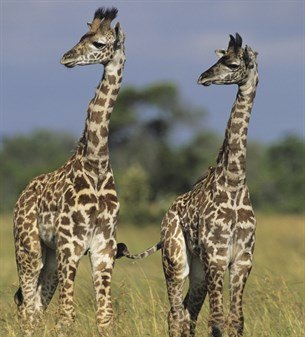
Individuals that are better able to cope with the challenges of their environment tend to
a)
Decrease in population over time.
b)
Leave more offspring than those less suited to the environment.
c)
Leave fewer offspring than those less suited to the environment.
3.

Starting in 1954, commercial fishers in the northwest Pacific were paid by weight, rather than by the individual fish, for pink salmon. The fishers increased the use of a type of net that selectively catches larger fish. Which of the following effects did this change in fishing technique most likely have on the salmon population over the next 20 years?
a)
The average body size of the salmon population decreased significantly.
b)
The average body size of the salmon population increased significantly.
c)
The average body size of the males in the salmon population increased, and the females stayed the same.
4.

European rabbits were introduced to Australia in 1859. The rabbits reproduced rapidly in their new habitat, displaced other animals, and overgrazed vegetation. In an attempt to reduce the rabbit population, a virus was introduced in 1951. This virus is usually deadly to European rabbits. When the virus was first introduced, the rabbits died in large numbers, but the death rate decreased over time. Which of the following best explains the decrease in the rabbit death rate?
a)
Young rabbits learned to avoid being infected with the virus.
b)
The lifespan of the virus was too short to affect rabbits over a long period of time.
c)
Natural selection favored rabbits that were resistant to the virus.
d)
No correct choices.
5.

Structures that share a common ancestry or are similar because they are modified versions of structures from a common ancestor that contain the same basic bone structure are
a)
Not related.
b)
Not homologous.
c)
Homologous.
d)
Young in origin.
6.

The process in which organisms with traits well suited to an environment are more likely to survive and to produce offspring is
a)
Natural Selection
b)
Origin of Species
c)
Genetic Principles
d)
Trait Mechanism
7.

Structures with no function that are remnants of an organism’s evolutionary past are
a)
Not visible organisms.
b)
Vestigial
c)
Young in origin
d)
Useful to the organism
8.

Comparing human hemoglobin of chimpanzees, horses, kangaroos, and chickens, reveal that humans have the fewest amino acid differences with
a)
Kangaroos
b)
Horses
c)
chickens
d)
chimpanzees
9.

What is the term for a feature that allows an organism to survive better in its environment?
a)
variation
b)
adaptation
c)
homologous structure
d)
vestigial structure
10.
What is the advantage of having different shaped beaks?
a)
To look different from other species.
b)
To be able to eat the food readily available in the environment.
c)
To protect itself against predators.
d)
To protect itself against prey.
11.
Why are advantageous traits more likely to be passed onto offspring?
a)
Because they are more likely to survive and reproduce.
b)
Because they come from dominant alleles.
c)
Because they come from recessive alleles.
d)
Because the trait is an acquired phenotype.
12.
Mutations are a change in what?
a)
DNA
b)
tRNA
c)
genotype
d)
phenotype
13.
Where humans have bred organisms together based on traits we like.
a)
Evolution
b)
Natural Selection
c)
Extinction
d)
Artificial Selection
14.
Genetic differences between organisms of the same species
a)
Variation
b)
Adaptation
c)
Behavior
d)
Environment
15.

Study of embryos of various organisms to show a common ancestor because of similarities in development
a)
natural selection
b)
embryology
c)
speciation
d)
evolution
16.
A fossil of an extinct dinosaur is found and the anatomy of the fossil shows similarities to that of a bird. What could this mean?
a)
This is purely by chance and isn't significant
b)
The extinct dinosaur and modern bird share a common ancestor
c)
All dinosaurs evolved into birds and that's why there aren't any dinosaurs alive today
d)
Dinosaurs choose to fly, and evolved into birds to escape predation and capture food
17.

Which of the following organisms the kingdom animalia are not closely related?
a)
mouse and hagfish
b)
mouse and lizard
c)
mouse and pigeon
d)
mouse and chimp
18.

Two organisms that are closely related would have
a)
very similar DNA sequence
b)
exactly the same DNA sequences
c)
no proteins in common
d)
completely different DNA sequence
19.

What type of selection is depicted in the picture?
a)
stabilizing
b)
directional
c)
disruptive
d)
the answer is not here
20.
Robins typically lay fours eggs. If more then four eggs are produced then the baby chicks are malnourished while smaller egg numbers result in no viable (able to live) baby chicks. This is an example of
a)
stabilizing
b)
disruptive
c)
direction
d)
none of the above
21.
If finches with large beaks and finches with small beaks increase in a population while finches with average sized beaks decreases, which pattern of natural selection has occurred?
a)
Directional selection
b)
Disruptive selection
c)
Stabilizing selection
22.

What is the correct explanation for what is happening in this graph?
a)
There are a lot of average-sized beaks
b)
There are no beaks
c)
There are a lot of small beaks only
d)
There are a lot of small and large beaks, but not average-sized ones
100 %

