
 Worksheets
Earth Science-Final Exam Review Ch. 17-25
Total questions: 66
Worksheet time: 41mins


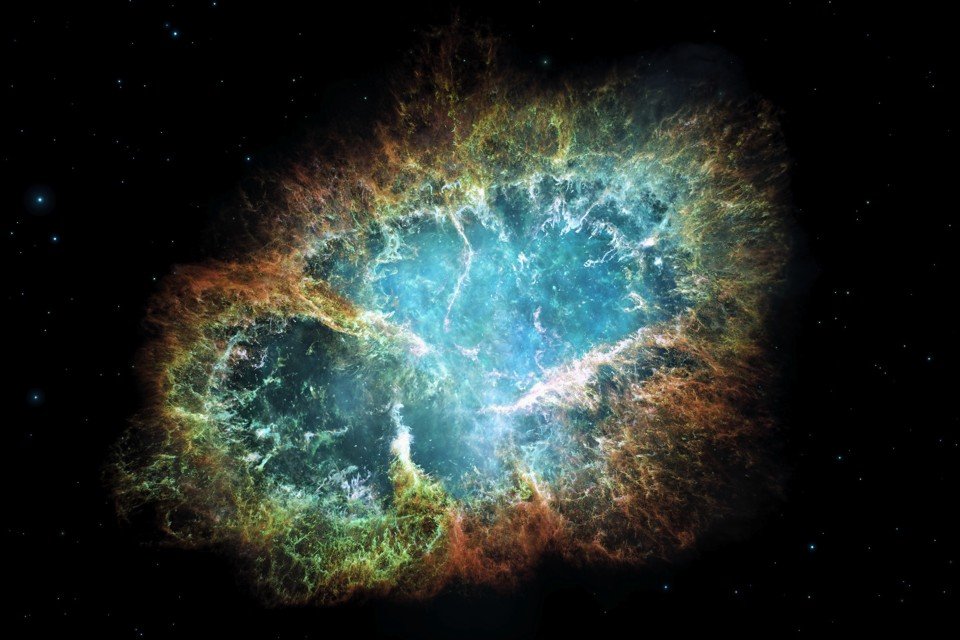
What type of galaxy is this?
Irregular
Spiral
Barred Spiral
Elliptical
Our galaxy is the Milky Way. From the side, the Milky Way would like a flat disc, with a bulge in the middle. From above, it has “arms” of stars that curve around the central bulge of stars. What type of galaxy is the Milky Way?
a planetary nebula
a spiral galaxy
an irregular galaxy
an elliptical galaxy
What can be concluded from Hubble’s Law about galaxies that have less of a redshift than other galaxies?
They are, in general, moving faster away from Earth than galaxies with a larger redshift.
They are, in general, moving more slowly away from Earth than galaxies with a larger redshift.
They have fewer stars in their galaxies than the Milky Way does.
They are farther from Earth than galaxies with a larger redshift.



A large, flat land area composed of dark lava flows on the surface of the moon is _______
Highlands
Maria
Rille
Craters

When the moon is lined up exactly between the sun and Earth, it is called a ______ ______.
Solar Eclipse
Lunar Eclipse
What is the process called when water vapor (a gas) becomes a liquid
evaporation
condensation
freezing
melting
The temperature at which the air become completely saturated with water vapor is called
humidity
dew point
air density
air pressure
Humidity is the
air density from cold air masses
amount of air pressure in the air.
amount of water vapor present in the air.
concentration of water vapor that form clouds in the air.
Type of cloud associated with thunderstorms and heavy precipitation
stratocumulus
cumulonimbus
nimbostratus
cumulus
The low-level featureless sheet of clouds that sometimes appear in the surface of the Earth in the form of mist or fog.
stratus
cirrus
nimbus
cumulus

What cloud is the closest to the ground?
cirrus
cumulus
nimbus
cumulonimbus
How is a cirrus cloud described?
wispy, stringy clouds
low, gray rain clouds
puffy, lumpy looking clouds
layered clouds

Clouds are formed by the process of ______________________.
precipitation
evaporation
condensation
collection


The process in which hot air rises and cool air sinks is called...
conduction
convection
radiation
magnetism

The rotation of the Earth causes winds to bend due to the...
coriolis effect
doldrums
trade winds
prevailing westerlies

Winds that blow from 300 latitude to the equator are called...
prevailing westerlies
polar easterlies
trade winds
horse latitudes

Winds that blow from 300 latitude to 600 latitude are called...
polar easterlies
prevailing westerlies
trade winds
doldrums

Cooler air sinks at 300 latitude causing a windless area known as...
doldrums
horse latitudes
polar easterlies
prevailing westerlies
Which global winds move FROM the east to the west?
Doldrums
Horse Latitudes
Prevailing Westerlies
Polar Easterlies
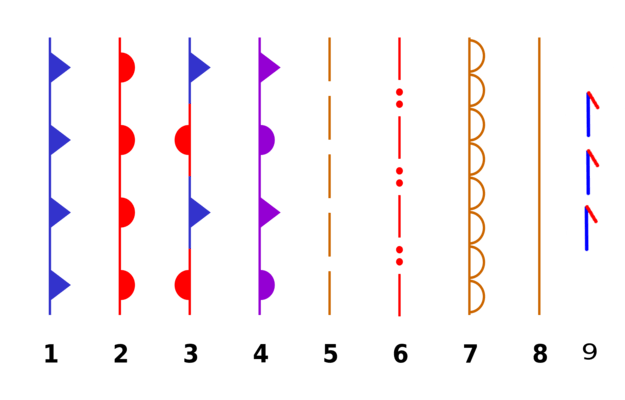

An air mass has similar
temperature and moisture
cold and wind
rain and temperature
warm and dry
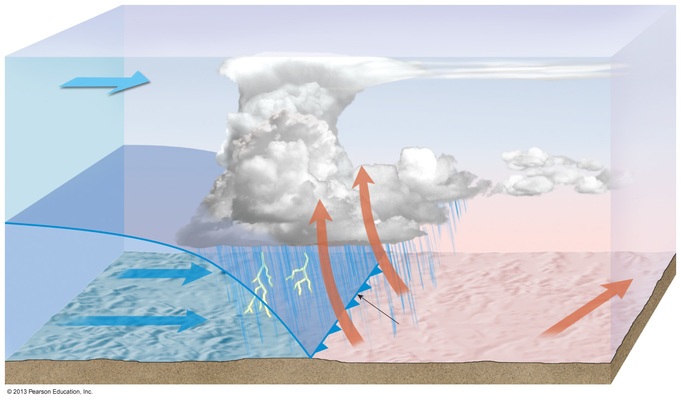
What type of weather will you see along a cold front?
Thunderstorms
Sunny skies
Gentle rain
No weather
Which of the following best describes hurricane's eye wall?
It has the clearest skies and lightest winds
It has the heaviest precipitation and strongest winds
The calm area that surrounds the hurricane
All of these
A violently rotating column of air in contact with the ground and extending from the base of a thunderstorm.
Funnel Cloud
Tornado
Condensation Funnel
Thunderstorm
A scale of wind damage intensity in which wind speeds are inferred from an analysis of wind damage.
Saffir-Simpson scale
Fujita scale
Wind speed scale
Damage indicator scale
A small-scale current of rising air. If the air is sufficiently moist, then the moisture condenses to become a cumulus cloud or an individual tower of a towering cumulus
Updraft
Straight-line winds
Suction vortex
Downdraft
What is the biggest difference between the Geocentric Model and the Heliocentric Model?
the shape of the planets' orbits
the movement of the moon
the center of the solar system
Kepler's first law states that the orbits of the planets are in the shape of a/an...
perfect circle
ellipse
spiral
What is at the middle of a Heliocentric system?
Mars
Moon
Sun
Earth

What gas makes up 21% of Earth's Atmosphere?
Nitrogen
Oxygen
Ozone
None of the Above
Which layer of the atmosphere contains the ozone?
Troposphere
Mesosphere
Stratosphere
Exosphere
The layer where most meteorites vaporize?
Stratosphere
Thermosphere
Troposphere
Mesosphere
The _____ protects us from Earth's harmful UV rays.
Ozone
Troposphere
Clouds
Exosphere
What is the hottest layer of the atmosphere?
Troposphere
Mesosphere
Exosphere
Thermosphere
The mesosphere helps protect the Earth from:
Dangerous cosmic rays.
The impact of meteors.
The effect of Solar Flares.
Harmful weather
The day of the year with the most daylight hours is the
spring equinox
fall equinox
summer solstice
winter solstice
The day of the year with the fewest daylight hours is called the
spring equinox
fall equinox
summer solstice
winter solstice

