Wayground logo

Free Printable Worksheets

Font size

S
M
L
XL
Worksheets

Semester Test

Total questions: 105

Worksheet time: 2hrs 53mins

Name
Class
Date
1.
A barefoot student steps on a hot concrete surface. Most of the heat transferred to the student’s skin by this contact is by the process of—
a)
convection
b)
conduction
c)
vaporization
d)
radiation
2.

When particles are heated they begin to ____.

a)

move faster

b)

mover slower

c)

move up

d)

jump out of the pot

3.

What tool is used to measure temperature?

a)

a stove

b)

a beaker

c)

a thermometer

d)

a glove

4.

When thermal energy is applied to an ice cube, it _____.

a)

freezes

b)

stays the same

c)

tastes better

d)

melts

5.

Thermal energy is transferred from————-

a)

A cooler object to a hotter one

b)

A hotter object to a cooler one

6.
Conduction can only occur between two objects when –
a)
one object is less dense than the other.
b)
both objects are in physical contact with each other.
c)
one of the objects is made of a metal.
d)
both objects are exactly the same temperature.
7.
Which of the following describes a way in which heat energy will be transferred by conduction?
a)
Sample 1 to Sample 2
b)
Sample 3 to Sample 2
c)
Sample 3 to Sample 1
d)
Sample 2 to Sample 3
8.
What two kinds of heat transfer are represented?
a)
stove→pot=radiation pot→egg=conduction
b)
stove→pot=conduction pot→egg=radiation
c)
stove→pot=convection pot→egg=conduction
d)
stove→pot=conduction pot→egg=convection
9.
Which of the following is an example of conduction?
a)
Solar energy warming a room.
b)
Heat rising from the coils of a stove.
c)
Hot air drying a wet towel.
d)
Heat moving from a clothes iron to a shirt.
10.
Which container allowed the most transfer of thermal energy from the water to the environment?
a)
Glass
b)
Wood
c)
Paper
d)
Plastic
11.
Which of following is a conductor?
a)
Wooden Stick
b)
Styrofoam Cooler
c)
Metal Pot
d)
Plastic Container
12.

The three scales used to measure temperature are

a)

metric, American and wrong

b)

Celsius, Fahrenheit, and Calvin

c)

Celsius, Fahrenheit, and Kelvin

13.

Heat always moves

a)

in convection currents

b)

by radiation

c)

from hot to cold

d)

from cold to hot

14.

Transfer of energy by electromagnetic waves is called

a)

conduction

b)

convection

c)

radiation

d)

infrared proton rays (sounds cool, but I made it up so don't pick this one)

15.
Jenny poured some hot chocolate into a cup and stirred it with a metal spoon.  She noticed the spoon was really warm.  What is the best explanation for this?
a)
The spoon is a conductor.
b)
The spoon reflects heat.
c)
The spoon is an insulator.
d)
She touched the spoon first and waited to touch the cup.
16.
Andy stirred a hot drink in a styrofoam cup with a  metal spoon.  In what order did the thermal energy reach Andy's hand?
a)
cup-hot chocolate-hand
b)
hand-spoon-hot chocolate
c)
hot chocolate-spoon-hand
d)
hot chocolate-spoon-hand-cup
17.
When you leave your cold drink outside, the glass may have water drops on it.  This is an example of...
a)
condensation
b)
evaporation
c)
precipitation
d)
estuary
18.

Water in gas form

a)

water vapor

b)

solid

c)

kinetic energy

d)

heat

19.
Conduction is heat transfer by -
a)
Touch
b)
Circles
c)
Waves
20.
Warm air rises and the cool air sinks demonstrates this type of heat transfer. 
a)
conduction
b)
convection
c)
radiation
d)
Insolation 
21.
The heat from a hot burner to a pot is transferred by ______.
a)
convection
b)
insulation
c)
radiation
d)
conduction
22.
The sun warming your skin is an example of heat transfer through 
a)
conduction
b)
convection
c)
radiation
d)
thermal electricity
23.
Which of the following are kinds of heat transfer.
a)
Conduction
b)
Convection
c)
Radiation
d)
All of the above
24.
What is it called when plants give off water vapor as a waste product?
a)
condensation
b)
evaporation
c)
sublimation
d)
transpiration
25.
During which stage do clouds form?
a)
condensation
b)
evaporation
c)
precipitation
26.
Which stages does liquid water from the ocean turn into water vapor?
a)
condesantion
b)
evaporation
c)
precipitation
d)
run off
27.
Which stage does ground water try to return to the ocean or soak into the ground?
a)
condensation
b)
evaporation
c)
precipitation
d)
run off
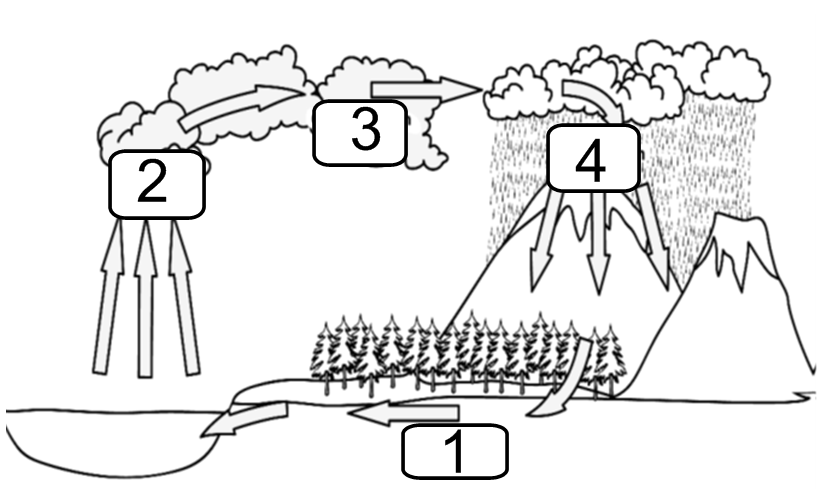
28.
Which stage does the #2 show in the diagram?
a)
condensation
b)
evaporation
c)
precipitation
d)
run off
29.
Which stage does the #3 show in the diagram?
a)
condensation
b)
evaporation
c)
precipitation
d)
run off
30.
what does the #4 show in the diagram?
a)
condensation
b)
evaporation
c)
precipitation
d)
run off
31.
does warm water evaporate quicker than cold water
a)
true 
b)
false
32.
What is the water cycle?
a)
the 3 forms of water
b)
the movement of water on, above, or below the surface of the Earth
c)
when water melts
d)
when clouds form
33.
Which best explains why runoff is important?
a)
It returns water to other locations on Earth
b)
It increases the chance of flooding
c)
It makes evaporation occur faster
d)
It increases condensation
34.
What follows evaporation during the water cycle? How does this occur?
a)
Water evaporates into water vapor
b)
Water vapor condenses and forms a  cloud
c)
Water precipitates to the ground
d)
Water runs down into the hydrosphere
35.
The sun will cause water in the puddle to change from
a)
a gas to a liquid
b)
a liquid to a gas
c)
solid to a liquid
d)
a liquid to a solid
36.
The ______________is the beginning source of energy for the water cycle.
a)
sun
b)
wind
c)
geothermal
d)
volcano
37.
Water begins to evaporate when you add _______ to it.
a)
cold
b)
ice
c)
water cycle
d)
heat
38.

What is the role of the sun in the water cycle?

a)

provide heat energy for evaporation

b)

provide heat energy for condensation

c)

dry out the soil for runoff to occur

d)

provide thermal energy for accumulation

39.

What process is shown by letter B in the diagram?

a)

condensation

b)

transpiration

c)

evaporation

d)

precipitation

40.

During evaporation, water changes from a _________ to a __________.

a)

solid, liquid

b)

gas, liquid

c)

liquid, gas

d)

liquid, solid

41.

Which part of the water cycle changes liquid water to water vapor?

a)

condensation

b)

evaporation

c)

precipitation

d)

transpiration

42.

What do we call water in its gas state?

a)

rain

b)

snow

c)

ice

d)

water vapor

43.

What process is show by letter A in the diagram?

a)

condensation

b)

evaporation

c)

accumulation

d)

precipitation

44.

What is the process called when water vapor turns to liquid water?

a)

evaporation

b)

condensation

c)

precipitation

d)

transpiration

45.

Water that falls to the ground from the clouds is ___.

a)

condensation

b)

evaporation

c)

precipitation

d)

transpiration

46.

Which of the following is an example of precipitation?

a)

sleet

b)

hail

c)

snow

d)

all of the above

47.

What is it called when plants release water vapor through their leaves?

a)

sublimation

b)

respiration

c)

transpiration

d)

precipitation

48.

What is shown by letter D in the diagram?

a)

runoff

b)

groundwater

c)

melting

d)

vapor

49.

Water that seeps through the soil into the ground is ___.

a)

condensation

b)

evaporation

c)

infiltration

d)

precipitation

50.

Where is the largest amount of water on Earth located?

a)

glaciers

b)

oceans

c)

lakes

d)

streams

51.

Water that is constantly moving and recycled above, on, and under the Earth is called ___.

a)

evaporation

b)

infiltration

c)

run off

d)

water cycle

52.

gives the cell ENERGY

a)

mitochondria

b)

vacuole

c)

cytoplasm

d)

ribosomes

53.

turns SUNLIGHT into food for PLANTS

a)

cell wall

b)

chloroplasts

c)

lysosome

d)

endoplasmic reticulum

54.

allows nutrients/waste IN and OUT of cell

a)

endoplasmic reticulum

b)

cell membrane

c)

nucleus

d)

cell wall

55.

CONTROLS all the functions of the cell

a)

nucleus

b)

mitochondria

c)

cytoplasm

d)

golgi bodies

56.

STORAGE of food, water, and waste

a)

lysosome

b)

ribosome

c)

cell wall

d)

vacuole

57.

cell DIGESTION and WASTE removal

a)

endoplasmic reticulum

b)

lysosome

c)

cell membrane

d)

nucleus

58.

makes PROTEINS

a)

ribosomes

b)

endoplasmic reticulum

c)

cytoplasm

d)

mitochondria

59.

gives STRUCTURE and PROTECTION in PLANT cell

a)

cell membrane

b)

cell wall

c)

chloroplasts

d)

cytoplasm

60.

MAKES and TRANSPORTS proteins

a)

cell membrane

b)

chloroplasts

c)

cytoplasm

d)

endoplasmic reticulum

61.

processes and PACKAGES PROTEINS

a)

golgi bodies

b)

mitochondria

c)

ribosomes

d)

vacuole

62.
Which organelle is a gelatin substance that helps fill out the cell
a)
Chloroplast
b)
Lysosomes
c)
Mitochondria
d)
Cytoplasm
63.
Which organelle releases the energy stored inside food
a)
Chloroplast
b)
Mitochondria
c)
Lysosomes
d)
Nucleus
64.
Which organelle takes sunlight and turns it into food?
a)
Lysosome
b)
Cell membrane
c)
Chloroplast
d)
Mitochondria
65.

Which cell part is a specialized part of the cell with a specific job?

a)

Lysosome

b)

Organelle

c)

Chloroplast

d)

Cytoplasm

66.

Which statement is part of the cell theory?

a)

All cells react to stimulus

b)

The cell is the basic unit of all organisms

c)

The cell can be large or small

d)

The cell is either prokaryotic or eukaryotic

67.
What is the name of the structure labeled #10?
a)
objective lens
b)
ocular lens
c)
aperture
d)
nosepeice
68.
What is the function of the structure labeled #10?
a)
controls amount of light that passes through the slide
b)
it is used to change the magnification of the object
c)
it holds that slide in place
d)
it is used to carry the microscope
69.
What is the name of the structure labeled #4?
a)
stage
b)
course adjustment knob
c)
fine adjustment knob
d)
aperture
70.
what is the function of the structure labeled #4?
a)
used with meduim and high power objectives to bring an object into focus
b)
used with low power objective to bring an object into focus
c)
used with all objectives to brign an object into focus
d)
it is used to change the magnification of the object
71.
while focusing a microscope on high power a student crushed the cover slip. The student probably
a)
closed the diaphragm
b)
turned up the light intensity
c)
rotated the eyepiece
d)
used the course adjustment knob
72.

What piece supports the microscope and is used to transport the microscope from one place to another?

a)

Eyepiece

b)

Stage

c)

Base

d)

Light Source

73.

What piece supports the body tube and is also used to transport the microscope from one place to another, along with the base?

a)

Arm

b)

Stage

c)

Aperture

d)

Objective

74.

What piece is the platform that supports the microscope slide?

a)

Base

b)

Diaphragm

c)

Stage Clips

d)

Stage

75.

What piece holds the microscope slide in place ?

a)

Base

b)

Diaphragm

c)

Stage Clips

d)

Stage

76.

What piece controls the amount of light that enters the microscope ?

a)

Aperture

b)

Diaphragm

c)

Light Source

d)

Arm

77.

What piece is a larger knob usually found on either the body tube or the arm and it is used to focus the image under low power?

a)

Aperture

b)

Fine Adjustment Knob

c)

Diaphragm

d)

Course Adjustment Know

78.

What piece is found between the base and the stage and shines light through the object being viewed and into the microscope ?

a)

Aperture

b)

Fine Adjustment Knob

c)

Light Source

d)

Stage Clips

79.

Which of the following should you NOT do when handling a microscope?

a)

Only use lens paper for cleaning

b)

Carry with one hand

c)

Always store covered

d)

Be careful of cords

80.

True of False: If the adjustment knobs are not turning, you should force them to turn.

a)

True

b)

False

81.

The movement of the tectonic plates is caused by

a)

the rotation of the Earth.

b)

convection currents in the Asthenosphere

c)

the gravity of the iron-nickel core.

d)

the Moho discontinuity.

82.
There are three types of plate boundaries. Which choice is NOT a type of plate boundary?
a)
convergent
b)
thrust
c)
divergent
d)
transform
83.

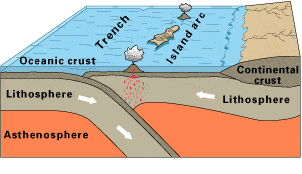
Observe this diagram of a plate boundary. One statement BEST describes what is happening. It is that

a)

the oceanic crust is melting.

b)

the denser ceanic crust is subducting under the less dense oceanic crust

c)

volcanic islands are forming.

d)

the tectonic plates are moving away from each other.
84.

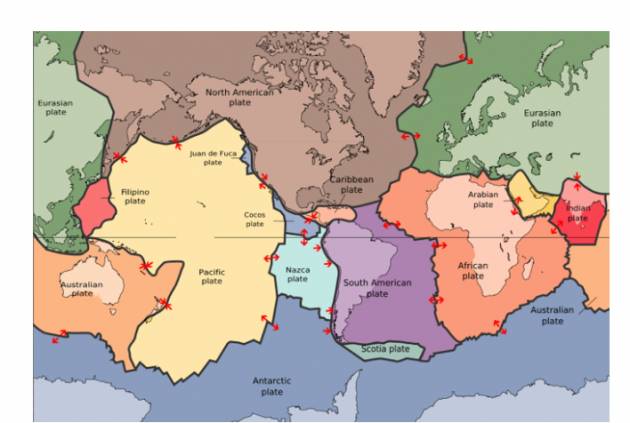
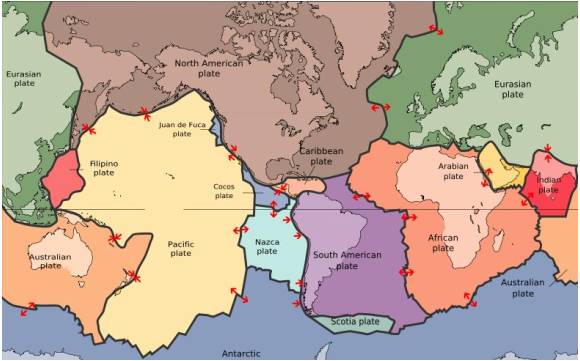
The map in the picture shows tectonic plate boundaries. This map would be useful in predicting the location of future

a)

droughts

b)

hurricanes

c)

earthquakes

d)

tornadoes

85.
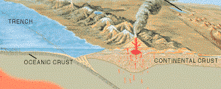
What geological forces might be responsible for this range of mountains?
a)
diverging tectonic plates
b)
erosion of the land by the ocean
c)
converging tectonic plates
d)
deposition of sediments by the ocean
86.
The Earth’s surface is not a solid surface but is divided into
a)
several oceanic plates.
b)
continental and crustal plates.
c)
seven continental plates.
d)
continental and oceanic plates.
87.

Where are earthquakes MOST LIKELY to occur?

a)

close to the equator

b)

close to the center of tectonic plates

c)

at divergent or convergent plate boundaries

d)

at transform plate boundaries

88.
Which of the following is where one plate slides under another plate?
a)
submarine zone
b)
divergence zone
c)
subduction zone
d)
lower zone
89.
What happens to temperature as you go deeper in the Earth?
a)
decreases
b)
increases
c)
fluctuates
d)
remains the same
90.
Name the boundary
a)
convergent boundary
b)
divergent boundary
c)
transform boundary
d)
sergent boundary
91.
What is represented by the picture? 
a)
Sea-floor spreading
b)
Pangea
c)
How the continents are arranged today
d)
Volcanoes
92.
Name the boundary
a)
convergent boundary
b)
divergent boundary
c)
transform boundary
d)
sergent boundary
93.
Name the boundary
a)
convergent boundary
b)
divergent boundary
c)
transform boundary
d)
sergent boundary
94.
Which type of crust is more dense and thinner?
a)
Continental
b)
Asthenosphere
c)
Oceanic
d)
Byers
95.
What was Wegener's hypothesis called?
a)
The Pangea 
b)
Moving Continents 
c)
The Continental Drift
d)
Techtonic Plates
96.
A location where two tectonic plates collide is known as a _________ boundary.
a)
Convergent
b)
Divergent
c)
Transform
d)
Spreading
97.

Earth's plates meet at ____________.

a)

plate tectonics

b)

plate boundaries

c)

continental drift

d)

oceans

98.

Breaks in the crust called __________ form where plates meet.

a)

mountains

b)

rift valleys

c)

faults

d)

trenches

99.

Plates slide past each other at _________________ boundaries.

a)

divergent

b)

convergent

c)

transform

d)

universal

100.

A __________ forms where plates diverge on land.

a)

rift valley

b)

mid-ocean ridge

c)

mountain

d)

trench

101.

________________ currents drive Earth's plate movement.

a)

ocean

b)

atmosphere

c)

wind

d)

convection

102.

Which theory describes the motion of the force driving Earth's Plates?

a)

continental drift

b)

plate tectonics

c)

first law of motion

d)

third law of motion

103.

What is the motion of Earth's plates like?

a)

fast and in stages

b)

slow and in stages

c)

fast and constant

d)

slow and constant

104.

The San Andreas fault is an example of which type of boundary?

a)

transform

b)

divergent

c)

convergent

d)

universal

105.

Which feature forms at convergent boundaries?

a)

trench

b)

rift valley

c)

mountain range

d)

mid-ocean ridge