
 Worksheets
Part 2 Midterm Exam
Total questions: 43
Worksheet time: 47mins
How many carbons are in the backbone (longest chain) of this organic compound: 2,3,3-triethyl-4-nonane
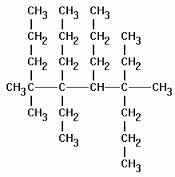
Nonane contains the following number of hydrogen:
20
4
9
17
Propane contains the following number of carbons:
3
4
9
7
In hydrocarbon nomenclature, a number next to a number should be separated with a :
blank space
comma
hyphen
In hydrocarbon nomenclature, a number next to a word should be separated with a :
blank space
comma
hyphen

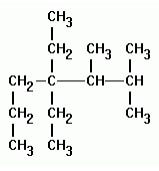
What is the IUPAC name of this structure?
(a)

4-isopropyl-2,3,5-trimethylheptane
2,3,5-trimethyl-4-propylheptane
4-propyl-2,3,5-trimethylheptane

chlorocyclopropane
1-chlorocyclopropane
1-chloropropane

2,3,5-trimethyl-4-propylheptane
4-sec-butyl-2,3-dimethylheptane
Which of the following statements concerning the reaction of methane with bromine is/are correct?
(1) It is an addition reaction.
(2) It is a substitution reaction.
(3) A similar reaction will occur if propane is used instead of methane.
(1) only
(2) only
(1) and (3) only
(2) and (3) only
In organic chemistry, commas separate....
numbers
names from numbers
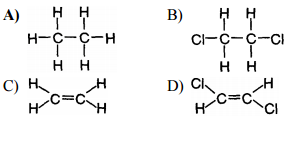
Which is the structures with IUPAC nomenclature
2,2,4-trimethylpentane
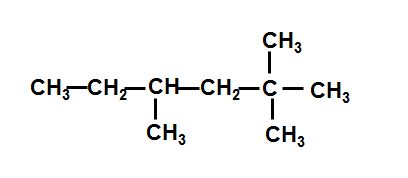
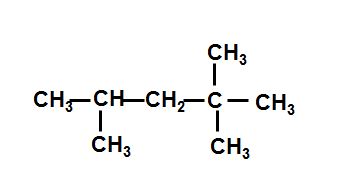
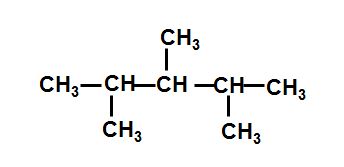
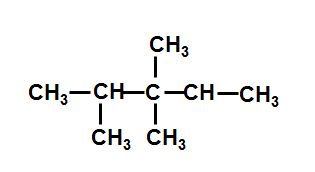

Which of the following is not true about this?
C4H10
butane
CH3CH2CH2CH2
all are true

What is the IUPAC name of this structure?
4-ethyl-2,2-dimethylhexane
2,2-diethyl-4-methylhexane
2,2-dimethyl-4-ethylhextane
4-diethyl-2,2-methylhexane

Give the name of this compound.
(a)

Name this compound.
cyclohexane
cycloheptane
cyclobutane
cyclooctane
Which of the following is not an alkyl?
CH3
CH3CH2
CH3CH2CH2
none of the above
Ice cream melting is an example of an __________ process.
endothermic
exothermic
what does c stand for?
heat capacity
specific heat
mass
temperature
When heat flows from system to the surroundings that is an example of an ________________ process.
exothermic
endothermic
What device is used to measure the amount of heat involved in a chemical reaction or physical process?
barometer
calorimeter
thermometer
What is calorimetry?
process of measuring kinetic and potential energy
process of measuring heat flow of chemical reactions
process of measuring pressure and temperature of a substance
Heat flows from _______ to _________.
warm to cool
cool to warm
The law of conservation of energy states that
in any chemical or physical change, energy cannot be created or destroyed, only changed in form.
heat changes occur during chemical and physical changes.
energy is the capacity to do work or to supply heat
there are two types of energy, kinetic and potential
What is the SI unit of heat and energy?
calorie
celsius
joule
The specific heat of aluminum is 0.21 J/g°C. How much heat(Q) is released when a 10 g piece of aluminum foil is taken out of the oven and cools from 100° to 50°?
-105 J
-10.5 J
-1.05 J
20g of water. specific heat of water is 4.18 J/g°C. temperature changes from 25° C to 20° C, how much heat energy (q) moves from the water to the surroundings?
-418 J
48J
A gas releases 45J of heat as 94J of work was done to compress it.
The change of energy in this problem is ___________.
endothermic
exothermic
Calculate the change in energy: A gas absorbs 67J of heat as it does 92J of work by expanding.
25J
-159J
-25J
159J
How do you calculate Enthalpy of a reaction?
ΔH = ΔHproducts - ΔHreactants
ΔT = q / mC
ΔG = ΔH -TΔS
E = mc2
Calculate the standard enthalpy: 3NO2+H2O(l)⟶2HNO2(aq)+NO(g)
NO = 90.4
NO2 = 33.85
H2O(l) = -285.8
HNO2 = -76.73
(a)
Cyclopentane



