
 Worksheets
Pre-SAT 3
Total questions: 45
Worksheet time: 1hrs 5mins
Valence electrons are
neutral (no charge)
found in the outer most energy level of the atom
equal to the number of protons

This could be the dot diagram of
Mg
Cl
C
O

This is a correct dot diagram for neon (Ne)
true
false
Select the 3 exceptions to octet rule.
Expanded octet
Even number electron
Incomplete octet
Odd number electron
Which of the following is true about expanded octets? (Check all that apply.)
Any element can have an expanded octet.
Elements in row 3 until 7 on the periodic table can have expanded octets.
An expanded octet is when an element has less than 8 electrons.
An expanded octet is when an element has more than 8 electrons.
An expanded octet is when an atom has an unpaired set of electrons in its outer shell.
Draw the Lewis structure for BH3 on your own. Then compare your drawing to the answer choices, and select the correct drawing for BH3.


Draw the Lewis structure for BeI2. Then compare your drawing to the answer choices, and select the correct answer choice.


What is incorrect about the following Lewis structure for SO3?
Oxygen is not fulfilling the octet rule.
Sulfur is not fulfilling the octet rule.
All 24 valence electrons are not being used.
There are too many valence electrons being used.

What is the formal charge on the oxygen atom at the top of this Lewis structure?
0
-1
+1
-3

What is the formal charge on the phosphorus atom in this Lewis structure?
0
-1
+1
-3
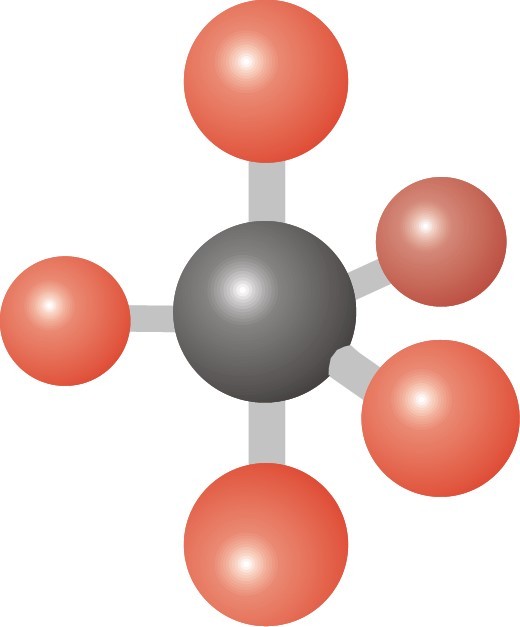
What shape is shown here?
Octahedral
Tetrahedral
Trigonal bipyramidal
Seesaw
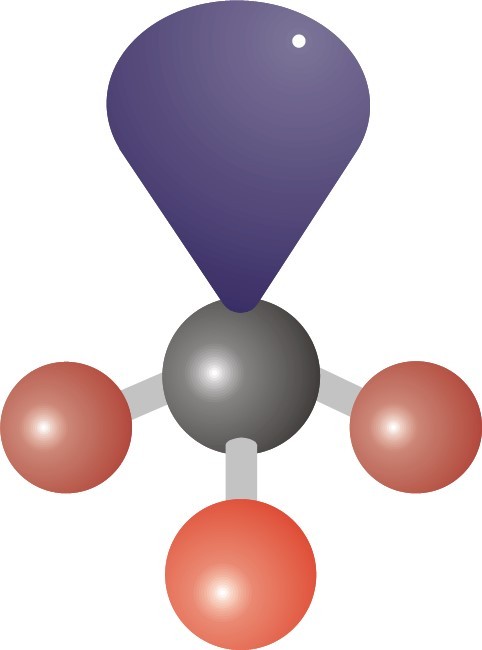
What molecular geometry would PH3 have?
Trigonal Pyramidal
Trigonal Bipyramidal
Bent
Linear
Which one of these structural formula is non polar molecule?


What is the molecular geometry/shape of HCN?
linear
trigonal planar
bent
tetrahedral
Which of these is the shape of CCl4?


The polarity of a bond is determined by...
The sum of the electronegativities of the two atoms.
The difference in the electronegativities of the two atoms.
The charges of the atoms.
None of the above.
A diatomic molecule like O2 is always _____ because electrons are shared _____
nonpolar; unequally
polar; equally
nonpolar; equally
polar; unequally

Is this molecule polar or non-polar?
Non-polar
Polar

BH3 molecules can form...
London dispersion forces
Dipole-dipole forces
Hydrogen bonds
HF molecules can form...
(choose all possible intermolecular forces)
London dispersion forces
Dipole-dipole forces
Hydrogen bonds
CH4 molecules can form...
London dispersion forces
Dipole-dipole forces
Hydrogen bonds
CH3Cl molecules can form...
(choose all possible intermolecular forces)
London dispersion forces
Dipole-dipole forces
Hydrogen bonds
Which type of intermolecular force is the strongest?
Hydrogen bonding
Dipole-Dipole
London Dispersion
which of following forces is the weakest intermolecular force?
Ionic bond
Hydrogen bond
Covalent bond
van der Waals forces

Intermolecular forces for: CO2
London Force
Dipole dipole
Hydrogen bonding

The diagram shows metallic bonding.
Which labels are correct?
X: atomic nucleus
Y: outer electron
X: metal atom
Y: mobile electron
X: metal cation
Y: mobile electron
X: positive ion
Y: negative ion
Why do metallic compounds conduct electricity as solids?
core electrons are mobile, allowing electricity to flow through the metal
valence electrons are mobile, allowing electricity to flow through the metal
protons are mobile, allowing electricity to flow through the metal
the metal cations are mobile, allowing electricity to flow through the metal

At equilibrium, __________.
all chemical reactions have ceased
the rates of the forward and reverse reactions are equal
the rate constants of the forward and reverse reactions are equal
the limiting reagent has been consumed

Which is the reactant and why?
A, it's concentration is decreasing
A, it's concentration is increasing
B, it's concentration is decreasing
B, it's concentration is increasing

At what time on the graph will the reaction reach equilibrium?
t1
t2
t3
t4
What is the equilibrium-constant expression for
CO2(g) + H2(g) ↔ CO(g) + H2O(l)
K= [CO][H2O] / [CO2][H2]
K= [CO2][H2] / [CO]
K= [CO2][H2] / [CO][H2O]
K= [CO] / [CO2][H2]


What is the concentration equilibrium constant expression?

