
Font size
 Worksheets
Environmental Science Final Review
Total questions: 41
Worksheet time: 42mins


Which of the following is an abioitic factor that could affect biotic factors?
Population of rabbits.
Length of daylight.
Presence of harmful bacteria.
Number of herbivores.

Living things pass on their ________________, stored in DNA.

What does the word "diversity" mean...
living
nonliving
toxic
variety

Which ecosystem is more likely to survive a change in the environment?
One with High biodiversity
One with Low biodiversity
A ________ is a group of organisms of one species that interbreed and live in the same place at the same time.
community
ecosystem
population
biome
Factors like predation can have a positive benefit to the population of prey organisms because predators tend to keep prey populations below their ___________.
carrying capacity
sustainibility number
exponential growth point
competition level
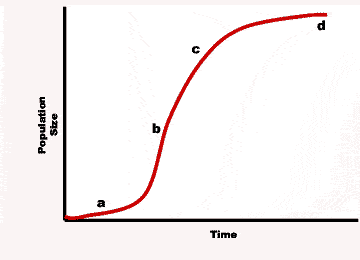
What point on the graph represents carrying capacity?
a
b
c
d

Many factors can affect the success or failure of a population. What are factors that can cause population growth to decrease.
growth factor
limiting factor
density factor
environmental factor
Which of the following are examples of a density independent factors?
forest fire
seasonal cycles
storms
disease
As a population of a species increases within a territory, which of the following most likely also increases?
Immigration
Food supply
Carrying capacity
Competition
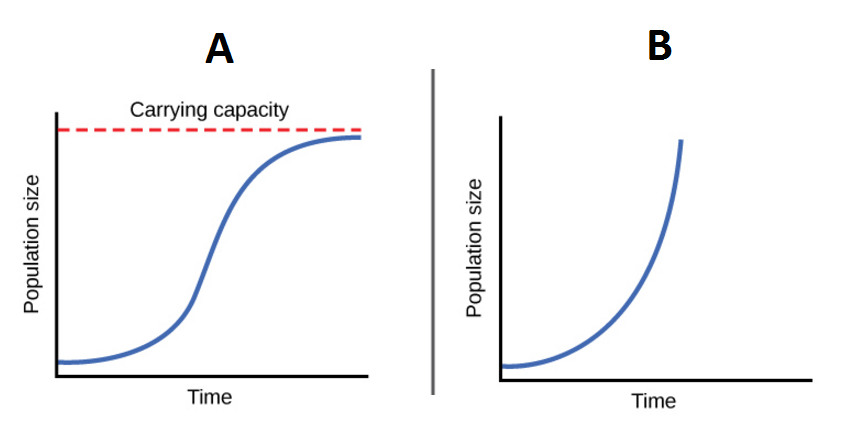
What type of growth model is shown in image A?
Exponential
Logistic
At carrying capacity, a population __________.
increases rapidly
increases slowly
decreases slowly
is in dynamic equilibrium
97%
3%

The graph shows us that
the earth temperature is always increasing
the earth's temperature has steadily increased since 1900
the earth's temperature is steadily rising since the 1960s
the earth's temperature decreased during the 19th and 20th centuries
______________ describes the weather conditions in an area over a long period of time.
Relative humidity
Weather
Climate
Heat Index
An organism whose DNA has been altered is called a(n)
Sediment
Organic
Genetically Modified Organism
Pollution
A large area of cropland seeded with one crop is a(n)
monocultre
polyculture
organic practice
traditional farming technique
Your friend tells you she’s decided not to use pesticides or synthetic chemicals on her farm; instead she’ll rely on composting and biological pest control. She is practicing
industrial agriculture
monoculture
organic agriculture
sustainable agriculture
___________________ are fuels made from the remains of ancient organisms.
fossil fuels
waste energy
renewable energy
nuclear energy

A large wind turbine can supply around 300 homes - True or False?

a renewable resource is ....
a resource that forms much more slowly than it is consumed
a natural resource that can be replaced at the same rate at which it is consumed
any natural material that is used by humans

Choose ALL of the renewable resources
sun
coal
wind
fossil fuels
Earth (geothermal)
The main problem with hydropower is that
it is renewable.
the fish wont have any water to live in.
it is nonrenewable.
it effects the ecosystem.
"Matter cannot be created or destroyed, it only changes form. " is known as
The Law of Conservation of Energy
The First Law of Thermodynamics
The Law of Conservation of Matter
The Second Law of Thermodynamics
A liquid that has passed through solid waste in a landfill
A gas that has passed through solid waste in a landfill
A solid that has passed through solid waste in a landfill
A chemical that has passed through solid waste in a landfill
The study of the spread of disease
dose
dose-response curve
epidemiology
particulates
Particles in the air that are small enough to breathe in to the lungs
dose
dose-response curve
epidemiology
particulates
Organism in which a pathogen lives all or part of it's life
vector
host
pathogen
dose

