
 Worksheets
The Science final Exam Page 138-163 Part 1 Evolution
Total questions: 98
Worksheet time: 2hrs 53mins
Natural Selection can lead to_______.
accumulation
evolution
Variations
Selection
Helpful _______ gradually accumulate in a species while unfavorable ones disappear.
competition
Variations
Selection
Overproduction
What is Overproduction?
When the world has too many trees and plants.
When animals overeat
When animals are Variations.
When an animal produces far more offspring it can possibly survive.
When organisms are better adapted to their environment they will survive and reproduce more successfully than organisms less adapted. This process is called what?
Selective breeding
Natural Selection
Cloning
Evolution of all species
Which scientist visited the Galapagos Islands and came up with the theory of natural selection?
Theodor Schwann
Gregor Mendel
Charles Darwin
Rudolf Virchow

Gigantopithecus were very large primates that lived 500,000 years ago. Since none of these mammals are still today, they are said to be....
Extinct
Threatened
Endangered
Declining

Scientists have collected millions of fossils of different organisms, and have developed a timeline of life on Earth. What do we call this?
Mutation
Natural Selection
The theory of evolution
Fossil Record

Sometimes bones in the front limbs of animals are very similar in structure. What do we call similar bone structures that indicate a link to a common ancestor?
Adaptations
Gradualism
Homologous Structures
Extinction
A physical or behavioral trait that helps an organism survive and reproduce in its environment is called a what?
An adaptation
A response to a stimulus
A mutation
Evolution
What most likely caused the finches on the Galapagos Islands to have beaks that were different from the finches on the mainland?
There were different types of predators on the island.
There were different types of food available on the island.
The finches had no water to drink.
The finches on the mainland could not fly high enough.
What do we call a change in a species over time?
Adaptation
Evolution
Extinction
Environmental influences

Evolution is best defined as:
the process which organisms die.
the process which organisms change over time.
the process which organisms that are extinct become revived.
the process which non-living things fossilize.

The solidified remain or imprint of a once living thing are called:
Fossils
Homologous Structures
Vestigial Structures
DNA

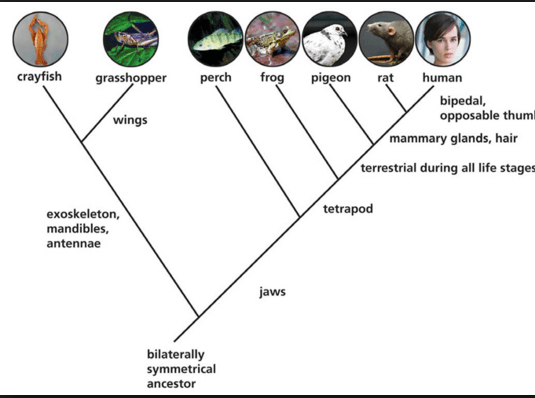
Which two animals are closer relatives?
Dolphin and Wolf
Wolf and Shark
Shark and Dolphin

Which two animals are closer relatives?
Bear and Raccoon
Bear and Opossum
Opossum and Raccoon

Which two animals are closer relatives?
Human and Sponge
Sponge and Tunicate
Human and Tunicate
What caused the Horse and Whale to evolve?
They wanted to become bigger so they ate as much as they could.
Their environments changed so they had to adapt.
They wanted to look different so they changed their appearance.

Which animal is the MOST similar to the Human from the list below?
Bat
LIzard
Whale
Bird
Which animal is the LEAST similar to the Human from the list below?
Bat
LIzard
Whale
Bird


Which scientist visited the Galapagos Islands and came up with the theory of natural selection?
Theodor Schwann
Gregor Mendel
Charles Darwin
Rudolf Virchow

What type of evidence is represented in the picture above:
Fossils
Vestigial Structures
DNA
Homologous Structures

What type of evidence is shown in the image above?
Fossils
Vestigial structures
Homologous Structures
DNA

What type of evidence are shown in the picture above?
Fossils
Embryology
Homologous Structures
Vestigial Structures

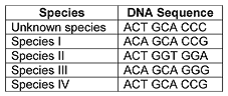


Body parts similar in structure and origin
evolution
embryology
homologous
variation
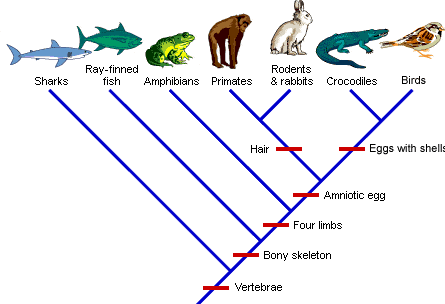
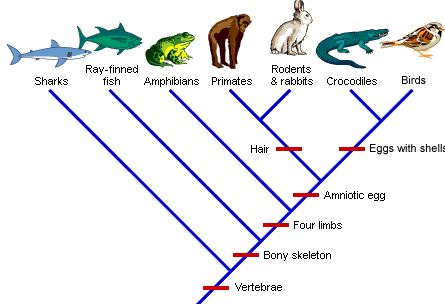
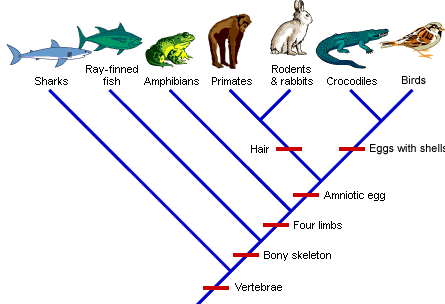
Dogs descend from wolves. Thousands of years ago, humans started to selectively breed wolves based on the traits they found desirable. This process by which people choose and select which animals (or plants) to pass on their genes is called...
artificial selection
genetic drift
transitional forms
natural selection
Charles Darwin discovered that the struggle to survive and reproduce selects individuals with certain traits over other. Over time, this selection process causes the population to become better adapted to an environment. This process is called...
natural selection
artificial selection
genetic drift
transitional forms
Why does genetic diversity increase the odds of survival for a population?
The more genetic variation there is, the more likely it is that there is an allele present that is best suited for the environment.
The more genetic variation there is, the less likely it is for mutations to form in the population.
The more genetic variation there is, the slower the rate of adaptation.
The more genetic variation there is, the larger and stronger the individuals that make up that population.
Which of the following is the most reasonable explanation as to why ostriches can no longer fly?
The ancestors of ostriches fed on ground plants and roots. Larger bodies digest plants more effectively. As they became larger and better adapted to eating plants and roots, the ability to fly was no longer beneficial and lost.
The percentage of atmospheric oxygen has decreased making it impossible for large birds like ostriches to fly.
The ancestors of modern ostriches lost the use of their flight muscles in an environmental disaster. Their offspring inherited this characteristic acquired from the disaster.
Ostriches can still fly. They only fly during the most extreme of emergencies.
Storms can accidently transport insects to isolated ocean islands. These insects can then begin new populations on these islands. When comparing different insect populations, which characteristic would make a population more likely to survive in a new habitat?
Having the most genetic variation
Having the largest wings
Having the smallest body mass
Having the least genetic variation
There are a wide variety of ducks around the world. Some are colorful, some are plain, some are large, some are small, some have large wide beaks, and others have small pointy beaks. Why is there so much variety between different types of ducks?
Different characteristics evolved in different species of ducks to best adapt them to the different environments they live in.
Ducks do not descend from a common ancestor.
All of the observed features of ducks are the result of genetic drift - a constant series of accidents and disasters have caused them to look different from each other over time.
Humans have selectively bred all the duck populations of the world, forming a diverse range of duck breeds.
The wings of a bat and the arms of a human are...
homologous
vestigial
analogous
transitional
If two organisms share a homologous structure, then....
they inherited that structure from a common ancestor.
they did not inherit that structure from a common ancestor.
it is a remarkable coincidence.
they must be the same species.
Fossils that show an organism in between an ancestral forms and its modern forms, like fossils of prehistoric whales with long legs or dinosaurs with feathers, are examples of...
transitional forms
homologous structures
analogous structures
vestigial traits
The embryos of fish, amphibians, reptiles, birds, and mammals all have common structures: gill slits, a tail, a backbone and four limb buds - even if these traits do not appear in the fully developed organism. Why do these traits show up in embryos?
These traits imply that all vertebrates descend from a common ancestor.
Natural selection can only work on embryonic traits.
Mutations appear during the embryonic phase of life.
Its all just a random coincidence.
Mistakes made in copying DNA are called...
mutations
alleles
fitness
genetic drift
How would the fossils in the sediment layers of Earth appear to prove evolution?
fossils in upper layers complex and lower layers complex
fossils in upper layers simple and lower layers complex
fossils in upper layers complex and lower layers simple
fossils in upper layers simple and lower layers simple
Which is the best evidence listed for the theory of evolution
fossil record
climate change
numerical data
religious information

Which statement is correct about the evidence in this picture?
similar bones indicate a similar diet
similar bones indicate a similar habitat
similar bones indicate a common ancestor
similar bones indicate evolution happened quick

What is the most likely cause for the change in the mice population over time?
hawks eat more dark mice because they taste better
hawks eat more white mice because they are easier to see
hawks eat more dark mice because they are easier to see
hawks eat more white mice because they reproduce better
The same species lives in the same area and have different appearances. What term can be used to describe this?
overpopulation
population
extinction
variation
Polar bears live in the Arctic. Ice in the Arctic in melting rapidly, reducing the range in which the polar bear can live. If polar bears do not have adaptation that allow them to survive these changes, what might happen to them?
become another speices
overpopulation
change the enviornment
become extinct
A reptile that is a herbivore and exists only on an isolated island. What is a reason they would go extinct?
produces many offspring with many unique traits, and the environment does not change
produces many offspring with few unique traits, and the environment changes
produces few offspring with many unique traits, and the environment does not change
produces few offspring with few unique traits, and the environment changes
Which statement best explains adaptations in context of the Theory of Evolution.
adaptations are critical to the survival of a species by providing ways to adjust
adaptations allow a single surviving organism to choose its traits and then reproduce
adaptations are when an organism changes is environment to make it easier to live
adaptations allow organisms to learn how to survive in any environment
A Koala eats a certain type of leaf from a Eucalyptus Tree. These trees are becoming less and less common. What will happen if the Koala can't adapt to a new food source?
The Koala population may increase as the strongest ones survive and reproduce
The Koala bear may become extinct if they can not find new food to eat
the Koala population will stay the same as long as they stay in a restricted space
The Koala bear's genes will immediately change and allow them to survive
Some scientist think that the dinosaurs went extinct because of an asteroid strike which changed the Earth's climate; other's think that volcanic eruptions changed the climate and caused the extinction of the dinosaurs.
What do these have in common?
both suggest climate change led to artificial selection
both suggest particles from the sky buried the dinosaurs
both suggest that dinosaurs evolved too quickly after a disaster
both suggest that dinosaurs were unable to adapt to climate change
Which of the following is a correct statement about the relationship between natural selection and evolution?
Natural selection results from evolution.
Natural selection includes evolution as a part of it.
Natural selection is the mechanism of evolution.
Natural selection and evolution are the same thing.
Which statement is correct about the theory of evolution, which is a piece of scientific knowledge that explains that all organisms have one common ancestor?
All scientists agree on the theory of evolution.
It was and still is a highly debated topic among scientists.
It was one of the fastest theories to form as evidence for it plentiful.
All scientists choose to disprove the theory of evolution because most evidence does not support it.
What happens when a species is unable to adapt to a changing environment?
it will adapt and become a new species
it will most likely go extinct
it will not adapt but will keep on living
it will move to a new area where it can live
Artificial selection is a form of biotechnology that has been around for centuries. Which of the following is a positive aspect of artificial selection?
It ensures that weak traits like disease tendency are not in a population.
It ensures that human-preferred traits are available in animals and plants.
It increases the speed of evolution and change in the human population.
It increases genetic variation among a population of organisms.

