wayground logo

Free Printable Worksheets

Font size

S
M
L
XL
Worksheets

End of Year Quiz (Y6)

Total questions: 100

Worksheet time: 50mins

Name
Class
Date
1.

An organism that can make its own food

a)

decomposer

b)

producer

c)

consumer

2.

What are the living and nonliving things in an environment or area?

a)

predator

b)

producer

c)

ecosystem

d)

abiotic factor

3.

Breaks down and feeds on the remains of other organisms

a)

decomposer

b)

consumer

c)

producer

4.

Small consumers that are hunted and eaten by larger consumers

a)

producer

b)

prey

c)

predator

5.

Interacting food chains found in an ecosystem

a)

food web

b)

food chain

c)

predator

6.

An animal that hunts and eats other animals for energy

a)

prey

b)

predator

c)

decomposer

7.

These organisms cannot make their own food; they must eat something for energy

a)

decomposer

b)

consumer

c)

producer

8.

Choose the producer.

a)

rock

b)

tree

c)

cow

d)

bird

9.

Choose the decomposer.

a)

grass

b)

elephant

c)

bacteria

d)

bird

10.

Choose the consumer.

a)

mushroom

b)

horse

c)

tree

d)

grass

11.

Where does the food chain START?

a)

with consumers that eat grass

b)

with the sun giving energy to producers

c)

with the sun giving energy to consumers

d)

with consumers eating other consumers

12.

A decomposer is also a producer.

a)

True

b)

False

13.

Which of the following are factors that could cause extinction?

a)

Destruction of animals' habitat

b)

Climate change

c)

Pollution

d)

Increased human population (more people)

e)

ALL of the above could cause extinction

14.

Which of these living things is a producer?

a)

horse

b)

cow

c)

fly

d)

grass

15.

Mice and grasshoppers are examples of prey.

a)

True

b)

False

16.

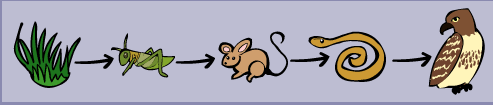
Explain the flow of energy in this food chain (who passes energy to who).

a)

The hawk gives energy to the snake. The snake gives energy to the mouse. The mouse gives energy to the grasshopper who gives energy to the grass.

b)

The mouse gives energy to the hawk. The snake gives energy to the grasshopper. The grass gives energy to the snake.

c)

The grass gives energy to the grasshopper. The grasshopper gives energy to the mouse. The mouse gives energy to the snake who gives energy to the hawk.

17.

What does the digestive system do?

a)

gets ride of the waste in our body that it sees as poison

b)

moves blood throughout the body

c)

breaks down food so we can be healthy

d)

controls the muscles in our body by making them work together

18.

True or False: Each system is made up of smaller parts like cells, tissues and organs.

a)

True

b)

False

19.
The major organs of this system allow movement in the body; there are three major types - cardiac, skeletal, and smooth.
a)
SKELETAL
b)
MUSCULAR
c)
INTEGUMENTARY
d)
DIGESTIVE
20.
The heart, blood vessels and blood are the major organs of which system?
a)
CIRCULATORY
b)
DIGESTIVE
c)
EXCRETORY
d)
NERVOUS
21.
Which is the major organ of the skeletal system?
a)
teeth
b)
nails
c)
bones
d)
tendons
22.
The stomach, liver, small intestine and pancreas are all part of which system?
a)
Muscular
b)
Digestive
c)
Circulatory
d)
Excretory
23.
This system works with the circulatory system to provide oxygen to the body's cells and to remove carbon dioxide.
a)
The respiratory system
b)
The nervous system
c)
The digestive system
d)
The muscular system
24.

The _______ is the basic building block of the human body.

a)

organ

b)

cell

c)

tissue

d)

system

25.

The respiratory system is made up of which of the following organs?

a)

brain, nerves and spinal cord

b)

cells, lungs and heart

c)

esophagus, stomach, small intestine

d)

mouth, nose, trachea, lungs

26.

How many chambers does the human heart have?

a)

1

b)

2

c)

3

d)

4

27.
This system allows for movement of the body.
a)
skeletal
b)
nervous
c)
muscular
d)
integumentary
28.
This system transports essentials and removes wastes to and from the cells of the body.
a)
circulatory
b)
respiratory
c)
skeletal
d)
integumentary
29.

Every living organism is made up of one or more cells

a)

True

b)

False

30.
How many cells do you have in your body?
a)
hundreds
b)
thousands
c)
millions
d)
trillions
31.

Animals cells and plant cells are exactly the same.

a)

True

b)

False

32.

Only ____________ cells have a cell wall instead of a cell membrane.

a)

plant

b)

animal

c)

white blood

d)

living

33.
The nucleus is like the ____________ of the cell.
a)
foot
b)
hand
c)
stomach
d)
brain
34.
all matter is made of what 
a)
energy 
b)
atoms 
c)
electrons 
d)
compounds 
35.
The positive particles of an atom are 
a)
electrons 
b)
positrons 
c)
neutrons 
d)
protons 
36.
Particles in an atom that are neutral and have no charge are 
a)
negatrons 
b)
electrons 
c)
neutrons 
d)
protons 
37.
The particles that are found in the nucleus of an atom are
a)
neutrons and electrons
b)
electrons only
c)
protons and neutrons
d)
protons and electrons
38.
Neutrons are _______________ particles.
a)
negative
b)
positive
c)
neutral
d)
cows
39.
What is at the center of every atom?
a)
an electron
b)
a compound
c)
a molecule
d)
a nucleus
40.

The order of elements in the periodic table is based on

a)

the number of protons in the nucleus.

b)

the electric charge of the nucleus.

c)

the number of neutrons in the nucleus.

d)

atomic mass.

41.
The atomic number tells you what?
a)
number of electrons
b)
number of protons
c)
number of neutrons
d)
both electrons and protons in an atom.
42.
In the modern periodic table elements are arranged by:
a)
atomic mass
b)
atomic number
c)
valence electrons
d)
number of isotopes
43.
Measure of the amount of matter 
a)
mass
b)
volume
c)
weight
d)
density
44.
Anything that has mass & takes up space
a)
gravity
b)
force
c)
matter
d)
volume
45.
Smallest unit of an element
a)
compound
b)
atom
c)
molecule
d)
product
46.
Substance that cannot be broken into simpler substances
a)
element
b)
molecule
c)
gram
d)
proton
47.

What do we call the chemicals that result from a chemical reaction?

a)

reactants

b)

products

c)

subscripts

d)

coefficients

48.

The Law of Conservation of Mass says that matter can neither be __________ or __________.

a)

created; destroyed

b)

recycled; renewed

c)

subtracted; added

d)

joined; separated

49.

According to the Law of Conservation of Mass, what happens to the wood and oxygen when it is burned?

a)

The wood disappears.

b)

It stays the same chemically.

c)

The atoms in the wood and oxygen rearrange and form smoke and ash.

d)

Nothing.

50.
Is melting butter for popcorn a chemical or physical change?
a)
chemical
b)
physical
51.
Which of the following is a sign that a chemical reaction has occurred?
a)
change in shape
b)
melting
c)
formation of a gas
d)
dissolving
52.
Melting a chocolate bar?
a)
Physical Change
b)
Chemical Change 
53.
Rotting bananas?
a)
Physical Change
b)
Chemical Change
54.
Cutting your hair?
a)
Physical Change
b)
Chemical Change
55.
Which is the best 
conductor of heat? 
a)
a glass tube 
b)
a copper wire 
c)
a piece of string 
d)
a fuzzy blanket
56.

Herbivores only eat __________.

a)

meat

b)

plants

c)

meat and plants

d)

trees

57.

What does an omnivore eat?

a)

Meat only

b)

Plants only

c)

Meat and plants

58.
Which of these is true of fruits blended together?
a)
chemical change
b)
physical change
c)
both types of changes
d)
none of these
59.
Gallium spoon melting is a physical change because a puddle of _____ metal is left afterwards.
a)
iron
b)
steel
c)
aluminum
d)
gallium
60.
Changes between states of matter are often which?
a)
chemical changes
b)
physical changes
c)
both
d)
neither
61.
When something burns it is which of these?
a)
chemical change
b)
physical change
c)
d)
62.
What is a circuit?
a)
an outlet or switch
b)
a path which an electric current flows
c)
a poor conductor
63.
What is an electric current? 
a)
the flow of electricity 
b)
electricity moving in only one direction
c)
a switch that gives power
64.
What is a switch? 
a)
part of the toaster that you plug into the wall
b)
an outlet that gives power
c)
part of a circuit that starts or stops the electricity
65.
Electric current moves in only one direction. 
a)
True
b)
False
66.
A conductor is ____________
a)
something that allows electric current to flow easily
b)
something that limits the flow of electricity
67.
Electrical energy can make heat energy. 
a)
True
b)
False
68.
All metals conduct electricity equally well. 
a)
True
b)
False
69.
A _____________ limits the flow of electricity 
a)
resistor
b)
conductor
c)
circuit
70.

Another name for a battery is a _____________.

a)

Switch

b)

Cell

c)

Load

d)

Wire

71.

A ____________ circuit has many pathways through which electricity can flow.

a)

Current

b)

Series

c)

Parallel

d)

Closed

72.

What causes the chemical reaction in a battery?

a)

Anode

b)

Cathode

c)

Electrolyte

73.

When the light is on, it means that the circuit is open.

a)

True

b)

False

74.
Which of the following is NOT a conductor?
a)
Water
b)
Aluminum
c)
Wood
d)
Penny
75.
What does a food web represent?
a)
All connections of energy flow throughout all organisms in a habitat.
b)
The specific ways that mutualism is carried out.
c)
A single pathway or energy flow between organisms. 
d)
How carnivores get their food. 
76.

The heart is made of which of the following types of muscles?

a)

Cardiac muscle

b)

Striated muscle

c)

Smooth muscle

d)

None of the above

77.

Which of the following are chambers of the heart?

a)

Valves

b)

Atrium and ventricle

c)

Arteries and veins

d)

Sinoatrial nerve

78.

Blood clots can cause a heart attack

a)

True

b)

False

79.

Which of the following is true about your heart?

a)

Your heart may stop beating from time to time.

b)

You have to think in order to keep your heart beating.

c)

Your heart pushes blood through your body.

d)

All of the above

80.

6. Our heart is of the size of our __________

a)

Hands

b)

Ears

c)

Fist

81.
Which side of the heart pumps oxygen-rich blood to the rest of the body?
a)
Right
b)
Left
82.
_____ carries blood away from the heart.
a)
Blood cells
b)
Veins
c)
Capillaries
d)
Arteries
83.
Name the part.
a)
Pulmonary vein
b)
Right atrium
c)
Aorta
d)
Pulmonary artery
84.
What is the largest artery in the body?
a)
femoral artery
b)
brachial artery
c)
carotid artery
d)
aorta
85.
When forces on an object are balanced, what is the force?
a)
Five
b)
Ten
c)
Six
d)
Zero
86.
What is the net force?
a)
20 N 
b)
0 N 
c)
400 N 
d)
40 N 
87.
What is the unit to MEASURE force?
a)
Kilogram
b)
Meter
c)
Pascal
d)
Newton
88.
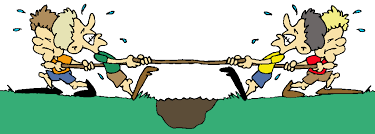
If these teams are pulling with the same amount of force what will happen?
a)
The boy in blue will win.
b)
They will not move at all.
c)
The boy in red will win.
d)
Both will fall down.
89.
This is an example of what kind of force?
a)
Balanced Force
b)
Pushing Force
c)
Gravity Force
d)
Unbalanced Force
90.
If an object is not moving the forces acting upon it are _____________
a)
unbalanced
b)
weak
c)
balanced
d)
Hulk Smash!
91.
Calculate the net force of the object in the image shown.
a)
20N
b)
35N
c)
5N
d)
25N
92.

What causes a change in an object's motion?

a)

Balanced forces

b)

Acceleration

c)

Unbalanced forces

93.

In the picture, what force is acting upward on the skydiver?

a)

Gravity

b)

Air resistance

94.

In the picture, what force is acting downward on the skydiver?

a)

Gravity

b)

Air resistance

95.

Velocity is the speed and _________ of a moving object.

a)

vector

b)

magnitude

c)

direction

d)

motion

96.

What is Newton's 1st law?

a)

Law of Force and Acceleration

b)

Law of Inertia

c)

Law of Action-Reaction

d)

Law of motion

97.

Newtons 3rd Law of Motion states:

a)

An object at rest will remain at rest unless acted upon by an outside force.

b)

For every action, there is an equal and opposite reaction

c)

The greater the mass of an object, the more force it will take to accelerate the object

98.

An object in motion stops when.....

a)

It falls of an edge.

b)

it is acted upon by an outside force.

c)

It is eaten

d)

It never stops

99.
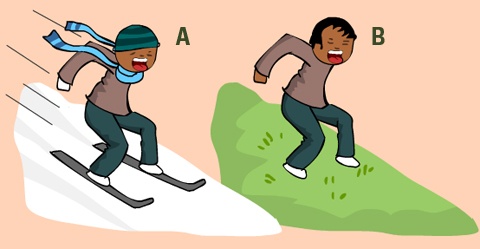
Why is it harder for the boy in Image B to get down the hill?
a)
Motion
b)
Friction
c)
Work
d)
Displacement
100.
Are forces balanced or unbalanced when a marble speeds up rolling down a ramp?
a)
Balanced
b)
Unbalanced