wayground logo

Free Printable Worksheets

Font size

S
M
L
XL
Worksheets

Honors Chemistry Final review

Total questions: 140

Worksheet time: 6hrs 33mins

Name
Class
Date
1.
Convert 0.000456 to scientific notation.
a)
4.6 x 10⁻⁴
b)
4.6 x 10⁴
c)
4.56 x 10⁻⁴
d)
4.56 x 10⁴
2.
How many sig figs are in the following number
0.003040?
a)
1
b)
2
c)
3
d)
4
3.
What is a qualitative observation/measurement?
a)
Has to do with numbers
b)
Does not have to do with numbers
4.
Which is quantitative?
a)
The desk is black
b)
it is 72 degrees fahrenheit outside
c)
The sky is blue
d)
Solution 1 is darker than solution 2
5.
How many sig figs would be reported after calculating the following. 34.2 + 2.34
a)
1
b)
2
c)
3
d)
4
6.
Which of the following is a mixture?
a)
Iron
b)
Aluminum
c)
Aluminum chloride (AlCl3)
d)
Tap water
7.
After a calculation a calculator spit out these numbers. 4.00036821. Round to six sig figs.
a)
4.0003
b)
4.00037
c)
4.00036
d)
4.0003621
8.
If I had water with a density of 1.0 g/ml, alcohol 0.7890 g/ml, corn syrup with a density of 1.300 g/ml. Which would float on top?
a)
corn syrup
b)
Alcohol
c)
water
9.
Which state of matter has indefinite volume and indefinite shape?
a)
liquid 
b)
solid 
c)
gas
10.
What is another name for a homogeneous mixture?
a)
pure mixture
b)
compound
c)
distilled mixture
d)
solution
11.
What is a example of a pure substance?
a)
NaCl (sodium chloride) - compound
b)
Kool-Aide
c)
Salt water
d)
sea water
12.
A 100.0 cm3 sample of gold has a mass of 1930 g. First calculate the density of gold, then convert g/cm3 to oz/qt (ounces per quart) (1.00 ounce = 28.4 g, 1 L = 1.06 qts). Remember 1 ml = 1 cm3
a)
641.1 oz/qt
b)
641.11 oz/qt
c)
641.111 oz/qt
d)
641 oz/qt
13.
Which is a chemical change?
a)
boiling water
b)
water freezing
c)
Iron when exposed to air and moisture turns into rust (Fe2O3)
d)
water condensing
14.
Which metric relationship is correct?
a)
1L = 102 ml
b)
1 microliter = 10-6 L
c)
1g = 103 cg
d)
10 dam = 10 m
15.

According to this graph, the dependent variable would be

a)

volume

b)

mass

16.

A statement that describes HOW nature will behave is called a

a)

theory

b)

law

c)

hypothesis

17.

What is the density (in g/mL) of an object that has a mass of 15.6 kg and a volume of 2760 mL?

a)

0.00565 g/mL

b)

5.65 g/mL

c)

177 g/mL

d)

4.3 x 10⁴ g/mL

18.

Convert 988200 cm into km.

a)

98.82 km

b)

9.882 km

c)

0.9882 km

d)

988.2 km

19.

All of the following are physical changes EXCEPT

a)

breaking an egg open

b)

boiling water

c)

cooking an egg

d)

squeezing an orange for juice

20.

Which of the following is an example of a chemical property?

a)

water can evaporate

b)

gallium melts in your hand

c)

paint hardens if the lid of the container is left off

d)

sodium reacts with water

21.

The state of matter with a fixed shape and volume is

a)

solid

b)

liquid

c)

gas

22.

The state of matter that is compressible is

a)

solid

b)

liquid

c)

gas

23.

The unit mm is used to measure what quantity?

a)

mass

b)

volume

c)

length

d)

density

24.

The unit g/cm3 is used to measure what quantity?

a)

mass

b)

volume

c)

length

d)

density

25.

The unit mL is used to measure what quantity?

a)

mass

b)

volume

c)

length

d)

density

26.

What are the building blocks of matter?

a)

Atoms

b)

Protons

c)

Cells

d)

Neutrons

27.

The nucleus of an atom is made up of ___________________.

a)

Protons and Neutrino

b)

Neutrons and Electrons

c)

Protons and Neutrons

d)

Protons and Electrons

28.

The image shows the periodic grid of potassium. How many electrons are found in the potassium atom?

a)

19

b)

20

c)

39

d)

40

29.

When two elements combine with each other to form more than one compound, the mass of one element that combine with a fixed mass of the other are in a ratio of whole numbers.

a)

Law of Definite Composition

b)

Law of Multiple Proportions

c)

Law of Mass Conservation

d)

Law of Constant Composition

30.

How does the average atomic mass of an element compare to the mass number?

a)

The average atomic mass is the average mass of a mixture of isotopes, whereas each isotope has its own mass number.

b)

The average atomic mass of an element is the same as its mass number.

c)

The average atomic mass is equal to the mass number of the most abundant isotope of an element.

d)

The average atomic mass includes the mass of the electrons, whereas the mass number depends only on the neutrons and the protons.

31.

Which of the following best describes isotopes?

a)

Isotopes have different numbers of neutrons.

b)

Isotopes have different numbers of protons.

c)

Isotopes are atoms of the same element with the same mass.

d)

Isotopes have different numbers of electrons.

32.

What is the chemical name of Fe2(SO4)3?

a)

Iron (III) Sulfate

b)

Iron Sulfate

c)

Iron (II) Sulfate (III)

d)

Iron (II) Sulfate

33.

What is the chemical name of MgCl2?

a)

Magnesium Chloride 2

b)

Magnesium Chloride

c)

Magnesium (II) Chloride

d)

Magnesium Dichloride

34.

If your cation is a transition metal, it should have a _________________.

a)

Roman numeral

b)

Subscript

c)

Polyatomic Ion

d)

Prefix

35.

What is the chemical name of CsI?

a)

Cesium Monoiodide

b)

Carbon Sulfide Iodide

c)

Cesium Iodide

d)

Carbon Silicate

36.

How many electrons are there in the cation Aluminum?

a)

10

b)

13

c)

16

d)

3

37.
In the modern periodic table elements are arranged by:
a)
atomic mass
b)
atomic number
c)
valence electrons
d)
number of isotopes
38.
An element's identity is determined by the number of
a)
electrons.
b)
protons.
c)
neutrons.
d)
valence.
39.
All matter is made of .....
a)
energy 
b)
atoms 
c)
air
d)
chemistry
40.
The atomic number of an element tells the number of _____ in the nucleus of an atom of that element.
a)
protons
b)
neutrons
c)
electrons
d)
isotopes
41.
What is the atomic mass of "F"
a)
9
b)
18
c)
17
d)
19
42.
An atom of the element with atomic number 6 always has _____.
a)
six protons in its nucleus
b)
an atomic mass of six
c)
more than six neutrons
d)
six electron clouds
43.
What are subatomic particles? 
a)
the nucleus 
b)
electron cloud
c)
positive charge
d)
electrons, protons, and neutrons
44.
Ba+2, Br-1
a)
BrBa
b)
Br2Ba2
c)
BaBr2
d)
Br2Ba
45.
Ca+2, O-2
a)
CaO
b)
OCa
c)
Ca-2O+2
d)
Ca2O2
46.
When adding a subscript to a polyatomic ion, you should...
a)
multiply any subscripts on the polyatomic ion by the subscript you are adding
b)
put parentheses around the polyatomic ion before adding a subscript
c)
write the new subscript next to any subscripts on the polyatomic ion
d)
put the polyatomic ion in square brackets before adding the subscript
47.
What is the correct name for P₃Cl₆?
a)
Potassium chloride
b)
Phosphorous chloride
c)
Triphosphorous hexachloride
d)
Tetraphosphorous heptachloride
48.
What is the correct name for MgI₂?
a)
Manganese IV iodide
b)
Manganese diiodide
c)
Magnesium iodide
d)
Magnesium diiodide
49.
The correct name of Mg₃N₂ is
a)
manganese nitride
b)
magnesium nitride
c)
magnesium (III) nitride
d)
trimagnesium dinitride
50.
What is the correct formula for dinitrogen tetroxide?
a)
N₃O₃
b)
(N₂)₂(O₄)₃
c)
N₂O₄
d)
N₄O₂
51.
What is the correct formula for phosphorous trichloride?
a)
P₃Cl
b)
PCl₃
c)
KCl₃
d)
K₃Cl
52.
What is the correct name for SO₂?
a)
Sulfur oxide
b)
Sulfite
c)
Sulfur dioxide
d)
Sulfur II Oxide
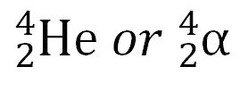
53.
What do these symbols represent?
a)
alpha particle
b)
beta particle
c)
neutron
d)
gamma ray
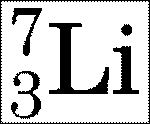
54.
How many protons are in this atom?
a)
3
b)
4
c)
6
d)
10
55.
What do you call the energy required to prevent the protons in the nucleus from repelling?
a)
nuclear energy
b)
binding energy
c)
radioacitve energy
d)
electromagnetic energy
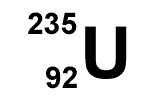
56.
How many neutrons are in this isotope of Uranium?
a)
235
b)
92
c)
327
d)
143
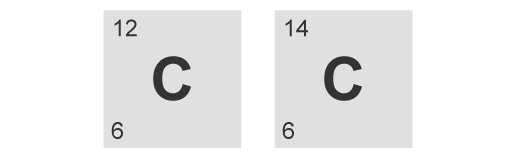
57.
How are these isotopes different?
a)
Different atomic numbers
b)
Different number of protons
c)
Different number of neutrons
d)
Different number of electrons
58.
What sort of shield will block gamma rays?
a)
skin
b)
paper
c)
aluminum
d)
thick lead
59.
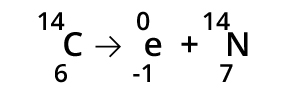
What type of nuclear equation is this?
a)
fusion
b)
fission
c)
alpha
d)
beta
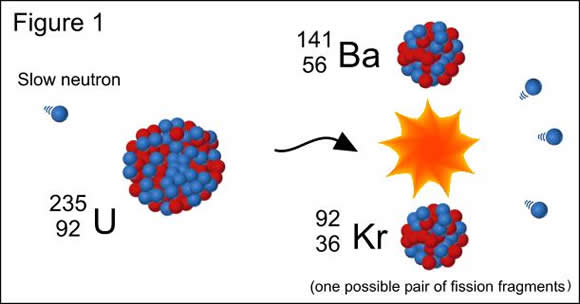
60.
Which nuclear process is shown in the picture?
a)
fission
b)
fusion
c)
alpha decay
d)
beta decay
61.
Why does an atom undergo beta decay?
a)
It has too many electrons.
b)
It has an atomic number greater than 83
c)
It has more neutrons than protons
d)
It has more protons than neutrons
62.
What happens to the atomic number during alpha decay?
a)
The atomic number decreases by 4
b)
The atomic number increases by 1
c)
The atomic number decreases by 2.
d)
The atomic number stays the same.
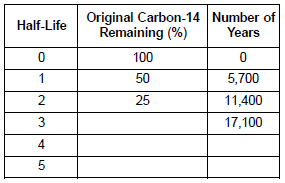
63.
After the third half-life, how much of the sample is left?
a)
1/2
b)
1/3
c)
1/16
d)
1/8
64.
The half-life of strontium-90 is 25 years. How much strontium-90 will remain after 100 years if the initial amount is 4.0 g?
a)
3.0g
b)
0.25mg
c)
0.3g
d)
0.25g
65.

After 22,800 years, approximately what percentage of the original carbon-14 remains?

a)

15%

b)

12.5%

c)

6.25%

d)

3.125%

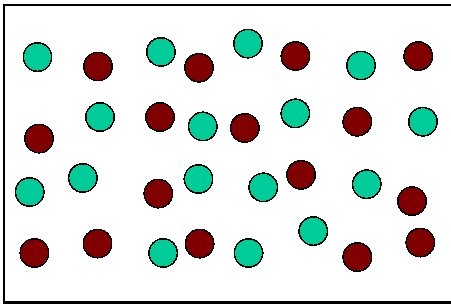
66.

The diagram shows 32 atoms.

16 of the Red are parent isotopes

16 of the Green are daughter isotopes

How many half-lives have occurred?

a)

0

b)

1

c)

2

d)

3

67.

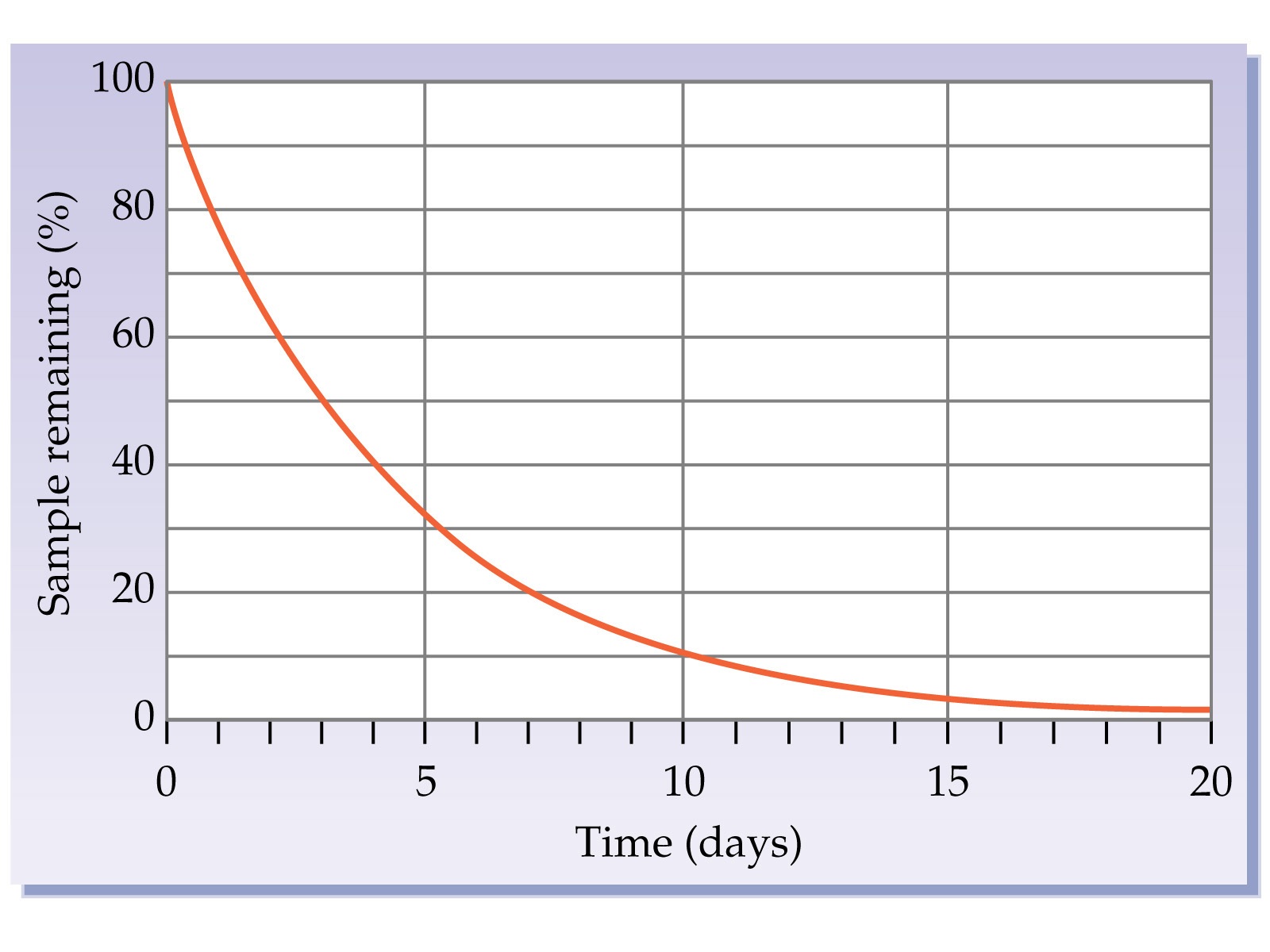
What is the Half Life of this isotope?

a)

3 days

b)

5 days

c)

8 days

d)

10 days

68.
Imagine you have 50,000 atoms of uranium-238. If U-238 has a half-life of 4.5 billion years, how many U-238 atoms will be left after 4.5 billion years? 
a)
25,000
b)
50,000
c)
12,500
d)
0
69.
You have 100 grams of radioactive C-14. The half life of C-14 is 5730 years. 
How many grams are left after 1 half life? 
a)
100 grams
b)
25 grams
c)
2 grams
d)
50 grams
70.
How many elements are in C6H12O6?
a)
1
b)
2
c)
3
d)
4
71.
If a chemist calculates the maximum amount of product that could be obtained in a chemical reaction, he or she is calculating the
a)
theoretical yield
b)
mole ratio
c)
actual yield
d)
percentage yield
72.
What is the measured amount of a product obtained from a chemical reaction?
a)
mole ratio
b)
theoretical yield
c)
percentage yield
d)
actual yield
73.
Mole ratios are obtained from the
a)
balanced chemical equation
b)
periodic table
c)
molar mass
74.
What is the mole ratio of H2O to H3PO4 in the following chemical equation?   P4O10 + 6 H2O --> 4 H3PO
a)
6:4
b)
4:6
c)
1:3
d)
3:1
75.
2Al + 3H2SO4 -> Al2(SO4)3 + 3H2
How many grams of aluminum sulfate would be formed if 250g H2SO4 completely reacted with aluminum?
a)
0.85 g
b)
290 g
c)
450 g
d)
870 g
76.
For the reaction represented by the equation Cl2 + 2KBr → Br2 + 2KCl, how many grams of potassium chloride can be produced from 356 grams potassium bromide?
a)
749 g
b)
225 g
c)
479 g
d)
814 g
77.
When does a chemical reaction stop?
a)
When the lab is finished
b)
When the excess reactant is used up
c)
When the limiting reactant is used up
d)
Chemical reactions never stop
78.
Identify the limiting reagent when 6.00 g HCl combines with 5.00 g Mg to form MgCl2.
 
Mg +  2HCl --> MgCl2  +  H2   
 
a)
Mg
b)
H2
c)
MgCl2
d)
HCl
79.

How many grams are in 7.8 moles of NaCl?

a)

476 grams

b)

460 grams

c)

452 grams

d)

462 grams

80.
Balance the following reaction :
 
CaC₂(s)   +   H₂O(l)   -->   C₂H₂(g)   +   Ca(OH)₂(aq)
a)
1,2,2,2
b)
1,2,1,1
c)
2,1,1,1
d)
2,1,2,1
81.
Using the following equation:
Fe2O3(s) + 3H2(g) → 2Fe(s) + 3H2O(l)
How many moles of iron can be made from  6 moles H2
a)
4 moles Fe
b)
6 moles Fe
c)
9 moles Fe
d)
2 moles Fe
82.
Identify the limiting reagent when 6.00 moles HCl combines with 5.00 moles Mg to form MgCl2.
 
1 Mg +  2 HCl --> 1 MgCl2  +  1 H2   
 
a)
Mg
b)
H2
c)
MgCl2
d)
HCl
83.
9. Complete the equation for the percent yield of a chemical reaction:
Percent yield=(________)
÷(________)×100%
a)
actual yield; theoretical yield
b)
theoretical yield; actual yield
84.
11.
LiOH + KCl → LiCl + KOH 

b)  I actually produced 6 grams of lithium chloride and I began this reaction with 20 grams of lithium hydroxide. What is my percent yield?
a)
16.9%
b)
5.91%
c)
1.88%
d)
12.3%
85.
Fe (s) + S (l) --> FeS (s)  

In the experiment above, 7.62 g of Fe are allowed to react with 8.67 g of S.
How much FeS is formed?
a)
14.8 g
b)
12.2 g
c)
13.7 g
d)
19.9 g
86.
A neutralization reaction will (almost) always produce...
a)
water & salt
b)
water
c)
salt
d)
water & carbon
87.
Identify the salt in the following equation:
Zn(OH)2 + HNO3   ---> H2O  + Zn(NO3)2
a)
Zn(OH)2
b)
HNO3
c)
H2O
d)
Zn(NO3)2
88.
In a ____ reaction, an acid and a base produce a salt and a water. 
a)
concentrated
b)
decomposition
c)
dilute
d)
neutralization
89.

Complete the following reaction:

HCl + Mg(OH)2 -->

a)

MgCl2 + H2O

b)

Mg +H2O

c)

MgCl2 + H2

d)

MgCl2 + H2O + CO2

90.

Complete the following reaction:

HNO3 + Ca(OH)2 -->

a)

Ca(NO3)2 + H2O

b)

Ca +H2O

c)

Ca(NO3)2 + H2

d)

Ca(NO3)2 + H2O + CO2

91.
The products of a neutralization reaction are acids and bases
a)
True
b)
False
92.

Which of these equations represents a redox reaction?

a)

Ca(HCO3)2 --> CaCO3 + H2O + CO2

b)

CH3COOH + NaOH --> CH3COONa + H2O

c)

Zn + 2FeCl3 --> ZnCl2 + 2FeCl2

d)

NaCl + AgNO3 --> AgCl + NaNO3

93.

What is the oxidation number of chlorine in ClO3- ?

a)

-1

b)

+1

c)

-1

d)

+5

94.

Which of the following is the oxidising agent in the experiment shown the diagram?

a)

Iron(II) ion

b)

Sulphate ion

c)

Iron

d)

Bromine

95.

Oxidation is the _________ of electrons.

a)

loss

b)

gain

c)

sharing

d)

transfer

96.

Reduction is the ___________ of electrons.

a)

loss

b)

gain

c)

sharing

d)

transfer

97.
Which statement is true:
Mg → Mg2+ + 2e
a)
Mg gains 2 electrons
b)
Mg2+ loses 2 electrons
c)
Mg loses 1 electron
d)
Mg loses 2 electrons
98.
Which of the following half reactions correctly represents a reduction half reaction?
a)
Fe →Fe2+ + 2e-
b)
Pb4+ + 2e- →Pb2+
c)
2O-2 →O2 + 4e-
d)
Fe + 3e- →Fe3+
99.

In a reaction, copper is reduced; its number of electrons has:

a)

Increased

b)

Decreased

c)

Remained Constant

d)

Varies Randomly

100.
     In the reaction Zn + H2O --> ZnO2 + H2
 which element, if any, is oxidized? 
a)
Zinc
b)
Hydrogen
c)
Oxygen
d)
None
101.
In the reaction
2Ca(s) + O2(g) --> 2CaO(s), calcium is __________
a)
Reduced
b)
Synthesized
c)
Oxidized
d)
None of the above
102.
What substance is oxidized in the following reaction?
4Fe + 3O2 --> 2Fe2O3
a)
Iron
b)
Fluorine
c)
Oxygen
103.

Find the oxidation number of S in S2O4 2-

a)

+3

b)

+6

c)

-6

d)

-3

e)

-4

104.
The _____is the part that gets dissolved. 
a)
solute 
b)
solvent 
c)
solution 
d)
Sacajawea 
105.
A solution is a kind of ________. 
a)
mixture 
b)
compound 
c)
element 
d)
stuff 
106.
When one of the parts of the solution is water we call it _________. 
a)
water stuff 
b)
water mixture 
c)
aqua-man
d)
aqueous 
107.
A sample of 0.0255 mol potassium hydroxide, KOH, was dissolved in water to yield 10.0 mL of
solution.  Which amount would you need to change to solve for molarity?
a)
change .0255 moles to grams
b)
change 10 mL to L
c)
change both values to grams and L
d)
leave it as it is
108.

A questions asks, "what volume of 0.125 M KMnO4 is required to yield 0.180 mol of potassium permanganate,

KMnO4?" What is the correct formula set up to solve for this problem?

a)

M x V = #moles

b)

M1 V1 = M2 V2

c)

V x M x MM = g

d)

none of these choices

109.

In this scenario, which formula should you use to solve it? How many mL of a 1.00 M stock solution should be

used to mak 2.00 L of a 0.300 M sulfuric acid solution

a)

molarity formula, (Moles solute/ L of solution)

b)

dilution formula, M1V1 = M2V2

c)

M x V = #moles

d)

V x M x MM = g

110.

A student is making 1.0 L of a 0.5 M aqueous solution of calcium bromide, CaBr2. Student puts the 0.5 moles of CaBr2 and then puts in how much water?

a)

exactly 1.0 L of water

b)

exactly 0.5 L of water

c)

enough water to make 0.5 L of solution

d)

enough water to make 1.0 L of solution

111.

What is the molarity of a solution containing 4 moles of KCl in 2.5 L of solution?

a)

1.6 M

b)

0.63 M

c)

10 M

d)

2.6 M

112.

What is the concentration, in percent by mass, of 0.62 g of solute in 45.0 g of solution?

a)

0.014 %

b)

1.4 %

c)

0.13%

113.

What is the molarity of a solution containing 4.26 g of KCl in 1.25 L of solution? [Change g to mol first, molar mass of KCl = 74.55 g/mol or use V M MM = g]

a)

3.41 M

b)

0.0457 M

c)

0.0571 M

d)

0.0714 M

114.

What mass of NaOH is needed to make 500mL of a 5.0M solution?

a)

100g

b)

100,000g

c)

10,000g

d)

1,000g

115.
The following is what type of reaction:
PbCl2 + AgNO3 → Pb(NO3)2 + AgCl
a)
Synthesis
b)
Decomposition
c)
Single Replacement
d)
Double Replacement
116.
The following is what type of reaction:
NH3 + HCl  → NH4Cl
a)
Synthesis
b)
Decomposition
c)
Single Replacement Replacement
d)
Double Replacement Replacement
117.
What is decomposition?
a)
putting substances together
b)
breaking substances apart
c)
element replacing another element in a compoud
d)
burning of a subtance
118.
What type of chemical reaction is this?
Al(OH)3 → Al2O3  + H2O
a)
Decomposition
b)
Combustion
c)
Synthesis
d)
Single Replacement 
119.
One element replaces another in a compound.
a)
Synthesis
b)
Combustion
c)
Single Replacement
d)
Double Replacement
120.
3Ca + 2AlCl3 --> 3CaCl2 + 2Al
a)
Synthesis
b)
Decomposition
c)
Single Displacement
d)
Double Displacement
121.
Two Reactants and One Product
a)
Decomposition
b)
Synthesis
c)
Combustion
d)
Single Replacement
122.
Always starts with a Hydrocarbon that reacts with oxygen and produces carbon dioxide and water. 
a)
Decomposition
b)
Synthesis
c)
Combustion
d)
Single Replacement
123.
C4H12 + O2 → CO2 + H2O
a)
Synthesis
b)
Combustion
c)
Single Replacement
d)
Double Replacement
124.
4Si   + S8   -->   2Si2S4
a)
Synthesis
b)
Decomposition
c)
Single Displacement
d)
Double Displacement
125.
3KOH + H3PO4 --> K3PO4 + 3H2O
a)
Synthesis 
b)
Decomposition
c)
Single displacement
d)
Double displacement
126.

Which of the following is the correct definition for a strong acid?

a)

Partially dissociates into ions when dissolved in water and the change is not reversible

b)

Fully dissociates into ions when dissolved in water and the change is not reversible

c)

Fully dissociates into ions when dissolved in water and the change is reversible

d)

Partially dissociates into ions when dissolved in water and the change is reversible

127.

Which of the following is a strong acid?

a)

Ethanoic acid

b)

Nitric acid

c)

Carbonic acid

d)

Citric acid

128.

Which of the following is the correct balanced equation showing the dissociation of sulfuric acid into ions?

a)

H2SO4 (aq) → H+ (aq) + SO4(aq)

b)

H2SO4 (aq) ⇌ 2H+ (aq) + SO42- (aq)

c)

HSO4 (aq) → H+(aq) + SO4(aq)

d)

H2SO4 (aq) → 2H+ (aq) + SO42- (aq)

129.

HNO3

a)

strong electrolyte

b)

weak electrolyte

c)

non - electrolyte

130.

Ba(OH)2

a)

strong electrolyte

b)

weak electrolyte

c)

non - electrolyte

131.

H2SO3

a)

strong acid

b)

weak acid

c)

strong base

d)

weak base

132.

Li2CO3

a)

strong electrolyte

b)

weak electrolyte

c)

non - electrolyte

133.

HC2H3O2

a)

strong base

b)

strong acid

c)

weak base

d)

weak acid

134.

Ba(OH)2

a)

strong base

b)

strong acid

c)

weak base

d)

weak acid

135.

HClO

a)

strong electrolyte

b)

weak electrolyte

c)

non electrolyte

136.

HClO3

a)

strong acid

b)

strong base

c)

weak acid

d)

weak base

137.

NH3

a)

strong acid

b)

weak acid

c)

strong base

d)

weak base

138.

H3PO4

a)

strong electrolyte

b)

weak electrolyte

c)

non electrolyte

139.

H2SO4

a)

strong electrolyte

b)

weak electrolyte

c)

non electrolyte

140.

HI

a)

strong electrolyte

b)

weak electrolyte

c)

non electrolyte