
 Worksheets
18.1 Reaction Rates (Kinetics)
Total questions: 136
Worksheet time: 2hrs 26mins
The ____________ states that atoms, ions, or molecules must collide in order to react.
transition state
activation energy
rate law
collision theory
Which of the following increase the reaction rate?
less surface area
lower temperature
increasing pressure
increased concentration
If the temperature is reduced, a reaction rate will ______
increase
decrease
stay the same
The ____________ states that atoms, ions, or molecules must collide in order to react.
transition state
activation energy
rate law
collision theory
_______ refers to how much solute is dissolved in
a solution.
Surface Area
Catalyst
Temperature
Concentration
Which of the following increase the reaction rate?
less surface area
lower temperature
increasing pressure
increased concentration
If the temperature is reduced, a reaction rate will ______
increase
decrease
stay the same
If the concentration of a reactant is increased, the reaction rate will ___________.
increase
decrease
stay the same
The ____________ states that atoms, ions, or molecules must collide in order to react.
transition state
activation energy
rate law
collision theory
Which of the following CAN affect reaction rates? Check all that apply?
temperature
concentration
surface area
catalysts
How will a rate of reaction be altered if temperature is increased?
reaction rate decreases (goes slower)
reaction rate increases (goes faster)
reaction rate is constant (stays the same)
Products will form faster if which of the following occurs? Select all that apply.
surface area is increased
temperature is decreased
reactant concentration is increased
the reactant solution is not stirred
Which of the following increases a reaction rate without being used up?
catalyst
product
reactant
How does a catalyst affect a reaction rate?
it makes the reaction faster by lowering the activation energy and energy needed to form the activated complex
it makes the reaction faster by raising the activation energy and energy needed to form the activated complex
it makes the reaction slower by lowering the activation energy and energy needed to form the activated complex
it makes the reaction slower by raising the activation energy and energy needed to form the activated complex
When a sugar cube is crushed up, the particles get smaller. How has the surface area of the particles changed?
the surface area increases
the surface area decreases
the surface area remains constant
When surface area increases, the reaction rate does which of the following?
goes faster (rate increases)
goes slower (rate decreases)
Increasing the temperature will increase the kinetic energy of particles, therefore increasing the frequency of the collisions among particles.
false
true
If solution A is put into an ice water bath before being combined with solution B, how would the reaction rate be altered?
it would be faster (rate increases)
it would be slower (rate decreases)
How does increasing the concentration affect a reaction rate?
makes it go faster (increases rate)
makes it go slower (decreases rate)
Which of the following will increase the reaction rate (make it go faster) on an all gas system?
decreasing the surface area of a reactant
lowering the temperature of a reactant
increasing pressure of the container
increasing reactant concentration
Which of the following best describes how a catalyst works?
lowers the pressure
raises the temperature
lowers the activation energy
raises the activated complex
Which of the following best describes the Collision Theory?
reactants must collide, collide with proper orientation, and enough activation energy
products must collide, collide with proper orientation, and enough activation energy
the activated complex must collide, collide with proper orientation, and enough activation energy
reactants and products together must collide, collide with proper orientation, and enough activation energy
A reaction between which of the following would increase the rate of a reaction and make it occur the fastest? What variable is being manipulated?
10 g of aluminum strip and 0.5 M hydrochloric acid at 20°C
10 g of aluminum strip and 0.5 M hydrochloric acid at 60°C
10 g of aluminum strip and 0.5 M hydrochloric acid at 20°C; concentration is being altered
10 g of aluminum strip and 0.5 M hydrochloric acid at 60°C; concentration is being altered
10 g of aluminum strip and 0.5 M hydrochloric acid at 20°C; temperature is being altered
10 g of aluminum strip and 0.5 M hydrochloric acid at 60°C; temperature is being altered
A reaction between which of the following would increase the rate of a reaction and make it occur the fastest? What variable is being manipulated?
10 g of aluminum strip and 0.5 M hydrochloric acid at 20°C
10 g of aluminum strip and 1 M hydrochloric acid at 20°C
10 g of aluminum strip and 0.5 M hydrochloric acid at 20°C; concentration is being altered
10 g of aluminum strip and 1 M hydrochloric acid at 20°C; concentration is being altered
10 g of aluminum strip and 0.5 M hydrochloric acid at 20°C; temperature is being altered
10 g of aluminum strip and 1 M hydrochloric acid at 20°C; temperature is being altered
A reaction between which of the following would increase the rate of a reaction and make it occur the fastest? What variable is being manipulated?
10 g of aluminum strip and 0.5 M hydrochloric acid at 20°C
10 g of granular aluminum and 0.5 M hydrochloric acid at 20°C
10 g of aluminum strip and 0.5 M hydrochloric acid at 20°C; concentration is being altered
10 g of granular aluminum and 0.5 M hydrochloric acid at 20°C; concentration is being altered
10 g of aluminum strip and 0.5 M hydrochloric acid at 20°C; surface area is being altered
10 g of granular aluminum and 0.5 M hydrochloric acid at 20°C; surface area is being altered
You have 1 M HCl reacting with 5 g of granular magnesium at room temperature. If you add water to the 1 M HCl, how will this alter the reaction rate?
it will make the reaction faster because you are increasing the concentration
it will make the reaction slower because you are increasing the concentration
it will make the reaction faster because you are decreasing the concentration
it will make the reaction slower because you are decreasing the concentration
You have a solution of 0.1 M silver nitrate reacting with a 5 g chunk of salt at room temperature. If you crush/pulverize the salt chunk, how will this alter the reaction rate?
it will make the reaction faster because you are increasing the surface area of the salt
it will make the reaction slower because you are increasing the surface area of the salt
it will make the reaction faster because you are decreasing the surface area of the salt
it will make the reaction slower because you are decreasing the surface area of the salt
You have a 0.2 M aqueous solution of copper (II) sulfate reacting with powdered iron at room temperature. If you put the solution of copper (II) sulfate in an ice water bath, how will this alter the reaction rate when combined with the iron?
it will make the reaction faster because you are increasing the temperature of the solution
it will make the reaction slower because you are increasing the temperature of the solution
it will make the reaction faster because decreasing the temperature of the solution
it will make the reaction slower because you are decreasing the temperature of the solution
What is the minimum amount of energy needed for colliding particles to react?
Chemical Energy
Kinetic Energy
Activation Energy
Potential Energy
A catalyst can be "recycled" and used again and again and again...
False
True

The following graph shows two different reaction pathways for the same overall reaction at the same temperature. Which pathway is slower and why?
Purple, because the activation energy is larger
Green, because the activation energy is lower
both reaction progress at the same rate
How can you increase the surface area of a solid?
crush/pulverize the solid into smaller pieces
add a larger mass of the solid particles
melt the solid into a liquid
increase the temperature
How does increasing concentration increase the rate of a reaction?
fewer collisions occur among reactants
more kinetic energy is provided to the reactants
more collisions occur among reactants
less kinetic energy is provided to the reactants

Examine the model between the two reactants. Which variable is being changed and how does it alter the reaction rate?
concentration is increasing and will increase the reaction rate (it goes faster)
concentration is decreasing and will decrease the reaction rate (it goes slower)
surface area is increasing and will increase the reaction rate (it goes faster)
surface area is decreasing and will decrease the reaction rate (it goes slower)

Examine the model between the two reactants which are red and blue. Which variable is being changed and how does it alter the reaction rate?
concentration is increasing and will increase the reaction rate (it goes faster)
concentration is decreasing and will decrease the reaction rate (it goes slower)
surface area is increasing and will increase the reaction rate (it goes faster)
surface area is decreasing and will decrease the reaction rate (it goes slower)

Examine the model between the two reactants which are red and blue. Which variable is being changed and how does it alter the reaction rate?
temperature is increasing and will increase the reaction rate (it goes faster)
temperature is decreasing and will decrease the reaction rate (it goes slower)
surface area is increasing and will increase the reaction rate (it goes faster)
surface area is decreasing and will decrease the reaction rate (it goes slower)
concentration is decreasing and will decrease the reaction rate (it goes slower)
The ____________ states that atoms, ions, or molecules must collide in order to react.
transition state
activation energy
rate law
collision theory
_______ refers to how much solute is dissolved in
a solution.
Surface Area
Catalyst
Temperature
Concentration
Which of the following increase the reaction rate?
less surface area
lower temperature
increasing pressure
increased concentration
What is collision theory?
Molecules must collide in the correct orientation with enough energy to bond.
Molecules need enough energy to collide and react.
Atoms constantly collide and react.
The minimum energy needed for atoms to react
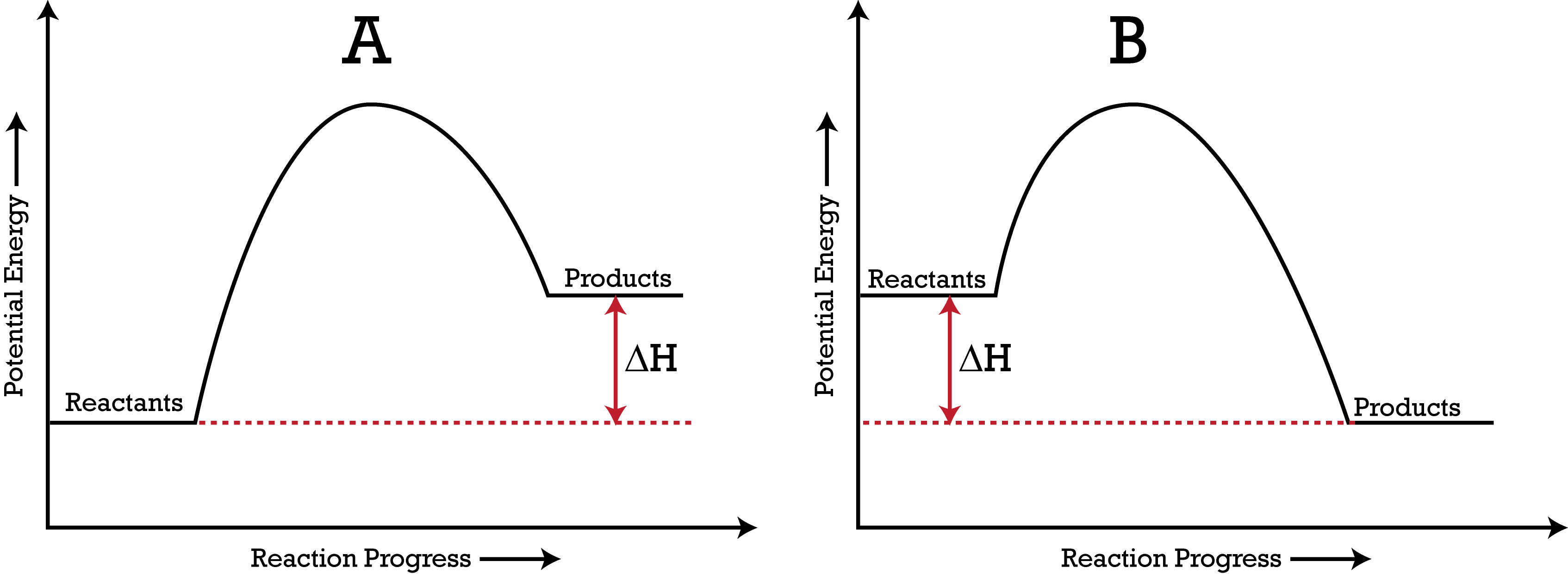
Which PE Diagram represents an endothermic reaction?
A
B
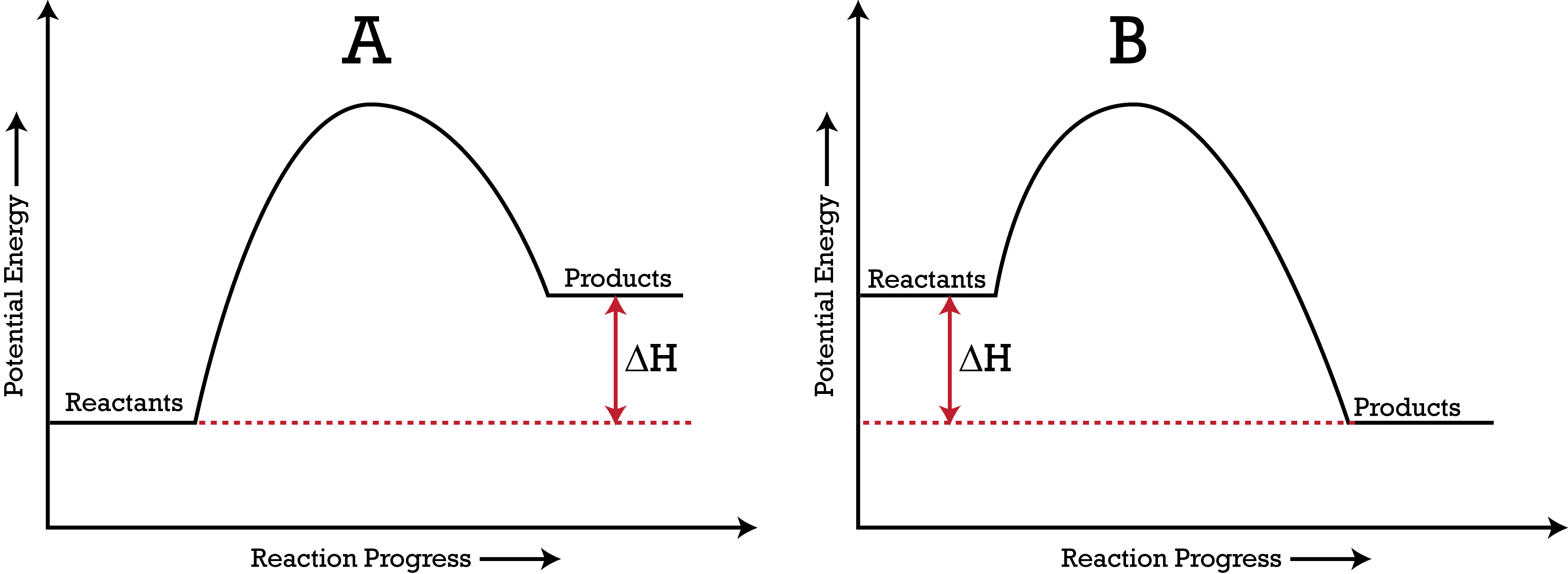
Which PE Diagram represents an exothermic reaction?
A
B
What is the rate of reaction?
How much energy is needed for a reaction to occur.
The energy required to break a bond.
The time it takes for a reaction to occur.
Collision Theory
What is the purpose of a catalyst?
Helps to slow down a reaction
Raises the activation energy
Lowers the activation energy
Is consumed by the reaction
What factors effect rate of reaction?
Temperature, Concentration, Pressure and Energy
Surface Area, Concentration, Energy and Pressure
Temperature, Pressure, Concentration and Surface area
Pressure, Surface area, Density and Energy
Would the reaction rate speed up or slow down: A tablespoon of powdered sugar placed into HCL.
Slow down
Speed up
Stays the same
Increasing the temperature of your solution will.......
Not affect the rate of reaction.
Speed up the rate of reaction
Slow down the rate of reaction
Decreasing the concentration of a substance will usually........
Slow down the reaction
Speed up the reaction
Have no affect on the reaction
Which has more surface area?
Large chunks of chalk
Cube of sugar
Powdered sugar
Small chunks of sugar
If you shrink the container size that your gas substance is in what will happen?
The reaction rate will stay the same
The reaction rate will speed up
The reaction rate will slow down
What criteria must be met for reactant collisions to result in a successful product?
The reactants must collide with each other
The reactants must collide with enough energy and be in the right positions
The reactants must have enough energy to form the activated complex
What criteria must be met for reactant collisions to result in a successful product?
The reactants must collide with each other
The reactants must collide with enough energy and be in the right positions
The reactants must have enough energy to form the activated complex
A chemical change that occurs when two or more substances combine to form a
new substance.
Activation Energy
Chemical Kinetics
Chemical Reaction
Product
The measure of the change in the concentration of the reactants or products.
Activation Energy
Activation Rate
Chemical Reaction
Concentration
The substance or particles that enter into and are altered in the course of a chemical reaction.
Catalyst
Enzyme
Product
Reactant
The number of particles present in a given volume of solution.
Catalyst
Concentration
Product
Temperature
The measure of how fast or slow a reaction happens.
Activation Energy
Collision theory
Particle Size
Rate of Reaction
A condition that needs to be met for a chemical reaction to occur.
The substance must be homogeneous.
The temperature should be kept constant.
Particles should maintain a certain distance from each other.
Particles in the substance must collide and have enough energy.
The factor that would NOT affect the rate of a chemical reaction.
Concentration
Humidity
Particle Size
Temperature
The factor that will slow down the rate of a chemical reaction.
Manual stirring of the substance.
Placing substance in a hot water.
Placing products in iced water.
Placing reactants in an ice bath.
The factor that does NOT show evidence of chemical reaction.
Absorption of heat
Change of color
Change of size
Liberation of heat
The measure of the hotness or coldness of a substance.
Energy
Humidity
Temperature
Thermometer
The substance formed as a result of a chemical reaction.
Product
Reactant
Resistance
Substrate
The measure of how much-exposed area a solid object has expressed in square units.
Volume
Surface
Surface Area
Concentration
The substance that is dissolved in a solution.
Solid
Solute
Solvent
Substance
The component of a solution that is present in the greatest amount.
Sample
Solute
Solvent
Substance
A form of matter that has definite composition and distinct characteristics.
Atoms
Compound
Mixture
Substance

