
 Worksheets
Cell Structure and Function Review
Total questions: 45
Worksheet time: 24mins
Which cellular structure in an animal cell helps maintain homeostasis by controlling the transport of substances into and out of the cell?
vacuole
cell wall
mitochondrion
cell membrane
What is the main function of the cell wall in a plant cell?
to protect against disease
to give structural support
to contain the parts of the cell
to help with cell division
A lipid bilayer allows certain molecules to pass through and blocks other molecules. Which structure is most often protected by a lipid bilayer?
cell
organ
tissue
system
What is the main function of the chloroplasts in plant cells?
to produce glucose
to keep the cell rigid
to make the cell divide
to allow the plant to reproduce
The function of the mitochondria is to _________.
store DNA
make energy for the cell
make proteins
store water and other nutrients
Which of these could only be found in a plant cell?
nucleus
chloroplasts
mitochondria
cytoplasm
The sites where the cell makes proteins based on genetic instructions are called _____________.
vacuoles
centrioles
ribosomes
lysosomes
The _________ is the site of manufacturing, warehousing, sorting and shipping of proteins inside a cell.
Golgi apparatus
endoplasmic reticulum
vacuole
lysosome
The __________ modifies proteins delivered from the rough endoplasmic reticulum.
Vacuole
lysosome
Golgi apparatus
cell membrane
The Golgi apparatus is the site of storing, modifying, sorting and shipping of _________ inside the cell.
food particles
ribosomes
proteins
enzymes
Which statement describes a primary function of the cell wall of a plant cell?
the cell wall performs photosynthesis
the cell wall stores DNA
the cell wall provides structural support
the cell wall manufactures proteins
Research has shown that specialization of stem cells into specific cell types results, in part, from cell shape. What provides a specialized cell with its shape?
number of mitochondria
presence of a nucleus
structure of the cytoskeleton
salt concentration of the cytoplasm
Osmosis occurs in living organisms as water moves across the cellular membrane. An environment is hypertonic when the concentration of solutes in the environment is greater than the concentration of solutes inside the cell.
In hypertonic environments, water flows
from the nuclear membrane into the cell membrane
from the cell into the environment
inside and outside the cell at equal rates
from the environment into the cell
Osmosis occurs in living organisms as water moves across the cellular membrane. An environment is hypotonic when the concentration of solutes in the environment is less than the concentration of solutes inside the cell.
In hypotonic environments, water flows
inside and outside the cell at equal rates
from the cell into the environment
from the environment into the cell
from high concentration of solutes to low concentration of solutes
Which structures are common to both plant and animal cells?
vacuole, chloroplast, nucleus
cell membrane, nucleus, mitochondrion
nucleus, cell wall, cell membrane
mitochondrion, vacuole, cell wall
What type of cell has a nucleus?
eukaryotic
prokaryotic
neither
both
Plants and animal cells are examples of ___ cells
prokaryotic cells
eukaryotic cells
both eukaryotic and prokaryotic
neither
Which type of cells has a chloroplast?
Prokaryote
Plant Cell
Animal Cell
Bacteria
Which do BOTH prokaryotes and eukaryotes contain?
nucleus
mitochondria
ribosomes
cell wall
Prokaryotes do NOT have....
membrane bound organelles
DNA or RNA
Cell membrane
Life
Bacteria are considered what?
Eukaryotes
Prokaryotes

Prokaryotic cells do not have…….
membrane bound organelles
cell membrane
DNA or RNA
life
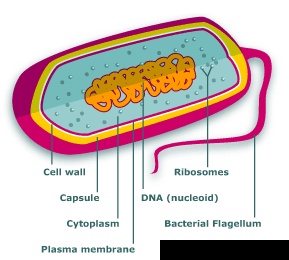
Which of the following is NOT a characteristic of a Prokaryotic cell?
unicellular
floating DNA
very small
complex

Which type of cell?
Prokaryote
Eukaryote
Both
Neither


Which of the following is NOT a characteristic of a Prokaryotic cell?
unicellular
floating DNA
very small
complex
Organelle found in plant cells that performs photosynthesis
mitochondria
ribosomes
chloroplast
cell membrane
Which biomolecule is found in the cell membrane to help transport substances across the membrane?
carbohydrate
proteins
lipids
nucleic acids
Organelles that carry digestive enzymes are classified as:
Ribosomes
Facilitated Diffusion uses a _____ to aid in diffusion, but they do not require energy to function
carrier protein
sodium/potassium pump
vesicle
vacuole
Synthesize or make protein
Fluid-filled container used for storage; in large plant cell
vesicles
vacuoles
lysosomes
flagella
Which type of transport uses energy in the form of ATP to transport substances?
Active transport
Passive transport

