
 Worksheets
Digestive System Review
Total questions: 75
Worksheet time: 39mins
The term for the process of changing food into a useable substance mechanically and chemically is called:
absorption
digestion
ingestion
elimination
The process of chewing is:
mastication
eructation
defecation
bruxism
Difficulty swallowing is:
deglutition
mastication
defecation
dysphagia
What is the wavelike movement that propels food through the digestive system?
digestion
peristalsis
defecation
eructation
The tube that connects the oral cavity with the esophagus is the:
pharynx
eustachian tube
larynx
trachea
A ridge or wrinkle in the stomach which allows the stomach to expand is a:
villus
rugae
plica
pylorus
Medical term for burping.
Flatulence Gleeking Extrusion Eructation
Flatulence
Gleeking
Extrusion
Eructation
Where is insulin created?
Gallbladder
Liver
Pancreas
Colon
What does the liver do to help digestion?
Produces bile Regulates insulin Neutrilazes stomach acid Makes important enxymes
Produces bile
Regulates insulin
Neutralizes stomach acid
Makes important enzymes
What is another word for vomiting blood?
Secretion
Hematemesis
Hemoccult
Hematochezia
What is dyspepsia?
Indigestion
Inability to make pepsin
Excess pepsin
Painful cramping
Where does most of the digestive process take place?
stomach
large intestine
small intestine
all of the above
What is the section of the large intestine between the appendix and ascending colon?
Sigmoid colon
Cecum
Ileum
Rectum
What is the stomach's main job
Break down proteins Begin the digestion process Absorb water Nothing
Absorb water
Break down proteins
Begin the digestion process
Nothing
What is not part of the mouth?
soft palate
tongue
uvula
villi
The mix of food, gastric juices, and hydrochloric acid in the stomach is:
chyme
bolus
feces
flatus
The sphincter between the stomach and first part of the small intestine is the:
LES
ileocecal sphincter
pyloric sphincter
cardiac sphincter
The process of releasing feces from the body is:
digestion
defecation
deglutition
flatus
Which part of the intestine is between the jejunum and the cecum?
ilium
duodenum
ascending colon
ileum
The healthcare term for indigestion is:
halitosis
regurgitation
dysphagia
dyspepsia
What is abnormal discharge of watery, semisolid stools?
constipation
obstipation
diarrhea
hematemesis
Enlarged veins in or near the anus that may cause pain and bleeding. Also know as piles.
anal fissures
hemorrhoids
inguinal hernia
gingiva
A bolus is made of:
chewed food and saliva
digested food and chyme
bile
salivary lipase
Where does digestion to begin?
stomach
small intestine
esophagus
mouth
What would happen to food you swallowed if your esophagus did not perform peristalsis?
The food would be stuck in you esophagus.
The food would enter your trachea.
You would vomt when the foo hit our stomach.
You would pass out.
During digestion, food leaves the stomach and enters the:
ileum
duodenum
cecum
jejunum
What part of the large intestine does NOT serve as a passageway for fecal waste?
colon
rectum
anus
appendix
The liver secretes bile that aids in the digestion of:
carbohydrates
proteins
fats
glucose
The pancreas produces digestive enzymes that empty into the:
gallbladder
stomach
duodenum
liver
Which of the following disorders of the digestive system is the MOST life threatening?
cirrhosis
constipation
heartburn
hemorrhoids
Which disorder is often treated by the surgical removal of the gallbladder?
hepatitis
diverticulitis
cholecystitis
peritonitis
Because of laxative use can be habit forming, what is the BEST way to treat constipation?
vitamin supplements, diuretics, and rest
antibiotics, stoool softeners, and sitz baths
high fiber diet, increased exercise, and increased fluid intake
high protein diet, small meals, and lithotripsy
It is recommended that health care workers receive a vaccine to prevent:
hepatitis A
hepatitis B
hepatitis C
hepatitis D
Which of the following disorders can you actually see?
cirrhosis
hepatitis
inguinal hernia
ulcerative colitis
What disorder could be found during a colonoscopy?
peritonitis
halitosis
cancer
hepatitis
In the mouth, carbohydates will be broken down a little by an enzyme called_________________.
pepsin
insulin
amylase
lipase
Check all structures which are considered a part of the alimentary canal.
esophagus
liver
small intestine
stomach
gallbladder
Mashing with teeth and stomach churning are examples of
chemical digestion
peristalsis
mechanical digestion
propulsion
Choking occurs when the ________ directs food down the windpipe instead of the _______.
epiglottis; trachea
epiglottis; esophagus
gallbladder; trachea
gallbladder; esophagus
True or False: Both mechanical and chemical digestion take place in the stomach.
True
False

In the picture, the large organ found in red (which was clearly evident in the rat dissection too) is the
stomach
gallbladder
liver
large intestine

In the picture, the small green structure, which was absent in the rat but responsible for storing bile in humans, is the
liver
pancreas
gallbladder
epiglottis
The small intestine is lined with villi which are responsible for
absorption
chemical breakdown
peristalsis
propulsion
Most of the excess water in food is absorbed in the ____ before undigested byproduct is packaged as waste.
stomach
liver
large intestine
pancreas
If the pancreas were to stop functioning, what could be the result?
loss of absorption of water from food
loss of mechanical breakdown of food
significant decrease in production of digestive enzymes
inability to store bile to release between meals

This image shows the digestive process ____, which helps to move food through the GI tract via smooth muscle contraction.
ingestion
segmentation
peristalsis
absorption
The only digestive process which is both active and voluntary is
absorption
propulsion
ingestion
segmentation
Which of the following are considered macronutrients for humans?
vitamins
carbohydrates
lipids
minerals
protein
Carbohydrates are broken down into _____ and their main function is _____.
monosaccharides; provide living things with energy
monosaccharides; provide body insulation
amino acids; provide living things with energy
amino acids; provide body insulation
If enter/o means intestines, which doctor specializes in stomach and intestinal conditions?
Abdoenterologist
Thoroenterologist
Gastroenterologist
Meteorenterologist
What do the rugae do in our stomach?
Allows for expansion and shrinking of our stomach
Churns the food to break it down
There is no true purpose
Move the stomach up and down
Where does the appendix attach to the large intestine?
Cecum
Ascending Colon
Duodenum
Illeum
Which organ contains villi?
stomach
small intestine
large intestine
pancreas
Chemical digestion occurs in the mouth.
True
False
The stomach breaks food down into a partially digested, partially liquid mixture called
bolus
pepsin
chyme
amylase
Which can contain both food and air?
larynx
esophagus
trachea
pharynx
Pepsin helps digest
fats
carbohydrates
proteins
Which is an organ that food does not pass through?
stomach
gall bladder
small intestine
esophagus
________________ are macromolecules that help support growth and repair of structures, such as skin and muscle.
carbohydrates
lipids
proteins
nucleic acids
The enzyme secreted by salivary glands which begins the digestion of starch is called
pepsin
amylase
lactase
protease
What is the final product of digestion for a protein?
Fatty Acid
Glycerol
Glycogen
Amino Acid
What is the term given to a ball-like mixture of food and saliva that forms in the mouth?
Peristalsis
Mucus
Epiglottis
Bolus

The main function of the stomach is to:
Store food
Produce hydrochloric acid
Begin protein digestion
All the above
Which enzyme does the stomach produce?
amylase
lipase
maltase
pepsin
Which of the following kills bacteria in the human digestive system?
Hydrochloric acid
Mucus
Amylase
Pepsin
Which food is unsuitable for a person who cannot secrete enough bile?
butter
lean meat
spinach
rice
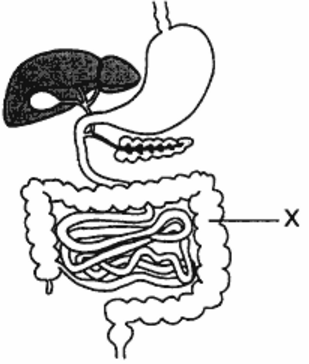
The diagram represents a portion of a human body. The principal function of structure X is to
produce amylase
produce pepsin
absorb water
absorb nutrients
Which of the following correctly describes the purpose of digestion?
To break down complex food molecules into simple soluble molecules
To make complex food molecules from simple soluble molecules
To make use of simple soluble food molecules
To remove complex food molecules from the body
Large food molecules need to be broken down to be small enough to pass through cell membranes.
True
False
Select all the enzymes present in the intestinal juice.
amylase
lipase
maltase
protease
Which of the following enzymes breaks down proteins?
amylase
lipase
trypsin
maltase

