wayground logo

Free Printable Worksheets

Font size

S
M
L
XL
Worksheets

Chemistry final review

Total questions: 148

Worksheet time: 3hrs 8mins

Name
Class
Date
1.

LiBr is called

a)

lithium bromine

b)

lithium (I) bromine

c)

lithium bromide

d)

lithuim (I) bromide

2.

Which of these combinations is an ionic compound?

a)

Metal and Metal

b)

Nonmetal and Nonmetal

c)

Metal and Nonmetal

d)

Cation and Cation

3.
What is the name of N2O3
a)
Nitrogen trioxide
b)
Dinitrogen oxide
c)
Dinitrogen trioxide
d)
Nitrogen oxide
4.
What is the chemical formula for Tetrasulfur pentoxide?
a)
SO
b)
S4O
c)
S4O5
d)
S5O4
5.

A(an) __________ bond exists between two nonmetals.

a)

ionic

b)

covalent

6.

What type of reaction involves 2 substances combining to form 1 new compound?

a)

Decomposition Reaction

b)

Single Displacement Reaction

c)

Double Displacement Reaction

d)

Synthesis Reaction

7.

What are the reactants in the chemical equation pictured?

a)

CH4 and CO2

b)

CH4 and O2

c)

CO2 and H2O

d)

O2 and H2O

8.

What are the products of the chemical reaction pictured?

a)

CH4 and CO2

b)

CH4 and O2

c)

CO2 and H2O

d)

O2 and H2O

9.
What is a coefficient?
a)
The small number on the right of the chemical symbol.
b)
The large number to the left of a formula.
10.
What does the Law of Conservation of Mass state?
a)
Matter cannot be gained or lost in a chemical reaction.
b)
Matter can only be lost in a chemical reaction.
c)
Matter can only be gained in a chemical reaction.
d)
Matter can be gained and lost in a chemical reaction. 
11.
Number of H in 3(NH₄)₂CrO₄
a)
4
b)
6
c)
8
d)
24
12.

How many valence electron does Beryllium have?

a)

1

b)

2

c)

0

d)

4

13.

Which subatomic particle has NO CHARGE?

a)

Protons

b)

Neutrons

c)

Electrons

d)

Nucleus

14.

Which subatomic particle tells you the identity of the Element?

a)

Protons

b)

Neutrons

c)

Electrons

d)

Nucleus

15.

If an element has 11 protons and 12 Neutrons, what is it's atomic mass?

a)

12

b)

11

c)

23

d)

1

16.

In the formula 2C6H12O6, what is the Coefficient?

a)

5

b)

6

c)

2

d)

12

17.

What is a negatively charged atom called?

a)

Anion

b)

Cation

c)

Ion

18.
What is a positivly charge atom called?
a)
cation
b)
anion
19.

What type of reaction involves 2 substances combining to form 1 new compound?

a)

Decomposition Reaction

b)

Single Displacement Reaction

c)

Double Displacement Reaction

d)

Synthesis Reaction

20.
Balance this equation
_Zn+_HCl-->_ZnCl+_H2
a)
1,1,2,1
b)
1,1,1,2
c)
1,2,1,1
d)
2,1,1,1
21.
What are the smaller numbers that you CANNOT change in a chemical equation? 
a)
Coefficient
b)
Products
c)
Reactants
d)
Subscript
22.

What are isotopes?

a)

different element with the same number of electrons

b)

same element with a different number of electrons

c)

same element with a different number of neutrons

d)

different element with the same number of neutrons

23.

Which element will have a higher electronegativity than Arsenic (As) ?

a)

Carbon

b)

Antimony

c)

Germanium

d)

Neon

24.
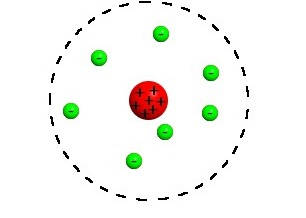
This could be the dot diagram of
a)
Mg, group 2.
b)
Cl, group 17.
c)
C, group 14.
d)
O, group 16.
25.

What is the molecular geometry of this boron trifluoride (BF3)?

a)

linear

b)

bent

c)

trigonal planar

d)

tetrahedral

26.

One mole is equal to the number of atoms in exactly 12 grams of carbon-12. The number (6.02 × 1023 particles per mole) is known as

a)

Planck's constant.

b)

Avogadro's number.

c)

Coulomb's constant.

d)

Faraday's number.

27.
What two types of measurements make up DENSITY
a)
Mass and Volume
b)
Temperature and Mass
c)
Grams and Centimeters
d)
Volume and Weight
28.
In order for an atom to be neutral what has to be true?
a)
The atom has more protons than neutrons
b)
The atom has more neutrons than protons
c)
The atom has the same number of protons and neutrons
d)
The atom has the same number of protons and electrons
29.
Which pair has the same empirical formula?
a)
NaCrO4 and Na2Cr2O7
b)
C2H4O2 and C6H12O6
c)
C3H6Oand C2H6O2
d)
CH4 and C2H6
30.
This model this model was the first to show a nucleus, consisting of protons and neutron.  Electrons surround the nucleus but are not shown in distinct energy levels. 
a)
The "Rutherford Model" of the atom
b)
The "Plum Pudding Model" of the atom
c)
The "Quantum Mechanical Modell" of the atom
d)
Democritus's model of the atom
31.
A compound consists of 72.2% magnesium(Mg) and 27.8% nitrogen(N) by mass. What is the empirical formula?
a)
Mg4N3
b)
MgN2
c)
Mg3N
d)
MgN
32.

How many molecules are in 2.5 mol of NaCl?

a)

1.5 x 1024 molecules

b)

1.5 molecules

c)

4.15 molecules

d)

1.5 x 10²³ molecules

33.

What is the correct representative particle for CO2?

a)

Atoms

b)

Molecules

c)

Formula Units

34.

What is the correct representative particle for NaCl?

a)

Formula Unit

b)

Atom

c)

Molecule

35.
What is the molarity of 4 grams of sodium chloride in 3,800 mL of solution?
a)
0.018 M
b)
0.018 mol
c)
1.052 M
d)
1.052 mol
36.
Molarity is measured in
a)
moles per kg
b)
mols per L
c)
moles per kJ
d)
moles per mL
37.
How many L are required to make 3.5 M hydrochloric acid using 1.1 moles? 
a)
3.18 L
b)
0.31 L
c)
3.85 L
d)
4.6 L
38.

A dilution is when

a)

solute is added to the volume of solution

b)

water is added to the volume of solution

c)

solute is removed from the volume of solution

d)

water is removed from the volume of solution

39.

What is the molarity of a solution made by diluting 26.5 mL of 6.00M HNO3 to a volume of 250.0 mL?

a)

15.9 M

b)

0.636 M

c)

0.642 M

d)

1.59 M

40.

Which part of the atomic theory did Niels Bohr prove?

a)

there are electrons

b)

there is a nucleus

c)

electrons are in energy levels

d)

gold foil experiment

41.

Which statement is incorrect?

a)

The nucleus is very dense.

b)

The nucleus contains protons and neutrons.

c)

The nucleus is positively charged.

d)

The nucleus is involved in chemical reactions.

42.

What determines chemical reactivity?

a)

protons

b)

neutrons

c)

electrons

d)

isotopes

43.

What determines the identity of the atom?

a)

protons

b)

neutrons

c)

electrons

d)

isotopes

44.

What happens to particles when energy is added (heated)?

a)

They speed up and spread out

b)

They slow down and compress

c)

They stop moving

d)

They move closer together and speed up

45.

Phase change going from a Liquid to a Gas...

a)

Vaporization

b)

Deposition

c)

Condensation

d)

Melting

46.

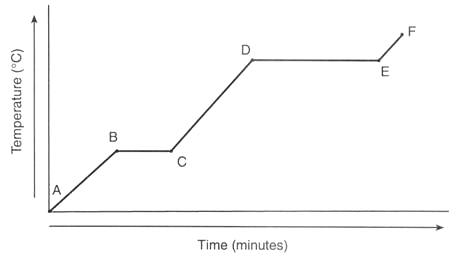
What state/phase is the object likely from points A to B?

a)

Solid

b)

Liquid

c)

Gas

d)

Plasma

47.

What is happening to the particles in the substance between points D and E?

a)

Melting

b)

Freezing

c)

Vaporizing

d)

Sublimating

48.
If you could see the molecules within a solid, what would you observe?
a)
molecules flowing past one another, but unable to move far away from one another
b)
molecules vibrating in place, closely packed
c)
molecules moving with great energy, far apart from one another
d)
molecules vibrating and moving far away from one another
49.

Name the compound Fe(NO3)2.

a)

Iron (II) Nitrate

b)

Iron (II) Nitrite

c)

Iron (III) Nitrate

d)

Iron (III) nitride

50.

The electron configuration of an element is [Kr] 4d6 5s1. To what group does this element belong?

a)

4

b)

5

c)

7

d)

9

51.

An electron for which n = 4 has more ____ than an electron for which n = 2.

a)

spin

b)

particle nature

c)

energy

d)

wave nature

52.

The measurement 0.035550 g rounded off to two significant figures would be

a)

0.03

b)

0.35

c)

0.036

d)

3.5 x 10²

53.

The energy required to remove an electron from an atom is the atom's

a)

electron affinity

b)

electron energy

c)

electronegativity

d)

ionization energy

54.

In the reaction represented by the equation 2Al2O3 ® 4Al + 3O2, what is the mole ratio of aluminum to oxygen?

a)

10:6

b)

3:4

c)

2:3

d)

4:3

55.

According to the kinetic-molecular theory, particles of matter

a)

are in constant motion

b)

have different shapes

c)

have different colors

d)

are always fluid

56.

Which is not an example of a colloid?

a)

paint

b)

smoke

c)

butter

d)

sugar water

57.

The greater the average kinetic energy of the particles in a sample of matter,

a)

the higher the temperature is.

b)

the lower the termperature is.

c)

the more energy is absorbed by the sample in the form of heat.

d)

the less energy is released by the sample in the form of heat.

58.
Which state of matter is represented here?
a)
Solid
b)
Liquid
c)
Gas
59.
Which of these represents the bonds in order from strongest to weakest?
a)
Network covalent, dipole-dipole, electrostatic (ionic), London dispersion
b)
London dispersion, dipole-dipole, electrostatic (ionic), network covalent
c)
Network covalent, electrostatic (ionic), dipole-dipole, London dispersion
d)
Network covalent, London dispersion, electrostatic (ionic), dipole-dipole
60.
What kind of intermolecular force is shown here?
a)
hydrogen bonding
b)
London dispersion
c)
network covalent
d)
electrostatic (ionic)
61.
Which kind of intermolecular force is shown here?
a)
electrostatic (ionic)
b)
network covalent
c)
London dispersion
d)
dipole-dipole
62.
What kind of intermolecular force is shown here?
a)
hydrogen bonding
b)
network covalent
c)
London dispersion
d)
electrostatic (ionic)
63.
What kind of intermolecular force does this form?
a)
dipole-dipole
b)
London dispersion force
c)
electrostatic (ionic)
d)
network covalent
64.

The optical portion of the electromagnetic spectrum above represents visible light (red, orange, yellow, green, blue, indigo, and violet). Which statement is correct about the optical portion of the spectrum?

a)

The photons of red light have more energy than photons of violet light.

b)

The photons of red light have equal energy as photons of violet light.

c)

The photons of red light have less energy than photons of violet light.

d)

The photons of violet light have less energy than photons of red light.

65.

What atom matches this electron configuration?

1s2 2s2 2p6 3s2

a)

Magnesium

b)

Neon

c)

Aluminum

d)

Potassium

66.

Which is the correct Lewis structure for Nitrogen?

a)
b)
c)
d)
67.

Covalent bonds form when the bonded atoms are at their ______ potential energy.

a)

slowest

b)

lowest

c)

strongest

d)

fastest

68.

The molar volume of a gas at STP occupies _____________.

a)

22.4 L

b)

0˚C

c)

1 kiloPascal

d)

12 grams

69.

Chemical equations must be balanced to satisfy ____.

a)

The law of definite proportions

b)

The law of multiple proportions

c)

The law of conservation of mass

d)

Avogadro's principle

70.

What is the name of H2SO4?

a)

hyposulfuric acid

b)

hydrosulfuric acid

c)

sulfuric acid

d)

sulfurous acid

71.

Which of the following shows both the correct formula and correct name of an acid?

a)

HClO2, chloric acid

b)

HNO2, hydronitrous acid

c)

H3PO4, phosphoric acid

d)

HI, iodic acid

72.
H
H2
NaCl
Cl
O2
List the correct answers in order.
a)
molecule, compound, molecule, element,molecule
b)
element, molecule, compound, compound, molecule
c)
element, molecule, compound, element, molecule
d)
Compound, element, ,molecule, vector, roger
73.
Boiling point, Freezing point, creating a mixture, can be separated, change in state, are all what type of property?
a)
Chemical
b)
Physical
74.
The easiest way to tell if a change is physical or chemical is to ask yourself?
a)
Did it break?
b)
Did it change color?
c)
Did it create a new substance?
d)
Did it look cool?
75.

When water and oil combine, oil sits on top of the water. Why do oil and water not mix?

a)

Water is more dense than oil.

b)

Oil is nonpolar and water is polar.

c)

Oil is polar and water is nonpolar.

d)

Oil can eventually dissolve in water.

76.

What is an electrolyte?

a)

A nonmetal that conducts electricity.

b)

A metal that conducts electricity.

c)

An ion that conducts electricity.

d)

A metalloid that conducts electricity.

77.

What is an electrolyte?

a)

A nonmetal that conducts electricity.

b)

A metal that conducts electricity.

c)

An ion that conducts electricity.

d)

A metalloid that conducts electricity.

78.

What is an electrolyte?

a)

A nonmetal that conducts electricity.

b)

A metal that conducts electricity.

c)

An ion that conducts electricity.

d)

A metalloid that conducts electricity.

79.

What is an electrolyte?

a)

A nonmetal that conducts electricity.

b)

A metal that conducts electricity.

c)

An ion that conducts electricity.

d)

A metalloid that conducts electricity.

80.

In which mixture can you see all of the parts?

a)

homogeneous

b)

heterogeneous

81.

How does thermal energy play a role in particle motion and changes of state?

a)

Thermal energy is a term that refers to temperature

b)

Increasing an object's thermal energy increases particle motion and can cause a change of state.

c)

Decreasing an object's thermal energy increases particle motion and can cause a change of state.

d)

Thermal energy is the energy added from a heat source.

82.

Name this group: These metals are the most reactive.

a)
b)
c)
d)
83.

Name this group: These metals are the second most reactive.

a)
b)
c)
d)
84.

As you move left to right on a row or period what happens?

a)

Atomic number increases by 1

b)

Electrons decrease

c)

Number of shells decrease

d)

Nothing

85.

Elements in the same group or column have the same ...

a)

# of valence electrons

b)

# of shells

c)

# of protons

d)

Mass Number

86.

Elements in the same group have __________

a)

Similar Properties

b)

Same number of shells

c)

Similar Mass

87.
The atoms along the staircase are called 
a)
metals
b)
nonmetals
c)
metalloids
d)
noble gases
88.
How many protons are in this element?
a)
79
b)
196
c)
117
d)
Cannot be determined
89.
5. A student determined the density of aluminum by averaging the results of three density calculations. Each value was different, but the average was equal to the accepted value for aluminum’s density. The results of this investigation are best described as ______.
a)
a.  Accurate, but not precise.
b)
a.  Precise, but not accurate.
c)
a.  Both precise and accurate.
d)
a.  Neither precise nor accurate.
90.
8.  Which are the sublevels in an energy level of n = 3?
a)
s, p,  and f
b)
s, d, and f
c)
s, p, and d
d)
p, d and f
91.
9.  What electron configuration rule states: All orbitals of equal energy are occupied by one electron before any single orbital is occupied by a second electron.
a)
Pauli Exclusion Principle
b)
Hund's Rule
c)
Aufbau Principle
d)
Bohr Model of the the atom
92.
10. What electron configuration rule states:  No two electrons in the same atom can have the same four quantum numbers.
a)
Pauli Exclusion Principle
b)
Hund's Rule
c)
Aufbau Principle
d)
Bohr model of the atom
93.
11.  What electron configuration rule states: An electron occupies the lowest energy orbital that can receive it. 
a)
Pauli Exclusion Principle
b)
Hund's Rule
c)
Aufbau Principle
94.
14.  What is the correct formula for copper(I) cyanide?
a)
      CuCy
b)
      CuCy2
c)
    CuCN
d)
  Cu2CN
95.
15.  What is the correct formula for the compound made of magnesium and nitrogen?
a)
   Mg2N3
b)
      Mg3N2
c)
    MgN2
d)
      MgN
96.
16.  Which equation below violates the law of conservation of mass?
a)
     2H2 + O2 --> 2 H2O
b)
   KCl + Br --> KBr + Cl
c)
a.  2 Fe2O3 + 3C --> 4Fe + 3CO2
d)
a.  Na 2 CO3 + 2HCl  --> 2NaCl + H2 O + CO2  
97.
What explains the very high melting and boiling point of water
a)
Strong dipole-dipole bonds between water molecules
b)
Strong hydrogen bonds between water molecules
c)
Dispersion forces which are present in all molecules
d)
Asymmetrical shape of the polar bonds.
98.
Does HCl have hydrogen bonding?
a)
yes
b)
no
99.
Does CH4 have hydrogen bonding?
a)
yes
b)
no
100.
All molecules have London forces between them, but dipole-dipole and hydrogen bonding are so much stronger that when they are present we can ignore London forces.  Which of these has ONLY London forces?
a)
I2
b)
NH3
c)
OCl2
d)
SH2
101.

Which substance would have the weakest intermolecular forces of attraction?

a)

CH4

b)

NaCl

c)

H2O

d)

MgF2

102.

Intermolecular forces for: NH3

a)

Dispersion Force

b)

Dipole dipole

c)

Hydrogen bonding

103.
Intermolecular force present in HCl?
a)
dipole dipole
b)
dispersion
c)
H-bond
d)
ionic
104.

Which substance has the weakest intermolecular forces?

a)

Substance A, boiling point of 75 °C

b)

Substance B, boiling point of 105 °C

c)

Substance C, boiling point of 25 °C

d)

Substance d, boiling point of 45 °C

105.

The weaker the intermolecular forces of a substance the _____________ the boiling point

a)

higher

b)

lower

106.

Intermolecular forces for: CO2

a)

Dispersion Force

b)

Dipole dipole

c)

Hydrogen bonding

107.
Rank these in order of strength:
covalent bond
London forces
hydrogen bond
dipole-dipole attraction
a)
dipole-dipole>covalent bond>hydrogen bond>London
b)
London>dipole-diple>hydrogen bond>covalent bond
c)
covalent bond>hydrogen bond>dipole-dipole>London
d)
hydrogen bond>dipole-dipole>London>covalent bond
108.
What will be the state of the following molecule?
a)
gas
b)
liquid
c)
solid
109.
Hydrogen needs _____ electrons in its valence shell to be stable.
a)
4
b)
6
c)
8
d)
2
110.
A Lewis structure can be used for showing an ionic bond but instead for dashes for the bonds positive and negative _____ are represented.
a)
atoms
b)
ions
c)
molecules
d)
electrons
111.
If electrons are shared unequally then the bond is....
a)
Non-polar covalent
b)
Ionic
c)
Non-polar ionic
d)
Polar covalent
112.
If electrons are shared equally then the bond is....
a)
Non-polar covalent
b)
Ionic
c)
Non-polar ionic
d)
Polar covalent
113.
Metals and nonmetals form which kind of bond?
a)
Polar covalent
b)
Ionic
c)
Non-polar covalent
d)
Metallic
114.
How strongly an atom attracts electrons is called....................
a)
Ionization energy
b)
Electronegativity
c)
Electricity
d)
Nuclear force
115.
How strongly an atom attracts electrons is called....................
a)
Ionization energy
b)
Electronegativity
c)
Electricity
d)
Nuclear force
116.

What is the correct Lewis Dot Structure for ammonia NH3

a)
b)
c)
d)
117.

Which is the correct molecular structure for carbon dioxide?

a)
b)
c)
d)
118.
Which of the following is the correct Lewis dot structure for the molecule fluorine (F2)?
a)
A
b)
B
c)
C
d)
D
119.

What is the correct structure for BF3?

a)

Option A.

b)

Option B.

c)

Option C.

d)

Option D.

120.

By replacing the element symbol, this could be a diagram of which element?

a)

Li

b)

Al

c)

C

d)

Be

121.
Each line in a Lewis Structure represents __________ electron(s).
a)
3
b)
2
c)
1
d)
4
122.

Which image could be a representation of NH3?

a)

A

b)

B

c)

C

123.

NH3 has how many lone pairs?

a)

0

b)

1

c)

2

d)

3

124.
As you move down a group, atomic radius increases because - 
a)
you add more and more neutrons
b)
you add more and more protons
c)
you add more and more shells (energy levels)
d)
you add more atomic mass
125.
The atom with the largest atomic radius in Group 18 is - 
a)
Ar
b)
He
c)
Kr
d)
Rn
126.
As you move across the periodic table from left to right, the atomic radius decreases.  This is because - 
a)
the number of protons increases, so attraction to electrons increases
b)
the number of energy levels increases
c)
the number of electrons increases
d)
the atomic mass increases
127.
The atom with the largest atomic radius in Period 4 (row 4) is - 
a)
K
b)
Kr
c)
Fe
d)
Fe
128.
Francium (Fr) has the lowest ionization energy in Group 1 because - 
a)
it has the smallest number of valence electrons
b)
it has the greatest atomic mass
c)
it has the greatest number of protons, so it attracts its electrons the strongest
d)
its 1 valence electron is very far from the nucleus, so little energy is needed to remove it
129.
The element with the smallest ionization energy in Period 6 is - 
a)
Rn
b)
Cs
c)
Os
d)
Tm
130.
The energy required to remove electrons is the definition of: 
a)
Electronegativity
b)
Atomic Number
c)
Atomic Radius
d)
Ionization
131.
Which has the greater Electronegativity: 
N or C?
a)
C
b)
N
132.
Identify the element that is non-reactive (inert) with 4 energy levels.
a)
Krypton
b)
Argon
c)
Potassium
d)
Calcium
133.

When atom gains an electron, the size will

a)

increase

b)

decrease

c)

have no change

d)

smaller

134.
Atomic Radius is...
a)
the relative size of the atom's nucleus
b)
the relative size of the atom's electron cloud
c)
the energy required to shield the outer electrons from the nucleus
d)
a measure of the ability of an atom to attract electrons
135.
Which atom has the largest atomic radius?
a)
potassium
b)
rubidium 
c)
francium
d)
cesium
136.
Which of the following will have a higher ionization energy than arsenic (As)?
a)
Gallium (Ga)
b)
Neon (Ne)
c)
Antimony (Sb)
d)
Germanium (Ge)
137.
Atoms that have a high electronegativity, _______________.
a)
give up their electrons more easily.
b)
hold on to their electrons more tightly.
c)
have more electron shells.
138.
The electronegativity of Cl is the highest in Period 2.  Why?
a)
Cl is the largest and has the greatest effective nuclear charge
b)
Cl is the smallest and has the lowest effective nuclear charge
c)
Cl is the largest and has the lowest effective nuclear charge
d)
Cl is the smallest and has the greatest effective nuclear charge
139.
What term is used to describe "an atom's tendency to attract electrons to itself when is is chemically combined with another element"
a)
electronation
b)
electron affinity
c)
electronegativity
d)
electrolysis
140.
What term is used to describe "A measure of the size of an atom"
a)
chemical reactivity
b)
atomic radius
c)
energy levels
d)
orbit
141.
Which is a halogen?
a)
Helium
b)
Chlorine
c)
Oxygen
d)
Neptune
142.

A water molecule is held together by this type of bond

a)

Ionic

b)

Non polar covalent

c)

Hydrogen

d)

Polar covalent

143.
Why can water have no net charge but have slight charges in different parts of the molecule?
a)
The oxygen end is slightly negative and the hydrogen end is slightly positive
b)
The hydrogen end is slightly negative and the oxygen end is slightly positive
c)
The hydrogen and oxygen ends change in polarity
d)
Because it is hydrophobic
144.
Acids have more what? 
a)
OH ions 
b)
OH- ions
c)
H+ ions 
d)
All of the above 
145.
Which of the following is LEAST likely to dissolve in water?
a)
nonpolar fats and oils
b)
polar sugar molecules
c)
salt made of a positive sodium ion and a negative chloride ion
d)
all of the substances will dissolve easily in water
146.
Pure water has a
a)
Neutral pH 
b)
Negative pH
c)
Positive pH
d)
Both Negative and Positive pH
147.

A new dish soap claims that it is able to remove grease from pots and pans while still fully dissolving in the dishwasher water.

Which of the following best explains the ideal structure of the dish soap molecule?

a)

The dish soap molecule must be polar at one end to dissolve grease, and nonpolar at the other end so it can dissolve in water.

b)

The dish soap molecule must be nonpolar so that it can dissolve in both grease and water.

c)

The dish soap molecule must be polar so that it can dissolve both grease and water.

d)

The dish soap molecule must be nonpolar at one end to dissolve grease, and polar at the other end so it can dissolve in water.

148.

Water has a boiling point of 100.0∘C, which is unusually high compared to many other liquids.

Which of the following properties allows water to have a high boiling point?

a)

It contains only three atoms.

b)

It is a small, covalent molecule.

c)

It contains oxygen.

d)

It can form hydrogen bonds.