
 Worksheets
Chemistry Unit 3 Review
Total questions: 146
Worksheet time: 6hrs 54mins
What is the left part of a chemical equation called?
2H2 + O2 ---> 2H2O
Reactants
Yields
Products
Chemical equation
What is the right part of a chemical equation called?
2H2 + O2 ---> 2H2O
Reactants
Yields
Products
Chemical Equation
What is the total number of atoms present in 5Na3PO4?
5
55
40
8
How many Mn atoms are found in the following compound?
2MnO4
1
2
4
8
What is the little number after an element in a chemical equation called?
Example: H2
Coefficient
Atom
Subscript
Equation
Is the following equation balanced?
Al + O2 ---> 2Al2O3
YES
NO
What is the number before a chemical formula called?
Example: 2H2 + O2 ---> 2H2O
Coefficient
Atom
Subscript
Equation
How many elements are in C6H12O6?
1
2
3
4
Which of the following equations are correctly balanced?
12CO2 + H2O ---> C6H12O6 + O2
CO2 + H2O ---> 3C6H12O6 + O2
CO2 + 9H2O ---> C6H12O6 + O2
6CO2 + 6H2O ---> C6H12O6 + 6O2
Balance this equation:
H2 + Cl2 ---> HCl
It is balanced.
H2 + Cl2 ---> 2HCl
3H2 + Cl2 ---> 6HCl
H2 + 3Cl2 ---> 6HCl
Balance this equation:
HgO ---> 2Hg + O2
It is balanced.
2HgO ---> 2Hg + O2
2HgO ---> Hg + O2
HgO ---> Hg + 2O2
Complete the sentence.
During a chemical reaction, atoms ________.
can appear
can disappear
get rearranged
stop moving and vibrating
What is the Law of Conservation of Mass?
It states that matter cannot be created or destroyed.
It states that energy cannot be created or destroyed.
It states that matter can be created or destroyed.
It states that sound can be created or destroyed.
Mg + __HCl ---> MgCl2 + H2
Balance the following equation:
___ H2+ ___ O2→___ H2O
1, 1, 3
2, 2, 2
1, 2, 1
2,1, 2

How many molecules are represented by 2C6H12O6 ?
(a)
How many different elements are present in this molecule?
3 NH4C2H3O2
15
36
5
4
4CF2Cl2
C = 4, F = 4, Cl = 2
C = 1, F = 8, Cl = 8
C = 4, F = 8, Cl = 8
C = 1, F = 4, Cl = 8
Coefficients in chemical formulas...
Multiply just the first atom
Add to the subscripts at the end of the molecule
Multiply elements without subscripts
Multiply EVERYTHING!
The ______ are numbers found on the lower right-hand side of an element symbol.
Coefficient
Exponent
Multiplier
Subscript
How many different elements are present in H2COCH2
5
4
3
2
H2SO4
Al3+ O2-
Cr3+ O2-
K1+ S2-
The name of FeCl₂ is
iron chloride
iron (II) chloride
iron (I) chloride
iron dichloride
Which of the following combinations would need roman numerals in the name?
potassium + fluorine
beryllium + oxygen
boron + iodine
lead + oxygen
What is the name of the compound Na2(SO4)?
Sodium sulfate
Sodium sulfide
Sodium sulfite
Sodium sulfuroxide

What type of reaction involves 2 substances combining to form 1 new compound?
Decomposition Reaction
Single Replacement Reaction
Double Replacement Reaction
Synthesis Reaction

What type of reaction involves the breaking down of a substance into simpler substances?
Single Replacement Reaction
Double Replacement Reaction
Synthesis Reaction
Decomposition Reaction

What type of reaction involves one element replacing another element in a compound?
Single Replacement Reaction
Double Replacement Reaction
Synthesis Reaction
Decomposition Reaction

What are the reactants in the chemical equation pictured?
CH4 and CO2
CH4 and O2
CO2 and H2O
O2 and H2O
What type of reaction involves ions from 2 compounds exchanging places to form 2 completely new compounds?
Single Replacement Reaction
Double Replacement Reaction
Synthesis Reaction
Decomposition Reaction
What type of chemical reaction is this one?
Al(OH)3 --> Al2O3 + H2O
Decomposition
Combustion
Synthesis
Single Replacement
What type of chemical reaction is this one?
Ca + MgCl2 --> CaCl2 + Mg
Decomposition
Combustion
Synthesis
Single Replacement
Combustion reactions will always involve
Oxygen and a solid
Liquid nitrogen and heat
Oxygen and heat/energy
CO and H2O
Balancing this reaction:
____ CH4 + ____ O2 ---> ___ CO2 + ____ H2O
2,1,3,1
1,2,1,2
1,2,2,1
2,1,1,2
Balance this reaction:
____ Na3PO4 + ____ KOH ---> ____ NaOH + ____ K3PO4
1,3,3,1
1,3,2,1
2,3,3,1
1,1,3,1
Balance this reaction:
____ NaF + ____ Br2 ---> ___ NaBr + ____ F2
3,1,2,1
1,2,3,4
2,1,2,1
1,2,1,2


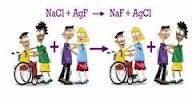
What is the name for the solid formed during a reaction?
Precipitate
Rocks
Aqueous
What are the products of this Single Replacement reaction?
Zn(s) + H2SO4(aq) -->
ZnH2SO4
ZnSO4 + H2
No reaction
What is the correct way of representing hydrogen gas alone, in a reaction?
2H
H
H2
What is the charge of Iron in this compound. (Hint: think criss cross method):
Fe3(PO4)2
+3
+2
+1
If an element is diatomic it should have a subscript of___
1, always
2, only when it is by itself
it shouldn't have a subscript, it should have a coefficent
Predict the products for the this Double Replacement reaction:
AgNO3 + KCl -->
AgCl + KNO3
AgK + ClNO3
KAg + NO3Cl
Predict the products for the this Single Replacement reaction:
Mg + CuCl2 -->
MgCl2 + Cu
Mg + Cu
MgCu + Cl2
Predict the products for the this Single Replacement reaction:
K + HCl -->
KCl + H2
KHCl
KH + Cl2
Complete the balanced equation for this Double Replacement reaction.
3 NaOH + Fe(NO3)3 -->
NaFe + OH(NO3)3
2NaNO3
3 NaNO3 + Fe(OH)3
Predict the products for this equation.
(Zn with a charge of +2)
Zn + H2SO4 -->
Zn(SO4)2 + H
ZnSO4 + H2
ZnSO4 + H4
Fill in the blank. (Copper has a charge of +2)
Cu+ AgNO3--> Ag + _____
Cu(NO3)2
CuNO3
CuAg
Cu
What is the missing product?
CxHy + O2 ➔ CO2 + __________
H2O
HO
CHO
Which of the following chemical equations follows the Law of Conservation of Mass? Hint: which is balanced?
CO2 + H2O --> C6H12O6 + O2
C6O + H12O --> C6H12O2
CO2 + H2O --> C6H12O6 + O2
CO2 +H2O --> C6H12O6 +O2

Which of the following pictures is an example of a chemical change?
Wood burning in a fireplace
ice melting in water in a beaker
a cracked rock
boiling water on a hotplate
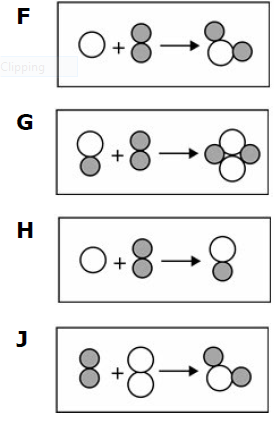
Which of the following models best demonstrates a balanced chemical equation?
F
G
H
J
Coal contains carbon and other elements. Carbon dioxide forms when coal burns in the presence of oxygen. Which of these is the best evidence that a chemical reaction occurs when coal burns?
The shape of the coal changes
Oxygen is present
A new substance is produced
Coal is made up of more than one element
If an element is diatomic it should have a subscript of___
1, always
2, only when it is an element
it shouldn't have a subscript, it should have a coefficent
2, when bonded in a compound
What is the charge of Iron in this compound. (Hint: think swap drop method):
Fe3(PO4)2
3+
2+
1+
6+
The symbol for a substance dissolved in solution is ______
(s)
(l)
(aq)
(g)
Fill in the blank. (Copper has a charge of 2+)
Cu+ AgNO3 → Ag + _____
Cu(NO3)2
CuNO3
CuAg
Cu
Predict the products of this synthesis reaction: H2 + Cl2 →
HCl
H2Cl2
H2Cl
HCl2
What type of reaction is this?
2 C6H14 + 19 O2 → 12 CO2 + 14 H2O
Single Replacement
Double Replacement
Combustion
Decomposition
Predict the products for the this Single Replacement reaction:
K + HCl →
KCl + H2
KHCl
KH + Cl2
HCl + K2
Predict the products for the this Double Replacement reaction:
AgNO3 + KCl →
AgCl + KNO3
AgK + ClNO3
KAg + NO3Cl
AgCl + 3 KNO
Complete the balanced equation for this Double Replacement reaction.
3 NaOH + Fe(NO3)3 →
NaFe + OH(NO3)3
NaNO3 + Fe(OH)3
3 NaNO3 + Fe(OH)3
3 NaFe + 3 (OH)NO3
Predict the product of this synthesis reaction:
Al + S₈ →
AlS
AlS8
Al2S
Al2S3
Predict the products for the decomposition of aluminum oxide, Al2O3 →
Al + O2
O + Al2
Al2 + O3
Al + O
Predict the products for the this Single Replacement reaction: (Copper has a charge of 1+)
Mg + CuCl →
MgCl2 + Cu
Mg + Cu
MgCu + Cl2
MgCl + Cu2
What are the products of this reaction:
C2H4 + O2 →
C2O2 + H4
CO2 + H2 + O2
CO + H
CO2 + H2O
Predict the products of this single replacement reaction: Na + H2O →
NaO + H2
NaOH + H2
NaH + O2
ONaH
Calculate the formula mass of Ba(BrO4)2
How many particles are in 45.6 grams of Aluminum bromide?
Convert 2.75 x10¹⁵ particles of lead (II) iodide to grams of lead (II) iodide.
Calculate the formula mass of (NH3)2O.
Convert 35.5 grams cobalt (III) chloride to moles
Convert 8.34X1045 particles of iron (III) oxide to grams
How many moles are in 2.45 x1057 particles of NaCl?
How many grams are in 3.4 X10¹⁴ moles of Chromium (III) oxide?
Convert 24.98 moles of boron to atoms of boron
Convert 52 g of mercury (II) bromide to moles
Convert 5.78 moles potassium phosphide to grams
Convert 7.63 grams of Lithium sulfide to particles
Calculate the formula mass of Aluminum chloride
Convert 14.5 grams aluminum chloride to grams of chlorine
Convert 127 grams Li2O to particles of lithium
How many grams of aluminum sulfate would be formed if 250g H2SO4 completely reacted with aluminum?
CaC₂(s) + H₂O(l) --> C₂H₂(g) + Ca(OH)₂(aq)
Fe2O3(s) + 3H2(g) → 2Fe(s) + 3H2O(l)
How many moles of iron can be made from 6 moles H2?
In the equation 2 Al2O3 --> 4 Al + 3 O2, what is the mole ratio of aluminum to oxygen (aluminum is asked for, oxygen is given)?
10/6
3/4
4/3
2/3
In the reaction 2 H2 + O2 → 2 H2O what is the mole ratio of oxygen to water
1/2
2/1
3/4
4/3
What is the molar mass of table salt (NaCl)?
116.89 g/mol
35.45 g/mol
22.99 g/mol
58.44 g/mol
What is the molar mass of NaOH?
40.00 g/mol
38.99 g/mol
23.99 g/mol
57.00 g/mol
How many moles of hydrogen are needed to react with 2 moles of nitrogen?
How many grams of hydrogen are produced if 120 g of Na are available?
Fe2O3(s) + 3H2(g) → 2Fe(s) + 3H2O(l)
How many moles of iron (Fe) can be made from 6 moles H2?
In a balanced equation, the ratio between the coefficient of any two substances is called the _______.
mole ratio
stoichiometry
limiting reactant
excess reactant
1 Cheese + 2 Bread --> 1 grilled cheese
How many grilled cheeses can you make with 26 slices of bread and 14 pieces of cheese?
14
13
26
determines when a reaction stops.
is used up first.
is the reactant that is left over.
speeds up a reaction.

The Formula to make S'mores is:
2C + 1M + G2 → C2MG2. If you have 5 Marshmallows (M), 9 Chocolate Pieces (C), and 9 Graham Cracker Halves (G), how many S'mores can you make?
5
4
8
42

