wayground logo

Free Printable Worksheets

Font size

S
M
L
XL
Worksheets

Physics Lab Final Exam

Total questions: 110

Worksheet time: 4hrs 40mins

Name
Class
Date
1.

Which of the following statements is correct?

a)

The car has less kinetic energy because it has more mass than the girl.

b)

The car has the most kinetic energy because it has more mass than the girl.

c)

The car and the girl have the same amount of kinetic energy because they are moving at the same speed.

d)

The girl has the most kinetic energy because she has less mass than the car.

2.

Why does a soccer ball eventually stop rolling once it’s kicked on a grassy field?

a)

none of these

b)

Gravity acts upon it.

c)

Light acts upon it.

d)

Friction acts upon it.

3.

A sled starts at rest with 51,450 J of potential energy. After traveling part of the way down the slope, the sled has 32,781 J of potential energy. If there is no friction, what is the kinetic energy of the sled?

a)

18,669 J

b)

51,450 J

c)

84,231 J

d)

32,781 J

4.

Car 1 and Car 2 have the same mass. Which of the following statements is true?

a)

Car 1 has the most kinetic energy because it is moving at a faster rate of speed.

b)

Car 2 has the least amount of kinetic energy because it is actually smaller than car one.

c)

Car 2 has the most kinetic energy because it is moving at a slower rate of speed.

d)

Car 1 has the least amount of kinetic energy because it is moving at a faster rate of speed.

5.

Which of the following is a correct statement?

a)

Both the mass and speed of an object affect the amount of kinetic energy it will have.

b)

Only the speed of an object affects the amount of kinetic energy it will have.

c)

Only the mass of an object affects the amount of kinetic energy it will have.

d)

Neither the mass nor speed of an object affects the amount of kinetic energy; only the height of the object.

6.

Why does a brick that is thrown into the air fall back down?

a)

Gravity acts upon it.

b)

Friction acts upon it.

c)

none of these

d)

Light acts upon it.

7.

How could you increase the number of snowmen destroyed by the sled sliding down the hill?

a)

Increase the starting kinetic energy of the sled.

b)

Increase the mass of the sled.

c)

all of the above

d)

Increase the starting height of the sled.

8.
The faster an object moves, the ________ kinetic energy it has. 
a)
more
b)
less
c)
none of the above
d)
all of the above 
9.
As mass increases, KE ...
a)
increases
b)
decreases
c)
stays the same
10.
Which has a greater impact on KE?
a)
mass
b)
velocity
11.
The SI unit in which kinetic energy is measured is 
a)
Newton
b)
Kilogram
c)
Joules
d)
Metres per second
12.
Rearrange the equation for kinetic energy to make mass the subject of the equation.
a)
m = KE/2v2
b)
m = 2KE/v2
c)
m = v2/2KE
d)
m = 2v2/KE
13.
Rearrange the equation for kinetic energy to make velocity the subject of the equation.
a)
v = √(2KE/m)
b)
v2 = 2KE/m
c)
v = √(m/2KE)
d)
v = √(KE/2m)
14.
Calculate the kinetic energy of a moving 4 kg object travelling at a velocity of 3 m/s.
a)
18 J
b)
36 J
c)
12 J
d)
6 J
15.
How much kinetic energy does a moving 6 kg object have if it moves with a velocity of 3 m/s?
a)
27 J
b)
18 J
c)
9 J
d)
2 J
16.
What is the kinetic energy of a 4kg shotput thrown with a velocity of 13m/s
a)
676 J
b)
3.25 J
c)
17J
d)
338 J
17.
A golf pro swings his driver which weighs 0.75Kg at a velocity of 60 m/s. Calculate the kinetic energy of the club.
a)
2700 J
b)
16.9 J
c)
1350 J
d)
45 J
18.
A rabbit of mass 3kg walks at a speed of 0.5m/s. Calculate its kinetic energy.
a)
0.5 J
b)
0.75 J
c)
0.255 J
d)
0.375 J
19.
A moving 10 kilogram object has 20 Joules of kinetic energy. What is its velocity?
a)
2 m/s
b)
4 m/s
c)
200 m/s
d)
10 m/s
20.
An 8kg dog chases a cat. if the dog has 400J of kinetic energy. What is the speed of the dog?
a)
10 m/s
b)
5 m/s
c)
1 m/s
d)
100 m/s
21.
The equation to calculate momentum is
a)
p=mv
b)
p=1/2mv2
c)
p=mgh
d)
p=mg
22.
The momentum of an object depends upon the object's ___________&_____________.  
a)
size and shape
b)
mass and speed
c)
mass and veloctiy
d)
mass and energy
23.
What are the units of momentum?
a)
kg
b)
m/s
c)
kg⋅m/s
d)
N
24.
Which of the following correctly defines momentum?
a)
mass in motion
b)
how difficult it is to stop a body
c)
product of a body's mass and velocity
d)
all of these are correct
25.
What are the units of momentum?
a)
kg
b)
m/s
c)
kg⋅m/s
d)
N
26.

What are the units of momentum?

a)

kg

b)

m/s

c)

kg⋅m/s

d)

N

27.

Which of the following correctly defines impulse?

a)

change of momentum

b)

force over time

c)

magnitude of impact

d)

all of these are correct

28.
Collisions can be ____________or ___________.
a)
fast or slow
b)
far or near
c)
elastic or inelastic
d)
none of the above
29.
What makes it possible to determine the motion of objects before or after colliding?
a)
Conservation of Energy
b)
Conservation of Strength
c)
Conservation of Momentum
d)
Conservation of Homework
30.

If a collision is inelastic which of the following must be true?

a)

the total momentum of the system is conserved

b)

The total momentum of the system is not conserved

c)

The total momentum of the system is 0

d)

The total kinetic energy of the system is conserved

31.

A small car and a large truck collide head-on and stick together. Which one has the larger momentum change?

a)

the car

b)

the truck

c)

they both have the same momentum change

32.
The difference between a car hitting a wall vs. a car hitting a hay stack is
a)
the Impulse on the car hitting the wall is greater
b)
the change in momentum of the car hitting the wall is greater
c)
the force on the car hitting the hay stack is greater
d)
the collision time of the car hitting the hay stack is greater
33.
A 50 kg ball rolls down the street at 5 m/s. Calculate the momentum of the ball. 
a)
55 kg*m/s
b)
100 kg*m/s
c)
250 kg*m/s
d)
500 kg*m/s
34.

An astronaut in a space suit is motionless in outer space. The propulsion unit strapped to her back ejects some gas with a velocity of 50 m/s. The astronaut recoils with a velocity of 1.0 m/s. If the mass of the astronaut and space suit after the gas is ejected is 120 kg, the mass of the gas ejected is

a)

1.0 kg.

b)

1.9 kg.

c)

2.4 kg.

d)

3.00 kg.

35.
Which object has the greatest momentum?
a)
soccer ball
b)
baseball
c)
bowling ball
d)
cannot be determined
36.
While bowling, a 5-kg bowling ball is accelerated up to a final speed of 7 m/s. How much impulse does this require?
a)
0 kg⋅m/s
b)
12 kg⋅m/s
c)
35 kg⋅m/s
d)
Cannot be determined
37.
Which of the following correctly explains why less force is required to stop a person using an airbag?
a)
hitting the airbag decreases the person's momentum
b)
the airbag changes the person's momentum over a longer time interval
c)
the airbag is very soft, like a pillow
d)
decreasing the time of the impact decreases the force of the impact
38.
The definition of momentum is
a)
Mass in Motion
b)
The size of an object
c)
The velocity of an object
d)
A comparison between two objects
39.
In any collision (crash) the ______ is ALWAYS constant
a)
Total Momentum
b)
total speed
c)
total Velocity
d)
Energy
40.
A runner has a momentum of 720 kg m/s and is traveling at a velocity of 5 m/s. What is his mass?
a)
14.4 kg
b)
1400 kg
c)
144 kg
d)
360 kg
41.

Which of the following has the greatest momentum?

a)

a scurrying cockroach

b)

a parked semi-truck

c)

more information is needed

42.

In an elastic collision, ______ is conserved.

a)

Momentum only

b)

Kinetic Energy only

c)

Both momentum and energy

43.
Newton's Third Law States...
a)
Objects in motion stay in motion and objects at rest stay at rest
b)
Force is equal to mass times acceleration
c)
For each action there is an equal and opposite reaction
44.
An archer shoots an arrow. The action force is the bowstring against the arrow, the reaction force is...
a)
Air resistance against the bow
b)
the arrow's push against the bowstring
c)
the grip of the archer's hand on the bow
45.
A baseball player bats a ball with a force of 1,000 N. The ball exerts a reaction force (without any additional forces action on it) against the bat of...
a)
Less than 1, 000 N
b)
1,000 N
c)
More than 1,000 N
46.
What is the reaction force to a foot pushing down on the floor?
a)
The foot going through the floor
b)
The floor pushing back against the foot
c)
The floor breaking to the foot
47.
According to Newton's Third law the strength or magnitude of forces will be...
a)
smaller
b)
equal
c)
larger
48.

A swimmer pushes on the water and the water pushes on the hand and the swimmer moves forward. What is the ACTION force?

a)

Swimmer pushes on the water

b)

the water pushes on the hand and the swimmer moves forward

49.

A swimmer pushes on the water and the water pushes on the hand and the swimmer moves forward. What is the REACTION force?

a)

Swimmer pushes on the water

b)

the water pushes on the hand and the swimmer moves forward

50.
Newton's _____ Law of Motion means that for every force there is a reaction force that is equal in size, but opposite in direction.
a)
First
b)
Second
c)
Third
d)
Fourth
51.
The ____ of an object is the force of gravity on the object.
a)
mass
b)
weight
c)
volume
d)
density
52.
How many Laws of Motion are there?
a)
1
b)
2
c)
3
d)
4
53.
Who was the scientist who gave us the Laws of Motion?
a)
Sir Isaac Newton
b)
Albert Einstein
c)
Galileo Galilei
d)
Aristotle
54.
For every action there is an equal and opposite re-action.
a)
Newton's First Law of Motion
b)
Newton's Second Law of Motion
c)
Newton's Third Law of Motion
d)
Newton's Fourth Law of Motion
55.
Which best explains why we are able to accelerate forward when starting to run?
a)
As one leg moves backward, it provides an equal and opposite force for the other foot to move forward.
b)
No acceleration takes place. Runners are always at a fixed velocity.
c)
The striking foot pushes backward against the ground. The friction with the ground provides an equal and opposite force forward.
d)
The runner's upper body quickly leans forward, causing the entire body to begin accelerating forward
56.
When a large truck pushes a small car with a given force, the small car is applying an equal and opposite force on the truck.
a)
True
b)
False
57.

What happens when two objects, such as a baseball and a bat, collide?

a)

They hit each other with the same force in the same direction.

b)

They hit each other with the same force in opposite directions.

c)

They hit each other with unequal force in opposite directions.

d)

One remains still while the other one moves in the same direction.

58.
The net force acting on an accelerating object is suddenly halved. This will cause the acceleration of the object to 
a)
double
b)
be halved
c)
remain unchanged
59.
The net force acting on an accelerating object is suddenly tripled. This will cause the acceleration of the object to 
a)
triple
b)
become one-third of the original
c)
remain unchanged
60.
Both the mass and the net force of an accelerating object are suddenly halved. This will cause the acceleration of the object to 
a)
double
b)
be halved
c)
remain unchanged
61.
Both the mass and the net force of an accelerating object are suddenly tripled. This will cause the acceleration of the object to 
a)
triple
b)
become one-third of the original
c)
remain unchanged
62.
The mass of an accelerating object becomes halved while the net force acting on it doubles. This will cause the acceleration of the object to 
a)
quadruple
b)
become one-fourth of the original
c)
remain unchanged
63.
An object is accelerating at a rate of 10.0 m/s2. If the net force acting upon the object is suddenly doubled, what would be the object’s new acceleration?
a)
5.0 m/s2
b)
15.0 m/s2
c)
20.0 m/s2
d)
25.0 m/s2
64.
An object is accelerating at a rate of 10.0 m/s2. If the mass of the object is suddenly doubled while retaining the same amount of net force, what would be the object’s new acceleration?
a)
5.00 m/s2
b)
10.0 m/s2
c)
15.0 m/s2
d)
20.0 m/s2
65.
An object is accelerating at a rate of 10.0 m/s2. If the mass of the object is suddenly doubled and the net force is quadrupled, what would be the object’s new acceleration?
a)
5.00 m/s2
b)
10.0 m/s2
c)
15.0 m/s2
d)
20.0 m/s2
66.
Suppose you are inside a vehicle which is at rest. The moment the car suddenly moves forward (accelerates), you have the tendency to -
a)
lean forward
b)
lean backward
c)
remain steady
67.
Suppose you are inside a vehicle moving at a constant speed. The moment the car suddenly slows down and and comes to a stop, you have the tendency to - 
a)
lean forward
b)
lean backward
c)
remain steady
68.

A force is a ________________________ that acts on an object.

a)

push

b)

pull

c)

push or pull

69.

A force that opposes, or pushes back against, an object moving past another object

a)

gravity

b)

friction

c)

inertia

d)

mass

70.

Acceleration is best described as a change in an object's

a)

velocity

b)

speed

c)

direction

71.

An object at rest will stay at rest unless an unbalanced force acts on it.

a)

True

b)

False

72.

An object's tendency to resist (not) change its state of motion.

a)

gravity

b)

force

c)

inertia

d)

friction

73.

If an object in motion is not acted on by an unbalanced force, it will continue with the same speed and direction.

a)

True

b)

False

74.
Which type of force(s) will cause a change in an object's motion?
a)
gravity
b)
zero net force
c)
balanced forces
d)
unbalanced forces
75.
What is Newton's First Law
a)
F=ma
b)
Every action has an equal and opposite reaction
c)
An object at rest stays at rest, an object in motion stays in motion. 
d)
Friction 
76.
____ is a force that occurs when an object rubs against another object.
a)
Motion
b)
Friction
c)
Velocity
d)
Speed
77.
Which of these is an example of Newton's First Law, inertia?
a)
pushing against a brick wall, and the brick wall does not move
b)
pushing against a stationary wheelbarrow, and the wheelbarrow accelerates forward
c)
pushing a wheelbarrow full of bricks, and the bricks slide back toward the handles
d)
pushing a wagon to the top of a hill, and the wagon to the top of hill and the wagon accelerates down the hill without assistance
78.

Which of the following terms describes a Vector and it's proper units?

a)

position in seconds

b)

distance in meters

c)

speed in hours

d)

velocity in m/s

79.

A car goes from rest to 30 m/s. If it takes the car 40 seconds to reach that speed then what is the car's rate of acceleration?

a)

1.33 m/s2

b)

0.75 m/s2

c)

10 m/s2

d)

0 m/s2

80.

A car is traveling south for 250 meters over the course of 100 seconds. What was the car's average velocity?

a)

0.4 m/s south

b)

0.4 m/s

c)

2.5 m/s

d)

2.5 m/s south

81.

What is the average velocity of the object between 0 and 10 seconds?

a)

6.0 m/s

b)

1.5 m/s

c)

-4 m/s

d)

0 m/s

82.

What is the average velocity of the object between 10 and 15 seconds?

a)

6 m/s

b)

1.5 m/s

c)

-4 m/s

d)

0 m/s

83.

What is the average velocity of the object between 15 and 40 seconds?

a)

6.0 m/s

b)

1.5 m/s

c)

-4 m/s

d)

0 m/s

84.

What is the rate of acceleration of the object between 0 and 4 seconds?

a)

1 m/s

b)

0 m/s2

c)

-1 m/s2

d)

1 m/s2

85.

What is the velocity of the object between 4 and 5 seconds?

a)

0 m/s

b)

5 m/s

c)

1 m/s

d)

2 m/s

86.

Which graph(s) represents a constant velocity?

a)

a and c

b)

b and c

c)

c

d)

a and b

87.

Horse A is running East at a speed of 6 m/s. Horse B is running at a speed of 8 m/s East as it passes Horse A. What is Horse B's velocity relative to Horse A?

a)

14 m/s

b)

-2 m/s

c)

2 m/s

d)

48 m/s

88.
Which has greater angular speed, a horse near the outside rail of a merry-go-round or a horse near the inside rail?
a)
The inside horse
b)
The outside horse
c)
Neither - they both have the same angular speed
89.
A fan spins with a constant angular speed of 500 radians/second. How long will it take to cover an angle of 2π radians (one revolution)?
a)
0.013 s
b)
0.002 s
c)
76.9 s
d)
6.28 s
90.
A merry go round starts from rest, and reaches an angular speed of 2 radians/second in 3 seconds. What is its angular acceleration, and through what angle does it sweep in the 3 second time interval? 
a)
α = 3/2 rad/s2,   θ=27/4 rad
b)
α = 2/3 rad/s2, θ=3 rad
c)
α = 2/3 rad/s2, θ=6 rad
d)
α = 6 rad/s2, θ=27 rad
91.

A gear spins at a rate of 400 revolutions/minute. Which choice is closest to its angular speed in radians/second?

a)

6.67 rad/s

b)

2500 rad/s

c)

41.9 rad/s

d)

20.9 rad/s

92.
A flywheel starts from rest, and has an angular acceleration of 4 rad/s2. What will be its angular speed when it has made one revolution? 
a)
5.01 rad/s
b)
50.27 rad/s
c)
2.83 rad/s
d)
7.09 rad/s
93.
a)
- 8 rad/s2
b)
+ 8 rad/s2
c)
-100 rad/s2
d)
-20 rad/s2
94.
a)
- 100 rad
b)
-100π rad
c)
-40π rad
d)
-200π radians
95.
Two bugs ride a turntable which is rotating at a constant rate of 4 rad/s. Bug A is at a radius of 4 cm, while bug B is at a radius of 8 cm. Which of the following is true? 
a)
Bug A has a greater rotational speed. 
b)
Bug B has a greater rotational speed. 
c)
Bug A has a greater speed. 
d)
Bug B has a greater speed. 
96.
Two bugs ride a turntable which is rotating at a constant rate of 4 rad/s. Bug A is at a radius of 4 cm, while bug B is at a radius of 8 cm. What is the velocity of bug B?  
a)
4 cm/s
b)
32 cm/s
c)
2 cm/s
d)
1 cm/s
97.
Which has greater linear speed, a horse near the outside rail of a merry-go-round or a horse near the inside rail?
a)
the inside horse
b)
the outside horse
c)
Neither
98.
a)
Clockwise and speeding up
b)
Counterclockwise and speeding up
c)
Clockwise and Slowing down
d)
Counterclockwise and slowing down
99.

free fall is any motion of a body where is the only force acting upon it

a)

body attraction

b)

tension

c)

gravity

d)

velocity

100.

the final velocity for the falling object is zero

a)

TRUE

b)

FALSE

101.

Which of the dot diagrams best describe the motion of a free-falling object that is dropped from rest?

a)

Diagram A

b)

Diagram B

c)

Diagram C

102.

A paint brush is dropped from the top of a tall ladder and free falls to the ground. What changes, if any, would be observed of the velocity of the brush as it falls?

a)

The velocity increases.

b)

The velocity decreases.

c)

The velocity remains a constant value.

103.

A paint brush is dropped from the top of a tall ladder and free falls to the ground. What changes, if any, would be observed of the acceleration of the brush as it falls?

a)

The acceleration increases.

b)

The acceleration decreases.

c)

The acceleration remains a constant value.

104.

Baby elephant experience greater force of gravity than the child

a)

TRUE

b)

FALSE

105.

Two rocks with different size and mass are dropped from the same height. Which of the rock will reach the ground first?

a)

greater rock

b)

smaller rock

c)

both reach the ground at the same time

106.

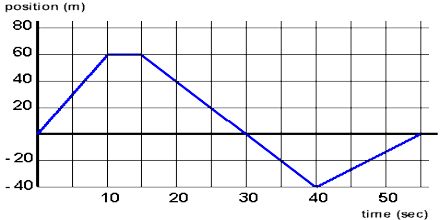
Which of the following graphs best represents free fall motion?
a)
b)
c)
d)
107.

A baseball is thrown up into the air. What direction is the velocity of the ball?

a)

upward

b)

downward

108.

A baseball is thrown up into the air. What direction is the acceleration of the ball?

a)

upward

b)

downward

109.

A stone is thrown straight up. When it reaches it's highest point,

a)

Both it's velocity and it's acceleration are zero

b)

It's velocity is zero and it's acceleration is not zero

c)

It's velocity is not zero and it's acceleration is zero

d)

Neither it's velocity nor it's acceleration is zero

110.

An object is thrown upwards with a speed of 14 m/s. How high above the projection point does it reach?

a)

5 m

b)

10 m

c)

15 m

d)

20 m