
 Worksheets
Midterm Review WH 2022
Total questions: 106
Worksheet time: 57mins
4. Which of these is NOT an achievement of the Islamic Empires?
They defeated christian crusaders many times
They defeated the Byzantine empire
They spread Islam to Russia
Their trade empire brought great wealth
• Forbidden City constructed as home for the emperor and his family.
• Blue and white porcelain becomes known worldwide.
• Zheng He makes voyages to the “western oceans.”
Which civilization is most closely associated with these events?
Aztec
Chinese
Persian
Axum

Using the map, what conclusions about indian ocean trade can you draw?
east african coastal cities were cut off from growth and trade
cultural contact between africa and the middle east didn't happen
india, the middle east, and east africa were connected through trade
trade promoted migration from east africa to west africa
What of the following was MOST influential in allowing the Mongols to create the largest land based empire in world history?
The Mongols had superior skills, weapons, larger cities, and better engineers than any other civilization at the time.
The Mongols enslaved the armies of conquered territories and made them conquer new areas. When they’d disobey the Mongols would brutalize them.
When the mongols wanted to conquer a new territory, they would study their enemies and adopt their tactics. They also allowed conquered people freedom and promotions based on merit
Marco Polo wrote heavily about traveling to the palace of Kublai Khan and the Mongol empire, which lead to heavy military support from Europe

this pyramid represents a society based on
social class
education achievement
wealth
politics

this illustration suggests what about the European feudal system?
designed to promote political and economic equality
controlled by a powerful middle class
allows for social mobility
is supported by the labor of peasants and serfs

european kings removed church leaders from their countries
the law weakened the power of european kings
european kings started appointing church officials to political office
kings are allowed to be appointed to religious positions
24. What was the result of The Magna Carta?
strengthened the power of the king.
checked the power of the king.
was willingly signed by John.
None of the above

answer the question at the bottom of the excerpt
overseas trade encouraged nations to build strong navies to defend their trade routes and aggressively expel regional rival
overseas trade led to increased use of military alliances between naval powers and wealthy city states
shifts in the balance of global trade discouraged middle eastern and asian empires from claiming valuable trading sites in asia
shifts in the balance of global trade led to short and violent wars of euopean allies against their asian rivals
how was european society effected by the crusades?
access to luxury trade goods was severely limited by war
islamic armies invaded europe and destroyed cities and farms
europeans developed a greater interest in trade
peasant rebellions stopped as the church gained more power
Interactions between the Byzantine Empire and Kievan Russia influenced the Russians to
recognize the absolute political authority of the Pope
adopt Orthodox Christianity
call for an alliance with the Muslims
terrorize Charlemagne’s empire
What was a major contribution of the Byzantine AND Islamic Empires?
adoption of democratic ideas from Russia
spread of humanism and secularism across Europe
reunification of eastern and western Christendom
preservation of Greek and Roman culture
• Justinian imposes new code of law.
• Completion of Hagia Sophia adds beauty to Constantinople.
• Greco-Roman tradition preserved.
Which empire is described in these statements?
byzantine
persian
mauryan
Islamic

According to the map, how was the Silk Road associated with the development of cities?
Increased trade along this route helped establish cities within major empires
The development of many cities created a need for better roads
The Silk Road was built as an alternative to trade between large cities by the sea
European governments promoted free trade between major cities
15. What do Hinduism, Confucianism, Christianity, and Islam all have in common?
They all encourage the worship of a god or deity
They all provide ethical codes of conduct to follow in daily life
They all require ritualistic fasting and feasting
They are all polytheistic in origin
Which of these is NOT a way that the Islamic Empires influenced other societies?
Spread of intellectual and technological advancements through trade
uniting all societies under the common laws and practices of Sharia
Preserving and building upon the ideas of the Greeks and Romans
Increasing the profitability of the Indian Ocean and Trans Saharan trade
Which situation is a result of the location of the Byzantine Empire?
Constantinople became an important center of trade and knowledge.
The Seljuk Turks protected and defended Byzantine leaders. Moscow became the religious center for all Orthodox Christians.
The Byzantine emperor was able to conquer areas from Korea to Spain.
Moscow became the religious center for all Orthodox Christians.
Which TWO things are achievements of the Byzantine Empire?
The magna carta and feudal system
Justinian Law Code and the Hagia Sophia
St. Basil’s cathedral and the Cyrillic alphabet
Increased trade and conversion of new lands to Islam
23. What is the purpose of the a caste system or social hierarchy?
To allow for social mobility in a society
To ensure that the people with power keep their power
To ensure that there are enough jobs for everyone
To more easily facilitate the redistribution of wealth
24. Feudalism became widespread because
It made everybody equal.
People needed protection from invaders.
The three-field system made farming desirable.
Christianity taught peasants to leave their lord.

The information in this chart could best support which historical argument?
The Persian empire is better because it affords the most political freedom
governments that allow people to vote and are based on majority rule can sometimes result in certain groups NOT having rights
republics and democracies are too similar to one another to properly study
Civil service examinations were used to select government officials empires, republics, and democracies
what is an important effect of the black death?
decrease in confidence in the church
decrease in pay for peasants
increase in power and money for nobles
increase in medical research in europe
fast during Ramadan
charity to the poor
practice meditation and yoga
pray five times a day
The bubonic plague paved the way for the Renaissance by
Thinning the population
and allowing people opportunities they might not have had before.
Forcing people to focus on
the afterlife, rather than the struggles of this world.
Forcing peasants to remain
on the manors to work the fields.
Reassuring survivors that
the manorial system was the best way to ensure prosperity.
What conditions are necessary for a society to be able to focus on art and entertainment?
A focus on basic day to
day survival.
Prosperity and the leisure
time that comes with it.
Overpopulation and a lack
of jobs.
The threat of invasion
from outside forces.
Martin Luther’s ideas were able to rapidly spread in part because of the
Jesuit monks
Expert scribes
Manorial system
Printing press
What changes allowed the rise of the Northern Italian city-states in the 14th century?
the Council of Trent
the spread of the manorial system to England
overseas trade, spurred by the Crusades
the English Reformation
Reformers in the Catholic Church began the Counter Reformation in order to
help Catholics remain loyal.
increase profits from indulgences.
argue that Christians are saved by faith alone.
encourage Christians to read and interpret the
Bible on their own.
What was an important effect of the invention of the printing press?
Gutenberg used his wealth from the invention to support artists.
It led to the development of public libraries in the 1500s.
It led to a renewed study of Latin and Greek.
It increased literacy and the spread of knowledge.
Luther protested the practice of selling indulgences. What was that practice?
Clergy members bought indulgences to reach higher offices.
The clergy sold pardons that released people from performing penalties for their sins.
Indulgences permitted priests to marry and have children.
Indulgences allowed people to move into a higher social class.
The Medici were patrons of the arts and supported the Church. What was a reason they did this?
They were eager to give back to the community that had given them so much.
They wanted to help Machiavelli in his rise to power.
They hoped that these acts would forgive them from the sin of charging interest on loans.
All of the above are true.
A person who produces work "in the vernacular" is one who
relies on realism.
uses only natural light.
uses a verse form of writing.
writes in a local, rather than a classical, language.
The intellectual and cultural movement known as humanism arose from the study of
medieval scholarship.
original Christian writings.
classical Greek and Roman culture
the contributions of the Tang and Song dynasties.
Henry VIII wanted to leave the Catholic Church because he
wanted a divorce.
felt selling indulgences was wrong.
was angry that the pope considered his marriage invalid.
wanted his subjects to interpret scripture for themselves.
Study the document carefully and answer the questions.
Here a question arises [for a prince, or ruler]: whether it is better to be loved than feared, or the reverse. The answer is, of course, that it would be best to be both loved and feared. But since the two rarely come together, anyone compelled to choose will find greater security in being feared than loved. . . . Men are less concerned about offending someone they have cause to love than someone they have cause to fear. Love endures by a bond which men, being scoundrels, may break whenever it serves their advantage to do so; but fear is supported by the dread of pain, which is ever present. . . . Returning to the question, then, of being loved or feared, I conclude that since men love as they themselves determine but fear as their ruler determines, a wise prince must rely upon what he and not others can control.
According to Machiavelli, why is more security found in being feared than in being loved?
People don’t worry about offending someone they love.
People don’t worry about offending someone they fear.
Fear leads to hatred and revolt.
If people fear you, they will love you.
Daimyo who seized control of Kyoto, but not all of Japan
Tokugawa
Oda Nobunaga
Zheng He
Kangxi
What contributed to the decline of both the Ottoman and Safavid Empires?
natural disasters
disruption in trade
religious rebellions
incompetent leadership
What did Suleyman the Lawgiver and Akbar have in common?
Architecture, the arts, and literature flourished under their rule.
Specially trained foreign slaves formed the core of their armies.
Both appointed Hindus to high government positions.
They both ruled the Ottoman Empire.
During the 1500s, what was China's official trade policy?
China openly traded with all European countries.
Only the government was allowed to trade with foreign countries.
China traded only with Japan and sometimes the Dutch
The government lowered taxes to promote trade.
Zheng He was important because he
was China's first Chinese emperor.
was China's first non-Chinese emperor.
led seven Chinese overseas explorations.
overthrew the Mongol rule.
What were China's main reasons for rejecting British offers of trade?
British merchants decided they didn’t need Chinese goods.
Britain wanted to be the exclusive trading partner with China.
China's emperor did not like the gifts the British merchants offered.
China believed it was self-sufficient and didn't need outside goods.
Emperor Mansa Musa of Mali is significant in part because he
Helped bring Muslim culture and religion to Northwest Africa
Is the founder of Buddhism in India
Defeated the Christians in the Crusades
Introduced much medical knowledge to Western Europe
What kept china from becoming highly industrialized? CHOOSE TWO ANSWERS
Confucian based government policies that favor agriculture
isolationism
they had too many workers to industrialized
hindu based government examinations
how did the daimyo hinder a strong central gov't in Japan?
the daimyo (warlords) were always fighting each other for power
the daimyo (warlords) created a manorial system in Japan
the daimyo (warlords) were overly concerned with controlling trade at the expense of the government
what type of foreign policy does Japan institute to control foreign ideas?
closed country policy
domestic trade policy
open door trade policy
open ports policy


What allowed Europe to become powerful and wealthy in the Renaissance era?
Military crusading
Increased trade, banking, and education
inefficient theocratic rulers and few government regulations
Low taxes and low immigration rates

the revolution was furthered by english protestants due to their distrust of catholic leaders
the revolution was furthered due by English people due to stories about what a hero william of orange was
the revolution was slowed by the english people due to their distrust of foreigners
the revolution was slowed by english protestants due to their admiration for King James' religious tolerance
beginning in the 1500s, European missionaries traveled to places like China to spread Christianity as part of the Catholic (counter) Reformation. How did missionaries contribute to increased global interactions?
they converted to local religions, which spread throughout europe when they returned home
they shared european knowledge of science, technology and humanities
they established trade networks between china and europe
they shared knowledge of Europe's many Utopian (perfect) societies
how did the printing revolution contribute to increased global interactions?
by making texts available to broader audiences, leading to the spread of new ideas
by creating interchangeable parts that made repairing the printing press easier
by mass producing the press to make it available to small towns
by using color to gain the interest of more people
What is the most influential impact of the Protestant Reformation? (select 2 answers)
The power of the catholic church increased
Many new denominations of Christianity formed in the west
The pope became the weakest religious leader in the world
Monarchs converted to Protestantism across Europe
how did the caravel improve navigation?
it's a small, fast ship, with a moveable sail
it's a large ship with new rudder system
it's a new age astrolabe that uses old school GPS
what were Europeans main motives for exploring?
gold, god, and glory
gold, salt, and camels
god, gold, and gremlins
gremlins, goblins, and ghosts
what was the purpose of the treaty of Tordesillas
to keep catholic Spain and Portugal from fighting over land
to resolve the conflicts of the reformation
to end the destruction of the native americans and their land
how did colonization impact business in europe?
increased business profits exponentially
decreased profits as the rich get more power
creates a war between england and spain
Which had the largest impact on the fall of Native American Empires, such as the Aztec and the Inca?
Muskets
Cannons
Diseases
Horses
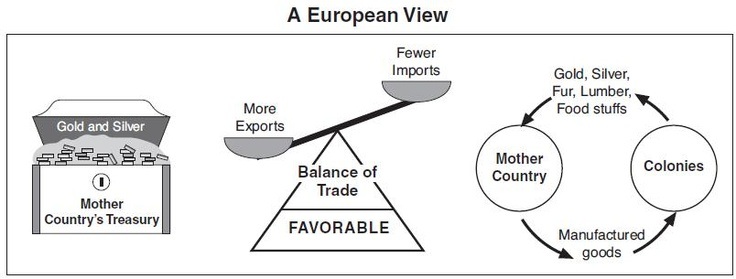
What is mercantilism?
A system where a mother countries gains money and power from natural resources that come from its colonies.
where colonies trade gold and silver with each other.
Wars that start over money.
Plantation colonies trading slaves for money.

True or False? Great Britain wanted to create wealth by importing more goods than it exported.
True
False

EXPORTS of the 13 colonies included:
Manufactured goods
Raw Materials
Slaves
Gold

The impact of mercantilism was that
The rate of slavery in the Americas went down
Trade was limited in the Atlantic
The Colony grew wealthy
The Mother Country grew wealthy
What was the purpose of most joint-stock companies of the 1500 and 1600s?
Financing wars in Africa
Funding colonies in the Americas
Paying for the building of slave ships
Funding the digging of gold mines
Encomienda, hacienda, and mit'a are all examples of...
Racial categories
Maritime empires
Coerced labor systems
Bureaucratic systems
When missionaries brought Christianity to the American colonies...
Almost all natives refused to convert
Most natives converted but syncretized it with old traditions
Colonial leaders pushed back against the Church's power
European Christians lost their faith after slaves converted
Which of the following was much MORE common in maritime empires than in Asian land empires?
Coerced labor
Taxation
Gunpowder weapons
Centralized rule
Where did most Spanish silver go?
Spanish Kings
The Dutch stole it
China
Mexico
A device used to determine latitude using the position of stars:
compass
caravel
Astrolabe
telescope
The Andes Mountain range is the longest mountain range in the world and was home to the _____________.
Aztecs
Inca
Maya
Olmec
Which three ancient empires were located in Mexico (mesoamerica)?
Maya
Olmec
Aztecs
Inca
Who created large stone heads as their major building projects?
Aztec
Olmec
Inca
Maya
Which civilization is considered the "Mother Culture" of Mesoamerica?
the Olmec
the Inca
the Maya
the Aztec

A system of record keeping that uses knots in a string is called ______________.
weapons
rope
braiding
quipu
Tokugawa Ieyasu, Louis XIV, and Tsar Peter the Great each increased his power by
limiting the power of the nobility.
moving toward a more limited monarchy.
encouraging the nobility to adopt western ways.
fighting for the natural rights of poor citizens.
“I do not agree with a word you say but will defend to the death your right to say it.” –Voltaire
Voltaire is espousing the Enlightenment ideal of
Freedom of Religion
Absolute Monarchy
The Right to Bear Arms
Freedom of Speech
7. Whom did Napoleon decide not to invade as a result of the battle of Trafalgar?
Russia
Britain
France
Haiti
8. How did the Russians under Alexander I beat Napoleon in Russia?
blockade running with small ships
scorched earth policy
cannon technology
The initial aim of the French Revolution was to secure rights for the oppressed people of France. During the Revolution, Maximilien Robespierre rose to power and established his Reign of Terror until he, like his victims, was killed. Later, Napoleon Bonaparte rose to power as dictator of France until he, too, was defeated.
What conclusion can be drawn from this information?
Good intentions triumph over evil ones.
Dictators always arise during a revolution.
France has an abnormally high number of dictators.
The goal of revolutions can sometimes be manipulated by power-hungry leaders.
An important goal of the Congress of Vienna was to
destroy France.
execute Napoleon by guillotine.
establish a balance of power in Europe.
establish Vienna as the new capital of Europe.
This was the name of the Russian Tsar in 1682 that greatly expanded and centralize the Russian state, largely modeling it after Louis the 14th of France.
peter the great
catherine the great
frederick the great
ivan the great
According to nationalism, one’s greatest loyalty should be to a
a king
a nation of people
a colony
an imperial power
Which did the Enlightenment promote?
Divine Right as proof of a king’s authority
a return to feudalism
increased faith in the Church
a more secular outlook
John Locke argued that the purpose of the government is to
protect a monarch’s divine right.
suppress discontent among citizens.
protect a citizen’s natural rights.
persecute the proletariat.
Which did Napoleon NOT accomplish?
uniform set of laws
stable economy
conquering England
equal-opportunity public education system

