Wayground logo

Free Printable Worksheets

Font size

S
M
L
XL
Worksheets

Chemistry Final Review

Total questions: 30

Worksheet time: 21mins

Name
Class
Date
1.

Which among the following is a NON MATTER?

a)

Mars

b)

Smoke

c)

Steam

d)

none of the choices

2.
Which of the following changes is a chemical change of matter?
a)
ice melting to produce water
b)
vinegar combining with baking soda to produce carbon dioxide
c)
water boiling to produce water vapor
d)
liquid silica solidifying to form glass
3.
Which of the following is a pure substance?
a)
air
b)
granite
c)
water
d)
stainless steel
4.
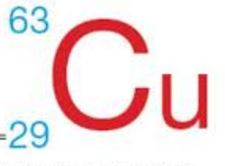
What is the atomic mass of Copper?
a)
63
b)
29
c)
34
d)
92
5.
A neutron has a charge of
a)
+2
b)
No charge
c)
-1
d)
+1
6.

An atom has 12 protons and 13 neutrons in its nucleus. Which is the correct symbol?

a)
b)
c)
d)
7.

What is the phase change of a solid to a liquid?

a)

freezing

b)

melting

c)

boiling

d)

condensation

8.
Solids melt when solid particles _____ energy, liquids freeze when liquid particles _____ energy.
a)
absorb, release
b)
release, absorb
c)
absorb, absorb
d)
release, release
9.
The splitting of a nucleus into smaller nuclei is
a)
fusion
b)
fission
c)
decay
d)
gamma radiation
10.
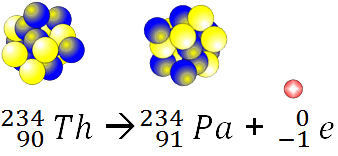
Which type of nuclear radiation is being emitted here?
a)
Alpha
b)
beta
c)
gamma 
d)
none
11.
Which of the following is not a property of metals?
a)
brittle
b)
malleable
c)
lustrous
d)
conductive
12.

How many valence electrons and energy levels does (Pb) lead have?

a)

4 valence electrons and 6 energy levels (orbitals)

b)

6 valence electrons and 4 energy levels (orbitals)

c)

5 valence electrons and 5 energy levels (orbitals)

d)

5 valence electrons and 10 energy levels (orbitals)

13.

Oxygen has six valence electrons. When forming an ion, oxygen will

a)

lose six electrons and have a charge of +6.

b)

lose six electrons and have a charge of -6.

c)

gain two electrons and have a charge is +2.

d)

gain two electrons and have a charge of -2.

14.
Put these in increasing order:
F, N, B
a)
B < N < F
b)
B < F < N
c)
N < F < B
d)
F < N < B
15.
At the end of chemical reactions, what is the total mass of the reactants compared to the total mass of the products?
a)
the product is doubled
b)
the product is half the mass of the reactants
c)
the mass is the same
d)
the mass changes depending on the reaction
16.

In the chemical equation H2O2(aq) → H2O(l) + O2(g), dihydrogen monoxide is a...

a)

reactant

b)

aqueous solution

c)

product

d)

solid

17.

Which is the correct formula for the compound: Calcium Oxide

a)

CaO

b)

CaO2

c)

Ca2O

18.

SO₃

a)

sulfate

b)

sulfur oxide

c)

sulfur trioxide

d)

monosulfur trioxide

19.
When dissolved in water, the solution is a good conductor of electricity.
a)
ionic compounds
b)
covalent compounds
20.
Ionic Bonding involves...
a)
The transfer of protons
b)

The sharing of electrons

c)
The transfer of electrons
d)

The sharing of protons

21.
The following is what type of reaction:
PbCl2 + AgNO3 → Pb(NO3)2 + AgCl
a)
Synthesis
b)
Decomposition
c)
Single Replacement
d)
Double Replacement
22.
What type of chemical reaction is this?
Al(OH)3 → Al2O3  + H2O
a)
Decomposition
b)
Combustion
c)
Synthesis
d)
Single Replacement 
23.

Fill in the blank. (Copper has a charge of 2+)

Cu+ AgNO3 → Ag + _____

a)

Cu(NO3)2

b)

CuNO3

c)

CuAg

d)

Cu

24.

A green powder is heated & a gas is given off while it turns to a black solid. This describes

a)

Physical Change

b)

Chemical Change

c)

Change in State

d)

Change in Temperature

25.

Identify what type of change happening in the picture below...

a)

Chemical Change

b)

Physical Change

c)

Endothermic Reaction

d)

Exothermic Reaction

26.

What separation method is used to separate and purify substances by their boiling point?

a)

Filtration

b)

Evaporation

c)

Crystallization

d)

Distillation

27.
What explains the very high melting and boiling point of water
a)
Strong dipole-dipole bonds between water molecules
b)
Strong hydrogen bonds between water molecules
c)
Dispersion forces which are present in all molecules
d)
Asymmetrical shape of the polar bonds.
28.

Coffee, mouthwash, and vinegar are examples of __________________ mixtures.

a)

heterogeneous

b)

homogeneous

c)

pure

29.
2 KClO3 → 2 KCl + 3 O2
How many moles of oxygen are produced when 6.7 moles of KClO3 decompose completely?
a)
6.7 mol
b)
1.0 mol
c)
10.1 mol
d)
4.5 mol
30.

Cl2 + 2KBr → Br2 + 2KCl

How many grams of potassium chloride (KCl) can be produced from 356 g of potassium bromide (KBr)?

KCl = 74.55 g/mol ; KBr = 119.00 g/mol

a)

749 g

b)

223 g

c)

479 g

d)

814 g