Wayground logo

Free Printable Worksheets

Font size

S
M
L
XL
Worksheets

11 adv revision quiz all topics

Total questions: 81

Worksheet time: 2hrs 46mins

Name
Class
Date
1.

In what process is mRNA synthesized?

a)

Transcription

b)

Translation

c)

DNA Replication

d)

Mitosis

2.

Where does TRANSCRIPTION occur?

a)

Nucleus

b)

Ribosome

c)

Cytoplasm

d)

Mitochondria

3.

How many nucleotides equal 1 amino acid?

a)

1

b)

2

c)

3

d)

4

4.

TRANSCRIBE this DNA sequence: TACGTTACT

a)

AUGCAAUGA

b)

ATGCAATGA

c)

AUGGATUGA

d)

TACGTTACT

5.

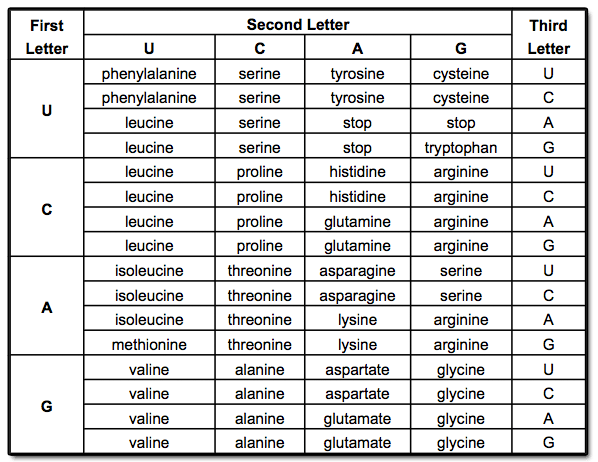
TRANSLATE this RNA sequence: AUGCAAUGA

a)

Met-Glu-Stop

b)

Met-His-Stop

c)

Thr-Glu-Stop

d)

Thr-Pro-Stop

6.
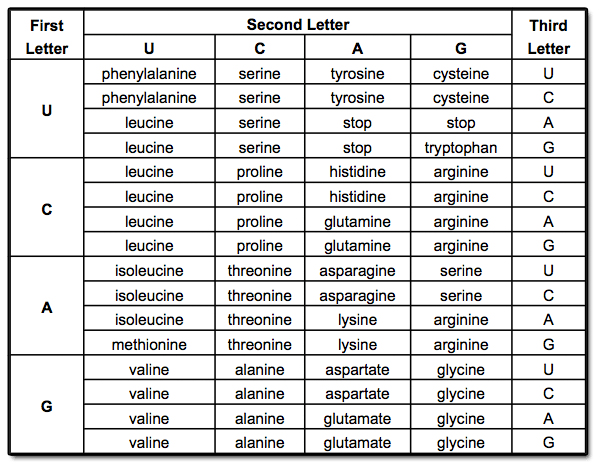
What amino acid is represented by the codon UUA?
a)
Phenylalanine
b)
Tyrosine
c)
Leucine
d)
Stop codon
7.
What is the correct amino acid sequence for the mRNA code AUGCCAGUAUGA
a)
Met-Pro-Ala-Val
b)
Met-Pro-Val
c)
Tyr-Gly-His
d)
Tyr-Gly-Arg-His
8.

What is the process called when DNA is made into mRNA.

a)

translation

b)

transcription

c)

transcribe

d)

translate

9.

What type of RNA moves to the ribosome to start protein synthesis?

a)

tRNA

b)

mRNA

c)

rRNA

d)

nRNA

10.

What does tRNA stand for?

a)

transition RNA

b)

transcription RNA

c)

transfer RNA

d)

translation RNA

11.

When using the genetic code, you look up sets of 3 bases on the mRNA which are called:

a)

anticodons

b)

codons

c)

base pairs

d)

amino acids

12.
What process is occurring in this photo?
a)
Transcription
b)
DNA unwinding
c)
Translation
d)
Transfer RNA is creating bases
13.
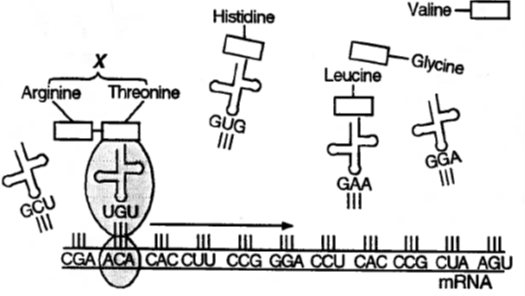
What process is occurring in this photo?
a)
Transcription
b)
Translation
c)
mRNA is matching with amino acids
d)
tRNA is transcribing the DNA
14.
How does RNA differ from DNA?
a)
RNA contains uracil and deoxyribose
b)
RNA contains ribose and thymine
c)
RNA contains uracil and ribose
d)
RNA contains adenine and ribose
15.

DNA makes RNA → RNA makes proteins →

Proteins make life.

a)

Homeostasis

b)

Mendelian Genetics

c)

Central Dogma

d)

Myocardial Infarction

16.
What process is going on in this photo? 
a)
Transcription 
b)
Translation 
c)
Replication 
d)
All the above 
17.
The mRNA leaves the ________ to find the ribosome to make proteins.
a)
cell
b)
nucleotide
c)
nucleus
18.

What is this process called in recombinant DNA?

a)

DNA ligases

b)

Restriction enzymes

c)

Transfer Vectors

19.

Look at the image and choose the correct name...

a)

DNA ligases

b)

Recombinant DNA

c)

Restriction enzymes

d)

Transfer vectors

20.

With this technique, many copies of DNA segment in a few hours are created

a)

PCR

b)

PDR

c)

PNR

d)

DNAR

21.
What is plant biotechnology?
a)
Adding chemicals to foods to preserve them.
b)
Making synthetic foods using artificial, man-made proteins.
c)
Inserting a gene or genes with beneficial traits into a plant cell.
d)
Taking immature plants and adding steroids to make them grow bigger and stronger.
22.
When human DNA is inserted in bacterial DNA to create insulin it is called
a)
viral DNA
b)
bacterial DNA
c)
recombinant DNA
d)
transcribed DNA
23.
At what temperature does the Denature step of PCR occur?
a)
94-96° C
b)
50-65° C
c)
72° C
d)
Any temperature
24.
At what temperature does the Extension step of PCR occur?
a)
94-96°C
b)
50-65°C
c)
72°C
d)
Any temperature
25.
What is the function of a primer?
a)
To identify the particular region of DNA to be copied by PCR.
b)
To copy DNA.
c)
To create DNA nucleotides.
d)
To maintain the temperature of the PCR reaction.
26.

The first step in PCR is

a)

Primer annealing

b)

Denaturation

c)

Primer extension

d)

None of these

27.
What happens during the Anneal step of PCR?
a)
Primers are created.
b)
The primers attach to the target DNA region.
c)
Primers copy the new DNA strand.
d)
Primers sequence DNA
28.

A student performed a gel electrophoresis experiment. The results are represented in the diagram

below. Compared to the fragments at the top of the gel, the fragments at the lower end are

a)

larger, and move slower

b)

larger, and move faster

c)

smaller, and move faster

d)

smaller, and move slower

29.

This technique used to analyze DNA involves the

a)

synthesis of new DNA strands from subunits

b)

separation of DNA fragments based on size

c)

production of genetically engineered DNA molecules

d)

removal of defective genes from DNA

30.
Based on these results whose blood was found in the blood stain at the crime scene?
a)
Bob
b)
Sue
c)
John
d)
Lisa
31.
In gel electrophoresis, the largest DNA fragment will appear
a)
closest to the starting wells
b)
farthest from the starting wells
c)
three quarters away from the starting wells
d)
it depends on how many fragments there are
32.

During which PCR step do primers form complementary base pairs with single-stranded template DNA?

a)

Denaturation

b)

Annealing

c)

Extension

d)

Synthesis

33.

DNA has a ___________ charge and will migrate through a gel towards the ___________ electrode.

a)

positive, negative

b)

positive, positive

c)

negative, positive

d)

negative, negative

34.
Which enzyme "glues" DNA fragments together?
a)
restriction enzymes
b)
DNA ligase
c)
DNA polymerase
d)
DNA helicase
35.
Restriction enzymes....
a)
Cut DNA at a specific site
b)
Can be used to isolate a gene of interest
c)
Can be used to cut vector DNA
d)
Do all of these things
36.

Which of the following could be used as a vector for a human gene?

a)

Bacterial Plasmid

b)

Bacteria

c)

A mitochondria

d)

mRNA

37.

Scientists found, that over a period of 200 years, a mountain pond was transformed into a meadow. During that time, several communities of organisms were replaced by different communities. Which of these best explains why new communities were able to replace older communities?

a)

The original species became extinct.

b)

Species in the older community died from old age.

c)

The abiotic characteristics of the habitat changed.

d)

Diseases that killed the older organisms disappeared.

38.

This graph shows...

a)

Logistical Population Growth

b)

Exponential Population Growth

39.

This graph shows...

a)

Logistical population growth

b)

Exponential Population Growth

40.

How would you describe the population of this country?

a)

They are experiencing stable population growth

b)

They are experiencing rapid population growth

c)

They are experiencing negative population growth

41.

Is this country Developed or Developing?

a)

Developed

b)

Developing

42.

Predict the future population growth of this country.

a)

Negative Growth (the population will shrink)

b)

Slow/No Growth (the population will stay about the same)

c)

Growth (the population will definitely grow)

d)

Fast Growth (the population will explode)

43.

What do we call the study of human populations?

a)

geography

b)

demography

c)

economy

44.

Which growth rate does this population pyramid represent?

a)

Slow Growth

b)

Zero Growth

c)

Rapid Growth

d)

Negative Growth

45.

What growth rate does this population pyramid represent?

a)

Rapid Growth

b)

Slow Growth

c)

Negative Growth

d)

Zero Growth

46.
All foreign materials that cause a response from the immune system are called _____________________.
a)
Antigens
b)
Active Immunity
c)
Antibodies
d)
Antibiotics
47.
Which of the following is a non-specific response?
a)
Fever
b)
Red, itchy eyes that may be crusted shut
c)
Signs that is related to one antigen
48.
Inspect antigen, attacks & kills antigen, if it is recognized
a)
Macrophage
b)
T Cells
c)
B Cells
49.
What do B cells produce?
a)
antigens
b)
macrophages
c)
T cells
d)
antibodies
50.
Which is an example of passive immunity?
a)
You have been infected
b)
You have been vaccinated
c)
You made antibodies
d)
You got your mother's antibodies
51.
Which answer best describes how infectious diseases get transmitted (passed on)?  
a)
people can sneeze or cough and pass disease on through the air
b)
drinking water can be contaminated with diseases
c)
objects such as doorknobs and towels can be contaminated by disease
d)
all of the above answers are ways that diseases are transmitted
52.
Antibiotics work against most
a)
Bacteria
b)
Bacteria & Viruses
c)
Vaccines
d)
Viruses
53.

What is the function of antibodies within the immune system?

a)

Antibodies kill off any antigen that enters the body.

b)

Antibodies are only made when you are given a vaccination for specific antigens.

c)

Antibodies bind to specific antigens to flag for destruction.

d)

Antibodies are part of an external defense mechanism.

54.

Ticks are an example of this way of transmitting (spreading) disease

a)

Air-borne

b)

Vector

c)

Touching a surface

d)

Contaminated food or water

55.

The diagram below shows a cell in the human body engulfing a bacterial cell.

The cell labeled X is most likely a

a)

red blood cell

b)

white blood cell

c)

liver cell

d)

nerve cell

56.
Which of the following diseases can be spread by pathogens in droplets in the air? (mulitple answers)
a)
flu
b)
common cold
c)
tuberculosis (TB)
d)
cholera
57.
Which of the following diseases is spread in water?
a)
cholera
b)
malaria
c)
flu
d)
chalara ash dieback
58.
Which of the following diseases needs a vector to spread the pathogen?
a)
malaria
b)
flu
c)
cholera
d)
tuberculosis (TB)
59.
What type of pathogen causes malaria?
a)
protist
b)
bacteria
c)
virus
d)
fungi
60.

What is an example of Artificial active immunity?

a)

Vaccination

b)

Natural infection

61.

If you go to your doctor and get flu shot, what type of immunity is this an example of?

a)

Innate Immunity

b)

Artificial Immunity

c)

Passive Immunity

d)

Natural Immunity

62.

What role do mucus and stomach acid have in common?

a)

Acting as barriers to pathogens

b)

Stopping particles from being transmitted further into your body

c)

Fighting off and/or trapping bacteria to prevent infections

63.

What are the major types of cells of Adaptive (Specific) Immunity?

a)

Natural Killer Cells

b)

Neutrophils and Basophils

c)

T cells and B cells

d)

Eosinophils and Macrophages

64.

Which type of immunity is transmitted from mother to child?

a)

Artificial active immunity

b)

Natural active immunity

c)

Passive immunity

d)

Mother immunity

65.

Which cells are NOT part of Adaptive (specific) Immunity?

a)

Phagocytes

b)

B cells

c)

T cells

d)

None of the above

66.

Is a disease of the heart and blood vessels.

a)

Cardiovascular disease

b)

Respiratory diseases

67.

Refers to conditions that cause hardening and thickening of the arteries

a)

Arteriosclerosis

b)

Atherosclerosis

68.

A kind of arteriosclerosis where fat is deposited on arterial walls, which could harden and create plaque

a)

Arteriosclerosis

b)

Atherosclerosis

69.

Main products of the Calvin Cycle

a)

Oxygen, NADP+, ADP

b)

Glucose, CO2, ADP

c)

ADP, NADP+, Glucose

d)

ATP, NADPH, Oxygen

70.

The Calvin Cycle occurs in the

a)

Thylakoid

b)

Grana

c)

Inner membrane of chloroplast

d)

Stroma

71.
What are the two products of the light reactions that are needed for the calvin cycle?
a)
NAD and NADPH
b)
NADP + and Glucose
c)
NADPH and ATP
d)
Oxygen and NADPH
72.
According to this absorption spectrum, what color is not used by the chlorophyll pigments?
a)
green
b)
blue
c)
yellow
d)
red
73.
Protons move into the thylakoid due to the
a)
concentration gradient in the stroma
b)
  Brownian motion of the protons.
c)
  peer pressure of the cool electrons in the stroma.  
d)
movement of electrons through the electron transport chain
74.
Where do the light reactions happen?
a)
mitochondria membrane
b)
thylakoid membrane
c)
stroma
d)
central vacuole
75.
What are the two products of the light reactions that are needed for the calvin cycle?
a)
NAD and NADPH
b)
NADP + and Glucose
c)
NADPH and ATP
d)
Oxygen and NADPH
76.

What part of the Chloroplast is C?

a)

Thylakoid

b)

Granum

c)

Stroma

77.

What part of the Chloroplast is D?

a)

Thylakoid

b)

Granum

c)

Stroma

78.

What connects the thylakoid together?

a)

Intermembrane

b)

Stroma Lamella

c)

Grana

79.

What does FADH2 and NADH bring to the electron transport chain?

a)

Oxygen

b)

Water

c)

Electron

d)

ATP

80.
What does ATP synthase do?
a)
Create ATP in chemiosmosis.
b)
Break down ATP in chemiosmosis.
c)
Break down NADPH. 
d)
Create NADPH.
81.

ATP synthesis by ATP synthase is driven by

a)

H+ movement

b)

electron movement

c)

NADH movement

d)

FADH2 movement